Welcome to Inside Acme X, a series where we discuss TV, film, video games, creative technology and art with practitioners in Melbourne. Each episode, we interview a resident that works at Acme X, Acme's screen-focused co-working space. I'm Amber Gibson, the community coordinator. Before we begin, I would like to acknowledge the traditional owners, the Wurundjeri people of the Kulin Nation, on whose land we record this podcast here in Melbourne. And I extend that respect to any Aboriginal or Torres Strait Islander peoples listening in.
Here with me today is Emile Zeal, who is an artist, filmmaker and performer. For this episode, we're talking to Emile about his practice and how he captures the traces of humanity within an accelerating digital culture. Welcome, Emile. Hey, Amber. Thank you. How do you describe your practice? Yeah, well, I call myself an artist and kind of let the subcategories fall away. I've been a performance artist in the past. I've been a filmmaker. I've been an exhibition maker as well, but I just like to say artist too.
to get everyone up to date because I don't know if new media art as a category should exist. So I'm just happy to be an artist. You do a lot of performances that incorporate technology as props. How do you describe that type of performance that you do? I mean, on one hand, I call it caveman VJing. It's kind of very elemental use of technology using low tech tools, just bad cameras, bad projectors, pretty vernacular technology, easy to access stuff. And I want to tell these stories about what it means to be alive, surrounded by media and surrounded by the internets and the kind of deformations.
of humanity that happen by technology and by language. I'm usually in a theater or a cinema. I'm performing to an audience, doing a monologue or incorporating these props, technology props. In some ways, I feel like the performances are test runs towards something else. They're almost like script writing.
kind of live script writing developments for films, the kind of these film nuggets that I want to make in the future. And what interests you specifically about the ways people interact with TV, print and the internet? I see the media as extensions of humanity, of extensions of us. I don't believe that there is a true self. I believe that I can read the deformations and character of people through the media. So I choose to look at how people use the media, how they interact with the media and take that as their authentic true self. So I think that's just the way that I have always found the use and reuse of media fascinating and interesting.
it's the way that we use the tools which tells us about who we are and that led on to doing a phd in digital ethnography at the digital ethnography research center at rmit recently just finished that and um yeah it's been a long-standing interest something I've been looking at through different modes of performance and then this very high-end academic research. Did you always know that you wanted to be a performer? Yeah, I think I can't trace where that interest has come from in particular. I think I've always had some stability within performing, as in when I'm performing it feels great and I like it. I'm not sure where it comes from, but yeah. Did you do it at school or anything like that? I did. So you knew earlier on that you felt comfortable being on stage and performing? I guess so, yeah. Yeah, the kind of library punks and the jocks and the goths. So I was probably a library punk slash theatre.
theater punk theater kid yeah and then early on in your career you were a contestant on the price is right which seems like it kind of set the tone for your practice and we actually have a snippet that can provide everyone listening in with a bit of context around emil's work a new contestant is about to be named i hear my name emil zeal I hear my name pronounced incorrectly by trained voiceover vocal cords. Jump up, sweat pores enlarge, adrenaline is pulsing, scurry to the vacant pedestal. The cameras follow the action, hot sweat, white fear, scanning the studio, Larry looks, people with clipboards look, Larry welcomes me to the set. You got some kind of nervous thing going on there?
Sorry. Yes, sir. Yes, I do. No. Hello. So what we were hearing is the video that you created called Larry M. DeSuit. Can you tell us about that performance? Yeah. So Larry M. DeSuit is a video that I made in 2002. And it's based on an earlier experience of being on TV, on The Price is Right, as you just heard. Yeah, I wanted to experience the machine of television and got a few tickets with some friends. And I was treating it like kind of a hyper nerd, loving media, loving sort of the spectacle of Larry M. DeSuit going to Channel 9 Studios. So I really tried to see behind the curtain of media production.
My intention wasn't to make a video, wasn't to make a weird comment. It definitely wasn't to dance with Larry Emder and kind of render him silent in a weird mute kind of miming way. Yeah, did you know when you started to do all those different movements that he would follow and mimic you? I mean, he's a great performer. Everyone's a performer. He's a great performer. And he was smart enough to go with me and not challenge it and not stop it. And yeah, I think as much as it's a kind of radical gesture, it also is totally predictable because once every 10 shows, you might get someone trying to break the rules or be a bit of a fruity character and provide the fruit. So I think he's also very well used to people bending the rules and kind of pushing.
against it, but I knew I'd be selected once I was doing the interview with the producers and deliberately tried to egg myself on with this interaction with the producers to make sure I'd get on stage. And then, yeah, there's the kind of combination of nerves and performative pent-up teenage hormonal performative angst that provided that very weird moment of bending TV. And you did guess the price of the nursery package, didn't you? Yeah, look, I'm very good at guessing prices. I did, and I won that. I won that. I hocked it for cash as a 17-year-old without a child. So that was good, a couple of hundred bucks for struggling students.
I missed out on the Lazy Boy package. So it's kind of both ends of the spectrum. You've got the kind of baby package plus the kind of retirement, 70-year-old retiree. I'm just sick of the world. I'm going to sit on my Lazy Boy and watch Price is Right. Those were the two prizes. I missed out on the Lazy Boy. And wasn't there like a prize of a jet ski, a holiday to Fiji, or a ride on lawnmower? It's beautiful, yeah. Price is Right. I miss it. I miss it to this day. Yeah, it's a great encapsulation of the desires of Australian suburbia and Australian mass middle-class dreaming. Yeah, it was great to watch it again. Are there performers or comedians or filmmakers that have inspired your work? Yeah, I grew up listening to...
The Dead Kennedys, punk bands like Jello Biafra on stage, his gestural contortions, I think were a big influence growing up. Kraftwerk, the German techno pop innovators, their sense of stagecraft and completely self-managed image. He's very inspiring. Andy Kaufman, chaotic comedian, blending real and imagined worlds together. Christoph Schlingenseef, German theater maker who died too young. Again, another amazing kind of creative, chaotic person. Yeah, these are the formative.
Influences, yeah. Since then, you have performed many times around the world, but OMG Sisyphus and Performance Audience Lens are ones that stood out to me when you use iPhones and laptops and projectors and digital cameras on stage as props. Can you talk about those performances? Yeah, so OMG Sisyphus uses the YouTube monologue as a device. It's quite a sad performance. I'm doing this kind of sad, lonely man doing a YouTube monologue, getting it wrong, failing, getting it wrong, failing. Doing this kind of Sisyphean task of pushing a rock uphill or doing a YouTube monologue and failing all the time. Hey YouTube, how's... Hey YouTube, how's it going? Basically, I'm talking to a laptop, but the laptop is a rock. The rock is Sisyphus. I'm doing this monologue a number of times. Eventually, I take selfies with the rock. Yeah, it's kind of a way of...
presenting that kind of background to these internet tropes that we're very familiar with, like the kind of shiny Instagram-friendly, nailed-it, perfect-life image and revealing the kind of truth behind it, which is usually pretty sad and pretty lonely. What up, Internet? Hey. Hey, Internet, how's it going? Hey.
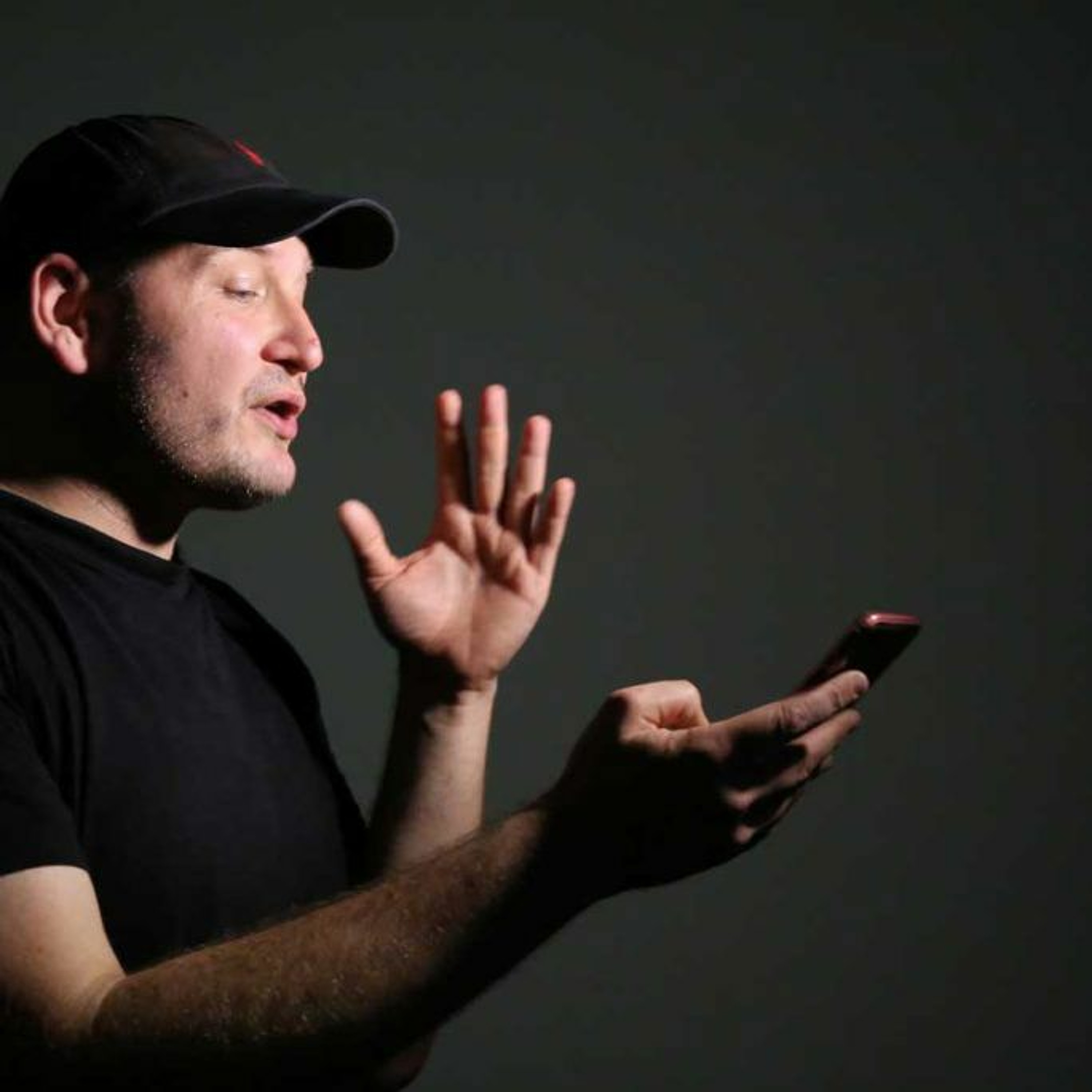
All my work is trying to uncover that kind of humanity behind the weird gloss that we're presented with and presenting it on stage as well. So I perform that in the round with the audience around me and I do selfies with them with the rock in this kind of very grotesque way. Audience Performer Lens is based on a Dan Graham performance from the early 70s. In that performance, I'm doing this kind of hyper-verbalization of my body and what I'm feeling and the kind of Wi-Fi beams going through me and really like over-verbalizing what's happening to my body. I'm streaming out to Instagram Live now. I'm seeing myself in my little hand. What's my hand? And I'm holding the phone with my right arm. And it's the same right arm that was in a bicycle crash maybe 10 years ago. So it feels a little bit weaker than the left.
People are joining. Willow has joined. Zero and Gary's joined. People are joining now. That's what's happening right now. There is an option where I can wave at them. By hitting a button, it represents a hand, which is a gesture of openness and friendship and of non-aggression. Someone has waved at me again. A separate person has waved again.
It does sometimes feel like the audience becomes kind of voyeur in your performances sometimes. Why do you choose dark comedy to explore these traces of humanity in digital culture? Yeah, I think it's a way that I can make my comments, make my points, bring my point forward, also in a kind of Trojan horse way that is coming in from a different angle, using this kind of dark comedy or some kind of empathetic relationship with the audience. It does work in a dramatic way rather than beating them over the head with something political or trying to express it a different way. I don't really have a good answer for it. I'm kind of stumbling because it's just something that I've always done and feels natural to me. And I think...
Most of the world is pretty absurd anyway. The way that, I mean, if you over-describe something, it becomes absurd and repetition creates absurdity as well. So yeah, just taking that moment to step back and reframe what's going on really gives, just reveals the thing underneath. Yeah, there's a lot of repetition used in your work and it does build that comic effect, doesn't it? Yeah, yeah. You know, if you're building a show, what are you toying with? Are you like, I'm going to play with influences and then you pick the medium and then how does that work as a practice on stage? Yeah, it's a good question because there's so much in the air.
when I'm developing these performances or artworks. So there's this usually very stressful time where I don't know exactly how the idea is going to physicalize itself. I know that some things are interesting. So I've got a log of things that are interesting, which I usually write down in a book, in a journal. I'm always writing and journaling. So finding that right way to depict the idea that I'm trying to present and find the right kind of technology or mode is super critical. And that's where basically the juggling act happens. The choice of...
media or choice of using technology. That can be very expressive. Choosing a 20-year-old projector versus a new digital screen. They're obviously very different cultural tools. So contrasting high and low, new and old. It's just a constant tension of how do you construct something that impacts an audience and hopefully is relevant and hopefully talks about our time. Also, the choice to use performance is also pretty important because I feel like the body is the first and last frontier. It's the place where everything begins for us. It's the site of all this experience for us.
Using performance kind of complicates things and the body complicates things and being close to people complicates things. So that's why I like doing it. And it's a great feeling when it does click and then you just know that that's the right idea. That's when the kind of work makes itself in your mind. So all these things are up in the air and you're kind of juggling technology. What is the meaning of that? What does this idea mean? What's the best way to shape these energies? And then when it works, it just feels like that's the only way it could have ever worked. And that's perfect. And it also resembles your work. I think that's the thing as you develop a practice, an art practice, you kind of understand genres and styles and modes. But then when you do something that actually feels authentically yours.
That's very precious and very important. And do you have an opportunity to gauge people's responses off stage? I know you get the laughs when you're performing, but do people feedback to you about the impact of those performances? Yeah, there is feedback that I choose to listen to only if it's positive. No, there's feedback, as you said, in the realm when you're performing. You can tell when things are landing and you can tell when things are hitting. And that's the best feeling, of course. Sometimes it might take years for it to come back to you as well. Somebody might see something and mention it ages into the future.
Yeah, ages into the future. Ages into the future. Yeah, there's a bit of a time collapse also in my work where I'm talking about things in the past, things in the future, and trying to collapse those differences. Yeah, I'm looking at this video right now. I'm looking at this video a year from now. A year from now, I'm looking at this video.
10 years from now, I'm looking at this video. I'm looking at this video 10 years from now. As in, now I'm looking at the video. But I'm looking at it 10 years from now. I found it on a hard drive. It's actually on a hard drive I thought I lost when I was moving house once. It was lost for quite a while. I'm watching it 25 years from now. We're watching it 25 years from now. We're showing our families what is this. This is what we're watching. Watching this 25 years from now. I mean, it's right now. I'm watching it right now. And this is the end.
You have just finished your PhD as a candidate in the Digital Ethnography Research Centre at RMIT. Congratulations. What happens now? I want to expand the practice into new realms and just do bigger projects. Yeah, I really just want to get back into art making, filmmaking, make some longer feature films. Sounds very pompous to say feature film, but just longer productions. Yeah, new performances as well. Getting away from the kind of one person performance and trying to do larger projects and basically get back to what I was doing pre-COVID, pre-PhD. Working with some more people on stage. Yeah. Yeah, awesome.
Before we let you go, I have a hypothetical question for you. If you were given $5 million to create an artwork, what would you make? You can make anything you want, no guidelines, no tick boxes, but you have to use it to make it work or works. Yeah, I think I would take my storyboard for a future film idea and create some stained glass windows, gigantic stained glass windows, and create a storyboard from... Really? Yeah. Cool. Yeah, just to put them in the sunshine and see how they look. Beautiful. We have to wrap up, but thanks so much for joining us, Emil. Pleasure.
Thanks for joining us on Inside Acme X. To learn more about Emile's practice and his influences, explore the links in the show notes. If you would like to find out about Acme X and keep up to date with the next episode, follow us on Twitter at Acme X Studio.