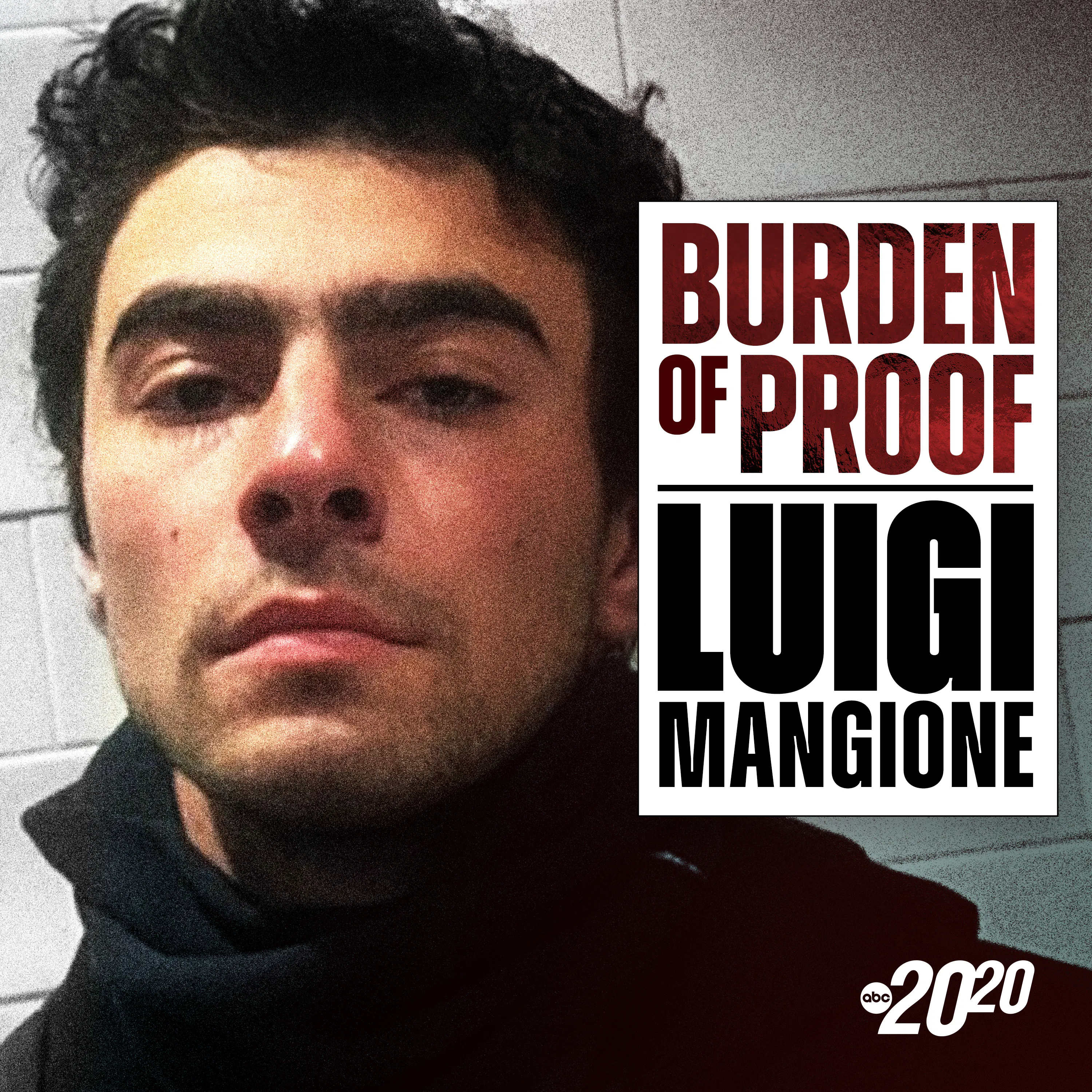
Hi, this is Brian Bachmeyer here with the final episode of Burn and Proof, Luigi Mangione. It's the last episode we'll be sharing here, but if you want to follow the trial and more legal coverage from ABC News, you can check out the podcast Burn and Proof Daily. Every Monday through Friday, you'll hear the latest coverage from ABC News on the trials America can't stop talking about. You might even hear my voice from time to time. Find Burn and Proof Daily on Apple Podcasts, Spotify, Amazon Music, or your favorite podcast app. And remember, you can listen to this podcast
ad-free and unlock access to so much more from 2020 by subscribing to 2020 True Crime Plus on Apple Podcasts. Click the link in the description to learn more. Now, here's a final episode of Burn and Proof, Luigi Mangione. The new documentary film Cat's Eye, Wild Hearts, is now available on Disney Plus and Hulu. The more we grow into Cat's Eye, the more eyes that we have on us, we want to do everything for the fans.
Our eye guns are what make Cat's iconic. Cat's Eye, Wild Hearts, now available on Disney Plus and Hulu. Visit Disney Plus.com or slash what's hyphen on for more information, terms apply. So far on Burn and Proof, Luigi Mangione, we've been feeling you in on everything that has unfolded since December 4th, 2024, when Brian Thompson was murdered by the Manhattan sidewalk. We talked about the manhunt for the shooter, who Brian Thompson was, who Luigi Mangione is, and why this case has captivated so much attention. When we started the series, Manjoni's
State Trial for the murder of Brian Thompson was supposed to begin tomorrow, with so much has changed since then. This is a case that has a lot of moving pieces and just keeps evolving. In this episode, we're going to get into where things stand at the Manjoni's case now and how we got here. For that, we're talking with ABC News' Chief Investigator Correspondent, Aaron Kritersky, who we've heard over this whole series. He's been following this case from the very start, as attended many of Mangione's court hearings. Aaron is always welcome back, it's always a pleasure
to have you. Good to be here, right? Let's start with what happened in Manjoni's Federal case. In that case, he was initially charged with murder through the use of a firearm, a firearms offense, and two counts of stalking. The murder charge made him eligible for the death penalty, but that and the firearms offense were dismissed by a judge months ago. The judge found that the
prosecution did not prove certain elements of the crimes that carried the death penalty, and when that happens, the charge gets dismissed. So when Mangione entered the courtroom in mid-August, he was only facing two counts of stalking, and he pled guilty to those. You were in the courtroom. What else happened during the plea hearing? The most interesting thing that happened other than Mangione's guilty plea, Brian, was his own explanation of exactly what he did, because the judge needed to be convinced that he was pleading guilty because he is in fact guilty and wasn't coerced or wasn't thinking that there was some other motive for what went on. So he ended up seated, reading a statement that occurred
when the judge asked him exactly what he did. And he said, I shot Mr. Thompson, meaning Brian Thompson, the CEO of UnitedHealthcare, and he said that he had done so after he learned that United Healthcare would be holding its annual investor conference in New York in December of 2024. He said he traveled with the intent to shoot Brian Thompson. I shot Mr. Thompson in Manhattan. Mangione
said, and he died. How would you describe your Mangione as he pled guilty? I would describe him as rather passive. There was no contrition. There was no remorse. There was no particular anguish. He
didn't fall on the sword, so to speak, Brian. But he matter of fact, he said that he came to New York to kill Brian Thompson and did it. And that was it. And for the first time we saw Thompson's widow in court for a proceeding, she was crying us all this, went on and had to be comforted by another relative who was seated next to her. The courtroom was hushed. Mangione just sat there in Beige,
jail garb. But there was something matter of fact about it. So if he felt any remorse or if he felt any kind of contrition, it did not show when he was delivering his statement to the judge. And I would say that's pretty par for the course. When it comes to an initial plea, there's a sentencing, and that may come forward in the way that he might talk about this now crime, no longer alleged.
And there's still a state case hanging over his head. But Aaron, as you're in courtroom, what was the energy like or I guess the vibe? There's always some anticipation when Luigi Mangione steps into the room. Many people kind of lean forward or crane their neck to get a good look at him because he has become a defendant who's the subject of fascination. But there were notably fewer of his supporters outside the courthouse. He had a few rows of supporters who have showed
up to just about every hearing. But I was struck that at this moment, as he's pleading guilty, as he's admitting that he killed Brian Thompson, he was largely alone there with his attorneys, but no family members, very few supporters. And Luigi Mangione simply gave his statement and then returned into the custody of the US Marshals. I think that for a lot of people, guilty plea was a surprise. I mean, think about it, right? Just days before Mangione's
attorneys were in state court discussing matters related to that trial, we were all gearing up for a potential early September trial in state court. You've covered this case closely for nearly two years. Were you surprised at all that a plea was taken in federal court? I think it had to be taken Brian, you know the evidence in the case it was overwhelming. Luigi Mangione is on video killing someone, shooting him in the back. It turns out there were eyewitnesses to the crime
as prosecutors mentioned in court prior to the actual recitation of guilty plea. They had a lot of physical evidence that connected Mangione to the crime, including the murder weapon pulled from his backpack notes that prosecutors took to be a motive. All of that was going to be brought to bear and it exposed him to the potential of a life sentence in a state prison in New York. And that was something from the outset that his attorneys had sought to avoid. So by pleading guilty in federal court, they're hoping for a slightly different outcome. They
know he's going to be incarcerated, but they perhaps prefer incarceration in a federal prison and maybe for not as long as life. For the record, I think everything you said was absolutely correct, but just to be devil's advocate. Because I'm curious as to what you think. There's a poet by the name of Sean Corey Carter. He used to say something about you didn't pass the bar, but you know a little bit. And I think I would put you in that category, Aaron, why not just go to trial and hope
that a Mangione fan or someone who has an axe to grind with the healthcare insurance companies is on there and you get a hung jury or you get some jury nullification. Why not that rather than the strategy you've just put forward? I think two reasons. One, the evidentiary hearing that Judge Gregory Carroll presided over in state court allowed most of the evidence to be put before a jury. So the defense was hoping to keep some statements that he made to Pennsylvania corrections officers, some items pulled from his backpack upon arrest at the McDonald's in Altoona, Pennsylvania. They
wanted to keep all of that out and they were largely unsuccessful. And I think the other thing, the idea of jury nullification or putting the healthcare system on trial, the judge was keenly aware of that possibility. And you had to imagine that prosecutors on jury selection would be well tuned to any attempt to keep a questionable panelist on the jury. That strategy, in the defenses you probably could not succeed, or at least they didn't want to take the risk. We've got to take a quick break. And when we come back, we'll talk about where things stand in Mangione's state case.
Today, I want to tell you about our friends at Layla Sleep. We cover a lot of difficult stories on this show, some that might make it hard to sleep at night, but Layla makes one of the best mattresses on the market and also one of the most affordable. It's innovative, flippable design offers something for everyone. There's a soft side and a firm side, so you can choose your preferred experience. It's infused with copper, which offers a cooler, cleaner nights sleep. And with motion
isolation and pressure relief, you can count on being able to sleep through the night. No 2am wakeups because your partner got up for a drink of water. There are two mattresses to choose from hybrid or memory foam. Both are ultra comfortable and with our unique deal, they come at an unbelievably good price. If you're ready to take your sleep to the next level, head to abc secretsavings.com slash 2020 to get free shipping and 40% off. With that discount, you can get the hybrid mattress
starting under $700 or the memory foam mattress for under $400, considering that a good night's sleep is priceless, you can't ask for a better deal. But don't wait, this discount is only good for a limited time. Head to abc secretsavings.com slash 2020 and start sleeping easier today. That's abc secretsavings.com slash two zero two zero. Josh Progren, survivor survivor. Whalefall, repeat either team. Maybe inappropriate for
children under 13. Now playing only in theaters. From the producers of the traders, who's the all new Hulu original series, The Mob. Posted by Parker Posey, 12 celebrities will compete in the ultimate game of power. You'll be doing jobs. Let's go. The dine decides who gets paid
and who gets taken out. You'll do what you got to do. Let the game speak in the all new original series, The Mob premieres October 26 on Hulu and Hulu, Disney plus for fungal subscribers. Right after Luigi Manjoni's federal plea hearing, his attorney's filed emotions dismiss his state charges, including second degree murder on double jeopardy grounds. Double jeopardy is a constitutional protection found in the Fifth Amendment. It protects people from being prosecuted
for the same crime twice. It's very important to say crime and not actions because it's as the distinction the law makes. Then every state, like with many criminal laws, has the ability to create further protections that go beyond the federal protections of double jeopardy. New York being one of the more litigious states because we have the subject of New York and eastern district of New York, where there are a lot of state and federal overlap go a little bit further in their protections. And they give greater definitions as to why the state and federal government cannot prosecute you for the same crime twice. Here's Luigi Manjoni's defense attorney, Karen Freeman,
Ignifalo, speaking about double jeopardy at a press conference after Manjoni's plea hearing. New York law does not permit a person to be prosecuted and punished twice for the exact same crime under a statute that governs successive prosecutions. It's also known as the double jeopardy law. Today's guilty plea triggers the statute and we just filed our motion in state court, explaining why the state charges must be dismissed under New York's double jeopardy protections. Aaron, as I read the New York state double jeopardy law and the motion that was filed by the defense of Luigi Manjoni, I zero in on about 15 words that I think is going to come down to why the defense either wins or loses. And I'm curious as to what your response is.
It's I understand that their strongest argument is to say that the stocking resulting in death in federal court and the murder charge and the second degree in state court are too similar. And that's why I stumbled jeopardy. The language and the law is that the statutory provisions of finding such offenses are designated or designed sorry to prevent very different kinds of harm or evil. I could see the state saying stocking resulting in death and murder in the second degree are two different evils. And therefore both jurisdictions have the right to prosecute. But the defense is
saying the opposite. The defense is saying stocking resulting in death and murder in the second degree are the same type of evil and therefore is double jeopardy. Where do you think the judge falls on that particular issue which I think is a heart of the argument here? I think it depends on whether the judge follows the technical definitions of the law or whether he follows more the substance of the case because both cases the defense has said rely on the same set of facts. There are no differentiating facts between the stocking resulting in death and the murder case in the state court. So if the judge believes that it's largely the same case,
he may see a distinction without a difference. Even though as you say Brian, the Manhattan District Attorney's Office would argue that these are two separate harms that the cases are meant to address two separate things, the stocking and the murder of Brian Thompson. The Manhattan District Attorney's Office put out a statement after the defense filed their double jeopardy motion saying quote, while federal sentencing is pending, we are prepared to litigate the defense motions. The Manhattan District Attorney's Office remains committed to seeking justice for Mr. Thompson and his family. What have you heard from the Manhattan DAs perspective on this
double jeopardy argument from the defense? The Manhattan DAs office knew that the defense's best shot at acquittal was trying to put the whole health care system on trial was trying to distract from the main actions which are on video of Luigi Mangione. And so they were going to be aware of this. The Manhattan DAs office also was mindful that a man is dead and a family is expecting justice. And so they wanted to push forward to make sure justice is done on behalf of Brian Thompson's family. Sources close to the Manhattan District Attorney, Oppenbrag know that there's going to be a
calculation in that office. If the sentence is stiff enough, the family may not want to go through the pain of a state trial and maybe they back off the DA's office, even though in that statement expressed a desire to go forward with a state trial, Brian, they well know that if there's a stiff sentence, there just may not be a need to put anyone through it. There's a desire on the part of prosecutors to never see Luigi Mangione walking free. So they're going to be tuned to the sentencing hearing and judge Garnett's decision in the federal case before deciding how hard to push for a trial on the state side. When will we know what's going to come next in the state case?
There are two important dates and they both occur toward the end of the year. The first is an appearance before Judge Gregory Caro, where he will ostensibly entertain the defense motion to dismiss the state case. And then the sentencing hearing in the federal case for Luigi Mangione, and that's going to be key because it will help prosecutors decide how hard to push. And so both of those dates are key and it may give us an understanding about the next steps for Luigi Mangione and whether he actually goes on trial. And if he doesn't, Brian, as much as he has admitted his guilt now through his guilty plea, it will be striking that he will never be convicted of murder of Brian Thompson.
Right, because what Mangione put a guilty to is stalking in connection with the murder of Brian Thompson, not murder itself. That's what he's charged with in the state case. In mid-December, Mangione will be back in federal court to be sentenced for those two counts of stalking. We'll talk about what might happen there after a quick break. Go on vacation. We're here for it. With kids who turned the vaccine to a courtroom
drama over whose tablet is louder, whose charge is faster, and why watching the same cartoon for the hundredth time as a human right? Yep, we totally have vehicles to handle that. Because whether it's a road trip or a business trip, where your flight's delayed, your phone's at 2% and your dinner is whether it's open? Yeah, here for that, dude. And to price, we're here for it.
What is falling in my lap is huge. FX is the lowdown. This is the tap of things up. You're not Jason Baugh. Ethan Hawke and Tommy Lee John. See conspiracy theorists. Eyes again.
The critically acclaimed series returns. Which one is being normal now and again? Where is your punk rock spirit? FX is the lowdown. Now streaming on Hugo.
I was an Avenger, but I'm not a hero anymore. The vision returns for the final chapter of the groundbreaking trilogy. That family wasn't real. You sure about that? I had a father called Vision.
How was this possible? It is the two episode premiere of Marvel Television's Vision Quest. Nothing bonds a family together quite like Mortal Jeopardy. Now streaming on Disney Plus. This is what's called an open plea and not a plea deal. And just for those who are
not in the court system, a plea deal is a deal. It's where the prosecutors say, Hey, we may reduce the charges or you don't have to plead guilty to the most serious crime. You could plead guilty to a less serious crime and we can agree to a certain amount of years in prison. But with an open plea, the defendant just bleeds guilty to the entire indictment or the entire charges. And in essence, turns to the judge hoping for a good sentence or a good deal.
What can we take away from the fact, Aaron, that this was not part of a plea deal, but instead was an open plea by Luigi Mangione. There's no guarantee what Mangione's sentence is going to be. And Judge Margaret Garnett will be the ultimate decider, but there was nothing promised. There is no particular expectation. He could face up to life in prison, if in fact, Judge Garnett decides, although typically on a stalking case, a defendant might expect far less than that.
But this is a unique circumstance because Mangione said that he came to New York with the intent to kill Brian Thompson and then did it. He meant to kill and he did kill Brian Thompson that day in December 2024. Yeah. And when it comes to the federal system, we have what's called federal sentence and guidelines. And from what I understand, the defense has already calculated or guessed that what that range would be in from their filings. It's something like 24 to 30 years and five months
is what they believe his range may be. And that's the gambit here. That's why the defense sought to plead out the federal case and do it first. The whole hope is that not only will Mangione serve his time in a federal prison instead of a state prison. It's generally thought federal prison conditions may be a little better, a little less violent, a little less crowded than state prisons. The defense is also hoping to convince the judge for something other than a life
sentence. If it's 20 to 30 years, even a little more than that, Mangione would still be eligible for release when he's a grown man, but still with some life left in him. And that's something that state prosecutors in Manhattan are going to be watching very closely because if it's anything other than a severe sentence, you can bet the Manhattan district attorney's office is going to push to still put Mangione on trial in state court. What kind of influence, if any, could state prosecutors have in the federal case, especially if the state charges are dismissed? There's no real mechanism for the Manhattan district attorney's office to weigh in, but they could try to send a letter to the judge. They could try to discuss the case with their
federal counterparts to make sure their views are reflected in whatever statements the federal prosecutors make during the sentencing hearing. There's an interest that the Manhattan DA's office has promised to pursue to make sure the federal judge, Margaret Garnett, understands where the DA's office is coming from and why they felt like justice needed to be served. The assistant district attorney handling the case, Charles Sideman, has said that he has been in constant communication with Brian Thompson's family and wants to pursue justice on their behalf. The DA's office has also said, this was a murder on our street in our borough. They want to also send a message that it's just not acceptable. There's also an interest there that the Manhattan DA's office wants to make clear.
I think Brian, in no small way, the DA's office felt like they did all the work. It's their evidence, along with the NYPD. The feds snatched Mangione upon his rather cinematic return aboard a helicopter to New York City. I'm not that they're looking for credit necessarily, but they wanted their day in court because they were confident that the evidence they amassed would have made a strong case. Looking down a little down the road to December, we're talking sentencing in federal court. What should we expect Mangione's federal
sentencing hearing to be like? I think it should be like any sentencing hearing in federal court. There will be the opportunity for victims to be heard, who's the victim in this case? Well, we know it's Brian Thompson. Does his family want to make a statement? Does the company that he worked
for as chief executive want to make a statement? Prosecutors will have a chance to argue, defense attorneys will have a chance to argue and Mangione himself will have the chance to address the court. Perhaps in his own words, explain why he deserves a more lenient sentence. That's his choice. He doesn't have to, but that would be his shot. It would also give him the chance, if he so chooses
Brian, to be a little bit more expansive than he has been allowed to be in court, where he has asked very specific questions and must-give specific answers. We've heard him give outbursts on his arrest in court once he stood up and talked about double jeopardy. This would be his chance if he feels that he needs to make a statement about the killing of Brian Thompson, it would be his chance to do so at sentencing. A couple of months ago, Mangione's defense attorney said they plan to use a psychiatric defense in his state case. I believe it's specifically the extreme emotional disturbance defense. But we saw them raise that potential psychiatric defense and then later withdraw.
Do you think there's a chance that Mangione's attorneys will bring up this mental health or mental state argument during the federal sentencing hearing? They could try and they could argue that that's a reason for leniency here, but there are no psychiatric records in evidence or on offer that would affirm the defense notion of Luigi Mangione's mental state. We don't know. And in case it doesn't get to trial, we may never know. But I think on sentencing, for sure, the defense may try to bring that up. In practicing myself in the Southern
District of New York and the Eastern District of New York, I am pretty familiar with what the factors are that the judge is going to consider. And some of the big ones, in my opinion, could cut both ways and maybe harm and journey more than help him. The judge has to consider certain factors, right? The idea being that the sentence must be sufficient but not greater than necessary to comply with certain purposes within federal law. You've got to look at things like the nature and circumstances of the offense and the history and characteristics of the defendant.
So how bad is the crime? Does a person have a criminal record or not? They also look at the seriousness of the offense, the adequacy to deter criminal conduct, so to stop other people from committing this crime in the future. They also look at the ability to protect the public from further crimes from this specific defendant. And they also look at things that I don't think apply to Mangione like the need for educational or vocational training or medical care or other correctional treatment. But looking at all those factors and looking at this case and looking at the arguments,
are you seeing anything that would give us any indication as to what kind of sentence Man Gione could get in federal court? Brian, it's as you know impossible to guess what a judge is going to do. But in addition to all those factors, just look at the series of events. This is someone who admitted he traveled to New York with the intent to kill somebody and actually did it. I don't know a judge in America who's going to take that lightly. And then there's Mangione himself. This is a high
school valedictorian, a son of privilege, somebody with every opportunity to travel the world. And what does he choose to do? He chooses to travel to New York with a gun and a silencer that he made using a 3D printer. He put his education, he put his privilege to work to shoot somebody on the streets of Manhattan. It may not bode well for Mangione. I don't see a world in which Judge Garnett
goes easy on Luigi Mangione. They're going to do everything they can that defenses to try to convince her. For a lean-in sentence to perhaps offer his back pain or his prolonged exposure to the health insurance system, even though UnitedHealthcare was not his provider, they could offer up a number of potentially mitigating factors. But he admitted that he intentionally killed someone on the street Manhattan. It was a shocking crime that shocked the city. And there's an expectation that
prosecutors have that the Judge is not going to go easy on him. Aaron, from December of 2024, we've been covering this case, you, more than anyone else I know, so reflecting back on everything that you've covered related to the murder of Brian Thompson, what stands out to you the most about this story as we approach what could be the end of a saga that is the death of Brian Thompson and the case of Luigi Mangione? It has to be the way the case is coming to an end, Brian. All of the facts, all of the evidence way against Luigi Mangione. You can put the health care system on trial, you can blame your back pain, but at the end of the day, you're on video killing a guy. And yet his defense did a job in
perhaps helping him avoid a life sentence in a state prison. And so it will be left to others to decide whether this is justice for Brian Thompson's family or whether there's something more to be desired here and whether in effect, Mangione did not fully go through the system as intended. I think his lawyers did a job for him, right? I mean, I don't know. I mean, the day he was facing the death penalty and now we are talking about does he get out with his lifetime or not? As a defense attorney, that's where you'll win in some sense.
With those set of facts, absolutely. Well, Aaron, I always look forward to these conversations on these podcasts. I know it's hard to get you because you're doing 20 things at once. So again, thank you for joining us and for your excellent reporting on this case and all cases that you covered. Thank you, Brian.
Burn Approved Luigi Mangione is a production of ABC Audio, hosted by me, Ryan Buckmeyer, produced by Vika Erenson and Audrey Mostek, our lead producer is Camille Peterson, edited by Tracy Samuelson, Music by Evan Viola, Mixing by Bob Mallory, special thanks to Katie Dendas, Sasha Aslanian, Michelle Margolis, Tanya Simpson, Josh Mark Olin, Peter Harlombos, and Jared Koski. Josh Kohan is our director of podcast programming. Amy McNiff is our executive producer. Thanks for listening to Burn Approved Luigi Mangione. That's the end of this podcast. But if you want to follow the trial and more legal covers from
ADC News, I'd recommend you check out the podcast Burn Approved Daily. Every Monday through Friday, you'll hear the latest coverage on the trial's America Can't Stop Talking About. You might have heard my voice, and Erens, from time to time. Find Burn Approved Daily on Apple Podcasts, Spotify, Amazon Music, or wherever you listen to podcasts, or listen at-tree on Apple Podcasts when you subscribe to 2020 True Crime Plus. Did you know that if your spouse goes missing and you don't tell anyone, that's not necessarily a crime? That surprising fact is at the heart of the brand
new season of Bearbrook, the critically acclaimed True Crime podcast from New Hampshire Public Radio. I'm your host, Jason Moon. In this season, Bearbrook investigates another New Hampshire mystery, a Christmas tree farm with dementia, vanishes. His wife never reports him missing. Can he still be found? Don't miss Follow Bearbrook, wherever you get your podcasts.