
EPISODE · Nov 4, 2021 · 16 MIN
Mapadiyam - Sirappurai
from Saiva Siddhanta · host suresh babu
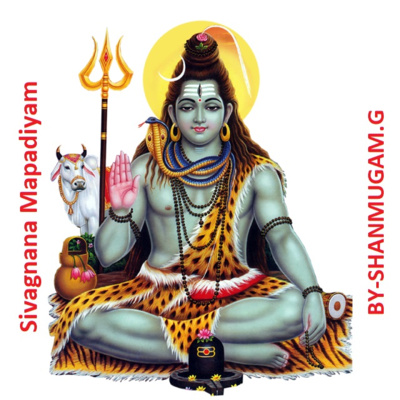
Among the three things of pathi, pachu, pAcham, like the pathi the pAcham of pachu is without origin. pAcham of pachu will not affect the pathi. If pathi approaches (the pachu) then the pAcham of pachu won't stay (with pachu). It is this concept of driving away the pAcham of pachus which surrendered to pathi, which is seen in many holy deeds of Lord Shiva like tripurasaMhAram. The three demons are like the three components of pAcham (ANavam, kanamam, mAyai). Lord Shiva, pathi, destroys them by His smile of grace. Thus when the three impurities are reduced to ash pathi dances there, bliss remains. Same is with the sUrasaMhAram. Lord subramanya is the form of grace of Lord Shiva. On the prayer of pachus pathi's grace destroys tArakan (mAyai), siN^gamukan (kanmam) and sUrapadhman (ANavam). Translation: Ignorants say the Lord with red matted hair, source of all, burnt three cities. Three cities signify the three impurities. Who knows the burning of those impurities. The entire thiruman^dhiram has a rich collection of the pathi pachu and pAcham concept. (For example 2405 to 2424). thirumuRai which is twelve in number are very sacred for the shaiva sidhdhanthis. It is mainly the tenth thirumuRai (thiruman^dhiram) that talks more of nyAna and yOga concepts. It is mainly based on the AgamAs. So it is called sAththiram. While those are widespread in all other thirumuRais also, it is the devotion that is given major emphasis. The bliss which is achieved by controlling the breath, meditating with all other thoughts carefully excluded which is the state of chummA iru, chol aRa (be idle, don't talk - not just in body level but in mind level), and sleeping (continuing) in the state effortlessly, is achieved through the flow of devotion which removes all the hurdles in the path as one who lies on that flow reaches the destination effortlessly. When a desire for God is developed all the other desires slowly get excluded liberating the pachu from the pAcham. While the rituals are duly acknowledged for enforcing the devotion, it is emphasized that it is the devotion and not just the rituals that lead to eternal bliss. There are a lot of books in thamiz which describe in detail about the principles of shaiva sidhdhantham. After the period of emergence of thirumuRais (after 12th century), a set of books known as san^dhAna n^UlakaL (meykaNda n^UlakL) were written which discuss in detail the principles of shaiva sidhdhantham. Like the samayak kuravar(champan^dhar, appar, sun^dharar, mANikka vAchkar) the four teachers who gave these books are called san^dhAnak kuravar. san^dhAna books are fourteen in number. thiruvun^dhiyAr and thirukkaLiRRuppAdiyAr to name a few. They talk about the thirty six principles and other much involved concepts of shaiva sidhdhantha.
Embed this episode
Ready to play
Mapadiyam - Sirappurai
No transcript for this episode yet
Similar Episodes
No similar episodes found.