
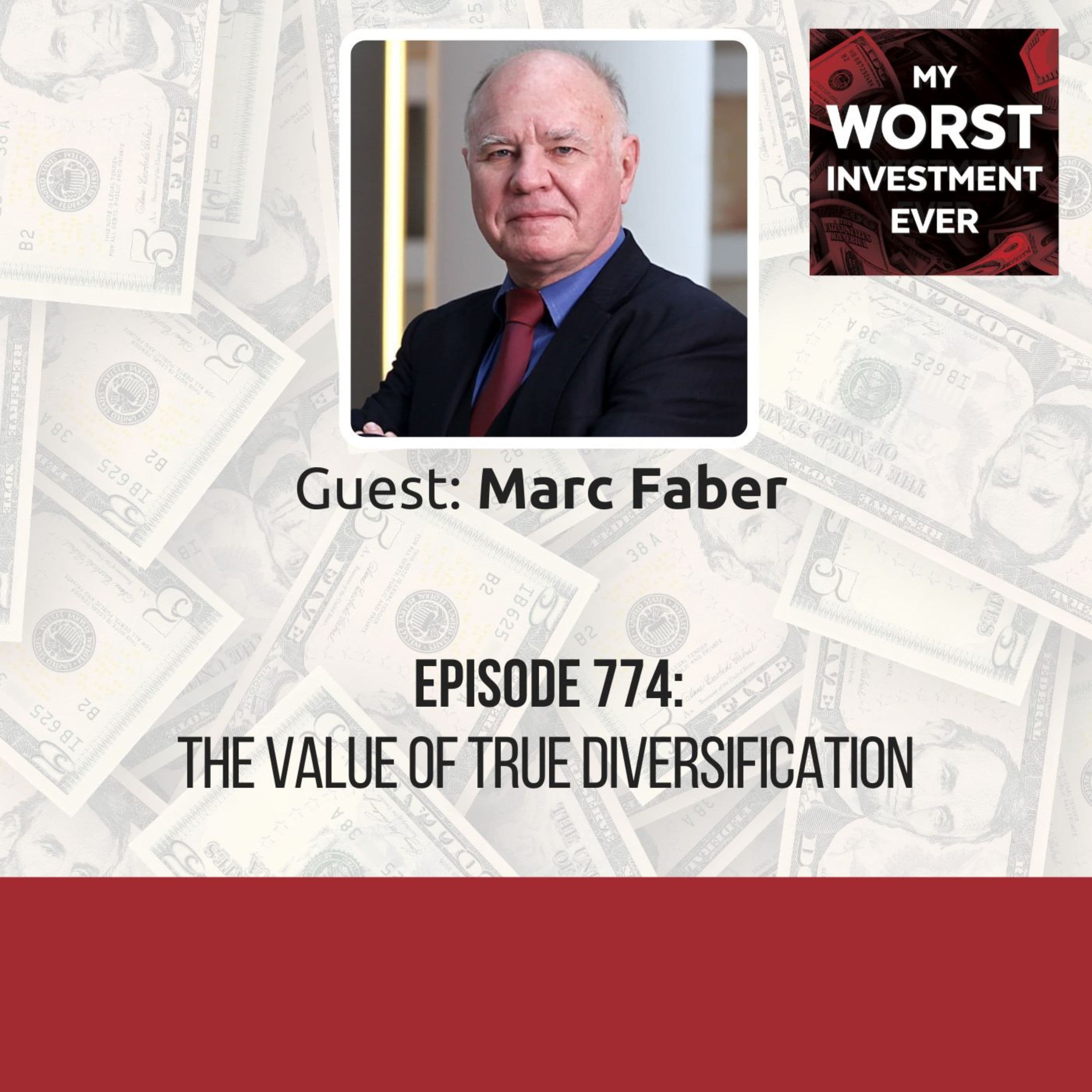
EPISODE · Feb 26, 2024 · 56 MIN
Marc Faber - The Value of True Diversification
from My Worst Investment Ever Podcast
BIO: Dr. Marc Faber, renowned for his unconventional expertise in investment strategies, is a fund manager and author. He serves as the editor of the “Gloom Boom & Doom Report” and the “Monthly Market Commentary,” earning international recognition as the pessimistic stock market expert “Dr. Doom.”STORY: Marc recounts getting caught on the wrong side of the late-1990s dotcom bubble. He had been convinced that the tech crash was imminent and had taken heavy short positions, but at the turn of the millennium, the Fed injected massive liquidity. This unexpected rally sent the NASDAQ soaring another 30% into March 2000. Because one surviving company (Amazon) went up 100× while most others crashed, his timing error turned into a dramatic bubble loss.LEARNING: True diversification saves the day. Spreading money across stocks, bonds, cash, precious metals, and real estate can protect you when markets surprise. “When you lend money to friends, you risk losing everything…you lose your money and you lose the friend.”Marc Faber Guest profileDr. Marc Faber, renowned for his unconventional expertise in investment strategies, is a fund manager and author. He serves as the editor of the “Gloom Boom & Doom Report” and the “Monthly Market Commentary,” earning international recognition as the pessimistic stock market expert “Dr. Doom.”Born in Switzerland in 1946, Faber pursued economics at the University of Zurich and achieved a magna cum laude doctorate in economics at just 24 years old.His career took him to White Weld & Company Limited in New York, Zurich, and Hong Kong between 1970 and 1978. From 1978 to 1990, Faber was instrumental in establishing the Asia business for Drexel Burnham Lambert (HK) Ltd.In 1990, he ventured into his own business. Faber’s monthly publications offer investors insights into potential market trends. While he maintains an office in Hong Kong, he has lived in Chiang Mai, Thailand, since 2001.Worst investment everMarc cites two “worst” investments. The first was personal: lending money to friends. In his words, “to lend money to friends…is the worst investment you can make,” since those who are in trouble will pay back the banks first and will default on friends. He now refuses loans outright and will give small amounts as a gift if he wants to help.Going overly bearish in the dotcom bustMarc’s huge market failure was due to the dotcom bust. In 1999, he believed that most tech stocks would die in the dotcom crash. He shorted the NASDAQ heavily, expecting ten dead companies for every single survivor.But the markets had other plans. A liquidity injection by the Fed in late 1999 (amidst Y2K fears) sent the NASDAQ soaring 30% by March 2000. Ironically, nine out of ten technology short bets he made did go bust 100%, but one – Amazon – rose roughly 100 times.This one survivor erased his profit, turning his timing call into a massive dotcom bubble loss. As Marc admits, overbetting on a crash came at a cost: “being on the short side made it difficult to make money.”Lessons LearnedDiversification is key. Don’t put all your eggs in one market or asset class. Diversify investments across stocks, bonds, cash, real estate, precious metals, and other assets, as well as globally (US, Europe, Asia, and Emerging Markets). That way, it’s unlikely everything falls at the same time.Avoid being too bearish. Markets can defy even the smartest predictions. One unexpected rally or winner can ruin a bear. Even if fundamentals look grim, stay flexible.Respect risk management. Managing risk is often about preserving capital. Sit on the sidelines or cash if unsure, rather than chasing hyperbolic gains.Personal finance is part of investing. He learned the hard way that lending money to friends is a risky proposition. It’s better to provide help as a gift instead of lending, because friends will default on you the moment pressure sets in. This underscores that investment risk management also includes everyday money decisions.Inflation matters. Understand inflation’s nature. It can shift across sectors over time (e.g., from goods to services). Rising consumer prices tend to precede rising interest rates, which can put pressure on assets. In short, understand what inflation is and be prepared for its evolving impact.Andrew’s TakeawaysEven professionals get humbled. No one has a crystal ball. Be humble and understand that it is extremely difficult to time a market collapse.Diversification is the answer. Global diversification is the hallmark of prudent risk management. By placing assets in instruments denominated in different countries and currencies, you reduce the exposure to any single bubble or crisis. This can include stocks, bonds, real estate, and bank accounts, diversified across the world, not all under the umbrella of a single economy.Balance caution with conviction. Investment risk management means giving yourself some “wiggle room.” Don’t go 100% short or 100% long on a single theme. Tactically changing your strategy will save you from further losses.Learn from history. Economies and markets run in cycles. Being inquisitive and learning (via books and past cycles) is an investor’s edge.Actionable AdviceDiversify globally and across asset classes. Hold equities, bonds, cash, property, metals, etc., in different regions. For example, own some US and European stocks, as well as funds in Asia, Latin America, or emerging markets. Keep bank accounts or bonds in multiple currencies (e.g., Swiss, US). True diversification means that one country’s policies or an asset bubble won’t wipe out your entire portfolio.Don’t chase bubbles or panic. Resist the urge to make huge bets on hype (or despairing sell-offs). If your analysis says “sell everything,” at least sell in increments or hedge, because markets can still rally unexpectedly.Focus on capital preservation. In uncertain markets, consider locking in gains or moving money to safer assets. In times like these, preserve your capital rather than aim at making a lot of money. In practice, that might mean having more cash or short-term bonds on hand.Plan for inflation shifts. Keep some assets that can hedge inflation (e.g., real assets, inflation-protected bonds). Track which sectors are heating up. Marc notes that inflation is sneaky and can shift between goods, services, and assets, so a mix of investments (including real estate or commodities) can offer protection.Avoid risky personal lending. If a friend asks to borrow, consider giving a small gift instead. Personal loans in tough times can become a “losing your money and your friend” situation. Treat such “investments” as non-recoverable.Educate yourself continuously. Read and learn not only market trends but also the broader context of economics, politics, and even history. A well-rounded view helps spot risks early.Marc’s recommendationsMarc recommends reading “The Economics of Inflation,” a deep dive into money printing and price cycles, and “Capitalism and Freedom,” a classic that explains how economic liberty underpins prosperity.No.1 goal for the next 12 monthsMarc’s goal for the next 12 months is to study the decline of the Roman Empire. He’s fascinated by how a powerful empire fell, noting it ultimately “ran out of money”. By delving into that history, Marc hopes to draw lessons about fiscal prudence and economic limits that can be applied to today’s world.Parting words “Understand what inflation is and that it can shift from one sector to another sector.”Marc Faber [spp-transcript] Connect with Marc FaberLinkedInTwitter<a href="https://www.gloomboomdoom.com/" rel="noopener noreferrer"...
Embed this episode
Ready to play
Marc Faber - The Value of True Diversification
No transcript for this episode yet
Similar Episodes
No similar episodes found.