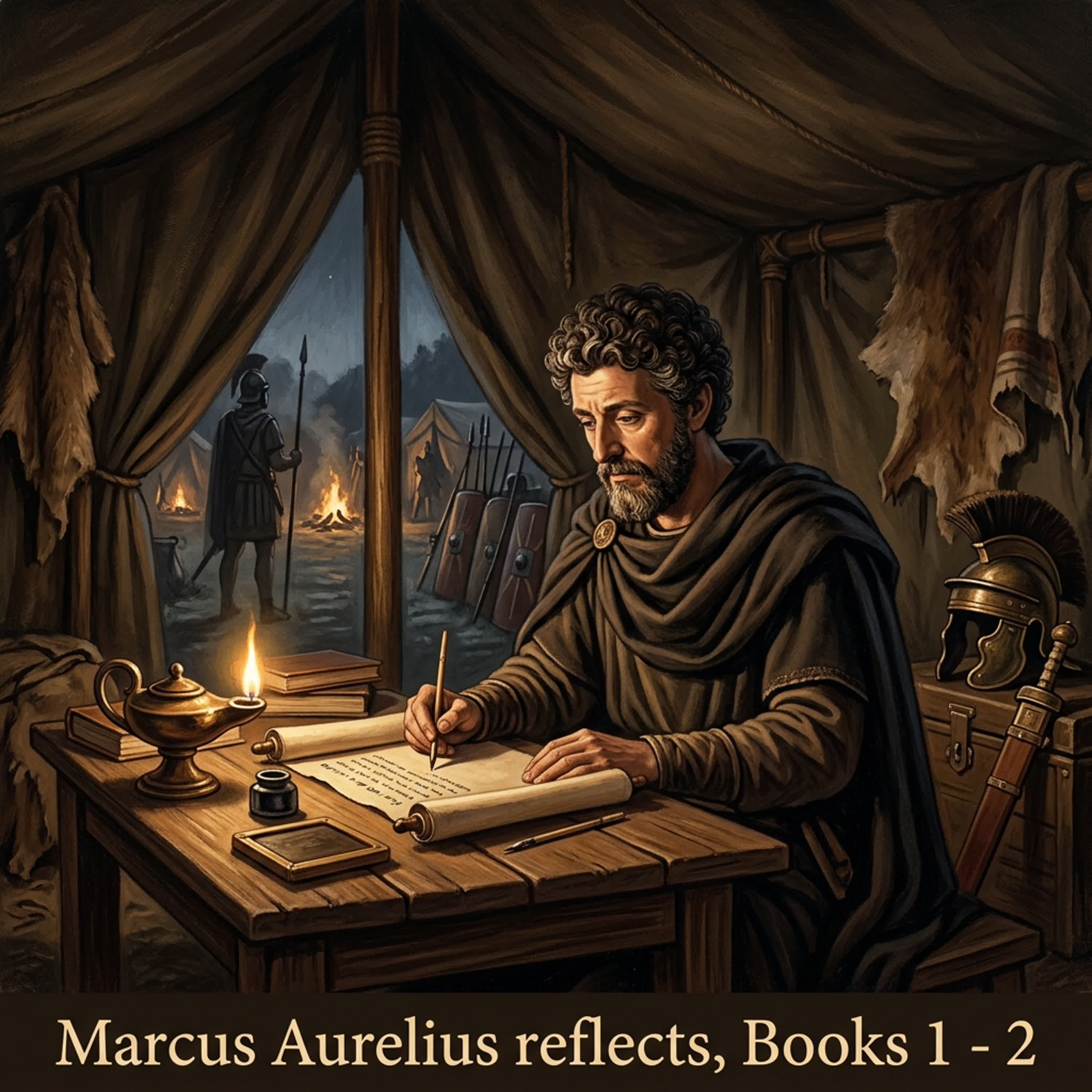
Marcus Aurelius, Meditations - 01 - Part 1
from Wisdom for the Present: Western Wisdom Literature Hosted by Kanu Emeruwa
Imagine being the most powerful human being on earth, possessing limitless wealth, commanding vast armies, and holding the literal power of life and death over millions of people. In a position where no one can tell you "no," what is the very first thing you write in your private, secret diary? For the Roman Emperor Marcus Aurelius, writing at the height of the Roman Empire, the answer was not a boast of conquest or an essay on military strategy, but a highly detailed ledger of thank-you notes. This radical act of gratitude serves as a psychological survival manual for a leader desperately trying not to lose his soul to the machinery of absolute power. In analyzing Books 1 and 2 of his Meditations, we discover a "dual engine" of personal growth that Marcus Aurelius used to stay grounded. The first half of this engine is radical gratitude—a meticulous checklist where he systematically documents the exact moral virtues he observed and borrowed from those around him. The second half, which drives the intense tone shift in Book 2, is urgent self-correction in the face of his own mortality. He continuously grabs himself by the shoulders, reminding himself that his time is strictly limited and that he must clear the clouds from his mind before his opportunity to live virtuously disappears forever. Through this deeply personal ledger, Marcus suppresses his ego by tracing his patience to his grandfather, his work ethic to his tutor, and his vision of justice to his brother, proving to himself that every good quality he possesses is borrowed. This ancient model of ego suppression stands in stark contrast to our modern "algorithms" of distraction. Today, we face a crisis of information overload where we are carried "to and fro" by digital feeds, doomscrolling through data that gives us the illusion of learning while masking a deep, sophisticated distraction. By translating his warnings, we can also confront the "busy trap"—how we routinely wear busyness as a badge of honor and use "urgent affairs" as a shield to avoid the vulnerability of real human relationships. What makes this text truly staggering is its physical and environmental reality. Marcus Aurelius was not writing in a comfortable, quiet study, but in a freezing, muddy military encampment on the Danube frontier, surrounded by the horrific violence of the Marcomannic Wars and the ravages of the Antonine Plague. Yet, amidst this absolute hell on earth, he does not complain about his physical discomforts or draft military campaigns in his diary. Instead, he focuses entirely on calibrating his internal moral compass, demonstrating a profound cognitive dissonance between his chaotic external environment and his serene internal focus. To reclaim our agency today, we must cultivate a rigorous sense of Stoic discernment, distinguishing enduring psychological resilience from the socioeconomic blind spots of an ancient autocrat who could easily label poverty as "indifferent" from a position of infinite wealth. For Marcus, philosophy was not an academic debate of abstract logical puzzles, but an "internal martial art"—the active daily practice of keeping the mind's ruling reason sovereign over irrational spikes of anger, tribal factionalism, and performative vanity. By deconstructing our anxieties to present physical realities and accepting that fame is ultimately no better than oblivion, we find the true freedom to act with unfeigned gravity and natural affection right now. In This Episode * Radical Gratitude as Ego Suppression: Understanding how Marcus Aurelius systematically dismantled his own ego by attributing 100% of his virtues to others. * The "Last Action" Filter: Using the acute awareness of mortality not to induce modern anxiety, but as a solvent to dissolve performative vanity and hypocrisy. * Philosophy as an Internal Martial Art: Shifting our definition of philosophy from theoretical academic study to the active daily preservation of the inner spirit. * Dismantling the Busy Trap: Calling out the linguistic hypocrisy of using "urgent affairs" as a socially acceptable shield to avoid real relationships. * The Premeditation of Difficult People: Embracing a morning routine that manages expectations to meet conflict with calm recognition instead of daily outrage. * Deconstructing Anxiety Through Reductionism: Stripping away catastrophizing narratives by reducing our physical experience to its basic biological components. * The Illusion of Time Ownership: Recognizing that we only ever possess or lose the razor-thin sliver of the present moment. Practical Reflection If you were to sit down tonight and write your own personal ledger of gratitude, taking zero credit for your own goodness, who would be on that list and what specific moral virtues would you attribute to them? How would your daily frustrations change if you approached difficult or ungrateful people as "fellow-workers" in a single organism, rather than enemies to be destroyed? Are you currently using the modern badge of "busyness" as a shield to protect yourself from the effort and vulnerability of maintaining meaningful relationships? Suggested Substack Excerpt How does the most powerful man on earth keep from losing his soul? Explore the private psychological survival manual of Roman Emperor Marcus Aurelius as we translate ancient Stoic wisdom into practical tools to defeat modern anxiety, tribalism, and the "busy trap". AI Disclosure This episode was created using Google NotebookLM Audio Overview, based on human-curated source material, structured guidance, and editorial review. AI is used as a tool for clarity and delivery, not as a replacement for thoughtful study or engagement with the original texts. Copyright © 2026 Wisdom for the Present / Kamashcu Production Studios. All rights reserved. This is a public episode. If you would like to discuss this with other subscribers or get access to bonus episodes, visit wisdomforthepresent.substack.com
Embed this episode
No transcript yet.