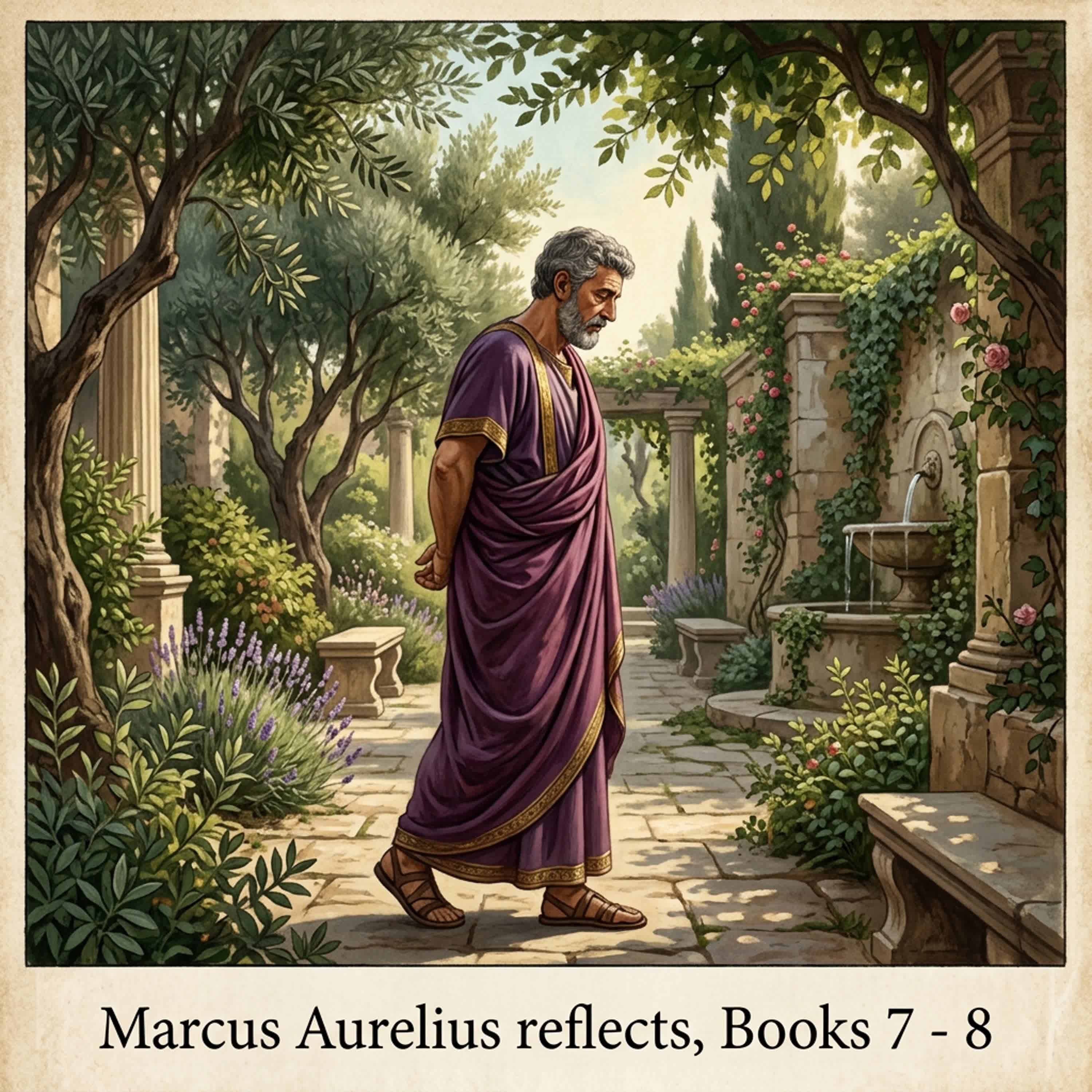
Marcus Aurelius, Meditations - 04 - Part 4
from Wisdom for the Present: Western Wisdom Literature Hosted by Kanu Emeruwa
Imagine bypassing the encryption of a highly private digital diary belonging to the most powerful person on Earth, expecting grand geopolitical chess moves, only to find an entry pleading: "please, for the love of everything, do not let annoying people ruin my morning today". This is the surprising reality of Marcus Aurelius’s Meditations—not a performative theatrical play, but the raw, unedited, and deeply private journal of a Roman Emperor trying to survive his own life. Written nearly two thousand years ago, these reflections serve as an emergency cognitive toolkit that directly mirrors modern evidence-based clinical psychology. In an era of hyper-optimization, his words challenge our modern relationship with stress, ego, and the stories we tell ourselves. To understand the power of Books 7 and 8 of Meditations, we must look at the brutal reality of Marcus Aurelius's world. He was not writing from a peaceful, air-conditioned villa, but from military tents freezing in the mud on the Danubian frontier. He was managing grueling, endless wars, political betrayals, and the devastating Antonine plague—a catastrophic epidemic that wiped out an estimated five million people. With death everywhere and state collapse feeling imminent, Marcus wrote not to lecture an audience, but to keep himself from breaking down under the sheer, crushing weight of his responsibilities. His starting point is an aggressive confrontation with impermanence, listing deceased loved ones—including his adoptive father and wife—to remind himself that both his critics and his plots will soon be dust. Marcus routinely reprimands himself for getting distracted by "syllogisms and logical subtleties"—the ancient equivalent of modern-day Twitter debates and Slack arguments meant solely to prove intellectual superiority. He reveals a deeply human struggle with impostor syndrome, admitting he has "done many things contrary to that perfection of life". In our modern world, we chase the same phantoms: optimizing our lives for social media aesthetics, obsessing over job titles, and climbing ladders leaning against the wrong walls. To combat this, Marcus constructs an "inner citadel," drawing a sharp boundary between the raw, inevitable data of life and the psychological narratives of suffering we write about them. He argues that while our bodies may suffer physical pain, our minds do not have to grieve. When the unexpected storms of life hit, our typical reaction is outrage—a cognitive confirmation bias where we expect the world to conform perfectly to our plans. Marcus challenges this with a brilliant metaphor: life is not a synchronized dance, but a wrestling match. A dancer requires a cooperative, predictable environment, but a wrestler expects resistance, lowering their center of gravity to absorb unexpected shocks. When we treat life like a dance, a delayed flight or a passive-aggressive message feels like a cosmic injustice. Marcus reminds us of the "bitter cucumber" principle: if a cucumber is bitter, set it away; if there are brambles, step around them. Instead of demanding that the universe explain why obstacles exist, we must accept the terrain of reality without paying an unnecessary emotional tax. Ultimately, reclaiming our agency requires us to practice "bare and naked apprehensions"—stripping events of our catastrophic narratives and viewing them with pure mindfulness. When faced with interpersonal hostility, Marcus instructs us to adopt the "sunbeam mindset". Just as a sunbeam does not violently crash through an opaque wall but simply rests upon and illuminates it, we must meet difficult people with a steady, non-reactive light of reason and professional boundaries. Whether the universe is governed by divine order or a chaotic collision of random atoms, our moral imperative remains unchanged. By choosing to lower our center of gravity and separate raw facts from fiction, we can protect our inner citadel and navigate any crisis with our character intact. In This Episode * The Emergency Toolkit: Why Marcus Aurelius's private writings serve as a raw, practical guide for modern burnout and anxiety rather than an abstract lecture. * The Reality of the Frontier: A look at the brutal historical backdrop of war, betrayal, and the Antonine plague that shaped Marcus's worldview. * Memento Mori as Liberation: How listing dead emperors, friends, and family members acts as a powerful release valve for modern ego and stress. * The Inner Citadel: Distinguishing between inevitable physical pain (raw biological data) and psychological suffering (the narratives we choose to write). * Wrestler vs. Dancer Mindset: Why lowering our center of gravity and expecting resistance prevents us from being shattered by unexpected disruptions. * The Bitter Cucumber Rule: How to route around daily "brambles" and unproductive communication without demanding explanations from the universe. * The Sunbeam Mindset: Meeting interpersonal hostility with a steady, non-reactive extension of reason rather than a chaotic, defensive collision. Practical Reflection 1. The Wrestler's Calendar: Looking at your schedule for tomorrow, which events are you approaching like a dancer (expecting frictionless execution), and how can you shift your mindset to that of a wrestler prepared for resistance? 2. The Bare Apprehension: When you encounter a stressful message or delay today, can you separate the bare, objective facts (e.g., an unreplied email) from the catastrophic story you are tempted to write about it? 3. The Bitter Cucumber: What is a modern "bramble" in your life right now that you are over-analyzing or stressing over, and how can you simply step around it rather than letting it ruin your weekend? Suggested Substack Excerpt Delve into the freezing military tents of Marcus Aurelius to discover how a Roman Emperor used the "wrestler mindset" and the "inner citadel" to survive plague, war, and burnout—and how his ancient diary predated modern cognitive therapy by two millennia. AI Disclosure This episode was created using Google NotebookLM Audio Overview, based on human-curated source material, structured guidance, and editorial review. AI is used as a tool for clarity and delivery, not as a replacement for thoughtful study or engagement with the original texts. Copyright © 2026 Wisdom for the Present / Kamashcu Production Studios. All rights reserved. This is a public episode. If you would like to discuss this with other subscribers or get access to bonus episodes, visit wisdomforthepresent.substack.com
Embed this episode
No transcript yet.