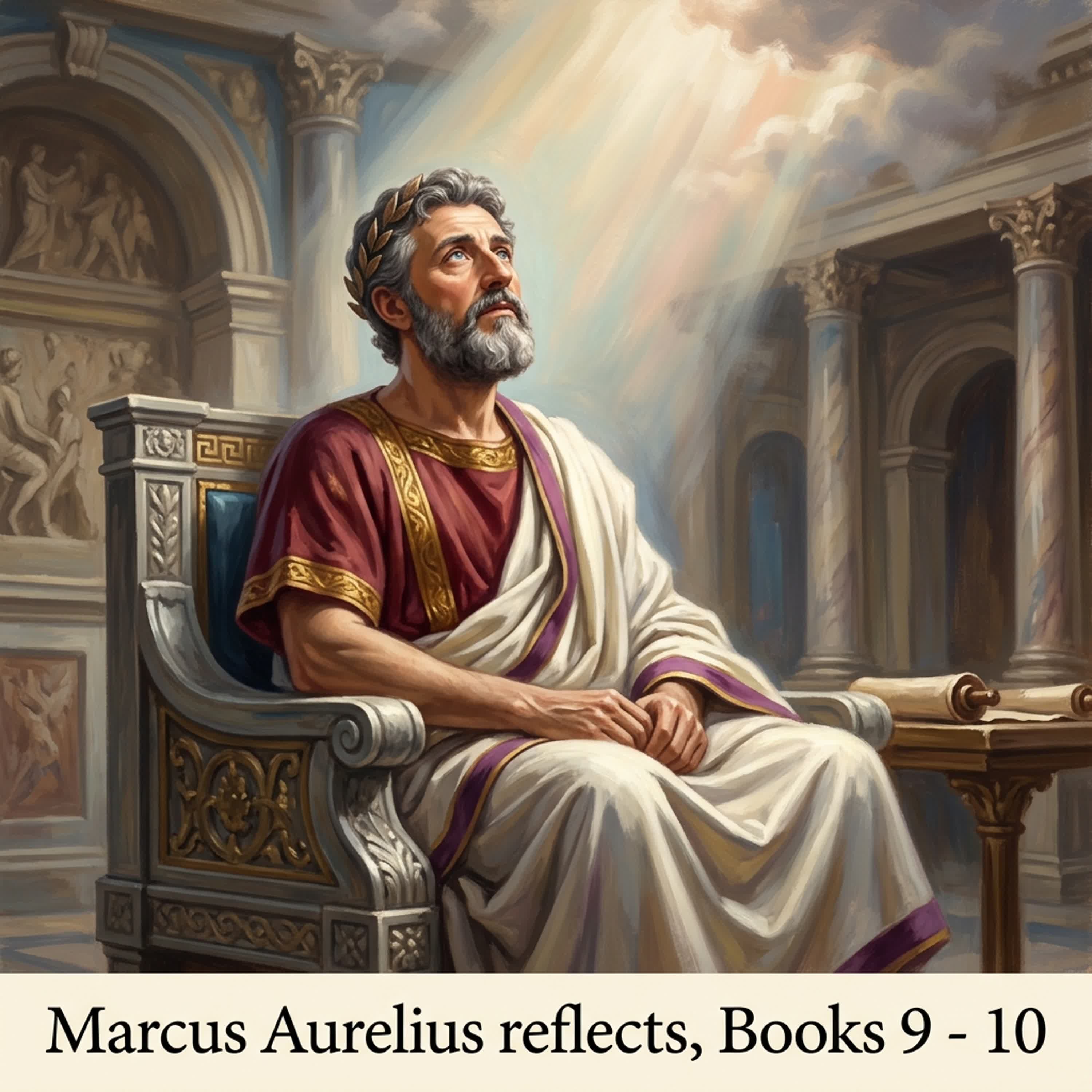
Marcus Aurelius, Meditations - 05 - Part 5
from Wisdom for the Present: Western Wisdom Literature Hosted by Kanu Emeruwa
What does it take to maintain your sanity and humanity when you are the single most powerful person on Earth, sitting in a freezing military tent, surrounded by the brutal logistics of war and a devastating plague? This is the exact crucible from which Marcus Aurelius’s Meditations emerged. Far from a polished, theatrical play, this text is a raw, private, and deeply personal cognitive survival manual written with no intention of publication. In Books 9 and 10, the Roman Emperor speaks directly to his own mind, establishing a rigorous framework of psychological defense that remains shockingly relevant for anyone navigating modern chaos, leadership under high-stress environments, or deep personal anxiety. At the heart of Books 9 and 10 lies the fundamental Stoic principle of universal interconnectedness. Marcus argues that the universe is not a random collection of void and rocks, but a rational, unified living organism governed by a common parent. From this cosmic perspective, all reasonable creatures are biologically designed to cooperate and do one another good. Therefore, behaving unjustly or deceitfully to another person is not merely a minor social infraction, but a literal "impiety"—a violation of the natural laws of physics, akin to a gear spinning the wrong way in a machine. Marcus challenges our modern tendency to focus on external metrics and appearances—what we might call "polishing the axe". He compares the physical body, social reputation, and material wealth to neutral instruments like a carpenter's axe, a weaver's shuttle, or a writer's pen. While we obsess over our physical fitness, resume formatting, and digital avatars, we routinely neglect the operator: our internal mind and the underlying beliefs or dogmata that guide how we swing the tool. To reclaim true agency, Marcus demands that we peel back the vessel and focus entirely on our core judgments, which dictate whether our actions build or destroy. This internal focus became a matter of life or death during the Antonine smallpox plague, which killed millions and eventually claimed his co-emperor. Marcus draws a sharp distinction between physical disease, which is merely a biological disruption of our temporary vessel, and mental corruption—such as falsehood, hypocrisy, or cruelty. To him, moral decay is a far deadlier plague because it destroys our rational core and humanity. Rather than feeding into public panic or confirmation bias, he urges us to separate the immediate biological shock of an external event from the secondary, catastrophic story we choose to tell ourselves about it. Ultimately, Marcus’s philosophy empowers us to construct an "inner citadel" against the external storms of life. Whether the universe is governed by divine design (providence) or completely random chaos (atoms), our individual duty to act with justice and virtue remains unchanged. By letting go of things outside our control and choosing not to rage against fate like a "squealing pig," we reclaim our unique human capacity for rational consent. True freedom, he reminds us, is not about controlling the shifting wind, but about choosing how we swing the axe of our own actions. In This Episode * Universal Kinship: All human beings share a single, reasonable common nature, making social cooperation a biological duty and injustice a direct rebellion against the cosmic order. * Polishing the Instrument: The body is merely a neutral tool; our true focus must be the operator—the core beliefs and judgments (dogmata) that direct our actions. * The True Plague: A virus that infects the body is simply nature running its biological course, but a corruption of the mind is a far more catastrophic plague that destroys our rational essence. * Ego Deconstruction: True virtue is an end in itself; just as an eye does not demand a salary for seeing, we should perform good deeds naturally without expecting rewards or validation. * Reframing the Obstacle: While external hindrances can halt physical things, the rational mind can turn every obstacle into fuel, incorporating setbacks into its path to practice virtues like patience and justice. * The View from Above: When overwhelmed by modern anxieties, mentally zooming out to a cosmic perspective helps put microscopic, temporary troubles into their proper context. * The Wind and the Leaves: Public praise, personal criticism, and the fleeting opinions of others are as temporary and meaningless as autumn leaves blowing in the wind. Practical Reflection In your daily life, are you spending more time "polishing the axe" (your appearance, digital presence, or status) or educating the "operator" of your mind? When faced with a crisis or toxic behavior, are you reacting like the "squealing pig" in futile resistance, or are you claiming your power of rational consent to accept reality? If even the most powerful emperor in history accepted that his closest companions might feel a secret relief at his passing, why are you still agonizing over what others think of you? Suggested Substack Excerpt Explore Books 9 and 10 of Marcus Aurelius's Meditations as an ancient cognitive survival manual, offering a powerful blueprint to manage ego, conquer anxiety, and build an unshakable inner citadel. AI Disclosure This episode was created using Google NotebookLM Audio Overview, based on human-curated source material, structured guidance, and editorial review. AI is used as a tool for clarity and delivery, not as a replacement for thoughtful study or engagement with the original texts. Copyright © 2026 Wisdom for the Present / Kamashcu Production Studios. All rights reserved. This is a public episode. If you would like to discuss this with other subscribers or get access to bonus episodes, visit wisdomforthepresent.substack.com
Embed this episode
No transcript yet.