
EPISODE · Jun 9, 2026 · 53 MIN
Marine Aviation in WWII: The Real Story of VMF-221
from The Naval Aviation Ready Room Podcast with Ryan Keys
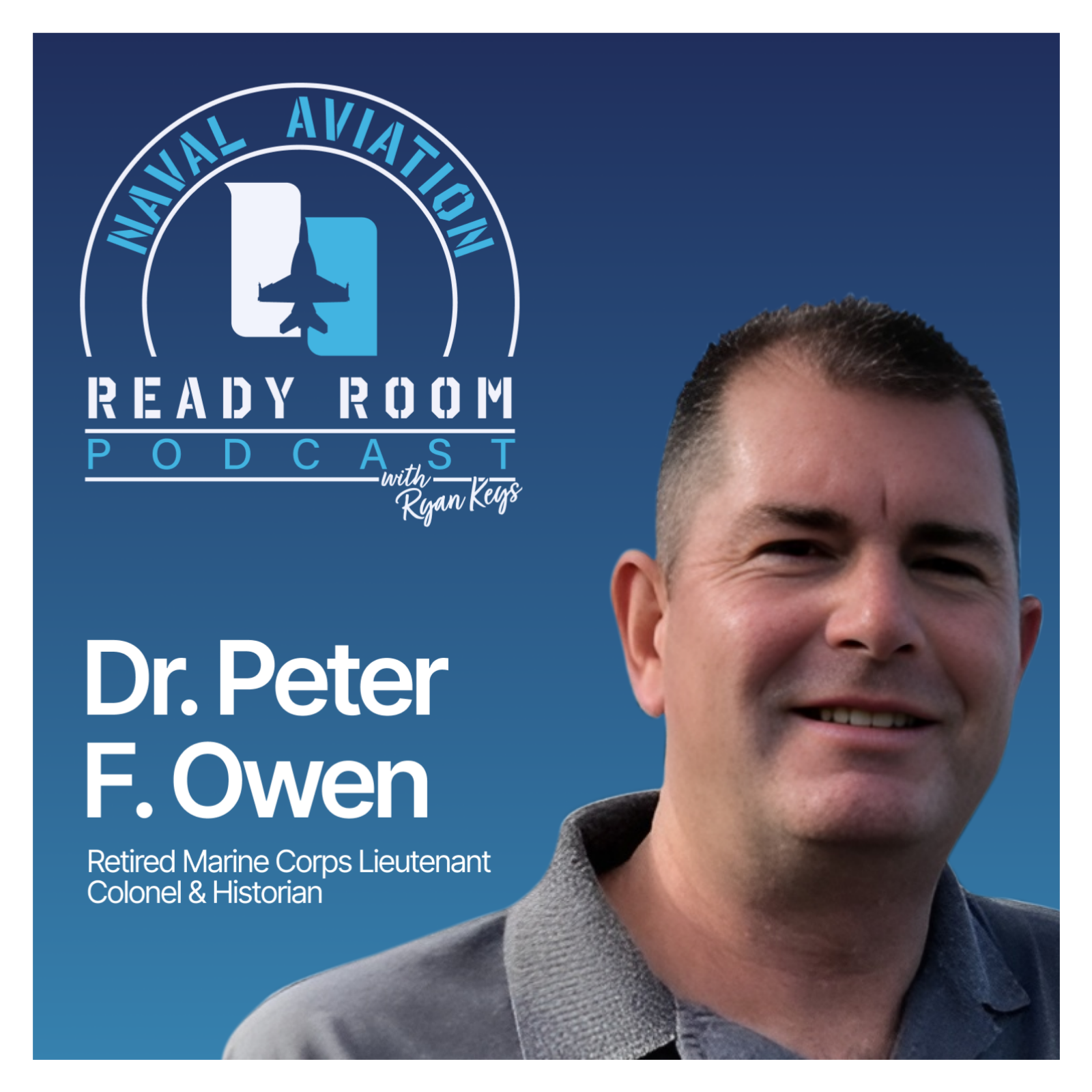
Military history often packages wartime campaigns into neat, linear victories, but what happens when the gear arrives on one beach, the tools land on another, and the unit is forced to operate out of primitive clearings in a malaria-infested jungle?In this episode of The Naval Aviation Ready Room Podcast, host Ryan Keys sits down with Dr. Peter F. Owen, a premier military historian, Marine Corps University adjunct professor, and decorated retired officer whose deep tactical background includes leading a reconnaissance platoon during Operation Provide Comfort and serving as Executive Officer of the 1st Marine Regiment during the 2003 invasion of Iraq. Dr. Owen uses the extraordinary trajectory of Marine Fighting Squadron 221 (VMF-221) as a pristine lens to analyze the rapid maturation of naval aviation throughout World War II.He breaks down how VMF-221 serves as the perfect historical through-line, spanning from their devastating defensive trials flying the outmatched Brewster Buffalo at the Battle of Midway, through a grueling year of continuous land-based deployment in the Solomons, to their ultimate evolution as carrier-based fighter components aboard the USS Bunker Hill in 1945. The conversation unearths the jarring realities of a broken wartime supply chain, the operational friction caused by massive personnel turnover, and the strategic doctrine of modern Expeditionary Advanced Base Operations (EABO) that makes 1943's logistical nightmares mandatory reading for 2026 tactical planners.What You’ll Learn:The Carrier Misconception: Why Marine aviation in World War II spent the vast majority of its time supporting the fleet at sea via land bases rather than operating purely as an infantry-support asset ashore.The Reality of the Jungle Supply Chain: Inside the brutal logistics chaos of the South Pacific, where mechanics, tools, and spare parts frequently landed on completely separate islands.Muster Roll Disruption: How a 50% personnel turnover rate during critical work-up phases completely changed the training baseline and combat capabilities of front-line units.Boom and Zoom Tactics: How severe time constraints forced commanders to skip complex gunnery training, teaching raw dive-bomber pilots simple altitude-and-aggression aerial tactics to defeat advanced Japanese fighters.The Industrial Capacity Warning: Why the rapid industrial scaling of 1942 cannot be easily replicated today, placing an immense premium on baseline readiness before a modern peer conflict begins If you enjoyed this episode, make sure to subscribe, rate, and review it on Apple Podcasts, Spotify, and YouTube Podcasts. Instructions on how to do so are here.
Embed this episode
NOW PLAYING
Marine Aviation in WWII: The Real Story of VMF-221
No transcript for this episode yet
Similar Episodes
No similar episodes found.
Similar Podcasts
No similar podcasts found.