
EPISODE · Apr 29, 2025 · 15 MIN
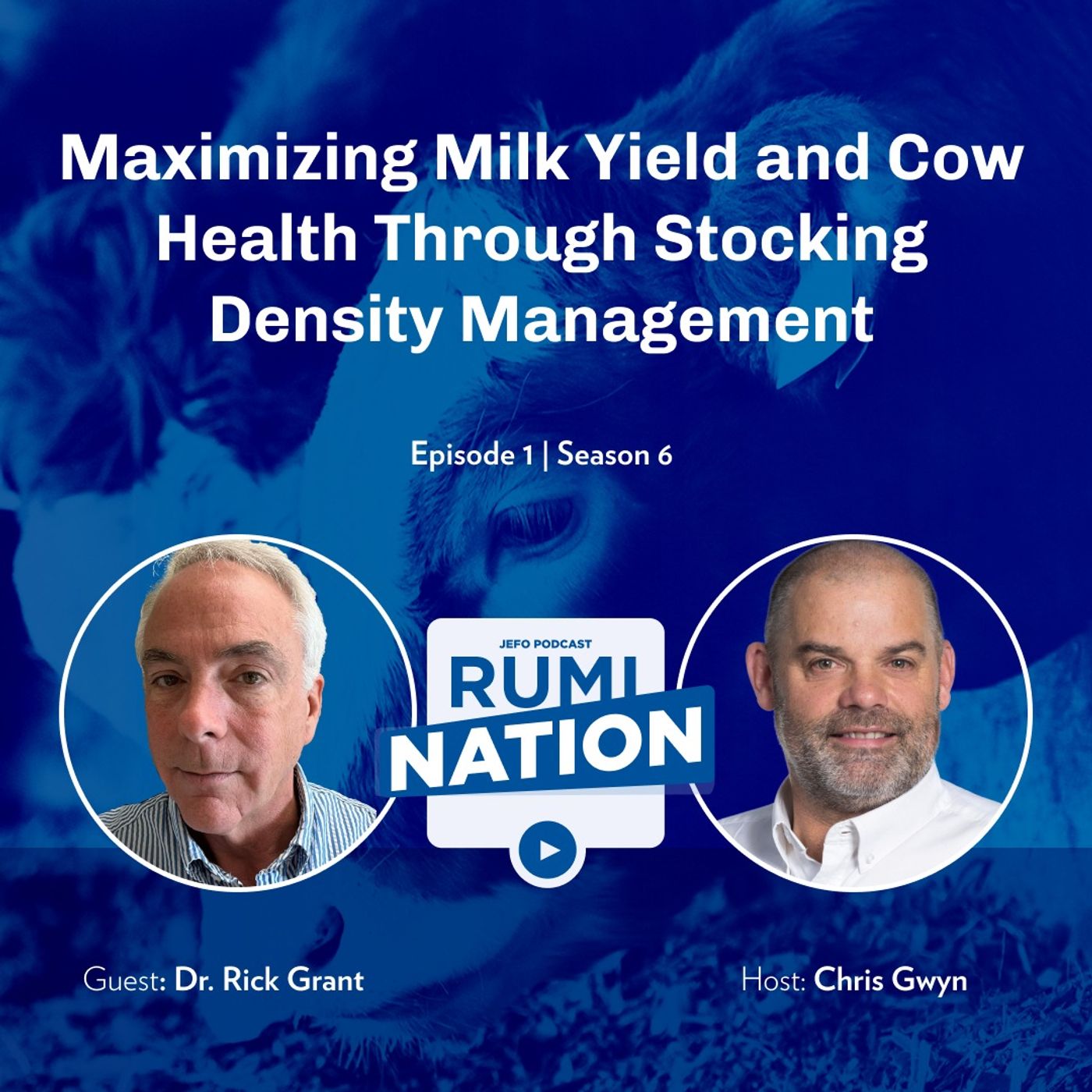
Maximizing Milk Yield and Cow Health Through Stocking Density Management
from RumiNation · host Jefo
Timestamps & Summary Chris Gwyn (03:02)What is important for producers and nutritionists to consider when optimizing stock and density in their dairies?Dr. Rick Grant (03:10)Well, that's the big question, isn't it?And there are at least two or three main factors that we can get into today. One would be just, I had an aha moment a few years ago when a grad student and I realized that we need to think about overcrowding as a subclinical stressor. That allows us to think about how the same level of stocking density of stalls or feed bunk doesn't affect every herd the same way because the point at which a subclinical stressor affects a cow within a herd really is a function of the quality of the management on that dairy as well as the quality of the facilities. […]The other thing, I would say is, we know this, but we don't think about it enough. When we say stocking density, we count stalls, we count cows, or we count headlocks, we count cows. But we need to always step back and think within a pen, what is the experienced stocking density from an individual cow's perspective? […] I think that's something we need to think more about in terms of managing a given stocking density on a specific farm, the cow's perspective. […]We did a study where we found that cows tend to prefer the stalls nearest the pen exit, particularly lame cows. And doesn't that make sense? If you're a lame cow and walking is a bit challenging for you, you may have 50 stalls to choose from, but you choose the ones that are closest to the exit or the entrance. That tells me right there that a simple mathematical calculation of stocking density would fail those moderately lame cows because they don't have 50 stalls available to them. They might only have 10 or 12 if you allow them to express their natural desired resting behavior. That's something we need to wrestle with in the industry. Chris Gwyn (07:13)What are some of the key metrics or cow observations that we should follow in order to ensure that what we use on the farm, as far as stocking density, helps us to maximize that component yield or profitability?Dr. Rick Grant (07:30)Well, certainly, the things that we normally measure, like milk yield, intake, repro health, all of those things can give us clues in terms of how well the cows in that pen are dealing with the day-over-day chronic subclinical stress of the overcrowding. […] But at some point, every herd will have a problem with additional stressors. And how many stressors are there on a typical farm? The list is long. You might say time outside the pen is too long. Are all the stalls comfortable? Is feed available 24/7? All these things are critical factors that can snowball or add to the negative consequences of some subclinical degree of overcrowding. […] Chris Gwyn (10:05)What are the essential factors in managing these cow pens if we're managing to a higher level of stocking density?Dr. Rick Grant (10:12)We did some work a number of years ago. We looked at almost 80 farms in New York and Vermont, and it was all breeds. Jersey and Holstein breeds, tie stalls, free stalls, and some robotic herds. The things that rose to the top in terms of essential factors […] is that they don't go as high in bunk stocking density. They just don't push the system as hard. That's simple to say, but that was the biggest factor. In fact, we looked at all the variations in terms of milk fat and protein across these 69 herds; 65 % of the variation in component output was due just to bunk stocking density, not necessarily nutrition. […] Chris Gwyn (12:58)What are the key takeaways that you would share with the audience: nutritionists, veterinarians, and primary producers? If they're going to manage through stocking density, what do they need to really pay attention to?Dr. Rick Grant (13:12)I think the best answer for that hit me a few years ago. I was reading this paper on robotic milking systems and automated milking systems. It was over 120 farms. […] What struck me is the factors on the farm that contributed to the best milk yield, and the best lameness outcomes were the exact same list of factors that we've seen with free stall barns and probably even tie stall barns to a certain extent. But it's feed push ups and deep-bedded sand in these 120 farms. Those two factors, feed availability, comfortable stalls, and deep-bedded sand, resulted in 4 to 5 pounds, at least more milk production on average. The other thing about lameness […] is the same as the free stall herds: greater bunk space, feeding frequency, and deep-bedded stalls. You sound like a broken record, but those factors rise to the top in every study that I'm aware of. […]At the end of the day, if you can get that done, you're going to have a good balance in your herd between eating time, and eating behavior, and you're going to have that recumbent rumination, that lying down rumination that we think is so critical to cow health and performance.
Embed this episode
What this episode covers
Dr. Grant highlights essential dairy management factors, including bunk space, deep-bedded stalls, and minimizing stressors to improve milk yield and cow well-being.
Ready to play
Maximizing Milk Yield and Cow Health Through Stocking Density Management
No transcript for this episode yet
Similar Episodes
No similar episodes found.