
EPISODE · Jan 15, 2026 · 1H 3M
Mediation testing with polynomial regression (Fu et al. 2026) | FT50 JoAP
from Revise and Resubmit - The Mayukh Show · host Mayukh Mukhopadhyay
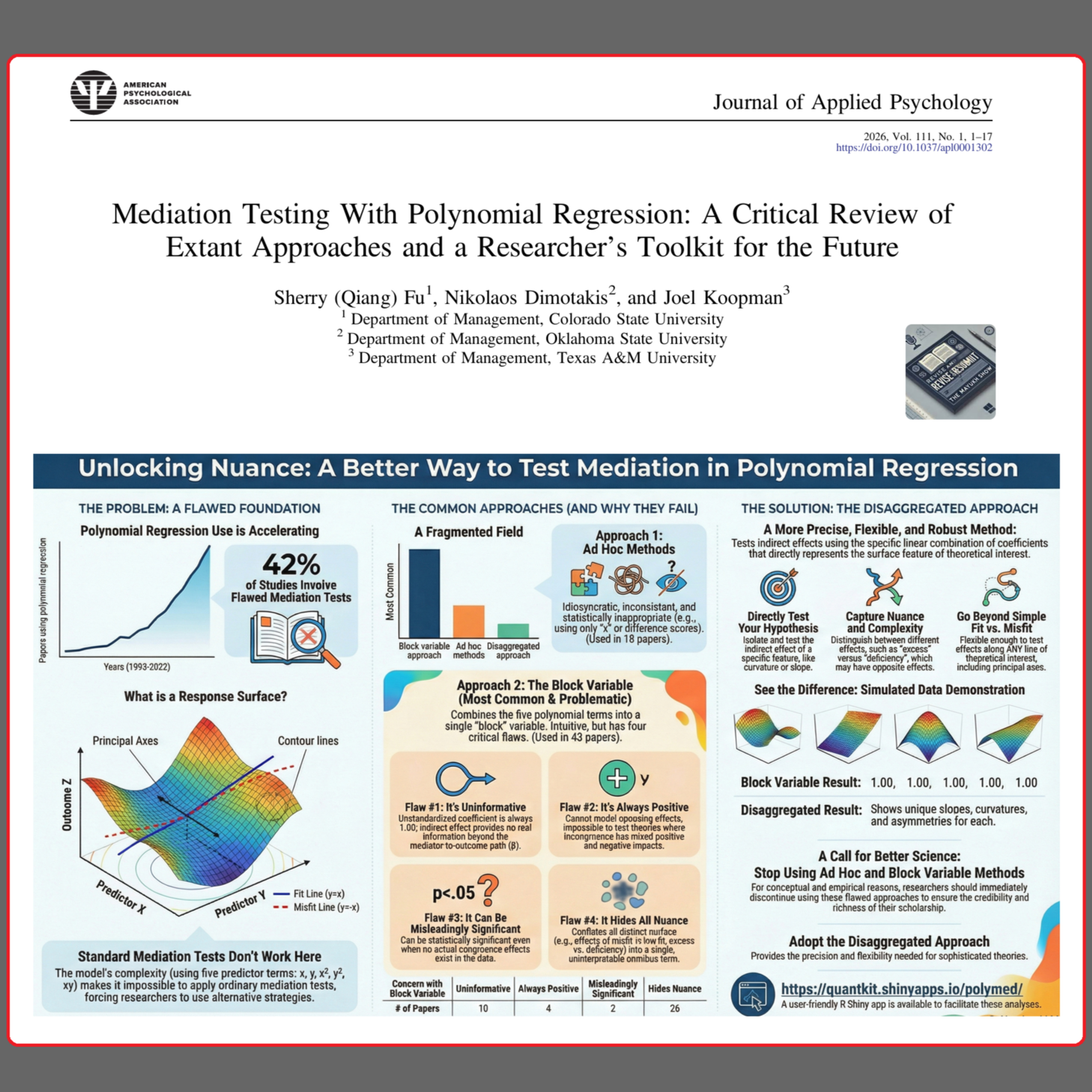
English Podcast starts at 00:00:00Bengali Podcast starts at 00:15:19Hindi Podcast starts at 00:33:13Danish Podcast starts at 00:47:59ReferenceFu, S. (Q.), Dimotakis, N., & Koopman, J. (2026). Mediation testing with polynomial regression: A critical review of extant approaches and a researcher’s toolkit for the future. Journal of Applied Psychology, 111(1), 1–17. https://doi.org/10.1037/apl0001302R Shiny app https://quantkit.shinyapps.io/polymed/Youtube Channelhttps://www.youtube.com/@weekendresearcherConnect over linkedinhttps://www.linkedin.com/in/mayukhpsm/You’re welcome to Revise and Resubmit 🎙️📚, the podcast where research stops being a PDF and starts being a conversation you can actually feel in your bones.Today’s episode begins the way a lot of academic revolutions begin: with excitement, a rush of new methods, and a quiet hope that the numbers will finally say what the theory has been trying to say all along ✨📈. A shiny technique appears, early adopters start publishing, and then something powerful happens. The method lands in a prestigious place, it gets blessed by visibility, and suddenly it becomes a kind of intellectual fashion. Not the frivolous kind, the consequential kind. The kind that shapes what counts as “rigor” for years.And the paper we’re diving into arrives straight from one of the most demanding stages in the field: the Journal of Applied Psychology, a proud member of the FT50 journal list 🏛️✅. Published online in January 2026, this research is titled: Mediation testing with polynomial regression: A critical review of extant approaches and a researcher’s toolkit for the future.The authors, Sherry (Qiang) Fu, Nikolaos Dimotakis, and Joel Koopman, are doing something that takes a rare kind of academic courage 🔍🧠. They are not just introducing a new trick. They are walking back into a crowded room where everyone thinks they already knows the dance, and saying: “Hold on. Some of these steps are off. Some of them can make you fall. And worse, some of them make you believe you’re gliding when you’re actually sliding.”At the heart of this paper is a problem that sounds technical, but feels human. Researchers want clean answers. Mediation, cause, mechanism, the story beneath the story. Polynomial regression enters like a Swiss Army knife, useful, flexible, seductive 🛠️🎯. But the authors argue that how we test mediation inside polynomial regression has often been built on habits, shortcuts, and templates that spread because they look publishable.They review three approaches: ad hoc, block variable, and disaggregated. And they do not just critique them from the balcony. They go down to the floor, run demonstrations, reanalyze a prior article, and show how certain popular choices can blur what matters or, worse, produce confident conclusions that should have been cautious ⚠️🔬.Then they offer something generous: a toolkit for the future, including a user-friendly R Shiny app you can actually use right now at https://quantkit.shinyapps.io/polymed/ 💻🧪. It’s the kind of contribution that says: here’s the critique, and here’s the road forward, and here’s a flashlight.Before we jump in, subscribe to Revise and Resubmit on Spotify 🎧 and follow the YouTube channel Weekend Researcher ▶️. You can also listen on Amazon Prime and Apple Podcast 🍏📺.So here’s the question that lingers like an unfinished sentence: when a method becomes popular because it looks elegant in top-tier journals, how do we know we’re inheriting a gold standard and not a beautifully packaged mistake 🤔🧩?And with sincere thanks to Sherry (Qiang) Fu, Nikolaos Dimotakis, and Joel Koopman, and to the American Psychological Association, the publisher of the Journal of Applied Psychology 🙏📖.
Embed this episode
Ready to play
Mediation testing with polynomial regression (Fu et al. 2026) | FT50 JoAP
No transcript for this episode yet
Similar Episodes
No similar episodes found.
Similar Podcasts
No similar podcasts found.