
EPISODE · Jan 9, 2026 · 16 MIN
MeerKAT’s Deep Gaze: Unveiling the Radio Ghosts of V4641 Sgr
from Multi-messenger astrophysics · host Astro-COLIBRI
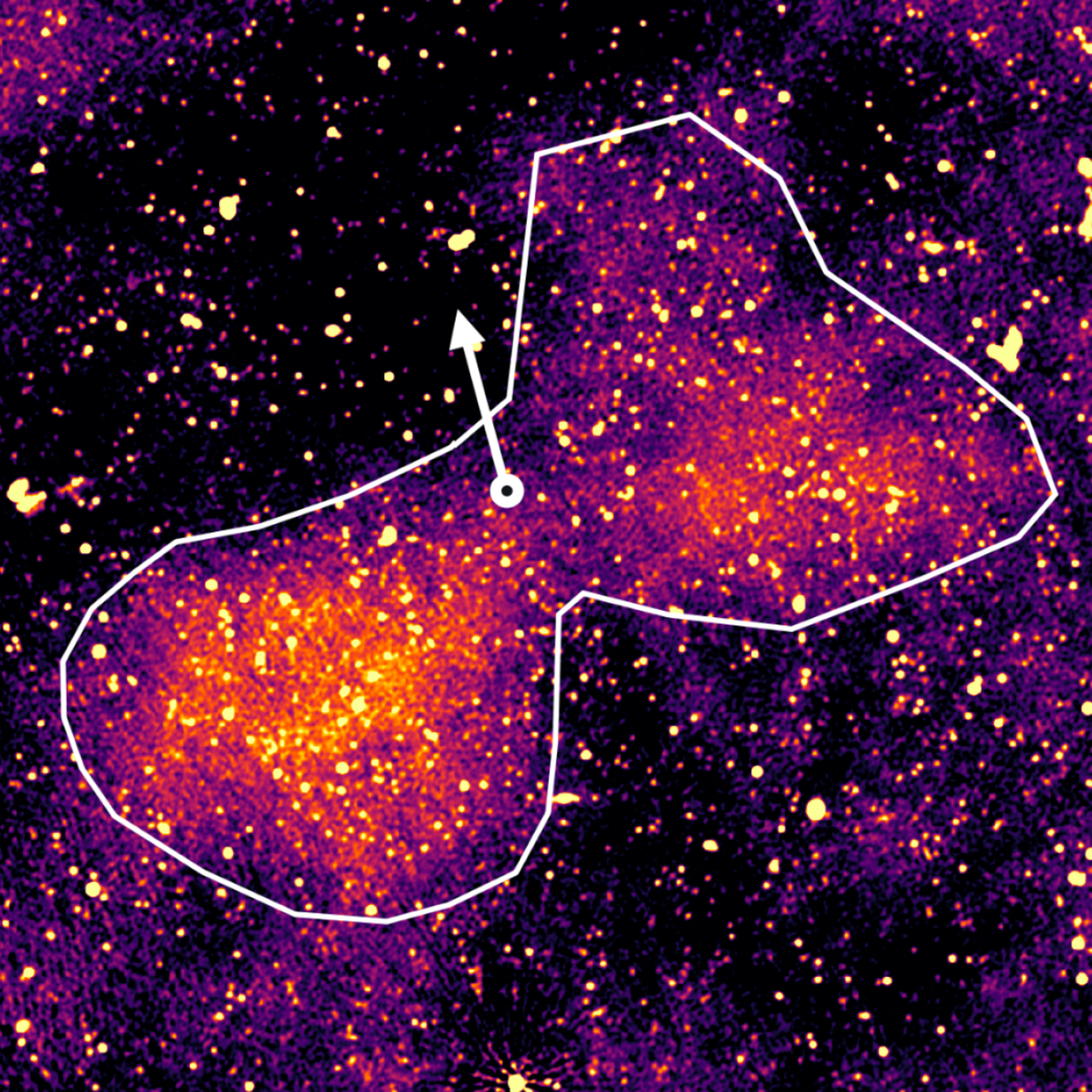
In this episode, we dive into a groundbreaking discovery made with the **MeerKAT radio telescope**: a massive, symmetric **"bow-tie" shaped radio structure** surrounding the black hole system **V4641 Sgr**. While this microquasar has been known since 1999 for its erratic outbursts and superluminal jets, this new research reveals the long-term impact these black holes have on their galactic neighborhoods, stretching across nearly **35 parsecs (about 114 light-years)** of space.**Key Topics Discussed:*** **The System:** V4641 Sgr is a low-mass X-ray binary (LMXB) featuring a **6.4 solar mass black hole** and a B-type stellar companion. It is famous for its "superluminal" jets that appear to move faster than the speed of light due to their orientation and velocity.* **The "Bow-Tie" Discovery:** Using deep imaging techniques, astronomers found a faint, diffuse radio structure that mirrors the size and position of extended X-ray emission recently detected by the XRISM satellite.* **Particle Acceleration:** The sources suggest the radio and X-ray emission are likely caused by **synchrotron radiation**. This implies that electrons are being accelerated to energies of **more than 100 TeV**—even tens of parsecs away from the central black hole.* **The Proper Motion Mystery:** Interestingly, the black hole is slightly offset from the center of the bow-tie. The researchers explain this through the **proper motion of the system**; by tracing the black hole's path backward, they estimate it was at the center of this structure roughly **10,000 years ago**.* **The Gamma-Ray Disconnect:** While large-scale gamma-ray "bubbles" have also been detected around this system, they are oriented differently and are much larger than the radio bow-tie. We explore why these different "colors" of light reveal different chapters of the black hole's history.**Why This Matters:**This discovery adds V4641 Sgr to a growing list of **"microquasars"**—stellar-mass black holes that act as smaller-scale analogs to the supermassive black holes found in the centers of galaxies. It reinforces the idea that these systems are significant contributors to **galactic cosmic rays** and powerful drivers of change in the interstellar medium.***### **Reference**Grollimund, N., Corbel, S., Fender, R., et al. (2026). **"Large-scale radio bubbles around the black hole transient V4641 Sgr."** *Astronomy & Astrophysics*, manuscript no. aa57124-25.Acknowledements: Podcast prepared with Google/NotebookLM. Illustration credits: N. Grollimund et al.
Embed this episode
Ready to play
MeerKAT’s Deep Gaze: Unveiling the Radio Ghosts of V4641 Sgr
No transcript for this episode yet
Similar Episodes
No similar episodes found.
Similar Podcasts
No similar podcasts found.