
EPISODE · Aug 31, 2026 · 20 MIN
Menarche, Menstruation and Menopause: Are We Mistaking Consequences for Physiology?
from Diabesity Decodified - Is Food the root cause of Type 2 Diabetes Mellitus pandemic?
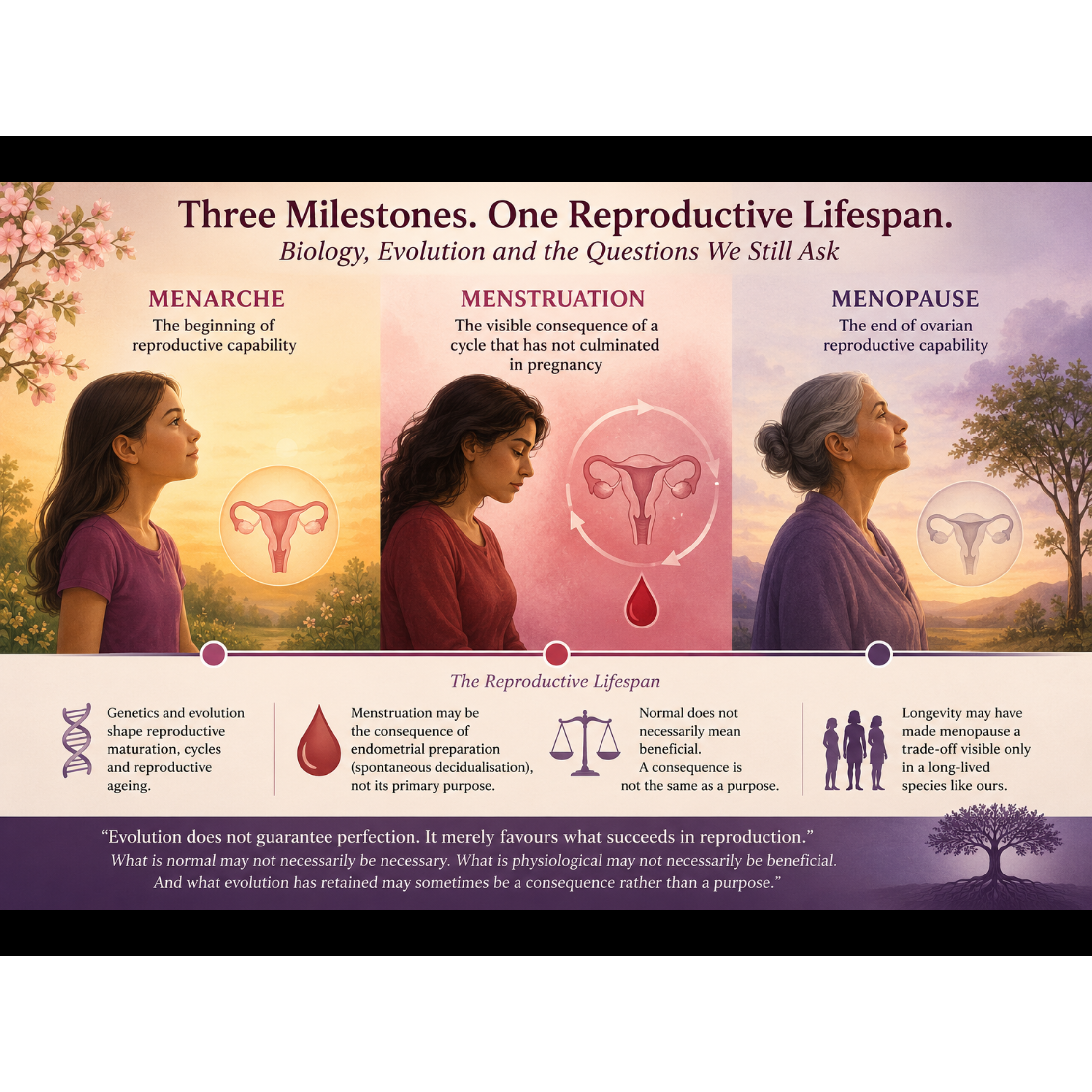
Menarche, Menstruation and Menopause: Are We Mistaking Consequences for Physiology?A woman’s reproductive life is marked by three remarkable events: menarche, menstruation and menopause. We accept them as normal and physiological. But what useful purpose does each event itself serve?Puberty establishes reproductive maturity, yet menarche occurs relatively late, after many physical and endocrine changes have already occurred. Could the first menstrual bleed therefore be regarded as a biomarker of reproductive maturation rather than an independent physiological objective?Menstruation raises a more intriguing question. The endometrium prepares for implantation. But if pregnancy does not occur, why must it be shed?Most mammals do not menstruate. One evolutionary hypothesis proposes that menstruation may not itself have been the trait favoured by natural selection. Spontaneous decidualisation—the preparation of the endometrium for pregnancy before an embryo arrives—may have been adaptive, with menstruation emerging as a consequence when pregnancy does not follow.If so, the reproductive process may be adaptive; the bleeding may simply be its consequence.Menstruation also carries costs. Normal menstrual blood loss represents recurring loss of blood and iron. Some women experience dysmenorrhoea, heavy bleeding, iron deficiency and anaemia, premenstrual symptoms, endometriosis or adenomyosis. These disorders cannot simply be attributed to menstruation, and menstruation is not a disease. Yet normal does not necessarily mean cost-free or beneficial.Our 2014 hypothesis asked whether menstruation should automatically be regarded as a physiological function, or might instead be a sign of failed reproductive function.Menopause presents another evolutionary puzzle. Why should ovarian reproductive capacity cease while a woman may remain alive and functional for decades?The grandmother hypothesis proposes benefits from survival after reproduction, but nature does not intend.Perhaps menopause is, at least partly, a consequence of the finite reproductive lifespan of the ovary—a limitation increasingly visible as human longevity expands. Genetic factors influence both menarche and menopause. Menopause might therefore represent a trade-off of reproductive ageing and longevity rather than a process designed for the woman’s benefit.Could genetic variation and evolution provide a common thread linking all three? Perhaps through the genetic architecture governing reproductive maturation, endometrial biology, ovarian reserve and reproductive ageing.Our hypothesis is cautious: these three events may represent different manifestations of the evolutionary architecture of human reproduction rather than three separate physiological objectives.Menarche may mark reproductive capability; menstruation, an unsuccessful cycle; menopause, the end of ovarian reproductive capability.Perhaps we have been confusing normality with necessity and consequence with purpose.Three events. One reproductive lifespan.Evolution does not guarantee perfection; it favours reproductive success.What is normal may not necessarily be necessary. What is physiological may not necessarily be beneficial. And what evolution has retained may sometimes be a consequence rather than a purpose.Read the full article on Medium:Read the full article
Embed this episode
Ready to play
Menarche, Menstruation and Menopause: Are We Mistaking Consequences for Physiology?
No transcript for this episode yet
Similar Episodes
No similar episodes found.
Similar Podcasts
No similar podcasts found.