
EPISODE · Dec 1, 2025
Mending Broken Hearts
from WPI News · host Lisa Eckelbecker
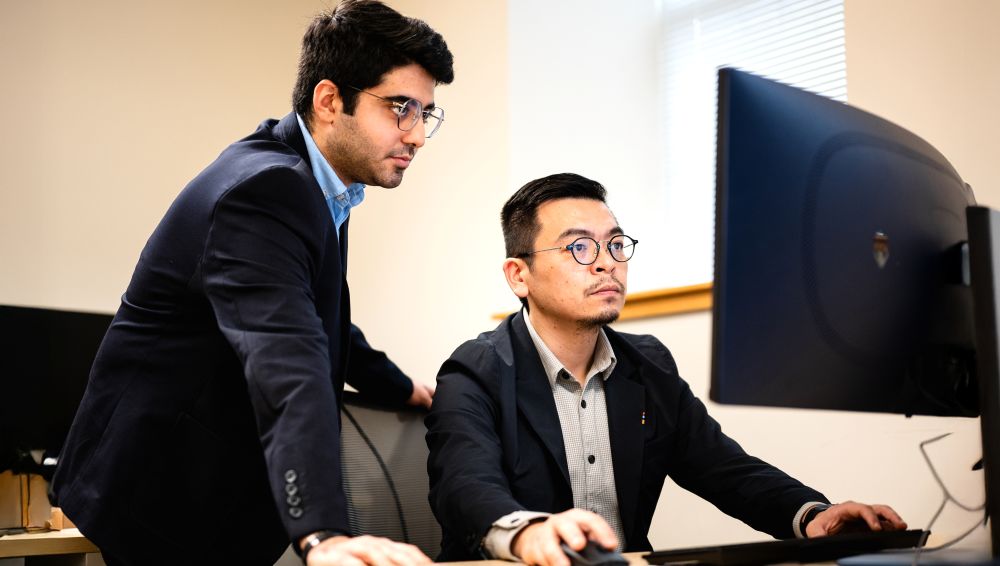
Among the many things that can make the heart pound—a new love, a scary movie, a vigorous workout—an irregular heartbeat known as ventricular tachycardia is particularly dangerous. Errant electrical signals make the heart race, sometimes too fast to pump blood. Patients may faint, and prolonged arrhythmias can even cause death. All too often, ablation procedures that aim to scar small sections of heart tissue contributing to the arrhythmia simply fail to work. WPI researcher Shijie Zhou is working to change that by using large sets of data from noninvasive clinical tests, computational methods, and artificial intelligence to reconstruct cardiac events such as arrhythmias in digital models. His goal is to make ablation procedures safer and more accurate. With funding from the American Heart Association and the National Institutes of Health, Zhou is developing technologies that can precisely map electrical circuits in the heart, pinpoint problem spots, and identify the best sites for treatment. “It is very challenging to treat ventricular tachycardia,” says Zhou, an assistant professor in the Department of Biomedical Engineering. “After ablation, ventricular tachycardia recurs about 30% to 70% of the time. However, with algorithms and data gathered from many patients, we can build tools that will enable clinicians to work toward better outcomes for patients.” Ventricular tachycardia originates in the lower chambers, or ventricles, of the heart and is often caused by heart disease. Treatments include drugs such as beta-blockers, implanted pacemakers, catheter ablation, and radiation. A minimally invasive procedure, catheter ablation involves inserting a long flexible tube into a blood vessel, guiding a probe to a specific spot in the heart, and then using radiofrequency energy or extreme cold to scar the tissue and block irregular signals. Zhou, who joined the WPI faculty in 2024, was a master’s student in computer engineering when a business executive encouraged him to develop a smartphone app for people with arrhythmias. As he learned about the challenges involved in treating ventricular tachycardia, Zhou pivoted into a PhD and biomedical engineering program at Dalhousie University in Canada that included two years of medical school courses. “My background includes both medical and engineering training, and my goal is to advance research from the laboratory to the clinic within a few years,” Zhou says. “Translational research is fascinating to conduct, but it’s also important for patients.” Now Zhou’s research builds on information collected about the heart through noninvasive methods, including sensors placed on the body to record electrical signals and computer tomography that stitches together two-dimensional scans to create three-dimensional images. Zhou received a Career Development Award from the AHA in March 2025 to develop software that uses scans and data to build a 3D computer model, or “digital twin,” of a patient’s heart. The three-year $231,000 project aims to build a system that can spot the exact location where an arrhythmia starts. Zhou and a collaborator will test the software in a pilot study at Brigham and Women’s Hospital in Boston. The AHA awarded Zhou a separate two-year $199,999 grant in June 2025 to develop an AI tool that automatically analyzes raw electrocardiogram signals. ECGs use electrodes placed on the skin to measure the electrical activity of the heart. Zhou’s project will develop a tool that can objectively and precisely predict optimal sites in a patient’s heart for ablation, potentially making procedures shorter and more accurate. More recently, the NIH awarded a $232,500 grant to Zhou in September 2025 for a two-year project to create a technology that will identify targets for cardiac stereotactic body radiotherapy. Also known as cSBRT, the noninvasive procedure uses highly focused beams of radiation to ablate abnormal tissue in the heart. Zhou will use a large clinical dataset, with personal details removed and accurate information from catheter ablations, to validate a noninvasive functional and structural localization approach to identifying targets for radiation. In his laboratory, Zhou projects colorful digital images of hearts on his computer screen, complete with depictions of muscle fiber and the electrical points where irregular signals are firing. The technology builds on work he launched during his PhD training at Dalhousie University, a clinical cardiac electrophysiology research fellowship with the Nova Scotia Health Authority, and postdoctoral training at Johns Hopkins University, where he developed and patented several related inventions. “Some arrhythmia patients undergo ablation more than once because the procedure so often fails,” Zhou says. “At a certain point, patients can no longer receive ablation. It is important to improve this procedure and get real solutions into the hands of doctors.”
Embed this episode
NOW PLAYING
Mending Broken Hearts
No transcript for this episode yet
Similar Episodes
No similar episodes found.
Similar Podcasts
No similar podcasts found.