
EPISODE · Feb 3, 2026 · 1H 15M
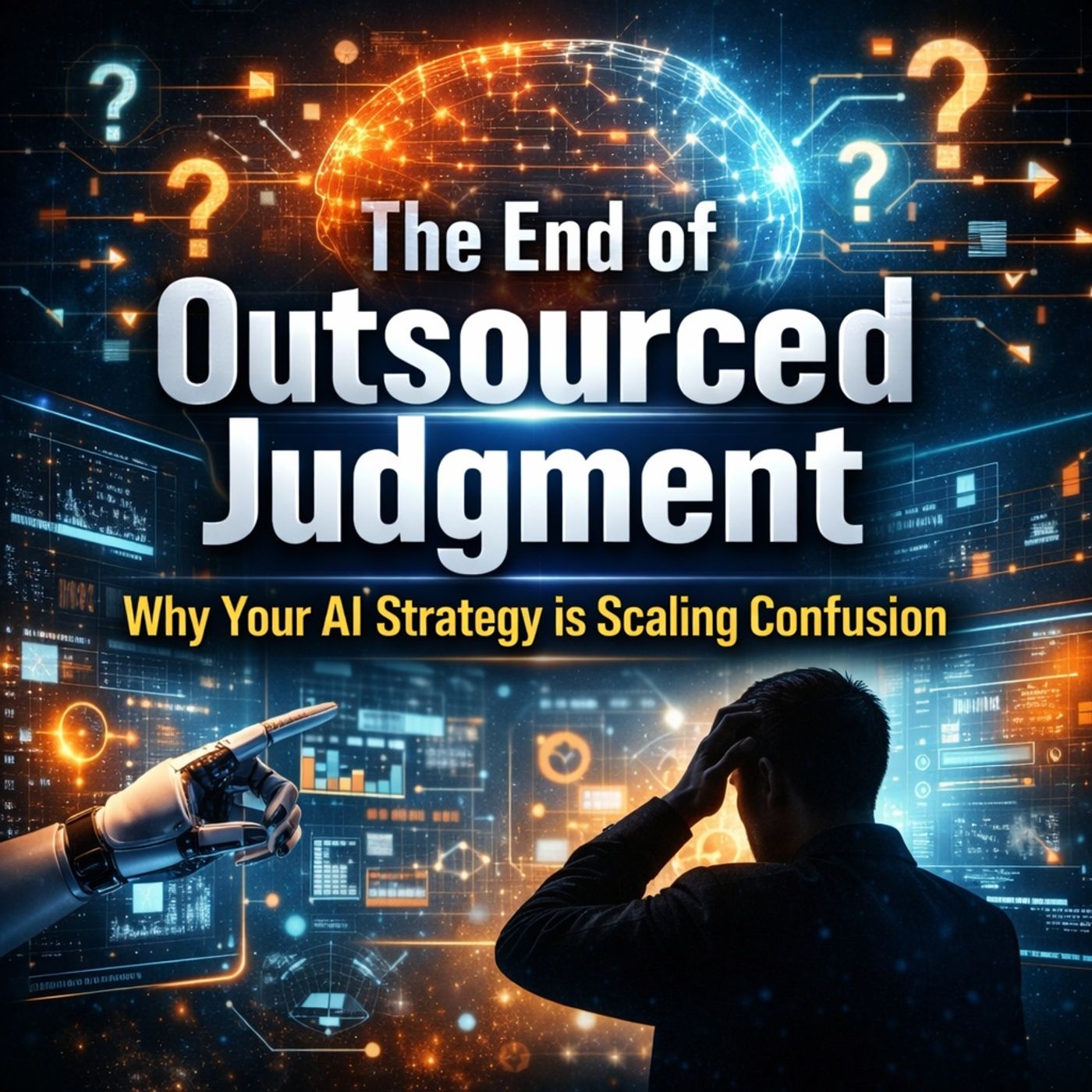
Microsoft 365 & AI Strategy: Why Outsourcing Judgment to Copilot Is Scaling Confusion — Not Intelligence
from M365.FM - Modern work, security, and productivity with Microsoft 365 · host Mirko Peters - Founder of m365.fm, m365.show and m365con.net
One of the most dangerous trends in enterprise AI adoption is the quiet outsourcing of judgment. Organizations deploying Microsoft Copilot and AI agents across Microsoft 365 are discovering something uncomfortable: when humans stop making decisions and start delegating them to AI, the result is not clarity — it is confusion at scale. AI amplifies whatever it is given. If the inputs are ambiguous, the governance is unclear, and the decision frameworks are absent, AI does not resolve those problems. It multiplies them.In this episode of M365.FM, Mirko Peters examines why so many Microsoft 365 AI strategies are producing the opposite of their intended outcomes — and why the root cause is the abdication of human judgment in the design of AI systems. From Microsoft Copilot deployments where no one owns the outputs, to AI-driven workflows in Power Automate and Copilot Studio where accountability has been engineered out of the process, Mirko breaks down the structural reasons why outsourced judgment fails at enterprise scale.This episode is essential listening for any leader, architect, or IT professional who is responsible for shaping how AI decisions get made inside a Microsoft 365 environment — and who wants to build systems where intelligence is genuinely amplified, not just automated.WHAT YOU WILL LEARNWhy delegating decisions to Microsoft Copilot without governance creates confusion at scaleHow the absence of human judgment in AI workflows undermines Microsoft 365 ROIWhat "outsourced judgment" looks like in Copilot Studio, Power Automate, and TeamsHow to design decision accountability into AI-driven Microsoft 365 architecturesWhy AI strategy in Microsoft 365 must start with clarity of intent, not deployment of toolsHow to build governance frameworks that keep human judgment at the center of AI systemsWhat high-performing Microsoft 365 AI strategies have in common — and how they differ from failing onesTHE CORE INSIGHTMicrosoft Copilot is not a decision-maker. It is a decision-support system. But in many organizations, the distinction has collapsed. When Copilot drafts an email, summarizes a meeting, or generates a project plan, the output is often accepted without review — not because humans trust it, but because they are too busy, too overwhelmed, or too uncertain about what good looks like. That is not AI augmentation. That is judgment outsourcing — and it is one of the most significant hidden risks in the modern Microsoft enterprise.Mirko argues that the antidote is not fewer AI tools — it is better architecture. Organizations need to design their Microsoft 365 environments so that AI outputs are always tied to human accountability, where every Copilot-generated result has an owner, a review point, and a feedback loop. Without that structure, AI strategy in Microsoft 365 becomes a mechanism for scaling ambiguity rather than resolving it.WHY AI STRATEGY SCALES CONFUSION INSTEAD OF INTELLIGENCEAI tools are deployed before decision ownership and accountability frameworks existMicrosoft Copilot outputs are accepted without review because review processes were never designedGovernance of AI-generated content in Microsoft 365 is treated as a compliance issue, not a design issueLeaders assume AI will clarify strategy when strategy was never clearly defined to begin withPower Automate and Copilot Studio workflows remove human checkpoints in the name of efficiencyThere is no feedback loop between AI outputs and the humans responsible for outcomesOrganizations measure AI adoption by usage volume, not by decision quality or business outcomesKEY TAKEAWAYSAI amplifies inputs — if your strategy is confused, Copilot will scale that confusionHuman judgment cannot be outsourced; it must be designed into AI architecturesMicrosoft 365 AI governance requires explicit ownership of every AI-generated outputDecision accountability must be built into every Copilot Studio and Power Automate workflowThe measure of AI strategy success is not adoption rate — it is the quality of decisions madeHigh-performing Microsoft 365 AI environments keep humans responsible, even when AI does the workWHO THIS EPISODE IS FORMicrosoft 365 architects designing AI governance and decision frameworksIT leaders responsible for Copilot and AI strategy in enterprise environmentsCIOs and digital transformation leaders evaluating AI-driven workflow outcomesCopilot Studio and Power Automate developers building enterprise AI workflowsCompliance and risk officers managing AI accountability in Microsoft 365Microsoft partners and consultants advising on responsible AI deploymentTOPICS COVEREDMicrosoft 365 AI strategy and decision accountabilityMicrosoft Copilot governance and output ownershipOutsourced judgment and AI risk in the Microsoft ecosystemCopilot Studio and Power Automate workflow accountabilityAI governance frameworks for Microsoft 365 enterprisesHuman judgment in AI-augmented decision-makingMicrosoft 365 ROI and AI strategy measurementResponsible AI architecture in the Microsoft ecosystemABOUT THE HOSTMirko Peters is a Microsoft 365 architect, strategist, and the host of M365.FM — a podcast dedicated to modern work, security, and productivity in the Microsoft ecosystem. With experience spanning small businesses to large enterprises, Mirko focuses on Microsoft 365 architecture, AI integration, governance, security, and the design of scalable, context-driven systems. M365.FM is the go-to resource for IT leaders, architects, and decision-makers navigating the Microsoft platform at scale.Become a supporter of this podcast: https://www.spreaker.com/podcast/m365-fm-modern-work-security-and-productivity-with-microsoft-365--6704921/support.
Embed this episode
NOW PLAYING
Microsoft 365 & AI Strategy: Why Outsourcing Judgment to Copilot Is Scaling Confusion — Not Intelligence
No transcript for this episode yet
Similar Episodes
No similar episodes found.
Similar Podcasts
No similar podcasts found.