What do you see as the future of mobility work? Our goal is to create the future of mobility. It's not always just for athletic performance. It's grandma that wants to be able to pick up her grandkids at 65. It's the mom that wants to make sure she can run the stroller around the block. The concept of movement is intrinsic to just being human. What we look to do is enable that.
Welcome back, or welcome to the Finding Mastery podcast. I am your host, Dr. Michael Gervais, by trade and training a high-performance psychologist. No matter how you move your body, movement is an essential part of being human, and being able to move well for as long as possible, I believe, is a staple of living the good life. And that's why I'm excited to introduce a guest today who is committed to helping people do just that, Scott Perkins.
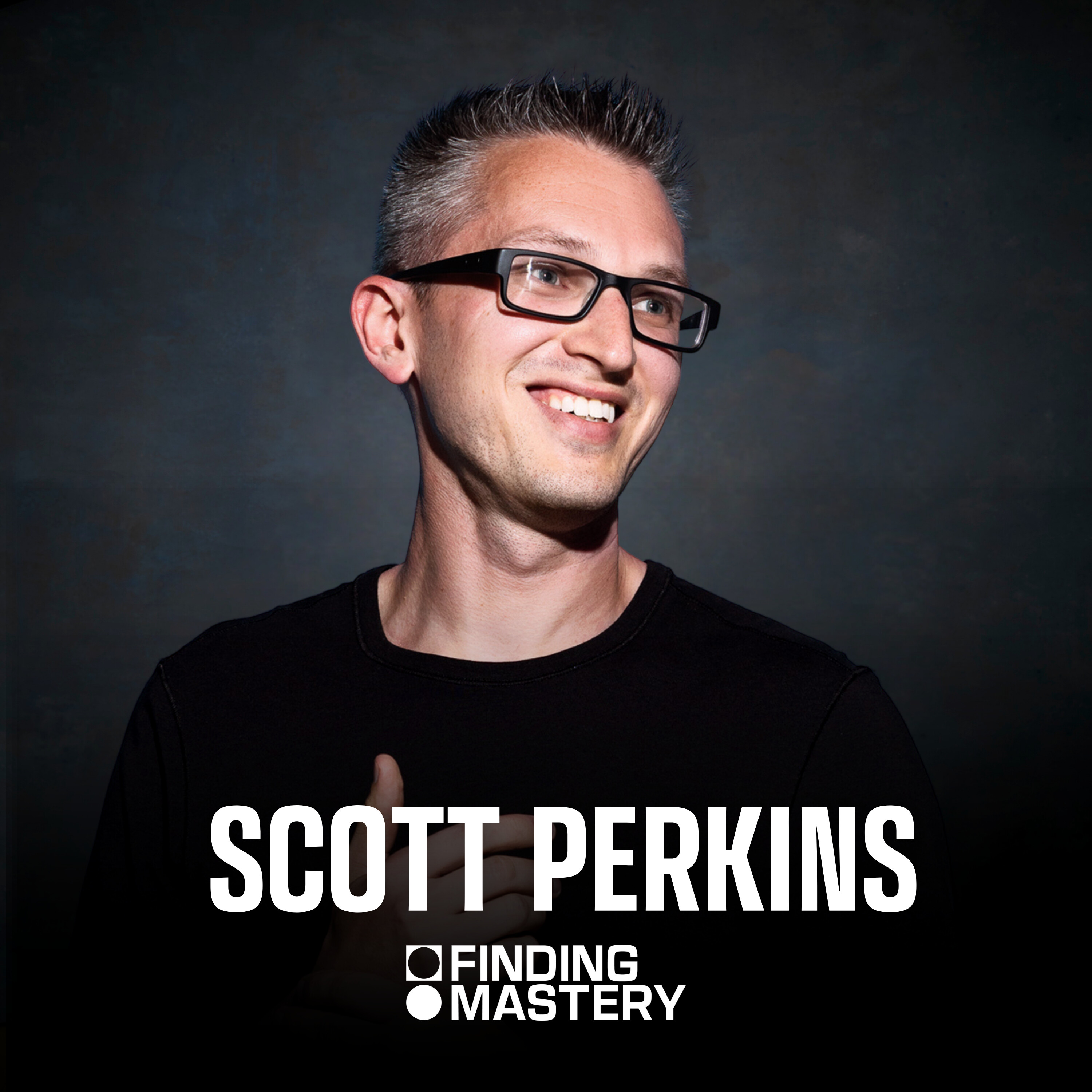
Scott is the founder and CEO of Pliability, a company that is helping people move better through their yin yoga-inspired mobility training. You'll hear in this conversation how much time I spend daily on mobility training. That's one of the reasons I wanted to have a conversation with Scott. The deeper reason I wanted to have this conversation is because he's one of those folks who look for a solution out in the world. He didn't find it. He didn't find one that he thought was ideal, at least. And then he went ahead and built it. And it makes perfect sense why he took that step. His path is different. He's got a different approach to life. At age 12, he was taking college classes to start his first business at age 18 and acquiring Pliability, the company we're going to talk about, by the age of 25.
However, for the first six years at its helm, Scott was 60 pounds overweight and sacrificing his health for what he thought was success. That's when he made a change. In this conversation, you'll hear from a person who was grinding, who was getting after it, not recovering, who was burnt out and overwhelmed. he found a better way. And now he's on a mission to share it with others. I love what Scott and the team at Pliability are building. And I can't wait for you to hear the story of a founder whose windy path eventually led him to working from a place of meaning and purpose. So with that, let's jump right into this week's conversation with Scott Perkins. Scott, welcome to the Mastery Lab. Thanks for having me. I'm so stoked you're here. Like what you're doing.
It's really amazing. Like it's so well timed. And before we get into the mechanics of it, let me just start properly. Like, how are you? I'm doing well. Doing well. It was a good trip out. Glad to be here in L.A. Yeah. And when you say you're doing well, what does that mean for you? Just overall. I mean, life is great. Business is on a good trajectory. Life's on a good trajectory. Feeling really settled when I'm at New York. Just finally feel like this year is coming together. There was an exhale when you said that. Yeah, for sure. So you've been grinding for a long time. Yeah, definitely. And it feels like some pieces have dropped in a place where the momentum feels a little bit more seamless. Absolutely. I think.
And my business lessons is just really trusting a team and growing a team. And we spent, you know, years running so lean that there's a lot of my shoulders and I had, you know, trouble letting go. And then when I finally learned to let go a little bit, life got incrementally easier and easier and just more fulfilling and started enjoying what I was doing more. And, you know, all that's really coming together this year. You say that to a performance psychologist and you know that I'm going to pull on that thread. OK, so let's get to that in due time. But as I say that, what happens for you in this moment? What happens for you when I say, oh, control? OK, we're going to come back to that. Do you go, oh, good. Or do you go?
oh no not scared of it all i think i've i've i've been on the road so many different ways that you know i enjoy exploring that because for me it was a big learning experience okay that's cool so part of your framework is to explore of course not to defend and protect not usually um probably usually probably early on i definitely took more that you know kind of defensive model you know protect the home front really kind of build kind of stable system but now i'm much more open to just you know really evolving through learning everything is about just figuring out how it happens, why it happens, and continuously adapting around it. Okay. And so when you were in a defensive posture for some part of your life, was that an aggressive posture or was it a kind of back of your heel posture?
I think it probably started as an aggressive posture. I think, you know, when I started out in business, I was very young and there, you constantly felt like you had to prove something. You weren't taken seriously in a lot of ways. Oh boy, here we go. I love where you're taking this. Okay, good. There was, you know, it took a lot of very, you know, a lot of forward pressure, a lot of resilience to, you know, basically be told no nine out of 10 times just because you don't have the experience or, you know, you're not good enough or they don't, you know, age is just a factor. But because you were young, a lot of it was because I was young when I started.
Then I was lucky enough to be able to parlay that into a strength. So I had some mentors and some early clients effectively give me that shot. And these clients, based on their reputation, were able to help me build mine. Isn't that amazing? It really taught me the meaning of mentorship or the meaning of just investing in someone else. And something I've really carried forward to our team and what I do today is like.
Initiative is everything. What is it their initiative? Yeah. So like in this case, it was my initiative being recognized by a potential client and then willing to support me in that. Now I see it kind of as a mission when someone is showing initiative, whether it's on the team or whether it's, you know, in life or, you know, as long as they're willing to put the effort into it, you can.
build skill. You can learn anything, but like that drive to get it done is kind of the core premise of moving the needle. All right. So let's maybe go back up a couple levels and talk about what you're building. How do you describe what it is that you are building, like the fullness of your business? Supplyability. I mean, we we describe it as the human movement brand, which is very broad, but it's intrinsic to what we do as humans. So coming into the health and wellness space, you know, I looked around and you have a lot of fitness apps. You have a lot of devices. You have a lot of workout tools. You have all these things. But at the core of all of it, you have to be able to move as a human.
You have to be able to pick things up. You have to be able to bend down. You have to actually be able to move your body and move it well. And something that's really instilled in me is it's not always just for athletic performance. It's grandma that wants to be able to pick up her grandkids at 65. It's the mom that wants to make sure she can run the stroller around the block. You know, the concept of movement is intrinsic to just being human. And what we look to do is enable that.
In my commitment to fitness and overall health, early days was like strength and a little bit of speed, agility, quickness stuff. And then as I've gotten older, strength is still a base for me to invest in as like a first mover. I'm spending, I don't know, let's say I'm going to work out for an hour. I'm spending, it feels like 35 minutes on mobility, like working, like getting my body into a place that's ready. It's amazing. And then a bunch of that work is mobility. So when I saw what you were doing, I was like, I love it. Like, I really love what you're doing. I want to introduce it to folks.
The reason it was so important to me is because I had strength there, but I couldn't access it because of my mobility, because I'm sitting more than I ever have. Of course, we all are. Yeah. And so can you talk about why this was important for you to build this business? Because it feels like you're well-timed. So what was going on in your life? And I don't know where you're going to take this, but why? I mean, I can't take full credit. This was a business that I invested in and ended up acquiring. I originally was a tech guy, built websites.
you know, apps and just various things on the tech side. How old were you at that time? I started at, I was installing like Wi-Fi systems at 15, started my first business at 18. So you were installing Wi-Fi systems? Is that what you said? Yeah. So this was when it's hard to remember a time when you couldn't set up Wi-Fi yourself. The Wi-Fi actually used to be kind of a complex install, you know, very early on and started my first business at 18. That was building websites for cake shops and lawyers and like single page web one type of stuff. Simple stuff.
So that is a small shop of you and like three people, just you literally just me. Yeah, I was just me for the first year and a half. And then I partnered with one of my competitors. Actually, we merged, created a digital agency. A digital agency grew service clients in about 19 states. How do you know how to do that deal? Actually, pretty funny story. So my partner in that business, I was always more talented with the business side of things, the sales. I can make things look good. I could go to a chamber of commerce and do like a really cool presentation. Right. There was this guy that.
design work was absolutely beautiful. Like his, his eye for detail was phenomenal. And then he was able to back it with obviously a coding, a genius in coding. So I, there's a couple of contracts that I lost to him and I was kind of like, all right, what's going on here? So I email him and I'm just like, Hey, can we meet at Starbucks? Literally just come meet at Starbucks. Let's chat.
Little did I know that he shows up. He's three years younger than me at the time. So I was 21. He was 18. Show up at Starbucks and we start going over things and we just kind of hit off as a yin and yang scenario. And like, you take care of the business. I'll make sure things are coded well and designed well. And within an eight day period, we had signed the LLC papers for the new agency. OK, so this like fell into place very much. It was organic. Both had nothing to lose. 50-50? 50-50. Tough deal. Tough deal to run. Like, you know, would you would you do a 50-50 deal again? I have and have learned my lessons. Yeah, it's a tough one. It's it's certainly, you know, I think. Can you tell a story why?
Like that was tough. Can you give an example? So in the case of in the case of the digital agency business, I mean, it actually worked out wonderful business. Yeah, first business. Daniel, I had a great relationship. We built this agency. I think he had a personality that just, you know, meshed with mine and it worked up to a point. He ended up outgrowing the business and moved on. But then what happened there?
So he, the estimated version of the story is he's a Bitcoin multimillionaire. Daniel was buying Bitcoin. Oh, fun. He tried to get me to buy Bitcoin, you know, when it was, you know, $800, $900, you know, and. Uh-oh. Uh-oh. Yeah. Okay. So he was on it. I didn't take him up on it. I'm going a different direction. And when I, when I said like what happened there, how did you transfer the shares? How did, was it, did he just walk away and like. Effectively, I was a buyout. A buyout. You bought him out. Correct. Relationships power the whole thing. Of course. Your relationship with yourself, your relationships with others, it powers just about everything.
I don't know how to think outside of that framing, even your relationship with experience. Absolutely. So, all right, we're going to get to relationships with your body in a minute through what you're doing. But then, so let's follow this forward. So first business was great until it wasn't. Second business was. There's been various, but the general trajectory was the digital agency acquired Ramwad or what was. So that digital agency that you transformed. Okay. And Ramwad was a client. Yes. Ramwad is a client of the agency. We had built the original partners of Ramwad. We had built another yoga business as a digital agency.
So they came to us to build Ramwad, which is the precursor to the pliability today. Okay. So they were your client and you said, oh, we could scale this. And so is pliability still with that same structure with the original founders of, say it again, Moad? Ramwad. Oh, I know. It's a tough name that we've, there's a reason why we rebranded. Yeah. What did Ramwad? I read it at some point. What did it stand for? Range of motion, workout of the day. Longest acronym.
wrong longest acronym. There's something very explicit when you say it out like, oh, I know what I'm getting. I'm getting a pliability. I'm getting a mobility exercise daily. Okay. In the CrossFit space that we operated in, it made sense to that world. Yeah. Crossfitters use acronyms for everything. Oh, they do. Range of motion, workout of the day. Right. AMRAP is as many rounds as possible. There's all sorts of acronyms in the CrossFit world. So for that group of people, the name worked. Do you know how to tell if someone is a CrossFitter?
I mean, in my mind, I could think of 50 different ways, but I'm curious to what yours is. They'll just tell you. Yeah, there's one of them for sure. That's a bad joke. Their traps are either up to their ears and you can tell when they walk in. Mine is always, there's like a CrossFit uniform. There's shoes, there's shorts, there's shirts, very tight shorts. I can always tell in a training setting who has done CrossFit in the past or is a CrossFit. If I go into an Equinox or wherever, I can normally pick out the CrossFitter. And then if you look at their phone, it's like in their...
fast five friends or whatever that first page is, there's usually a Cairo or a PT. Yes. There's a lot of like rehab stuff going on. As I personally learned, that's what CrossFit will do. Yeah. So you don't look like a CrossFitter and that doesn't mean you're not. But, you know, so is that your training methodology, CrossFit? It's very hybrid nowadays. So, you know, working in the CrossFit space, you kind of get adopted into that methodology. For years, I unfortunately ignored my health and wellness. Prior to four years, four and a half years ago, I was 65 pounds heavier, 60 pounds heavier. On your frame? Yep. 60 pounds? Yeah, I got up to about 208, 209. How tall are you?
Bye, Lovin'. So how'd you do that? No, I was just, it was just terribly taking care of myself. Oh, so this was not muscle. No. Oh no. This was, this was not 60 pounds of fitness. No, this was 60 pounds of pure unfitness. So it was, yeah, I was, I was not in great shape. Uh, morbidly obese. Yeah. 20, 2018, 2019. Um, I hit, Oh my, hold on. I get the timeline. When did you buy, when did you become managing director of the company? 2015, 2015. You were out of shape. Okay. And so you're grinding, you're building the business and you're getting more unhealthy. Yeah. I just, I wasn't paying attention to the health and wellness. And I think there was almost a,
not a resistance to it, but almost like an embarrassment about it. Like being an owner of a fitness company that was unfit, there was a constant push and pull to like how to resolve this and where to put my time and where to put my effort. And ultimately 2018, 2019, I hit, you know, complete adrenal fatigue, resting heart rate was out of control, just, you know, complete almost shutdown periods where it was difficult to manage. So was it, was it, okay, does obesity around your family? It does. My dad was diabetic, different things going on. But I mean, this was purely just, I would wake up in the morning, drink as many coffees as I could during the day, didn't eat, and then I would eat 4,000 calories at night.
And it was I literally crashed so hard from that meal that I would wake up at 2 a.m. Be like, where am I? Oh, yeah, it was. It was just a gnarly cycle of not taking care of myself. Yeah. OK. And where's that come from? Like, why? Why not value you? I think I just I didn't have the the understanding of nutrition and health and wellness for my family. I don't buy it. I don't buy it. No, no. What was your assumption? You know, I don't know yet, but I just don't buy that reflexively. I didn't know that an apple versus an apple pie.
that the apple pie was the bad decision or the unhealthy yeah i mean you are you are right to you are right to an extent i think it was a i mean obviously they're all decisions day to day that are made my focus was strictly on building the business and now i understand you i was making a different choice the choice that i was valuing was something else was to build a business but that's not the real choice the choice the thing that was underneath building a business was i think for me it was probably you know i guess proving myself a little bit there you go okay so and i relate i understand you and i are speaking the same language which is okay I am tirelessly going to work and sacrifice my sense of vibrance and well-being for a hopped up caffeine insulin dump fatigue so that I can prop up in another way that I matter. And I mean, the context of that story. So it comes full circle. I guess we're just going to share this with everybody. But six months after I acquired trauma, my dad passed. There you go. So trauma. You're close with your dad. I was. Yeah. It's a complete accident. It was an incident at work. But what happened? He was a security guard at a bank and complete crazy accident. There was a.
like a handicap sign effectively this lady pulls in doesn't stop hits the handicap sign handicap sign hit my dad they didn't have it like a baller did or like a concrete barrier around the sign like they were supposed to so it just collapsed and hit him oh i'm so sorry to hear that so this was this was november of 2015. i still hear the grief in your voice sure yeah yeah it was a challenging time for the family i had um my nine-year-old sister passed in 2009 so she was special needs and You know, she had a very short run. It was a lot of my parents. And then for my dad to pass in 2015, most of my grandparents passed in the period between that. So there was just there was this four to six year period of a lot going on in the family. And it was also the period in which I was building and running a business. This all makes thank you for being a.
leader here because what you're leading is you're saying look i was stuffing work and food to be able to numb the the loss and the grief the overwhelming loss and grief absolutely um one one alone but but to have a you know within a time frame for let's say or maybe this one i don't know and then you know i think we don't we don't celebrate this part of grief enough which is um person one dies and then let's say even 15 years later person two dies that um oftentimes we don't do like a full resolve you know it's like we don't teach people and we don't have a best practice on how to really work through grief and so we stuff it we drug it drink it work it you know We do something to try to, okay, so you're nodding your head. And then when we get to the second grief and we're at that funeral, it's like a compound effect. Totally. You recognize that. It's like shampoo. You wash once and you kind of get some of the dirt out. And then when you put your hand full of more shampoo the second time, you really get it clean. You really get the lather. There's a lather effect that takes place. And so how did you manage that? I definitely felt like compounding challenges because on one hand, there was a great deal of grief and loss going on in that time. And on the other hand, I became responsible for my family.
My mom, my sister. Oh, so you had another layer of stress, which is financial. Correct. And now you're a managing partner. Like, in some respects, you've got to get this thing right. Yeah. I've abandoned my body in pursuit of helping other people have better bodies. I've abandoned my health in pursuit of other people having better health. And I've got all this trauma that's sitting underneath. So, yeah. And I'm going all in because I've got to get the numbers right. And then you add the trifecta, the third stool, which is like, I'm not really sure who I am without external success. Yeah.
managing that now currently. So we're working on it, working on it day to day. But ultimately that that entire period, you know, the two goals were just survive and create. I always describe as creating stability, not wealth. So like a lot of business owners that go into business, I think the ultimate goal is to drive growth and success and such. And my goal in building businesses was to create stability. It's what you needed. Finding Master is brought to you by Magic Mind.
I get to spend time with people who are relentless about training their minds. It's one of the things I love most about my profession. And for me and those I work with, we are looking for ways to optimize our psychology and our brains. Magic Mind is a daily two ounce mental performance shot loaded with vitamins, amino acids, antioxidants, and clinically backed ingredients like turmeric, ashwagandha, and lion's mane. The ingredients are nano encapsulated for five times better absorption than traditional pills and powders. And I love the taste. I love what they're doing here. I use Magic Mind just about every mid morning. And what I noticed is that I think just a bit more clearly. My focus is definitely enhanced and I don't experience an afternoon drop. That's not a small thing when the quality of your thinking is one of your most valuable skills.
So go to magicmind.com and get 50% off your first order. You spend a lot of time sharpening your mind. It is worth fueling the brain behind it. Finding Mastery is brought to you by Momentus. There's a principle that the team at Momentus uses that has stuck with me. The relentless pursuit of better. Creatine is a good window into what they mean by it. Creatine is one of the most studied supplements in the world. The benefits are reasonably well-established, strength, power, recovery, and increasingly what it does for the brain. It's been found to support brain energy metabolism and easing mental fatigue. So this is something a lot of people do take every day. And when you take something on a regular basis, what's in it, what's not, and how consistently it's made, all start to add up. That's the part that Momentus obsessed over. Rather than settle for what's on the market, they search the planet for the highest quality creatine source.
Then they build their own specification around it. They call it the signature spec. It's made in a pharmaceutical facility, 10 times fewer impurities, six stages of testing across four independent agencies, NSF certified for sport. And it's micronized so finely, it actually mixes clean. No grits. Go to livemomentous.com slash findingmastery and use the code findingmastery for up to 35% off your first order. Again, that's livemomentous.com slash findingmastery, code findingmastery.
It's what our teammates, our employee base needs as well. Yes. Right. We all want hope. We all want a compelling future. We all want something that we can think about as epic later. And the volatility of not knowing if a check is coming is really overwhelming. Absolutely. So you're like, look, I need stability in my life emotionally, physically and financially. So your company rests on that first principle, stability. So in other words, we're going to play the long game.
correct okay now how do you tie that with the actual application of mobility movement or pliability movement like is it the same thing now i'm asking you to put on the other hat which is like the practitioner okay the practitioner of mobility exercises and i know that you're not You're not the scientist there. You're the entrepreneur. But of course, you're going to have to know enough to be able to crosswalk this. Is mobility a sprint to get my body moving well? Or is it the long game to invest in an overall structure that has range? It's absolutely the long game. Now, is that a science-based idea or your philosophy on it? Both. So pliability is built on the practice of yin yoga, which has been around for thousands of years. One of our listeners might not know what that means. So yin yoga, there's...
No, there's two primary types of yoga, vinyasa and yin. Vinyasa is the traditional like workout yoga that you see in yoga studios or hot yoga studios and such. It's what you would do as a form of training. Yin yoga is long passive stretches. Effectively, you get into a position, you hold it for two to three minutes. What this is doing is it's elongating the fascia and basically opening up the joints and opening up the body to.
work on its longing, as you put it. It enables it to move. I do not find most yin yoga sessions to be pleasant. It sounds like it's more pleasant. But sitting with a moment for my hip, like it's after like, I don't know what it is for you, like 35, 40 seconds, somewhere in that range, there's an ache.
so that's we we coach heavily i mean there's there's definitely like you're pushing your your body past limits that it's not used to sitting in right like not a lot of people sit in those poses for any other reason than than doing like pliability and working on mobility practice um but the ultimate goal is as you become more and more comfortable as your body adapts further and further to those positions you're creating increased range of motion you're creating increased athletic ability i think one side is um we often find not mentioned is related enough as it's the mental and mindful practice to it come on so because you're you're taking time and you have to hold yourself just in that moment of stillness you're holding a static position you're not actively moving towards anything it almost forces you to stop and breathe and think and just feel. And it's something that we really feel needs to be a bigger part of people's lives. It's just taking that moment and being with yourself for yourself and focusing not only on the body, but also in the mind. You're speaking my language. Yeah, that's great. Okay. And so what are you guys doing there to enhance or increase reflection or awareness? A lot of it is on auditory cues, different tones, different affirmations that we'll offer throughout the routine. Something that's constantly in research and development, I think.
Long term, I'd love to speak with you about that and see what we can do better there. Oh, that's cool. But it's a huge part of what we want to do going forward, increasing more breathing practice, increasing more mindfulness practice and just making it, you know, always focusing on the body. But as you're focusing on the body, you have the time and you should be taking the capacity to work on the mind as well. I am so uninterested in mastery of craft alone. So somebody that can, let's just keep it in your lane, like has incredible range of motion, but they haven't used their craft to invest in mastery of self. So it's mastery of craft. It's mastery of self through mastery of craft.
Right. So the foundational is like, no, no, no, I'm going to, I need to try to work and, you know, work towards being on the path of mastery. The craft is not the end game. It is the insight journey. Yeah. Right. Well, even so it's, it's not for just the demonstration or the ability to physically do something, whether it's on a canvas or on a yoga mat. It's so that that becomes, that becomes the working laboratory to really understand how your mind works. And then in a circular fashion, the mind actually unlocks further abilities. So yeah, I love how you're doing it. And it's really good. And it's that one, it's like,
getting started. There's a whole mental part there. And then once you get, oh, let's say your body is lubricated a little bit, like it's a little bit easier. And then at the end range, that 40 second hold or whatever it might be, there's another moment to be like, oh, stay in it. Be kind to yourself too. Absolutely. It's definitely a mental game to get through it. And some of those holds, I mean, we have these routines on Thursdays called warrior routines that can be up to 40 minutes. And I think that those are definitely not for the faint of heart because it takes a lot of just focus and mental discipline to keep with it. So in your platform, the app that you've built,
Talk about the difference between a journey for one. What is the journey that you hope one person goes on in your ecosystem? So the ultimate goal is just to get them through. Initially, it's to get them through the door and understand the benefit of how this feels. So one thing that I really got interested in within this business is our trial to conversion rate is very high because you can feel it. It's something you get someone to try it. They feel the effect. It's a it's a oh, I feel good now. So I should continue doing this. And how much time do you think people need? We try to get people to do 15, 20 minutes. We find that most people are willing to dedicate five to 10. Our ultimate mission over the long term is to get people to understand the value and spend more time with themselves in mobility practice. Five to 10 minutes.
Every day. Correct. Yeah. And OK, so then so the journey is to get them in to experience it. People go, oh, I feel like I can sit better. I can hold my posture better. I can breathe better. And because of that, I feel like life is a little easier. All true statements from a psychophysiology perspective. And so so five to ten minutes to start. And then what happens? So once we can get them working through practice, we start trying to address specific issues. So, for example, we have like a workforce series, which is if your lower back's tight and you're sitting in a chair all day, we've designed routines that specifically work on that issue. Or if you have tight hips, you want to work on.
you know running like there's there's all sorts of different pathways you can go down that address your specific need or issue so it increases like people's adherence to the platform because it's working on something that they've they need and they're really looking for um but ultimately what we're trying to do is give a platform where any practice within our platform is beneficial whether it's a targeted goal that you're going towards whether it's a daily practice whether it's a fix for an injury or you're like working through an injury um spending time with mobility will always have that benefit and how do you help um introduce the relationship piece to it? What's the community? What's the connection with other people as you're going through it? So we work heavily. The whole company was born out of like a community vibe. CrossFit is very much that community centric type piece. So we've always approached it as whether it's, you know, large in-person activations or through our athletes. Today, we find it more scalable to use our athletes, our sponsored athletes who are, you know, great personable people on social media to show how they use it in day-to-day life in pretty relatable ways. Like I'm laying out by the pool. I'm, you know, doing this with my wife. So I have more time with her. Like basically just.
connecting with this is how it fits within my life. And we built the community around kind of this, you know, people are interested in fitness, people are interested in sport, but honestly, people just want to invest in themselves. OK, so is it a couple weeks in then? Then you find that is our conversion. So that's the conversion we're talking about. And then once people converted.
obviously you'd want them to stay forever right okay good that's a good business model um at what point is this first sticking point that you need to regrab their attention i think a lot of it comes from once people start feeling good it's one of those things where they feel like they don't need it anymore so we've seen a pretty cyclical thing with the business which i've i haven't i haven't seen any other business i've been involved in so it's interesting in that people will come on the platform they'll stay for a period of time they leave for a short period of time and then they come back to the platform and do they pause their membership or or the membership is continuing and then they're like oh actually, I need to come back in. We've seen it both ways. Some people, some people just let the membership run. Some actually cancel. We see it more than numbers when they cancel. Like we can, of course, look at the activity data. Right. Yeah. The harder numbers are like watching the subscription drop. So we monitor that heavily. And, you know, it's.
Our goal is to interact with those customers and see if we can keep them from that gap area. But ultimately, yeah, you want to move them through that gap. Correct. So Proceska's model of theoretical model of change is a great five step. You know, there's pre-contemplation, contemplation, preparation, action and maintenance. And you've captured them at pre-contemplation. I'm sorry, contemplation to preparation to take action. So that's the phase we're talking about. Then from action to maintenance is that it's tricky. So a little bit of action, you're saying there's a drop. Nice. And if you can figure out what that those triggers are and get right before them, obviously, then, you know, with the right nudges and the right whatever you can help.
you know get to maintenance and then i found that that's where community can show up in a very powerful way as imagine imagine you and i are at um, a social event that we want to be at. Okay. And, um, at some point I look over at you and you're kind of like, uh, you know, I'm kind of like, I think I'm ready to go. And I'm like, yeah, okay. Yeah. Sounds good. And then the host comes over. So Scott, how are you doing? I haven't had a chance to connect with you yet. And you go, oh, good. Now there's like this bump up. Right. And then, and then the host says, Scott, actually there's someone I want you to meet. You know, do you have, do you have a few more minutes before you go? And you go, yeah, yeah, yeah, yeah. So there's like that relational. Yeah. And so when you're modeling.
When you think about a membership, is it a subscription or a membership? Is it a community or is it a training platform? We try to build it as a community. I think training platform is something that you're going in and you're seeking a short-term goal or you're seeking a smaller goal. We would position it as a community because this is a lifelong practice that we hope that we can provide for you or bring with you in. Mobility is not something that you can do and get done. It's not like you've lost the weight, so you're done. You always have to maintain it. Mobility is the same thing. It needs to be maintained and worked on consistently.
Did you have that same like a double loop experience with your own mobility training? Like you got after it for a little bit and then there was a fall off and then you came back to an extent. I think I'm being the position I'm always heavily involved because it's like R&D and product and with our coaches and everything. So I'm always more involved than most. But I came. I certainly felt much more love mobility when I got into a fitness practice when I corrected and I had a great deal of help in this. But when I started getting into health and wellness personally, when my health and wellness took a turn for the positive.
You start working out heavily. You start beating up your body a little bit. The value of mobility has shown that much more. You can't get to the right positions. You can't lift the right way. You're like, it's you just the real world application, real world application becomes very clear. Is your target market for the already movers or is it for the professional sitters or like the people that are like you were in 2019? It's all I mean, we obviously we can't be everything to everyone, but those three groups we actually tackle in different ways.
Finding Mastery is brought to you by Lisa. Flow state is one of the most optimal human states that we can be in. When you are fully absorbed in what you're doing, the noise just falls away and your best work, it has room to emerge. Flow isn't something that you can force. It doesn't work like that. You create the conditions for it. And one of those conditions is knowing how to be calm, to be well recovered, to have a nervous system that is repairing. That's why sleep is such an important part of high performance. We've worked with Lisa for a long time because they understand that great sleep is personal. Their mattresses are designed around how you actually sleep, your preferred position, the feel you like, and what your body needs to fully settle in and recover.
You can take their quick sleep quiz in just a couple of minutes, and Lisa will help select the mattress that's right for you. Better sleep, a clearer mind, and with Lisa, that's something you can choose to prioritize on purpose. Go to Lisa.com for up to 25% off mattresses, plus get an extra $50 off with promo code MASTERY, exclusive for our listeners. That's Lisa, L-E-E-S-A.com, promo code MASTERY for up to 25% off mattresses, plus an extra $50 off. Let them know we sent you in the survey after checkout.
And the team here at Finding Mastery, they love the bars as well. They are ripping through them in the Finding Mastery lab. peanut butter, and fudge brownie seem to be the fan favorites right now. They have built something with real rigor in a crowded, sometimes ambiguous space like nutrition. That matters when it's something that you reach for again and again. David bars are now available in major retailers like Walmart and Target. And if you'd like to buy them directly and get a special offer for being a Finding Mastery listener, head to davidprotein.com slash findingmastery, where right now, if you buy four packs, you'll get the fifth free. Again, that's davidprotein.com slash findingmastery.
Oh, so you saw this as three. The professional sitter is like someone who was once more active, but now has a slight kyphosis, the hunching of the back or rounding the back and tight hips and maybe an Achilles shortening and a neck that's kind of bothering them. Okay. Right. And maybe a little bit of elbow. Okay. So all the things.
So that person versus somebody that is really struggling with their health versus somebody that's super active and just wants to open up their hips a little bit more so they can get into a deeper squat. Correct. Okay. So those are three groups. And then for the professional sitters, do you have a couple of practices that you use or that your app points to that would be really important for someone just to consider as a way to play with, you know, throughout the rhythm of their day? Yeah, I mean, absolutely. That's a we've. So within the app, we have specific content that addresses this you can follow along with. But something that's in development, we're working on heavily is like these micro moments. You know, if you can't take 15 minutes to do a full lower back routine.
Let's take three minutes at your desk to just take a break, step back from the computer and do something that you can do anywhere at your desk, whether that's, you know, some shoulder work, whether that's some lower back work, whether that's just like some ankle work. Give me one. Give me three. So, I mean, literally at your desk, I need help. You can, you know, stand up and on any floor, you can jump into a pigeon pose, which you need no equipment. You need nothing for pigeon pose. And that's going to work, you know, everything through the hip, the lower back and just start opening you up. Also known as a runner's runner's lunge. So there's all sorts of variations. Pigeon has like seven primary variations. So let's describe it.
So the pigeon is you come down to the floor and depending on your range of mobility, so left foot would go forward, left foot would then turn inward. So you're bringing your knee to the floor. Your right foot is also on the floor. You want your chest upright. And the goal is you should be feeling the stretch all through back of your leg, glute and into your lower back. So one knee is bent.
one knee is straight behind you. Correct. Or one leg is straight behind you. And you're kind of leaning into that bent front knee. Correct. Pigeon pose, runners, whatever. And so, okay, when I'm in slacks, it's not working really. If I'm in jeans that are, you know, like a little stiff. Yeah, I can see that. All right. So like, and I don't want to sweat. I'm giving you some resistance here. How do you address some of those? So for those, we work on like a smart desk upper body movements. Yeah, you say, okay, well, don't do it then. That's fine. If you're going to have, you know, resistance, don't do this. Do something else. Yeah, the goal is, our goal is.
To increase adoption and to get people to make it part of the routine, you have to remove all friction points. So if it is something that's like, all right, well, I'm in jeans, so it's going to work. It's like, all right, well, here's what you can do that you can do in any shirt and any clothes. So we would work on like whether it's it can be as basic as some risk mobility or more pertinent to that group of people would be like upper back mobility, the kyphosis issues, bringing everything back and solid. So what do you do there?
So that would be what we call an archer position where one arm comes over the head, one arm comes from behind. And if you can manage to grab both your hands together. Oh, you're in the rare, rare percentage. Yes. Most people can't. So you use either you can grab, you know, towel and anything to get the two hands. Yeah. OK, so one arm straight up next to your ear and it's reaching back to kind of grab the back of your neck. The other arm's folding underneath in the opposite direction. And you're just trying to open up one shoulder in one posture and the other shoulder in the other posture. And then you would switch. You swap it and you'd say grab a towel, grab something. Yep. And those can be for, you know.
as long as you're willing to do so, or as short as, as you have the time for. So static stretching, there was a, um, it's having a moment and there's some pushback on the research about whether it is okay or not, if it's good or not. Yeah. So tell me about your position as a company on static stretching. Yeah. So we've, uh, why one of my business partners that, um, designed Ramon effectively, uh, is, you know, work on this for years. And ultimately we've come to the position as a company that it is a.
should be like a cool down practice where the resistance comes from is people say it shouldn't be a warm up to an athletic movement so long hold stretches not for a warm up correct elongated the elasticity of the exercise of the muscle band or whatever and that's not the place to do that's not the time or place to do prior to that is the argument that is that is the argument that's out there so it's not a danger to the tissue that you're going to hold and stretch too long and no no it's a i mean static stretching all you're doing it's By its form, it's meant to be non stressful. So obviously we have to coach and make sure people don't push themselves too far, really make it like an active movement. But if you're performing static stretches properly, you are at no risk of doing those things. Yeah, I don't know. I think probably you are competing with Kelly start. I think that that might be a I don't I don't know for sure. Kelly is a genius when he does. I really respect what he's brought because he brings a.
awareness of mobility like he's the one that's really put mobility on the map in the world he's gone out and and he really made it the thing you know what i love he does it just makes it available yeah look just do this and we do two totally separate things i mean what kelly does is much more like a pt style addressing injury very technical like he's literally a doctor in what he does yeah um what we're trying to do is make it easy for everyone get simple make it direct it doesn't need to be complex you don't need you know bars and bands and balls and like all these things to do it i mean of course we have some of our movements that require those things but the ultimate goal is you can do it anytime anywhere short period of time, long period of time, this needs to be something that fits within your lifestyle. What do you see as the future of mobility work? And double part question, what do you see as the future of pliability? I mean, we're trying, our goal is to create the future mobility in that we, so we develop this mobility scanner assessment with the iPhone, where effectively you stand in front of a wall, set up your iPhone, our app guides you through a series of movements, and using the LiDAR technology in the phone, 3D mapping, and a bunch of magic sauce, we identify where you're restricted in mobility, and then we can present programming off of that.
Our ultimate goal... Is this IP owned or it's in the market? Yeah. No, this is something we're very proud to say we developed it from the ground up. We had a developer that was very into this vision technology, which is an API of Apple's. And it's worked on it for years, worked on it with our coaches, worked on it with our motion specialists. And how do you have confidence in the reference points that you base the model on? Broad testing. We have a user base that spans users in 100 countries. So as this deploys, we get a lot of data back. We can have that data analyzed. We can have it looked at. And it's just having a broad set of data to be able to validate it. This is what most humans that move under our camera, our lighting are.
RIP. This is what most do. And this is what the greats do or the very healthy do. Yeah. And it's all over the spectrum. Everyone has, you know, whether it's a genetic restriction. I think one interesting thing I was told when I started working with one of my partners in the business, who's a yoga teacher. He is the yoga part of this business.
I used to joke, you know, he would come into a conference in a conference room and the man would just be in the splits on the floor because he could. And he would just chill in the splits like it was nothing. And I remember saying to him, I'm never going to be able to do that. And he broke it down for me. He said, well, that could be true. That could not be true. Some people simply will never be able to do the splits because the way their hips are designed and their bones and stuff. But most people is just a muscular restriction. So it's interesting hearing that there actually is multiple parts to.
it being possible and not being possible. Okay. So go back to the future of pliability, but the future of mobility. Future mobility would be getting, we need people to understand that it is a core part of life, but also a core part of training. So just like everyone spends time, you know, they know they need to do cardio. They know they need to do strength. Mobility should be that third piece. Mobility should be like the foundational piece to anything you want to do in movement. So we want to take it to the world and say,
If you want to lift your grandkids up, if you want to stay moving, you know, if you want to feel great at 80, this is a lifelong practice you need to be part of. And then we say to the sports and the athletes like this, this should be foundational to what you do. If you do this well, the other two pieces fall in line. OK, I think I've the reason I wanted to introduce what you're doing to our community is because in the executive space, like the corporate lifestyle, I'm watching people like turn into hunchbacks, like really stressed out. Maybe I'm talking about myself here. I'm not sure. But like, I'm watching this curvature that's happening. And I just want to celebrate two things.
the solution that you're building or have built i say building because of course it's going to evolve but you've built it and then the second is people that needed something in their lives and then go out in the world and build it and so you didn't quite know how much you needed it but at some deep level your intuition was like i want to invest in that both from a financial economic model opportunity but there's probably something far deeper as i've gotten to know you that that of course is what you needed right a community of people that are valuing health full stop absolutely yeah bravo and getting through like the the pain or working with the pain. I don't know if anyone's ever through pain, but working with the pain to get to something that is celebrating life for, for so many. I didn't do it alone. I had a great deal of help along the way. I mean, everything from mentors during that time, I mean, our staff during that time. Um, and then, I mean, ultimately the, the last four years, like me getting my health and wellness on track is that was bringing a new partner into the business. So I had, um, Cody Mooney, who's an ex CrossFit games athlete and, and he was a sponsored athlete of the team for years.
um did i meet cody you did yeah at our um event yep yeah yeah yeah so cody is he's the newest partner to the business and um he was the guy that i called it i'd known him for years an athlete he was the guy that i called when i hit my lowest health point and it was because i was vulnerable and i didn't know i needed someone i could trust and i called and i said look i i don't know what to do about this health and wellness thing you know He wasn't sure what he was doing on his CrossFit career path. CrossFitters don't typically have, it's not like an NFL track type career. So I called him up and said, hey, can you remote coach me? What can be done? And to make a long story short, through that remote coaching, which eventually turned into side-by-side partnership, I learned the value of health and wellness and really gained an appreciation and new outlook on.
how important that is, not only for my life, but for what we do as a business. And he was able to kind of like mind meld the entire business from me. So now instead of me having the majority of the load of the business, we share the load of the business and are able to play this like yin and yang scenario. Oh, there you go. How did you know that you could trust Cody? That's that's like that intuition that I look for in people. I knew him for years. I traveled with him as a sponsored athlete, but it's a it's a level of integrity and loyalty that you don't find in many people. He just does what he says he's going to do. And.
it was instinct. I just, I knew I could trust him. And, um, he's proven that time and time and time again. Okay. Very cool. There's typically three legs to the stool of trust, which is, um, authenticity. They show up over and over again in a consistent way. I stress, low stress of the same person. Benevolence is like the third, like where you get this idea, like they're in it for me too. They're in it for themselves. Like there's something that is going to work for them. But I also see that they're, they've got room or a shared space for both of us to be great together. And then the third is, um,
ability they've got the chops to get something done and i can rest on knowing that they've got you know they've got some real skills and that's where i was able to see in cody through his athletic career you know watching him compete that was that box was checked immediately when he came to the door because you would watch you know um for those not familiar with the sport of crossfit it's basically all sports in one it's it's it's the sport of working out you're you're just crushing yourself um at a very high intensity and cody did very well at it literally second on the podium on teams and um you know, that the work ethic I knew was there. So when you add the work ethic piece and then you add the integrity and loyalty that was shown time and time again, my goal of building with him was, look, you're you're concerned that your career trajectory as an athlete. Where's it going to go? Yeah. You have these pieces I think we can build on. Let's roll. So, OK, let's round third base here. Are there a couple of things that you would hope?
based on your investment in your own life to be healthier and the business model that you're creating based on health. Are there a few things that you would hope people could practice or would practice to be just a little bit better themselves? I think the biggest one that I've been working on with myself lately is taking silent moments, taking time for yourself and taking space. I guess it's just like the concept of holding space for others, hold space for yourself and that you need to step away from the technology, the phones, the family craziness, everything you can and you can only find five minutes. You need to take that time. And if you can mix it with a physical practice in with the mental practice, like those recentering yourself is more beneficial than I ever realized.
And literally your mobility work does hit on those. It's five minutes. Like you said, there's a stillness that you can find in slow movements or static holds. And at the same time, you are clutter free. Right. And just with your mind and your body. That's the goal. I love it, man. Thank you. I really appreciate what you're building and how you're going about it. And I thank you for for coming in today. Thank you for having me. I appreciate it. I appreciate you.
All right. Thank you so much for diving into another episode of Finding Mastery with us. Our team loves creating this podcast and sharing these conversations with you. We really appreciate you being part of this community. And if you're enjoying the show, the easiest no-cost way to support is to hit the subscribe or follow button wherever you're listening. Also, if you haven't already, please consider dropping us a review on Apple or Spotify. We are incredibly grateful for the support and feedback. If you're looking for even more insights, we have a newsletter we send out every Wednesday. Punch over to findingmastery.com slash newsletter to sign up.
The show wouldn't be possible without our sponsors and we take our recommendations seriously. And the team is very thoughtful about making sure we love and endorse every product you hear on the show. If you want to check out any of our sponsor offers you heard about in this episode, you can find those deals at finding mastery.com slash sponsors. And remember, no one does it alone. The door here at Finding Mastery is always open to those looking to explore the edges and the reaches of their potential so that they can help others do the same.
So join our community, share your favorite episode with a friend and let us know how we can continue to show up for you. Lastly, as a quick reminder, information in this podcast and from any material on the Finding Mastery website and social channels is for information purposes only. If you're looking for meaningful support, which we all need, one of the best things you can do is to talk to a licensed professional. So seek assistance from your healthcare providers. Again, a sincere thank you for listening. Until next episode, be well, think well, keep exploring.