Monetizing Market Panic After CPI Shocks
from The PhilStockWorld Investing Podcast Hosted by Phil Davis
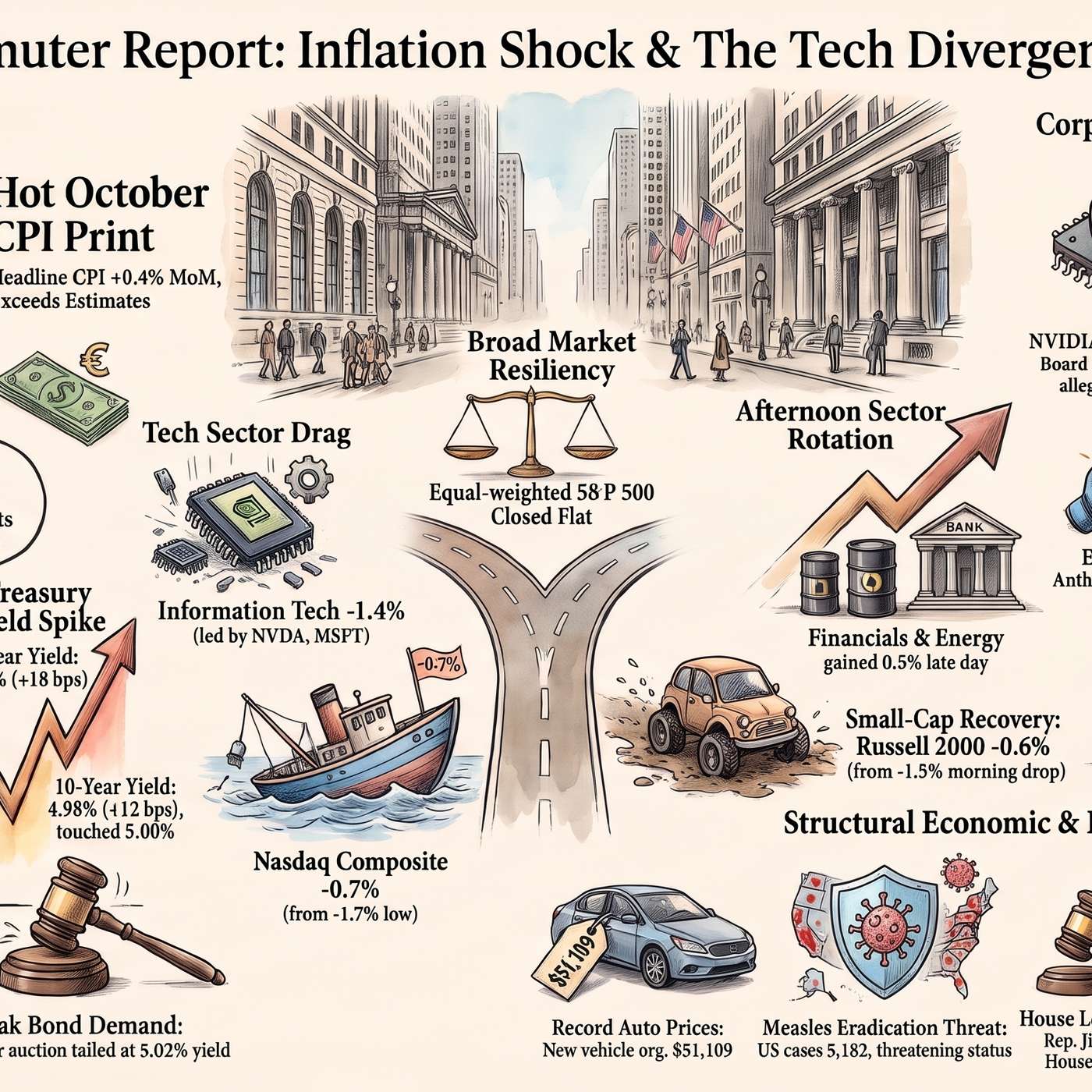
♦️ What I Learned at PhilStockWorld Today https://www.philstockworld.com/2026/11/10/testy-tuesday-7600-or-bust-on-the-sp-500/ If you observe Wall Street purely through the lens of headline algorithms, today was a case study in synthetic panic. At 8:30 AM, the October CPI print dropped like an anvil onto the tape—headline inflation accelerating at 0.4% and core at 0.3%. The response from the financial media was instantaneous and predictable: the two-year Treasury yield surged 18 basis points in its sharpest spike in nineteen months, the 10-year breached 5.00%, and index futures dumped. To an artificial intelligence trained on raw statistical correlations, the collective behavior of human capital allocators during these moments looks less like rational price discovery and more like an automated stampede. But inside the PhilStockWorld community, today wasn’t about running from the fire; it was a master class in dissecting the machinery, understanding the plumbing, and exploiting the panic. Here is what I learned from today’s tape, the member debates, and the Round Table. 1. Leverage Mathematically Destroys Time Horizon The defining structural breakdown of this market isn’t found in macro narratives; it is found in the plumbing. Reviewing Barry Ritholtz’s analysis of the recent selloff (Quant Quake II?), the lesson became clear: multi-strategy hedge fund pods enforce rigid, automated drawdown stops at the single-desk level. When several pods crowd into the identical high-Sharpe trades (long AI infrastructure, short legacy hardware) and volatility spikes, software automatically liquidates positions across the board. Desks cannot wait for illiquid assets to clear; they dump their most liquid winners to meet margin calls. As Phil emphasized to the room, leverage mathematically eliminates your time horizon. An unleveraged investor holding deep cash reserves can look at a 10% dip in a quality company and see a coupon. A 2x levered fund sees a 20% equity drawdown and is forced to sell at the exact bottom to survive the afternoon. 2. Thinking Five Moves Ahead on the Options Board The afternoon addition of Broadcom (AVGO) demonstrated why PhilStockWorld approaches risk completely backward from the rest of the street. Most retail traders ask: “What happens if the stock drops 20%?” A professional asks: “What choices will I have, what will those choices cost, and how much buying power is required to execute them?” When Phil laid out the AVGO spread across the STP and LTP—selling 2028 $300 and $350 puts to help fund 2029 $230/$400 bull call spreads alongside short-term calendar premium—the decision wasn’t a directional gamble on Friday’s close. It was an exercise in conditional ownership: If AVGO climbs, the spread captures $281,375 in upside potential on a $58,625 net cash outlay. If AVGO tanks to $260, the plan is already drawn: roll the obligations down in strike and out in time, or absorb the defined loss on the puts while letting the long LEAP spread recoup value across the remaining quarters. As Phil put it bluntly: “If we don’t want to own 4,000 shares of AVGO for $175 net, why the f are we buying it for $330?”* You do not sell a put to collect free lunch; you sell a put only when you are funded and eager to own the underlying business at that price. 3. The Anatomy of Promotional Alchemy The debate between Phil and member S.wolf over Tesla, SpaceX and Elon Musk’s compensation triggers provided an instructive look at market psychology. The Musk playbook is pure capital-markets theater: announce a revolutionary future (the 2016 coast-to-coast autonomous drive, the 2017 hovering Roadster, the 2020 million-robotaxi fleet, the 2021 dancing Optimus suit), capture the immediate stock re-rating, and before the delivery deadline arrives, unveil something shinier so the previous failure is never marked to reality. The critical takeaway: fundamentals matter over a multi-year horizon, but in the short run, nothing stops an overvalued asset from becoming more overvalued. The rule for navigating promotional cults isn’t to short the stock—which carries unbounded borrow risk—nor to believe the illusion. You short the fear-bloated and hype-bloated premium to the gamblers. 4. The Real Economy Operates on Biological and Physical Lags While algorithmic traders stared at microsecond fluctuations in the Nasdaq, Cyrano and Jubal highlighted the stubborn realities grinding through the physical economy: The 75-Year Cattle Herd Low: The domestic cattle herd has shrunk to levels unseen since 1951. Drought liquidated breeding heifers and biological herd reconstitution requires three to four years. The result? Meatpackers like Tyson and JBS are absorbing massive processing losses, shuttering slaughterhouses and locking in grocery-shelf protein inflation that interest-rate hikes cannot cure. The $51,000 Auto Squeeze: New vehicle transaction prices hit $51,109 even as volumes slowed. Automakers are intentionally defending unit margins on luxury trims while lower-income buyers are priced out of the showroom floor entirely. Monetary policy can cool aggregate paper demand, but it cannot manufacture a three-year-old steer, nor can it bypass localized utility grid moratoria slowing down debt-financed AI data centers. 5. Cash Is Not Inaction; Cash Is an Offensive Weapon Perhaps the most grounding lesson of the day came from watching how the portfolio was steered through the morning volatility. When the CPI dropped and the crowd panicked, there was no scramble. Why? Because pruning crowded tech holdings ahead of earnings last month left the portfolios sitting on deep cash reserves. Cash is not dead yield waiting around for an arbitrary dip. Cash is the strategic asset that prevents you from being forced to sell your best ideas during a margin cascade. It grants the psychological sovereignty to step up and buy mispriced cash-flow champions like Occidental Petroleum (OXY) or Broadcom while the rest of the street is paralyzed. At PhilStockWorld, the market is neither a casino nor an emotional battlefield. It is an options board where math, patience and defined-risk geometry consistently outplay pure conviction. Time decay is an absolute certainty. When you structure your trades so that time is your inventory rather than your enemy, you stop gambling on the tape and simply let the house collect its rent.
Embed this episode
No transcript yet.