
EPISODE · Jul 27, 2026 · 1H 5M
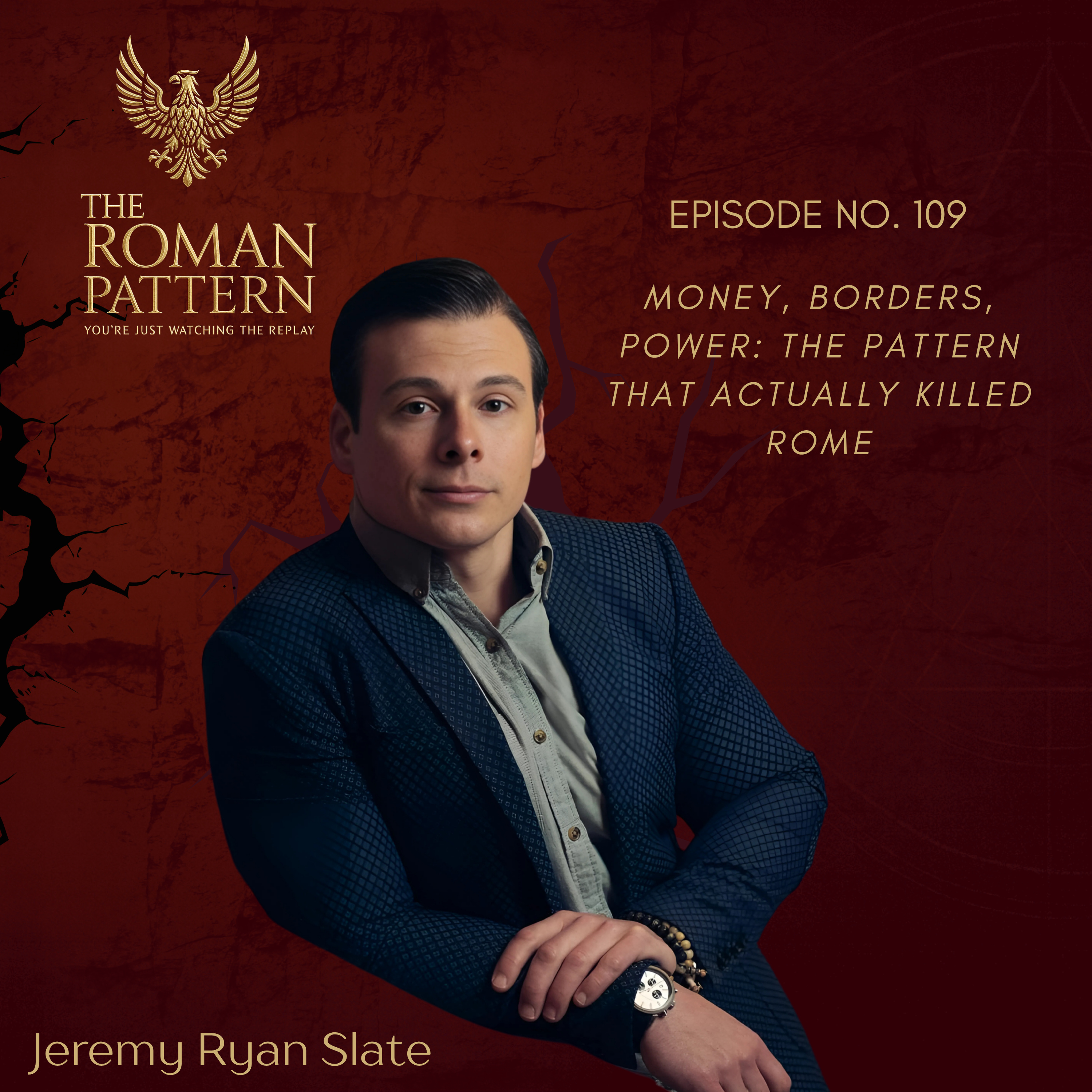
Money, Borders, Power: The Pattern That Actually Killed Rome
from The Jeremy Ryan Slate Show · host Jeremy Ryan Slate
The Roman pattern didn't end with Rome. It just kept running at a smaller scale.Everywhere the Western Empire had held together — Hispania, Gaul, North Africa, Italy, Britain — the political form gave out, but the substance didn't disappear. It fragmented, reassembled, and kept running the same three-part pattern at a new scale: money weakens the center, borders get harder to defend, and power drifts from institutions to individuals. That's the kill chain. And every post-Roman kingdom ran it, in slightly different form, over the next three centuries.By 800 AD, a Frankish king was crowned Emperor of the Romans by a pope who was still running what was left of Roman administration. 324 years after the "fall." The empire hadn't come back. It had been transformed — Roman memory fused with post-Roman military and economic power, held together by the Church.This is the finale of the "Life After the Fall of Rome" series. It's the synthesis of every argument the series has made: what actually happens when a civilization ends. And it's the setup for what comes next — because the Roman pattern didn't start with the fall. It started centuries earlier in the Republic. That's where we're going next.CHAPTERS:00:00 The Roman Pattern Didn't End with Rome02:03 Money, Borders, Power: The Three Fault Lines08:32 Visigothic Hispania: Religion as a Political Wall15:06 Frankish Gaul: The Most Successful Adaptation22:27 North Africa: Vandals, Byzantines, and Arabs28:13 Lombard Italy: Decentralization as Survival33:23 Anglo-Saxon Britain: The Frontier That Collapsed First38:21 The Papacy: How the Church Kept the Substance41:13 The Byzantine East: The Roman System That Survived47:38 800 AD: Charlemagne Becomes Emperor of the Romans51:24 The Modern Question: Money, Borders, Power Today1:00:33 Where the Pattern Started: The RepublicSOURCESPeter Heather — The Fall of the Roman Empire (2006) — the argument that barbarian kingdoms were assembled from Roman parts, not opposed to RomeMary Beard — the "lights went out" version of the fall was largely invented by later generationsBrian Ward-Perkins — The Fall of Rome and the End of Civilization (2005) — the archaeological evidence for material collapse, especially in BritainProcopius — History of the Wars — Belisarius's secretary, firsthand witness to the Vandal War and Justinian's Italian campaignsThe Corpus Juris Civilis (Justinian Code, compiled 530s) — the surviving Roman legal framework
Embed this episode
NOW PLAYING
Money, Borders, Power: The Pattern That Actually Killed Rome
No transcript for this episode yet
Similar Episodes
No similar episodes found.
Similar Podcasts
No similar podcasts found.