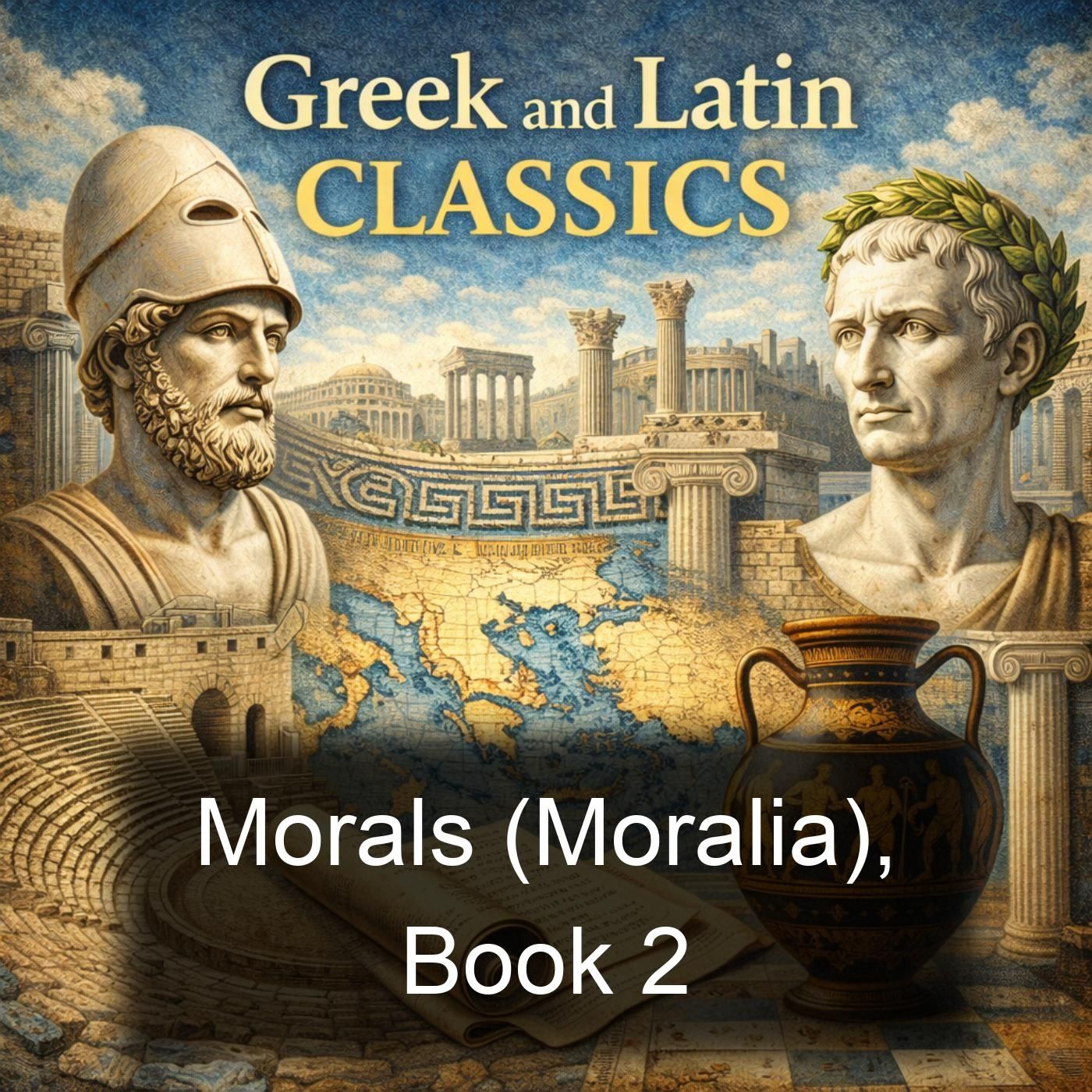
Morals Moralia Book 2 - Lucius Mestrius Plutarchus - Part 2 episode artwork

EPISODE · May 14, 2026 · 8H 19M

Morals Moralia Book 2 - Lucius Mestrius Plutarchus - Part 2

from Morals (Moralia), Book 2 · host Lucius Mestrius Plutarchus

The Moralia (loosely translatable as "Matters relating to customs") of the 1st-century Greek scholar Plutarch of Chaeronea is an eclectic collection of 78 essays and transcribed speeches. They give an insight into Roman and Greek life, but often are also fascinating timeless observations in their own right. Many generations of Europeans have read or imitated them, including Montaigne and the Renaissance Humanists and Enlightenment philosophers. The Moralia include "On the Fortune or the Virtue of Alexander the Great" — an important adjunct to his Life of the great general — "On the Worship of Isis and Osiris" (a crucial source of information on Egyptian religious rites), and "On the Malice of Herodotus" (which may, like the orations on Alexander's accomplishments, have been a rhetorical exercise), in which Plutarch criticizes what he sees as systematic bias in the Father of History's work; along with more philosophical treatises, such as "On the Decline of the Oracles", "On the Delays of the Divine Vengeance", "On Peace of Mind" and lighter fare, such as "Odysseus and Gryllus", a humorous dialog between Homer's Odysseus and one of Circe's enchanted pigs. The Moralia were composed first, while writing the Lives occupied much of the last two decades of Plutarch's own life. Some editions of the Moralia include several works now known to be pseudepigrapha: among these are the "Lives of the Ten Orators" (biographies of the Ten Orators of ancient Athens, based on Caecilius of Calacte), "The Doctrines of the Philosophers", and "On Music". One "pseudo-Plutarch" is held responsible for all of these works, though their authorship is of course unknown. Though the thoughts and opinions recorded are not Plutarch's and come from a slightly later era, they are all classical in origin and have value to the historian. The book is also famously the first reference to the problem of the chicken and the egg. (Summary adapted from the Wikipedia)

The Moralia (loosely translatable as "Matters relating to customs") of the 1st-century Greek scholar Plutarch of Chaeronea is an eclectic collection of 78 essays and transcribed speeches. They give an insight into Roman and Greek life, but often are also fascinating timeless observations in their own right. Many generations of Europeans have read or imitated them, including Montaigne and the Renaissance Humanists and Enlightenment philosophers. The Moralia include "On the Fortune or the Virtue of Alexander the Great" — an important adjunct to his Life of the great general — "On the Worship of Isis and Osiris" (a crucial source of information on Egyptian religious rites), and "On the Malice of Herodotus" (which may, like the orations on Alexander's accomplishments, have been a rhetorical exercise), in which Plutarch criticizes what he sees as systematic bias in the Father of History's work; along with more philosophical treatises, such as "On the Decline of the Oracles", "On the Delays of the Divine Vengeance", "On Peace of Mind" and lighter fare, such as "Odysseus and Gryllus", a humorous dialog between Homer's Odysseus and one of Circe's enchanted pigs. The Moralia were composed first, while writing the Lives occupied much of the last two decades of Plutarch's own life. Some editions of the Moralia include several works now known to be pseudepigrapha: among these are the "Lives of the Ten Orators" (biographies of the Ten Orators of ancient Athens, based on Caecilius of Calacte), "The Doctrines of the Philosophers", and "On Music". One "pseudo-Plutarch" is held responsible for all of these works, though their authorship is of course unknown. Though the thoughts and opinions recorded are not Plutarch's and come from a slightly later era, they are all classical in origin and have value to the historian. The book is also famously the first reference to the problem of the chicken and the egg. (Summary adapted from the Wikipedia)

NOW PLAYING

Morals Moralia Book 2 - Lucius Mestrius Plutarchus - Part 2

0:00 8:19:14

No transcript for this episode yet

We transcribe on demand. Request one and we'll notify you when it's ready — usually under 10 minutes.

いろはにマネーの「ながら学習」 IrohaniMoney この番組では、インターン生2人が、金融、経済、投資関連の気になる情報を分かりやすくお伝えしていきます。インターン生の会話を「ながら聴き」する感覚で一緒に勉強していきましょう!ご意見箱フォーム:https://forms.gle/TTGaVP2TJksNMKJo7ぜひお便りや感想をお待ちしています!公式X:https://x.com/irohanimoney番組のハッシュタグは「#いろはにながら」です。番組への感想をお待ちしています!いろはにマネー:https://www.bridge-salon.jp/money/姉妹サイト:https://kabu.bridge-salon.jp/姉妹サイト:https://bridge-salon.jp/(株)インベストメントブリッジ運営 French Your Way Jessica: Native French teacher founder of French Your Way Boost your French listening skills and test your comprehension with this one of a kind series of podcasts. Get the chance to listen to a real conversation between native speakers talking at normal speed AND customise your learning experience through carefully designed sets of questions (2 levels of difficulty) available for download at www.frenchvoicespodcast.com. All interviews also come with the transcript. French teacher Jessica interviews native speakers of French from around the world who share a bit of their life and passion. Where else would you meet in one same place a French yoga teacher based in Melbourne, a soap manufacturer from Provence, or a couple cycling around the world? 2 Old Ladies Walking Rozee 2 Old Ladies Walking features the journeys, insights, and light conversation between Liz and Rosie, two women of a certain age who live in the Hudson Valley of New York. From pelvic floor challenges and life with young adult children to food, bird calls, fear of “mad lamb” disease, and myriad topics in between, we cover it all while walking on the scenic trails of the northeast, or wherever our travels take us. Join us and have a listen! The 48 Laws of Power by Robert Greene (Full Audiobook) Robert Greene Amoral, cunning, ruthless, and instructive, this multi-million-copy New York Times bestseller is the definitive manual for anyone interested in gaining, observing, or defending against ultimate control – from the author of The Laws of Human Nature.In the book that People magazine proclaimed “beguiling” and “fascinating,” Robert Greene and Joost Elffers have distilled three thousand years of the history of power into 48 essential laws by drawing from the philosophies of Machiavelli, Sun Tzu, and Carl Von Clausewitz and also from the lives of figures ranging from Henry Kissinger to P.T. Barnum.Some laws teach the need for prudence (“Law 1: Never Outshine the Master”), others teach the value of confidence (“Law 28: Enter Action with Boldness”), and many recommend absolute self-preservation (“Law 15: Crush Your Enemy Totally”). Every law, though, has one thing in common: an interest in t

Frequently Asked Questions

How long is this episode of Morals (Moralia), Book 2?

This episode is 8 hours and 19 minutes long.

When was this Morals (Moralia), Book 2 episode published?

This episode was published on May 14, 2026.

What is this episode about?

The Moralia (loosely translatable as "Matters relating to customs") of the 1st-century Greek scholar Plutarch of Chaeronea is an eclectic collection of 78 essays and transcribed speeches. They give an insight into Roman and Greek life, but often are...

Can I download this Morals (Moralia), Book 2 episode?

Yes, you can download this episode by clicking the download button on the episode player, or subscribe to the podcast in your preferred podcast app for automatic downloads.
URL copied to clipboard!