
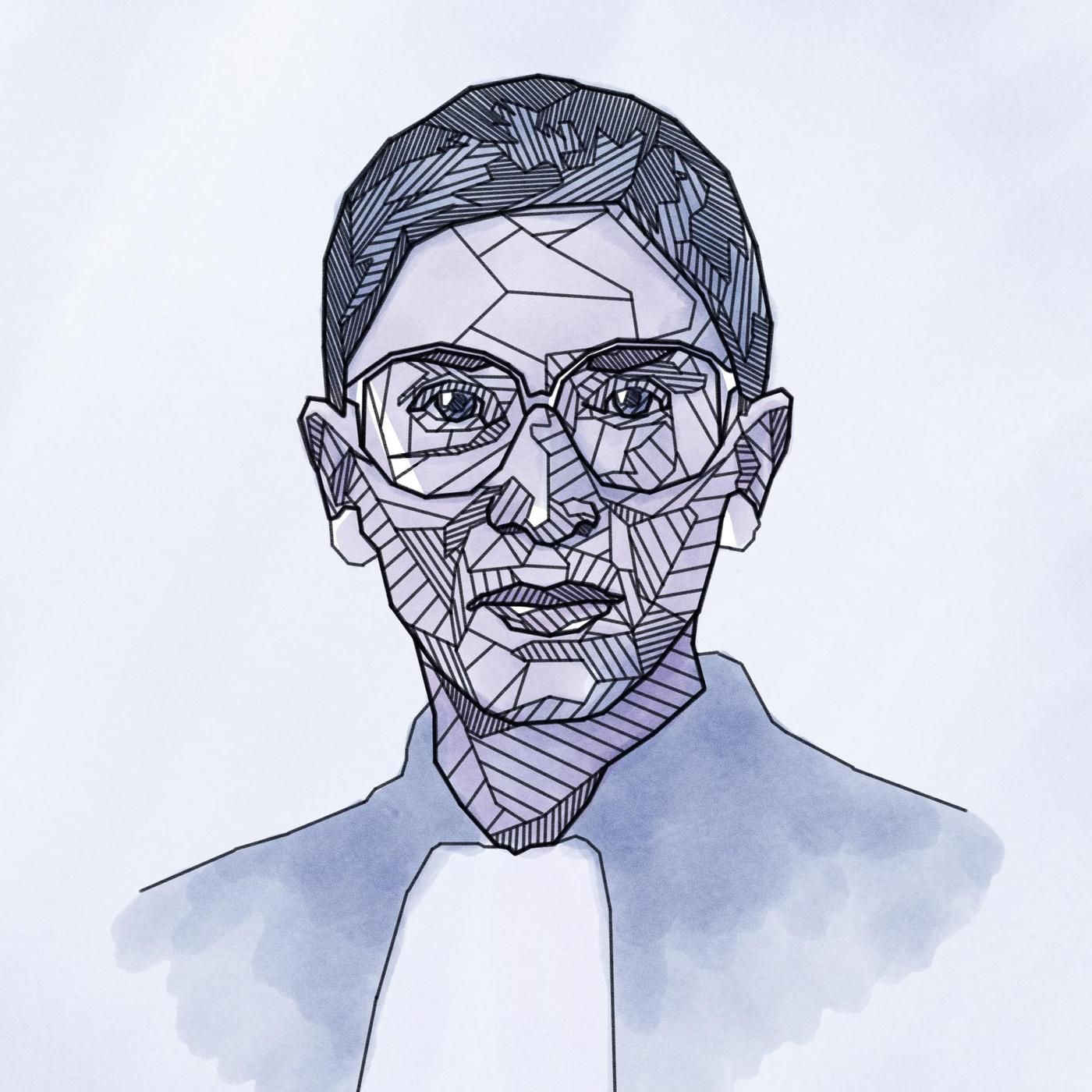
hey it's jad this is radio lab tonight we lost a legend supreme court justice ruth bader ginsburg died she was 87 that's a lot to think about a few years ago radio lab created a spinoff series more perfect about supreme court and in one episode we told a story about rbg that has um stuck with me i think it's a story we should all listen to right now because it's a it's a sort of a snapshot of how one person can make change in the world in memory of ruth bader ginsburg we wanted to re-release it for you again tonight it comes to you from producer julia longoria i'm gonna ask you an utterly false question which is where would you like to start we haven't been doing this for so damn long okay so let me outline the basic dilemma that's at the heart of the story here and i'm gonna put it to you as a question bring it if you were to do a control f in the constitution like how many times do you think the word sex comes up oh that's interesting six what's the answer it's one one time in the 19th amendment which grants people the right to vote based on sex really yes that's the only time that's the only time which is crazy because is there a sex word that's not sex like gender or something something nothing is there like ladies in the constitution women no really constitutionally women have a problem which is that basically we're not in the constitution except like in this one little spot so when it comes to discriminating against women some people have argued that you there's nothing in the constitution that says you can't do it certainly the constitution does not require sexual discrimination on the basis of sex constitution doesn't require it it simply doesn't forbid it that's the late justice antonin sculia it doesn't nobody ever voted for that so where do you get it from there was nothing that said i mean not those words explicitly but there's nothing that says you can't discriminate uh not on the basis of sex that's legal editor christian farias we have a 14th amendment that told people that we are equal under the law that everyone has equal protection of the laws but doesn't that say that's kind of enough they never applied the 14th amendment to women they didn't apply the 15th that's martha griffiths congresswoman when you think about the history of the 14th amendment as legal editor linda hirschman says the 14th amendment was passed in the aftermath of the civil war along with the 13th and 15th 13th amendment abolishing slavery and 15th amendment essentially giving black people really black men the right to vote if you understand the 14th amendment to be a part of that trio of amendments you're like oh okay it was meant to bring equality to black people when the 15th amendment had been written which said every citizen could vote in the name of heavens why couldn't women vote why didn't you why did you have to have the 19th amendment well of course the answer was they didn't consider women people there was this basic assumption in the law that you know equality for black people is one thing but men and women they're different it was the case that the supreme court had never once met a distinction between men and women it didn't like wendy williams law professor emeritus at george uh what are some of my greatest hits of the ridiculous distinction okay here here there was a case called bradwell and it was 1873 or four in that case a woman wanted to become a lawyer illinois bar said no and the justices said that um that that was a perfectly good rule because the justice system could be seen as not appropriate for women now let's jump clear into the next century here 1948 this case was called guesser versus cleary that went to the supreme court and the issue was whether women could be bartenders the court thought that that was pretty humorous that it made sense that women could not be bartenders unless their husbands or fathers were in charge of the bar both those laws you know women are not supposed to be at the bar at either bar those two cases represent attitudes almost 80 years apart that women belonged in the private sphere that was not only the place it was built into their bodies and that was the assumption for a long long time but just about 67 there are a lot of women in this country who feel like they're being pushed around things things have started to come to a boil and they've become very vocal they call themselves the women's liberation movement sex and race because they are easy visible differences have been the primary ways of organizing human beings into superior and inferior groups so in the late 60s and early 70s people like gloria steiner we are talking about a society in which there will be no roles other than those chosen free from the diseases of racism audie lord of sexism of classism they get some traction saying okay it's time to put us in the constitution some historians say it's a constitutional convention for women i move the adoption of the following resolution what you see is this push for something called the equal rights amendment the equal rights amendment should be ratified but it didn't get the votes in 1975 i hope 1976 will be the year or in 1976 a special report on the 1977 national women's conference or in 1977 and the movement is stalled why what what stalled it well a lot but much of the credit goes to this woman a woman named billis i would like to thank my husband fred for letting me come today i love to say that because it irritates the women's livers more than anything that i said she was a lawyer and a self-described housewife who started a movement called stop era the whole thing is misrepresented as a woman's rights amendment in fact the principal beneficiary will be men it will give men a great opportunity to get out from under their obligations her position was that the equal rights amendment would actually strip women of the special privilege that they have that comes from being a woman i think the laws of our country have given a very wonderful status to the married woman and the wife has a great deal of many rights for example she has the legal right to be supported by her husband and she said if this amendment passes there will be certain unintended consequences the equal rights amendment says you cannot discriminate on account of sex and if you want to deny a marriage license to a man and a man or deny homosexuals the right to teach in the schools or to adopt children it is on account of sex that you would deny it and that would be unconstitutional under era and that argument caught on i would caution the members of this platform committee that there are things that could happen from the passage of an era amendment that none of us would like to see happen i think the family would generation after generation deteriorate i think that there would be homosexuals who expect preferential treatment he said brother we're all in danger you gotta hear what i have to say because you know what's going to happen if it pass the era there will be women in all of our bathrooms women using all our stalls they'll be wasting paper towels they'll be hauling in the urinals they'll be have the equal rights amendment passed legal editor linda herschman again it would have looked a lot like the racial civil rights movement did but the equal rights amendment did not pass it fell three states short to get a constitutional amendment passed turns out you need three quarters of state legislatures to say they want it that is 38 out of 50 they only ever got 35 dude so the question is if you want to get equal rights for women written into the law what do you do there's no era the women's movement sparked a backlash like what do you do well enter stage left there she is this is the notorious rbg rbg can do 20 push-ups not so-called girl kind now before she was a supreme court justice or a workout sensation before all that ruth ginsburg she was at the aclu this was in the 70s and one of the characteristics of ruth ginsburg which exists to this day you can hear this it's the first time she argued in front of the supreme court in 1973 when you'd ask her a question there would be silence enough silence to make a person nervous and start trying to help her answer the question you had to wait but we can imagine that it was in one of those long pauses that ruth ginsburg rescued some of the key principles behind the era repackaged them and marched them in through a side door mr chief justice and may it please the court sex like race is a visible characteristic bearing no necessary relationship to ability sex like race has been made the basis for unjustifying wait so back up a second what exactly did rbg do so let me walk you through it now because it's it's beautiful um the era fight is underway and rbg and our colleagues are watching this happen right and they're getting worried what if the era doesn't pass so what are we going to do if that's the case how are we going to get equal rights for women so they decided okay as an alternate approach let's go back to the 14th amendment the 14th amendment's immediate objective was to provide national protection for the newly freed slaves you know which as we said was designed from the beginning to be only about race but its sweeping provisions suggest broader objectives the states were prevented from depriving any person equal protection of the laws well it says the word person so that should include women yeah if they could just get the courts to see it that way then by default almost we would have a sort of era and accordingly the task was showing that the racially inflected 14th amendment applied to sex so what about the law is she trying to change what what does she want the court to say she wants the court to say that sex would be treated just like race and here's why that's so important when the court sees racial discrimination happening under the 14th amendment it takes a really hard line it looks at it really really closely or at least it's supposed to whereas other kinds of discrimination not so much because actually some discrimination is necessary the law discriminates it has to it discriminates between 18 year olds and 17 year olds between criminals and non-criminals it would be chaos otherwise right but the court decided that race is going to be a big red flag they're going to ask the government's legislatures presidents to have a compelling reason a compelling state interest to do race discrimination otherwise it's going to be unconstitutional you with me so far yes uh to discriminate based on race you need to pass a really super hard test by the way the legal name for this test strict scrutiny oh i know they should have called it like we mean business or something like that but anyway the point was that like they took it seriously which you know back in the day they weren't doing with sex discrimination at all because when legislators would come up with these laws like this women can't be bartenders law the spring court would be like you know you guys probably have a good reason for that it doesn't have to be the reason it can just be a reason it doesn't have to be very good it doesn't have to be good they could even maybe even make it up on the fly it just has to be a reason for upholding this law like in the case of the bartender's law bars are dangerous women need more protection and courts would be like okay sure so rpg needed a way to convince the court to be as intense about sex discrimination as they were about race discrimination but how do you convince an audience of men who are used to discriminating on the basis of sex who've been doing it for years how do you convince them that discrimination is a bad thing i think that people who want to keep women down would like nothing better than women go off in the corner and speak only to women nothing would happen this is her giving a recent talk about her 1970s strategy you need to persuade men that this is right for society part one of her strategy choose your words carefully i had a secretary at columbia who said i'm typing these things for you and jumping out all over the pages sex don't you know that the audience you are addressing the first association of those men the word sex is not what you're talking about so why don't you use a grammar book term use gender because you know the word sex has a charge to it gender is cooler and part two of her strategy choose your cases carefully this is all happening in the 70s when rbg is the head of the aclu women's rights project so she's deciding which kinds of cases the aclu is going to support as they make their way to an all-male supreme court and her strategy was if we live in a man's world right now we need to find cases that nine men at this moment can handle so for example early on in her tenure at the women's rights project the other lefty lawyers are suggesting that the women's movement needs to take up the cause of lesbian rights and she says not yet and i think go slow is the right approach she said first we need to go after that small and insidious idea that the supreme court had been keeping alive for years the laws of our country have given a very wonderful status to the married woman that billish laughly idea that discrimination is actually good for women gender classifications were always rationalized as favors to women and so rpg decided not just to bring cases where women were the victims of discrimination okay my name is cordless craig she brought cases where men were the victims who were you as an 18 year old that's a great question um i was like any 18 year old young man um invincible you know i thought i was quite the ladies man you name it yeah me i he made it into lambda chi alpha at oklahoma state and he was living at the frat house our uh our fraternity was primarily made up with wrestlers so it was uh when you went down the hall you were about to be taken down at any moment you'd be thrown into the wall and you'd leave a body print what do you mean like an indentation literally in the wall or like yeah yeah it was it was amazing there was a lot of partying going on a lot of beer the yard would be filled with beer cans and here's the key if they want to get all that beer they have to enlist the help of the ladies yeah i mean uh you know the sorority sisters yes you would have a female buy your beer and you'd go out and party they need the women buy beer yep why because in oklahoma state at the time oklahoma had a very silly law girls could buy beer at age 18 but the boys had to wait until 21 there was something about the level of maturity i guess for women versus men at that time the basic principle was that boys had more car accidents so they should be trusted with less beer did that make you angry oh absolutely well it was extremely unfair yeah i would say it made i think most men angry at the time the supreme court case was born so the thirsty boys at a fraternity brought this case so the rbg rbg gets involved in this beer case yes but this is this is a this is a situation where women have rights men don't have why would she want to argue this case imagine she want the opposite well this is where her strategy is kind of like a trojan horse if you look at this case right on the outside it looks like a case about men being discriminated against yeah but if you think about it beneath that discrimination is actually this kind of unspoken idea about women so go with me on this right if men are irresponsible they can't handle beer then women girls are more responsible and well-behaved more delicate they could be trusted with something like beer because they won't abuse it you know so with that line of thinking it's not long before you're trying to protect women protect them from you know scary places like bars or courtrooms or political office using this case rbg is able to walk into the court this discrimination about men but also the discrimination against women that's attached to it or inside of it wow that's clever we're just getting started this is melissa gutierrez in evergreen colorado radio lab is supported in part by the alfred p sloan foundation enhancing public understanding of science technology in the modern world more information about sloan at www.sloan.org anxiety depression bipolar disorder at least half of us will experience a mental illness in our lifetime in a new podcast on call to mind we hear about the mental health impact of stress climate change immigration and more i'm angela davis joining for conversations with people managing hardship and experts seeking solutions from american public media comes call to mind listen and subscribe on your favorite podcast app this is radio lab i'm jada and we are marking the passing of supreme court justice ruth bader ginsburg with a story from producer julia longoria about a case involving boys and beer and a legal move which reminds you of the wily odysseus because the case that julie's about to describe became something of a trojan horse in the battle for women's rights now the story of the trojan horse maybe you know this it's uh you know ancient greece you've got sparta fighting troy the spartans want to get into the city of troy but it's a giant walled city too big they can't get in and so odysseus comes up with this clever plan we'll give the trojans this giant wooden horse they'll bring into the city they'll think it's a gift that we're retreating which is what they thought and then at night our soldiers who are hidden inside the horse will come out and they will take the city now in our case odysseus is rpg the city she's trying to get into is the all-male supreme court but in order for this very admittedly imperfect analogy to work um we need someone in the horse to come out the warrior in the horse the woman warrior and in our case that woman warrior she didn't even know she was gonna go into battle julia you take me here so i got in the car and i drove a long time tiny little gravel road leading up to narrow street of houses to sparta north carolina it's called sparta i know cows and horses and trump signs tractor up front and so i walk up to this house it's this beautiful cream colored cottage perched on top of a mountain wow and i can hear whitney houston saving all my love for you blasting hi no i didn't have you carolyn hi very nice to meet you and i meet carolyn whitner i'm 76 soon be 77 she immediately offers me a course will you have a beer with me no i can't i'm a diabetic i can wriggle a little bit and i'll match thank you i've got some brownies over here what does she look like this river reddish blonde hair green eyes she's wearing golden hoops she has like this this air about her that she could have been a beauty queen you know but she also could have been a car mechanic so we get to talking i tell her a little bit about who i am about the story she actually told me like a friend she's like i'm proud that i'm proud of the young women i have a granddaughter i'm so proud of you your generation they're finishing the fight i started and i was essentially like no no no this stuff like your story has like a huge impact on like women like me you know generation but see my name was never tied in with it it was always craig's name so you know it wasn't that big a deal she told me she grew up bouncing around different oil fields always an oil field trash that's what we were called oil field trash that meant carolyn and her brother and sister split the school year between two or three schools a year we moved a lot she said school didn't come easily to her but my dad he taught all three of us how to weld he was a welder how to work on a car she was very independent when she was about 13 they moved to chickashay oklahoma it happened in old oklahoma and that is where she met duane that was the first boy i went with they met in high school and they were roughly the same age but he was three years ahead of her in school and uh what attracted you to him his mind he had an excellent mind and he was just a farm boy with no education he never went to college but he could have been about anything he wanted to have been what do you think attracted um him to you like what do you think he saw in you i was somebody new in town talking to carolyn i got the sense she did not have any shortage of suitors that uh i married him uh when i turned 18 and when i married my husband uh i was equal to him except the money and he didn't think anybody could handle that but him he acted like he was raising me and he probably was she says she was really comfortable with him he was a quiet man with this brilliant mind but he just what he was pure german girl have you ever met a german man okay they are in total control and how does carolyn connect to the case with frat boys and rbt okay so here's what happens it's 1962 carolyn and duane are about 20 years old at this point and they move to a town called stillwater oklahoma to open a business and stillwater is a college town it's that college town they've got oklahoma state university right there tons of fraternities including lambda with the wrestlers huge homecoming drawing over 40 000 alumni we didn't know what homecoming was had no idea what homecoming was but shortly after moving to stillwater they opened the doors to the hunk and holler and where we went in was just about three blocks four blocks from the college and we went into business there a drive-through convenience store it was like a real old gas station with oil pit in the floor here's how it would work customers pull up to the side of the convenience store and they drive through hunk their horn holler their order and you have to go out and wait on them come back in and get what they warm it and take it back out so it's a lot of in and out and in and out all night long you wear tennis shoes out real fast so it was all sheer energy and guts homecoming night we were supposed to close at 11 the store is flooded with customers till i think two or three o'clock in the morning they're like thrilled because they've never run a business by themselves before and all these college kids are coming in and buying coars beer including of course a steady stream of girls buying beer presumably for their boyfriends and it yeah i never did get to see homecoming all i saw was cars coming in and out fast forward a few years it's 1972 back at the university he was tall had long blonde hair curtis craig's buddy named mark walker he was the president of the kai house at the time and the professor starts talking about the whole fight for the era which is happening right at that moment and at this point oklahoma hasn't ratified the era and somehow the conversation turns to this beer law mark's like talk about discrimination this beer law is discrimination against us and the professor challenged him about doing something about the beer laws if he was going to complain about them so one day i was behind the counter people coming in and out mark walker walks into the honking holler the young man came in to talk to me she doesn't really have time to talk she's running in and out but he stood there waiting patiently i bet he was in there four hours and he was looking at the beer license he looks at the license and he notices that carolyn's name is the one on it because actually my husband lost his license after he sold beer to a young man so he put him in my name anyway at a certain point in between all the hunks and hollers he asked me what i thought about the beer laws and i told him i was very vocal about it i always had been she says that doesn't make any sense we send these young men off to war we're being drafted at 18 but we don't let them drink beer when they come back was that just not to mention liability issues you have these 18 year old girls coming in buying beer slipping to their boyfriends how am i supposed to stop that you can't prove who buys what so eventually when mark walker asked for her help he said he was going to do a term paper she's like sure why not i was always willing to help him because they had helped us get started and i still thought it was a term paper so was he not being completely honest with you then well i didn't hear half of what he said i was busy every time he came in so you know it wasn't that important at the time so i didn't think anymore about it he left my husband was gone he was out of state working and i didn't say anything about it it wasn't important you know i just thought it was a conversation but it wasn't just a conversation because before that meeting mark had gone out looking for a lawyer that's correct and curtis and mark and the other proud brothers had tried to raise some money that was flawed um in a campus town everybody uses their last dollar for that last beer but they managed to find this lawyer who would do it on the cheap all right well i'm just read you over the attorney at law no big deal no big deal i remember him always wearing his military boots actually i believe he wore them even to the supreme court fred had worked on another male discrimination case in the past and to him this case was pretty straightforward men couldn't buy beer until they were 21 but most irresponsible and drunken woman in the state could buy it in unlimited quantities at 18 well that was discrimination would have more a male rights case well it was and do you remember corresponding with ruth bader ginsburg yes i knew ruth bader ginsburg before she was on the court somehow ruth bader ginsburg noticed this case and she watched as fred made his way up the courts losing at every level and by this point ruth bader ginsburg was head of the women's rights project at the aclu she'd already argued a few cases before the supreme court which had inched the court slowly toward the idea that sex was like race and she thought that this case was interesting she gave fred a call you know we have a problem in a personal relationship it was no question i was something of an unreconstructed male chauvinist and she was not fred did not see this as a women's rights case which is kind of an unnecessary insult to men for no reason at all and ruth looking at this case thought no fred it's more than that it didn't matter to her if the plaintiff was a man or a woman because in most of those cases the discrimination against the man was derivative of a prior and worse discrimination against the woman here's to the ladies the fair and the weak how do they do it where do they find all that energy that seemingly inexhaustible store of pep and ginger again ruth was after the stereotype about women that was nestled inside the beer lock that women are more responsible and well behaved but in order for her to make that connection she needed fred to write his brief in a way that would be useful to her so refer not just to male discrimination but discrimination based on gender well i supported her i just never was shall we say a militant feminist so like ruth had her work cut out for her at this point she was getting sort of used to dealing with these robes from the sticks so with other local lawyers that she'd worked with in the past ruth had been more forceful insisting that she made the argument but that had backfired so she like it's like okay you argue it right she wrote to brad telling him that she didn't need to be the one to present oral argument before the court she was fine if he'd do it but she very gently very persistently was able to convince him to let her help him with his legal brief but uh i think it was a couple of months later because my husband was out of state every month meanwhile back at the honking holler carolyn has no idea what's going on uh no no idea and i got a phone call my husband was on the phone well i had salesmen in and i had people coming in and out and he was irate he was furious i couldn't figure out what was going on she's like case what are you talking about well he had picked up a newspaper in north carolina in a bank and it was on the front page of the newspaper with my name and out as soon it looked like we sued everybody in the state of oklahoma that was in office all the way down to the garbage man he's like what did you do how are you don't get mixed up in this we don't want our name on this we don't want to make a fuss like this could hurt business like how dare you you know i didn't know what had happened i really didn't know and eventually you should figure out it must have been that kid who came in here and now it's like at the supreme court what i was back and forth on that phone with him trying to wait on customers and i bet that took about three hours and he would not let up i mean he kept calling back and calling back he called a lawyer he was mad and then the last phone call he said i am flying back in and he said you picked me up a couple nights later she drove to the airport picked him up and uh he was still mad that was the longest car ride as they drove back she says he just lectured her the whole ride i just listened to him what did he say i don't know what he said word to word i just know he was strong with what he said with my husband it was best to just be silent i was never afraid of him but i knew how far to push it kind of got from the airport to the other side it was about an hour and 20 minutes that's a long hour and 20 minutes in the car where you can't get out and over the course of that hour and 20 minutes she said something in her just kind of shifted and at a certain point she basically turned to him and was like no like i know you want me to drop this case but i'm gonna fight this he threatened me every which way i didn't budge and probably the reason why i didn't budge because he fought me so hard on it you know i believed in it but i had never stepped out like that that's the first time i really put my foot down and didn't budge i gave so much to him i mean i didn't get a salary for 25 years i didn't ask for it i figured we were equal i figured i worked the same hours he did and i figured i stood beside him not behind him and not in front of him october 5th 1976 the day of oral arguments the lawyer fred gilbert and i ran across very many people that i didn't care for i didn't care for her he was so pushy insists that caroline needs to come to dc i didn't have the money to go and i didn't want to go i never traveled anywhere by myself what i recall that day curtis crack came too i was dressed up suit and tie had borrowed a dress plastic look like leather walking up those stairs high heels i remember that distinctly it was so big beautiful building i felt like i was walking forever up those stairs i was burning up i was sweating we'll be arguing next to the 75 628 craved against foreign mr gilbert you've received one of your ready brad gilbert starts things off he walks up to the podium in his combat boots the law is broad all encompassing and it's sweet it says all females even those that are the most drunk most alcoholic most immature and most irresponsible they purchase 3.2 percent The law doesn't say it in quite those words, does it? And by all accounts, it didn't exactly kill it. No, Your Honor, and the law doesn't say it in quite the words that all males... The justices just kept hammering him.
The only way he can get the leaf is to move his age back in red. Hammering him. In a technical sense. I don't technical...
Yes, Your Honor, but it's technical. The complaint is drafted. What is before the court? Well, but you say, you say, what's before the court?
What's before the court is your complaint? Curtis was sitting beside me, and I kept punching him. What does that mean? What are they talking about?
What does that mean? And he kept saying, shh, shh, just be quiet. Do this over, I'll tell you. I didn't understand what they were doing.
But she says what caught her ear was a moment when Justice Rehnquist, when he called me... When you say we, you're referring to your client who is the tavern keeper? It's the tavern keeper. Yes, Your Honor, and me, Your Honor.
I'll tell you when, when he called me that in the Supreme Court, I came so near standing up and correcting me, and I've always wondered if this date when I did this. As arguments went on, Fred did at least try to do the thing that Ruth wanted him to do. Your Honor, I would say anything could be... You could pass a law saying no Negro will drive while intoxicated.
Compare sex discrimination to race discrimination. Now, this relates to the public thing, but the thing is you can't discriminate, even for something like public safety, on the basis of certain criteria. Well, has the court ever held that discrimination of this sort is of the same class as discrimination on the basis of race? Your Honor, this court has come very, very close...
Well, I ask you a question, has it ever held? No, it has never held that it is totally to be treated the same as race, right? To make a long story short, by the end of oral argument, things weren't looking great for Fred. I mean, I think that depends on the...
All right, let me explain this. First of all, we use... At one point, he even interrupts a Supreme Court justice, which, you don't do that. Supporting the denial of beer to young men 18 to 21.
It just, uh, yeah, wasn't happening. Well, you win some, you lose some, right, ladies? Well, no, no, no. Here comes the craziest part of the story.
It's like a double Trojan horse, horse within a horse, because after the Fred Gilbert debacle, there was another case at the Supreme Court that afternoon. And it just so happened that it was a case being argued by none other than Ruth Bader Ginsburg. Somehow she organized, I've not forgotten how, to get that argument the same day. That was on purpose.
Yeah, oh yeah, oh my God, that's genius. Yeah, no, she's a genius. Mr. Chief Justice, and they'd leave the court.
What, you're saying she somehow managed to get herself in the court on another case on the same day? So I couldn't confirm that for sure. I don't even know how you would do that. But what I can tell you is that she arranged to go second, because she knew there was probably a good chance that Fred, the completely incompetent lawyer, was going to be, you know, less than amazing.
The court was asking him questions, and he was completely incapable of answering, so finally the court just went, oh, never mind. And then when Ruth stood up to argue her case, they asked her about Gregory Borden. The case this morning, just to be concrete, involving a law that would not permit males to make certain purposes of females, was attacked as a discrimination against males. My question is whether we should examine that law under the same or a different standard than if it were a discrimination against the other.
My answer to that question is no, in part because such a law has an insidious impact against females. And then she told Justice Stevens, even in this case, where it seems like men are the ones who are being discriminated against, beneath that discrimination is a more insidious one. ...against females. It's past them, docile, compliant, safe to be...
But your answer always depends on their finding some discrimination against females. Is it your view that there is no discrimination against males? I think there is discrimination against males. If there is such discrimination, is it to be tested by the same or by a different standard from discrimination against females?
My response to that, Mr. Justice Stevens, is that almost every discrimination that operates against males operates against females as well. Is that a yes or a no answer? I just don't understand you.
Are you trying to avoid the question? No, I'm not trying to avoid the question. I'm trying to clarify the position that I don't know of any mind that doesn't work as a two-edged sword. They go back and forth a bit.
Justice Stevens is basically like, why do you keep insisting on this? Why do you keep saying that discrimination against men contains within it discrimination against women? They're different. And she's like, no, they're not different.
So your case depends then on our analyzing this case as a discrimination against men? No, my case depends on your recognition that using gender as a classification, resorting to that classification, is highly questionable and should be closely reviewed. She makes this point again and again, all discrimination based on gender is bad. And it should be checked with something at least approaching that hardcore standard that the court uses for race.
That was really something, seeing this little woman get up. I don't know of any purely anti-male discrimination. I'll never forget that because she was small. In the end, the women are the ones who end up hurting, yes.
She's so small in person that she had a lot of force. And the person case is submitted. About two months later, December 20th, 1976, Justice William Brennan announces that the court is striking down the beer law. We hold that Oklahoma's gender-based differential does constitute an invidious violation of the Equal Protection Clause.
This silly beer case was basically the first time the court clearly said that when you discriminate based on gender, you need to pass a harder test. It wasn't as rigorous as race. It wasn't strict scrutiny. They settled on a standard that we now call intermediate scrutiny.
And it was pretty damn close. RBG would go on to strengthen the standard over time, but this was the case. That first got us a kind of equal rights amendment through a side door. We wish that the court had picked a less frothy case to make that announcement.
But of course, we were very, very pleased that after that... The day the decision was announced... I had just came in from work. I was at home by myself there in Stillwater.
She's by herself in the kitchen. The phone rings. And who calls? Uh, who called?
National News called to tell me that we had won. I didn't ask what we had won. I didn't ask anything. I just said, okay.
She hung up. Stood there for a little bit, and then Craig called, and he wanted me to come down and celebrate with the guys there at his fraternity. Fraternity, yeah. She told him, no thanks.
And then she hands up the phone, and she gets one more phone call. And it was my husband. He was in North Carolina again, and he heard something about the case, but he didn't hear at all. And he said, what's going on now?
And I said, we won. And he says, is it over? I said, it's over. It's totally over with.
He said, good. And he hung up. I fixed me a very good drink, vodka and coke. Sat down in the middle of the floor, and that's the way I celebrated.
I drank that drink all by myself, and it was over with. It was over with. Carolyn says that for decades after this case, she didn't understand what it meant. She didn't understand what it meant as a legal principle or that it ushered in this new era for women in this country.
But even so, in her own life, this case was a beginning. A couple of years after we won that case, I went into China right after it opened up. She saved up money and went with her sister-in-law because Dwayne didn't want to come with them. I did.
I was so curious. And we never went like the tourists went. We'd get on a train, and if we saw something we wanted to stop and see, we would stop. We never had a schedule.
I never did really go to shop. I was just curious about the people and how they lived. I saw so much, and I talked to so many people while I was gone that it was like a hunger. And you grow from it.
And I just wanted to see things, and that just opened the doors for me. What happened to Carolina? She and Dwayne divorced in 2007. And when you said she didn't know the effect her case had for decades, when did she figure it out?
How? So, in around 1996, this professor, a guy named Bob Darcy, calls her up and invites her to speak at a class. And she is kind of learning from the students and from the professor what the case actually stood for. And then eventually the professor puts her in touch with Ruth Bader Ginsburg, and they meet again in person.
And it sort of starts to dawn on her. One of the letters. I don't know if that's the one. When we were sitting in her bedroom, she was looking through some old letters and pulled out one with a Supreme Court seal on it.
Can you read it? No, I don't have my license. Dear Carolyn, as I told you in 1996 when we celebrated the 20th anniversary of Craig v. Bourne, you are the true heroine of that case.
Although no financial gain was at stake for you, you realize the potential the case had in paving the way for the court's recognition of equal citizenship stature of men and women as constitutional principle. Yeah. I was going to get that framed. I haven't done it yet.
Signed, Ruth Bader Ginsburg. I need to get it lemonade before I have it framed. Producer Julia Longoria. So that was the story that we broadcast a couple years ago on More Perfect that we felt called to bring back right now in honor of Ruth Bader Ginsburg, who just passed away at age 87.
It's hard to imagine the world without her and without her influence. May she rest in peace. I'm Jed Abumran. Thanks for listening.