Mud up, Spirit down
from Gnostic Reformation, Clear and Simple Hosted by Cyd Ropp
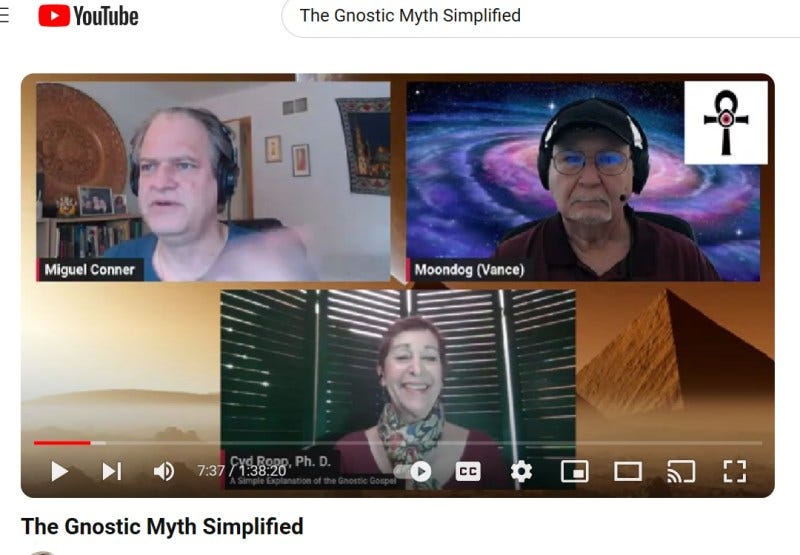
Earlier this week I was a guest on Aeon Byte Gnostic Radio and was interviewed by Miguel Conner about my new book—A Simple Explanation of the Gnostic Gospel of the Tripartite Tractate. The interview was about an hour and a half—very extensive. So, I hope that you will catch it. It’s on YouTube, but he’s also posted it to audio-only podcast platforms. The name of the episode on Aeon Byte was The Gnostic Myth Simplified. So that’s what you would look for. This week we’re going to look at the three-part nature of humankind, as presented by the Tripartite Tractate. We humans and all other creatures are called the second order of powers. The first order of powers are the Aeons of the Fullness, and we are their fruit. We have a three-part nature. This is why it’s called the Tripartite Tractate: tripartite, meaning three parts, tractate, book. It’s not just because this book is divided into three sections, which it happens to be, but it is because it describes the three-part nature of God, the three-in-one, and we humans are fractals of that tripartite system. And, by the way, I talk a lot about fractals in that Aeon Byte interview. The first part of our nature is our version of the monad of the Father, the Son, what is called our Self, with the big S. Self is what we call it here at Gnostic Insights; other people often refer to that as your spiritual aspect. The second part of the 3-part structure is called the psychical, our association with the Aeons of the Fullness, because we are representations of the Aeons of the Fullness; we are fractals of them. The psychical part is our psychological nature. It’s the part of us that thinks. Our third part is associated with the ego of Logos after the Fall. And our third part is the material level—the hylic. So, reading from the Tripartite Tractate, “To those who belong to the remembrance…” and those are the second order powers, because we are of the good thought, the remembrance, whereas the material world is of the presumptuous thought—the Fall. The material world is based upon egoic strivings of Logos in particular, and we all carry that ego forward through our material aspect, and so that’s why it’s called “those of the presumptuous thought,” because it was presumptuous of Logos to think that he could reach the Father and reunite without the Fullness. So, the presumptuous thought is the material level, whereas “those of the remembrance” is the psychical, or psychological level—our thinking, our thoughts and the fact that we can remember that there is a Father above. We remember we were pre-existent consciousness because we are all of the remembrance. But, of course, we forget it. We get all tangled up with the material and we forget our higher nature. Again, “To those who belong to the remembrance, however, he revealed the thought of which he had stripped himself with the intention that it should draw them into a communion with the material.” So let’s think about that sentence. We second order powers, we humans in particular, we belong to the remembrance, and all of the second order powers belong to the remembrance. The flowers remember the Father, the dogs and cats remember the Father. All the creatures on Earth, even the cells of your body, remember that we come from the Fullness and from the Father, because we all have to remember in order to instantiate the Golden Rule of cooperation, and it is cooperation that builds our bodies up from single celled, fertilized eggs, all the way up to whatever creatures we become. That’s the remembrance of the Father. So, we second order powers belong to the Father, but we also belong to Logos because we’re fractals of Logos himself. And, remember, Logos himself was a fractal of the Fullness of God, so he was already one iteration down from the entire Fullness. And we are a second iteration down because we’re fractals of Logos and the Fullness down here below. “He revealed the thought of that which he had stripped from himself…” And what is that thought that he had stripped from himself? It’s his ego, it’s his presumptuous thought. Logos, after the Fall, finds himself down here below in another dimension and he goes, what the heck did I do? He then stripped himself of the imitations of the likenesses. And the imitations of the likeness are imitations of the Fullness; imitations of the broken open fractals that Logos carried within him when he Fell into this dimension. That’s why they’re called imitations; they’re not true fractals. They’re the shadows, the imitations, the phantoms of those fractals that Logos carried along with him. He stripped himself of the presumptuous thought. That presumptuous thought was his over-reaching ego. He left that behind and Logos, “the best part of him,” that would be his noble thought, that would be his representations of all the images of the Fullness of God—his true Self—he fled back up to the Fullness. He deserted the material plane and retreated back to the ethereal plane to go back home to his brethren in the Fullness of God. Quoting the sentence again, “To those who belong to the remembrance.” That’s us. “He,” that’s Logos, “revealed the thought of which he had stripped himself.” So he gave us the egos. When we second order powers came down, we came not only with the good thoughts of the Fullness of God, but we came down with the presumptuous thought that Logos had peeled off of himself, that being his over-reaching ego. And that is why we have both the higher Self and we have an egoic structure, the ego. Our ego is a reflection of the Fall. All of the Aeons, the first order of powers, also have egos. But their egos are simply their position, place, name, rank, and duties. It’s the thing that defines them as individuals, and their relationship with neighbors. Down here below, our egos also reflect the over-reaching, presumptuous thought, and that’s how we second order power egos differ from the first order power egos. It’s not just who we are—our sense of identity—it’s also a drive for power, a striving to be on top. “He revealed the thought of which he had stripped himself with the intention…” So why did he do that? Why did Logo saddle us with that ego? “… with the intention that it should draw them into a communion with the material.” If we didn’t have the ego making us want to cling to these material bodies, to this material instantiation, we wouldn’t have been able to meld ourselves to the material world. Our bodies are made up of the mud from the bottom up. Our bodies, the hard parts of our bodies, the subatomic particles, the particles, the atoms and the molecules, that is the material part of the Demiurge. That is demiurgic. It’s not evil, it’s just material, whereas up above it’s ethereal. And it was given to in order for us to be able to stick the landing when we are born here into the world when we exit the ethereal plane and are literally born into this material world. You know, we begin at the cellular level. Life comes in at the cellular level. The Demiurge has the power from the mud up through the molecules. But the creatures, living creatures, all living creatures, from the bacteria on up—all the soft, squishy parts that coat the hard, rocky parts—that is the second order of powers. That is “those of the remembrance” at conception, coming in to that molecular level, coming on top of it and then through the pattern of the Fullness above, as directed by Logos, because we are the actual fractals of Logos, not the fallen fractals of the Demiurge. The Fallen fractals of the ego of Logos is the material level only, but we of the remembrance, the psychical,… This is a public episode. If you'd like to discuss this with other subscribers or get access to bonus episodes, visit cydropp.substack.com/subscribe
Embed this episode
No transcript yet.