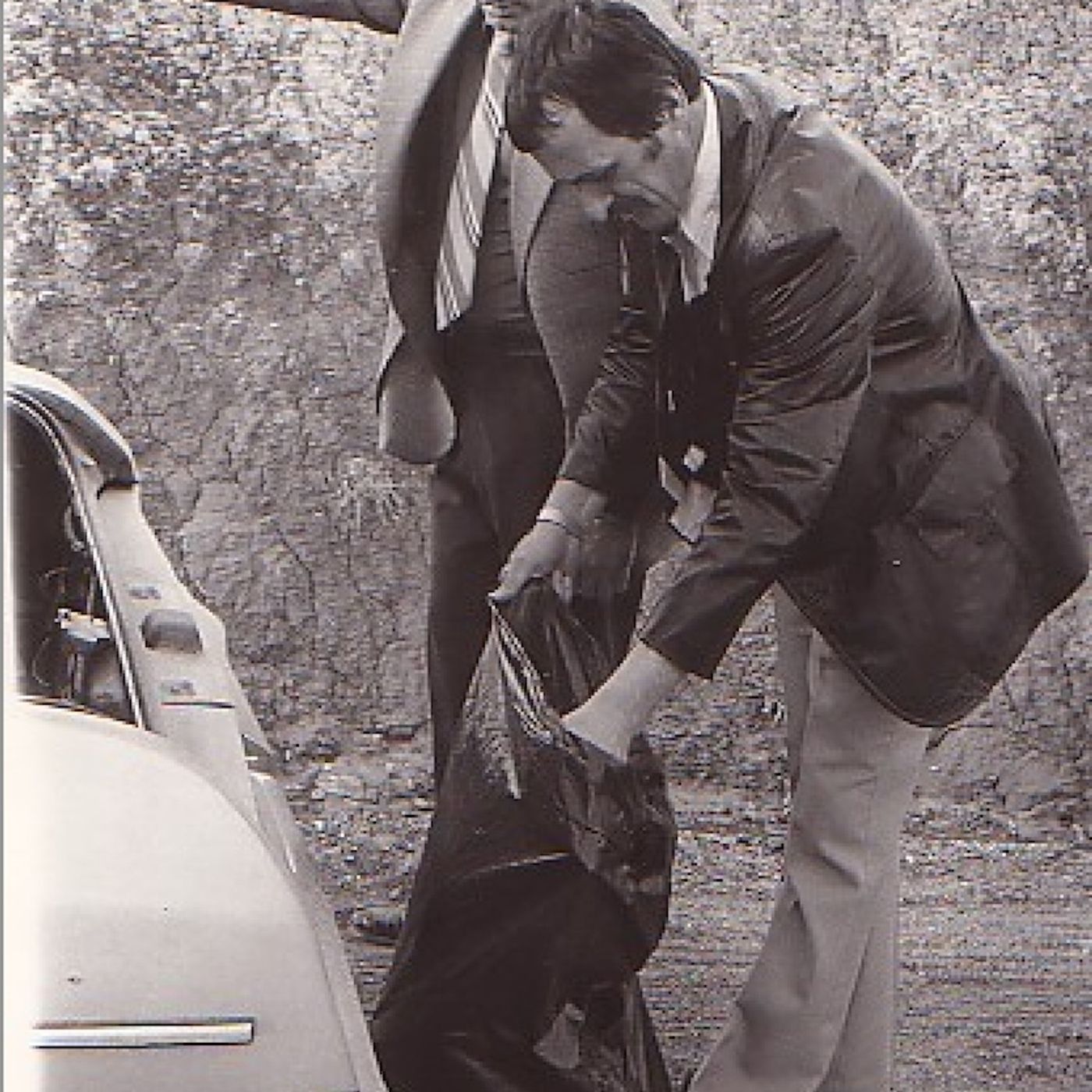
There's a photo of Sarté du Québec agent Jacques Filion staring into a garbage bag of clothing. At my sister's dump site the morning she was found April 13, 1979. Rockwood row is with him pretending to gaze into the plastic bag. Wish you were here as the agents misidentified as Jacques l'Assard, but it's Filion, the guy from Thécto's case.
Filion was the agent who recovered Carol's clothing. There's a second photo from that morning, Good Friday, April 13, 1979. The two agents standing next to a tree or a tree's bodylay, pretending to have a conversation. The photos are staged.
The detectives really aren't doing anything. They're not really investigating. It was never determined whose clothing was in the bag. It wasn't Theresa's.
It was Atécto's. Not the clothes she was wearing. Filion found those. But what if it was clothing left with her young boyfriend, Marc Charla?
What if, around the time the agents' rail, Chateau Nuff, found that bullet-rilled birch log under the basement stairs at the Charla's? Around January, 1979, his big brother Jean noticed the clothing in Marc's room and told his little brother something like, Hey, you gotta get rid of that stuff. You're under 18. You don't want the cops thinking you had anything to do with her shooting.
So Jean Charla gathered All-Fecto's stuff, put it in a garbage bag and ditched it, but just for a laugh. Just to screw around with police, he tossed it at the site where he knew later that spring when the snow melted, they were gonna find another dead girl. Some joke, right? Because Jean Charla knew the police weren't going to mess with him.
He's a made man. So when Jean-Fecto looked into that garbage bag, Good Friday, April 13, 1979, and he saw the clothing, did he know at that moment, on the eve of Fernando La Plante's trial for two murders he did not commit, that they started to take it back? Was missing the big picture? That they had a serious problem on their hands with sexual murder?
This is who killed Theresa. The first to be murdered, Charla Fecto would be the last to have her day in court. Once again police decided to put Fernando La Plante on trial, and no one else. Once again La Plante was assisted by defense attorney Jean-Pierre Rancor, who won a motion to move the process to Collinsville about 100 kilometers west of Sherbrooke due to the excessive publicity during La Plante's first trial.
The Crown was represented again by Claude Melison, and both attorneys agreed to include several admissions from the Grimard and Bergeron murder trials in an effort to avoid redundancy and speed the judicial process. This was going to be a swift, hatchet job. Fecto's affair opened on Monday, November 19, 1979. Jacques Mungo testified that he and a friend had gone fishing in a stream near East Harford on June 24, 1978, and discovered the nude body of a young woman who was, quote, white, not breathing and appeared to have worms coming out of her skin.
A provincial public works employee then took the stand to say on June 26, he found a wallet at the side of a gravel road running toward East Harford, before taking the wallet to police. The man blazed a tree with an axe to mark the location where the wallet was found. A forensics expert told the court that Fecto died from two bullets shot from a handgun, the first having entered the nape of the neck at a distance of about six feet, while the second entered Thorax penetrating the left lung and heart, which could have been fired from point blank range. There were no traces of alcohol in Fecto's body, and for some reason Fecto was not tested for drugs.
This expert stated Fecto had not been sexually active 24 hours prior to her death. SQ photographer Guimont de Biègien testified how he took photographs of the scene near East Harford, and said he was struck by the tattoos on her body but could not recall noticing any names. The excuse Michel Poulon said he took aerial photographs of the scene in January and October 1979, as well as some of the Wellington Street area of Sherbrooke on November 15. So it was SQ Agent Jacques Filion who eventually ended up with the wallet, and he testified that her clothes, jeans, underwear, sweater were recovered the same day as her torn poncho at two different points on the same road.
At this point, Jean-Pierre Rancour asked if Filion was aware that Mark and Jean-Charlotte lived in the Lennoxville area at the time of the crime. Filion confirmed that he was aware. The next day in the process, the Sherbrooke record reported something very curious. This is from November 22nd, 1979, Judge Sets Press Rules.
The majority of yesterday's testimony in the case of Fernand La Plon charged with the first degree murder in the death of Carol Fecto at East Harford on June 20th, 1978, was devoted to the testimony and cross-examination of a young male. The press, notably only represented by the record, were forbidden to mention his name, address, age, occupation, as well as the Christian name of his brother, Justice Jean-Louis Pelique also imposed other restrictions concerning his testimony. Yeah, so the absence of the Township's major French newspaper, Le Travión, was so noticeable. It was called out by the Township's sister English publication, the record.
In fact, Le Travión was missing for the first six days of the trial. And the young male, the courts were trying to protect, was rather obviously Carol Fecto's boyfriend. It was Mark Charla. And that's obvious.
And the Christian name of his brother was Jean-Charlotte. However, having not been present to hear this information, Le Travión never got the courts publication ban. And so they proceeded to expose the name Charla, all through their subsequent reporting. Here's an example of it, put it online.
Probably, we'll put Charla, Charla, online if you go to tressilor.com, T-H-E-S-A-A-L-L-O-R-E point. There's many, many visual goodies for this story. Under the court's protection, Mark Charla's testimony was essentially a mini version of Jean-Charlotte's story in the Grand Mart and Bergeron trial. He blamed for non-Le Plante for the murder of Carol Fecto.
Mark Charla claimed that Le Plante once told him Fecto, quote, was a bitch and had to die. I don't know why you would put that out anyway. I'll lose it here. If I was sticking to the script.
So then on June 20th, 1978, the night of Fecto's disappearance, according again to Mark Charla, Le Plante again confided that Fecto, quote, was dead and that her case was settled and that he had put her in a creek. Rather specific. And apparently, for now Le Plante couldn't stop talking about Fecto because on June 21st, the 34-year-old Le Plante again confided to this boy under the age of 18 that Fecto, quote, had bullets in her head and heart because she sent two guys to jail. Under cross-examination, Mark Charla toned down his statement and that he then said that he may have misinterpreted Le Plante's remarks.
Mark Charla's testimony was the chief evidence used by the Crown to prosecute Le Plante. Basically, they had nothing else up their sleeve. This was it. The Crown brought back Fecto's roommate, Helen LaRachelle, and under cross-examination, Jean-Pierre Rancore, got her to admit that shortly before her roommate's disappearance carol on or around June 20th, 78, their apartment was visited by two brothers who must remain anonymous.
But who we know now are Mark and Jean-Charla. Nothing up my sleeve. Fecto talked on the phone twice to Joanne, someone named Joanne Tungay, before she left the apartment around 8 p.m. and headed towards Wellington Street.
Mario Vallez was back and he repeated his testimony that he had once been convicted of arson charge with the brother of the anonymous witness. Again, Jean-Charla, he had been named only six months earlier by Vallez for this incident at the previous trial. Le gets juicier, apparently Charla had lived in the apartment that they burned down on June 4th, so I guess he no longer wanted to pay rent. And if you want to figure, Charla is flip-flopping, right?
Sometimes he lives on Wellington, sometimes he's at his parents' place, as anyone in his 20s would have done. What Mario Vallez then provided was a window into the underworld of the Wellington area in the late 1970s. He said that he was active in the drug trade in Sherbrooke, selling to both Jean-Charla and Ray-Mann Tiu, Grumard. According to Vallez, Grumard sold drugs to girls like Charla Fecto.
He said the main areas where drugs were pushed in downtown Sherbrooke included the Moulin Rouge, the Petibouff, Sinclair's pool room, the bar at Le Masc, the Queen's Hotel, and an amusement establishment, a place with slots and pinball. So this territory should all, by now, be illuminated. You know it. You know exactly what Vallez is talking about.
Vallez said he had seen Jean-Charla with a 32-caliber handgun capable of firing eight shots. He could not discern whether it was an automatic or a semi-automatic. He placed the time he had seen the gun as being between the week after the arson on Wellington Street, which he said was set on the night of Festive Al-D'Cantons in early June, 1978. On the stand, Vallez refused to name others who sold drugs in the area.
He said some of them worked for me and I don't want to identify them. He noted that he never made a drug transaction with Fernando La Plante, as he was not to his knowledge part of the crime milieu in the King and Wellington area. So again, as was the case with Grumard and Grumard in Bercionron trial, most of the evidence appeared to be pointing to Jean-Charla and his brother Mark, not La Plante. And you can say that some of this is hearsay, but I would say the differences in the differences when the Charlaans are saying something is not corroborated by anyone.
What Vallez is saying is backed up by Helen Laura Schell's story, and then we'll see later, someone else's story. So Jean-Charla had a handgun, and though police found ammunition at La Plante's apartment, they were never able to recover a weapon linking him to effect those murder. La Plante was not part of the Wellington milieu. Jean-Charla had lived within blocks of Ficco's apartment, and he was one of Ficco's drug suppliers.
Jean-Charla and Mark Schelland were two of the last persons seen with Ficco at her apartment on San Buer. Mark Schelland was Ficco's boyfriend, where his La Plante appeared to have no motive to kill her unless it was a contract killing. And then finally, for La Plante, does not strike me as being a blabbermouth, though there was a lot of testimony of witnesses putting words in his mouth. If you recall the Regis La Chaus episode on the balcony, and the Grand Mart and his bitch remark.
La Plante served 40 years in prison, and he never talked. Jean-Charla, on the other hand, will get there. Daniel La Chaus testified that he learned of Carol Ficco's death from Jean-Charlaa, while the two were playing a game of snooker at the Sinclair Pool Hall. We left the pool room and moved about 500 feet to the Moulin Rouge.
I suffered in La Plante, sitting at the bar in my companion, Charla, and I went to sit at a table near the stage. At this point, Jean-Charla and bragged about Ficco again, telling both of them, she's well off, and she'll be frozen there all winter. It's optimistic he's counting on her staying frozen for over a year. Bousier said, I asked what had happened as I had seen her with Grand-Mar de Neut prior, and his answer was, wait and see, you'll find out.
Several days later, Bousier's met up with Jean-Charla, and this time Charlaa told him to shut up. I did, because you can get into trouble with the mob if you talk. Bousier's told the court that the last time I saw Ficco alive was when she was with T'ilou Grand-Mar de on June 20, 1978. So this would be the Cadillac, I believe, on Short Street in the evening.
Bousier's then repeated the mob rule on silence and crimes that might implicate others. But Jean-Charlaa couldn't stop talking. Finally suggesting that Charlaa Ficco had been slain by the Grand-Mar gang as a result of a foul-up and a drug deal. He told me she had a good go before she was killed, and I presumed she was raped.
In his closing argument Jean-Pierre Rancor asked the jury to acquit for non-lapplant on grounds that it was improbable that his client murdered Charlaa Ficco. He mentioned that on the evening of June 20, 1978, her roommate Helen LaRachel observed Ficco leaving their apartment around APM for a mysterious meeting on Wellington Street. As we said, Ficco was later seen by LaCha Bousiez in the Cadillac of T'ilou Grand-Mar de in the Wellington area. Rancor noted that the same evening for non-lapplant was not in Sherbrook, he was in Lenoxville, doing some welding work for a garage owner.
Rancor told the jury that, quote, no one would be crazy enough to tell a boy that he had killed his girlfriend. In fact, the first person to mention Ficco's murder was Mark's brother Jean when he told Bousiez she's well off and she'll be frozen there all winter. Rancor expressed his opinion that Ficco was the victim of a drug deal in which she was involved and to which his client was a stranger. He concluded by saying that the jury did not have to find out who killed Ficco but to decide whether or not it was LaChlant.
On December 5, 1979, Fernando LaPlant was acquitted of the murder of Cattle Ficco. Fernando LaPlant burst into tears and said, just this is well done. He would return to prison for a three-year sentence for the armed robbery in Montreal and his life sentence for the first degree murders of Raymond Gromard and Manuel Burjourain. Well done indeed.
It may not have been the jury's job to determine who killed Cattle Ficco but it was someone's. And I'll venture a wild-ass guess and suggest that it was the police's job. Crown Attorney Claude Melison made a show of wanting to retry LaPlant but that too fizzled. Ficco's murder was left permanently unresolved.
This is something from Jean Pierre Rancor's book Confessions of a Criminalist. He talked, of course we've said this, he talked about the LaPlant case and how it affected him. He called it a cause that he still has on his heart. And then he said this interesting nugget.
He said, LaPlant had repeated to me that he was innocent in the Gromard and Burjourain case. He had not made such assertions for the murder of Carole Ficco. Why did Fernand LaPlant marry Claire Dusso in July 1978? Post.
Post the Ficco Gromard Burjourain murders. It wasn't anything sentimental. It was a question of spousal privilege so that Dusso could not testify against her husband. This was an old trick LaPlant had been the criminal partner of Gasthon, Moustache, Roshu, Ajita.
The two belonged to a crew that specialized in breaking in entries. They were responsible for hundreds of robberies and sherbrooke in the townships. When the law caught up with the Moustache Roshu, he tried to marry Christian Bueve before any criminal processes were initiated. Now, recall that Fernand LaPlant also knew Regis L'Champs.
Like Bueschou, they also may have been criminal partners. And they spoke about business in the summer of 1978 while Regis was standing on that balcony of his apartment on Rue LaRoc. Regis also married one of his wives in a hasty fashion. Regis wed Denny's Corbanon on October 27, 1978 of Friday, which is curious when I wait until the Saturday when the whole family can make a party of the occasion.
But no, Regis was married on Friday, October 27, 1978, exactly one week before Theresa L'Or's disappearance, and two weeks prior to the Aloha Motel Fire. So this marriage trick appears to have been something that was hand down from Kondacon. Note that when Corner Jean-Pierre Revard issued his verdict on October 16, 1978 holding Fernand LaPlant, criminal, criminally responsible for the violent death of Carol Fecht. He also named Claire Dusseau equally complicit in the murder.
And if you want the proof, I have the coroner's verdict posted on the website. Clearly, it basically says go arrest Fernand LaPlant and Claire Dusseau had done my work. Dusseau was set to also stand trial for Fechtau's murder, but the process fizzled as well. Dusseau was called to testify at Fechtau's murder trial, but she was a no-show.
In the summer of 1978, the Cervaté de Quebec placed a legal wiretap for Fernand LaPlant's phone in his apartment on Belvedere. At the trial, the prosecution had filed into evidence a transcript of two intercepted telephone conversations by the police at LaPlant's home. And the first, LaPlant talked about his recent marriage. It declared Dusseau about how it could help quote on many sides.
In the second, the phone conversation referenced someone called little cousin 32, who was quote, dead, finished, finished, finished. Little cousin is a familiar term, it can be in many things, but it's worth mentioning that Cervaté was the little cousin of Denis Cote, the wife of Gerald LaShance, and Gerald LaShance was the brother of Regis LaShance. I'll leave you here today with a puzzler. On Friday afternoon, September 2nd, 1977, so go back and back and back, two years, the start of Labor Day weekend, someone shot 37-year-old Monique Marchant, a butcher's store clerk and mother of three, while she was working the counter of her store in East Harford.
The lone bandit robbed the Fernand Marchant Abattoir, grabbing only a handful of cash from the till, and got away on a waiting red and black Camaro with American license plates, later found abandoned on a secondary road. This market was located two and a half miles south of East Harford, along the road to the Beecher Falls-Rémont border, crossing. Madame Marchant was alone in the storefront when the incident occurred, but her father-in-law, Johnny Marchant, was in the back room. He said he heard a shot, and when he approached the front, he saw a man standing near the cash, with the gun pointed at his daughter-in-law.
Madame Marchant was about to launch a meat cleaver at the man, at which point he shot her in the head. What's curious about this mom-and-pop store robbery in Nowhere'sville, Quebec, is that the investigation was headed up in none other than Rock-O-Drow from the Sherbrooke, started to Quebec, nearly 60 kilometers away. One wonders why someone like Jacques-Fillon didn't take charge from the much closer, quadacook detachment. Goodrow's first action was to set up roadblocks, which tells you that almost immediately the police didn't think they were looking for a local.
By Monday, police had arrested Michel Belé, and when the story broke in Montreal Gazette, that the notorious criminal, Belé was known for a string of faths from Quebec to Toronto to Kansas City. When he had been apprehended, Sherbrooke's surtité de Quebec called it, quote, pure fantasy. Michel Belé is absolutely not detained for this purpose. These journalists harm the investigation much more than they can help by making such declarations.
Nevertheless, at the conclusion of the holiday weekend, a breathtaking 72 hours after the Marchant shooting, Carparole Rock-O-Drow and Constable Noel Bullduke from the SQ's Criminal Investigations Bureau, along with Coroner Jean-Pierre Rivard, so a familiar trinity, quote, quote, "'Let it be known that they were certain of having solved the East-Herford murder, despite the fact that the only evidence against Belé was that he had once possibly lived in Sherbrooke. Belé was acquitted twice for this murder. The first occasion due to the un-corroborated testimony of an accomplice. In court, it was revealed that Corporal Rock-O-Drow fabricated evidence in order to incriminate Belé.
Specifically, Goudreau wrote two fictitious statements and then forged Michel Belé's signature on the documents. The documents would have implicated the accomplice in the murder, with the goal of then getting this accomplice to, in turn, blame the Belé for the murders. Goudreau's partner Noel Bullduke prepared the documents and then Goudreau signed them. So here we have the fabrication of evidence and police collusion in a manner identical to what SQ Agent Real Chatonuf described in the La Plante trial.
It's one of the tricks usually used. And used to get Jean-Charlant to incriminate Fernando La Plante. So this was not a one-time indiscretion on the part of Quebec police. It was a systemic practice of the Sarté de Quebec.
Police using what Bob Ulec called shortcuts, but it's no game. Lives were at stake when police played fast and loose with the law. So that's the first acquittal. On second occasion, an expert determined it was physically impossible for Belé to have driven from East Hartford to where he was later spotted that evening in Montreal in the time allotted.
Even a car racing champion would have been unable to overcome the distance, he said. By 1985, Michel Belé simply gave up and pleaded guilty. I imagine choosing to serve his time rather than gear any more nonsense from the Quebec judicial process. So let's get to the nut.
Why does anyone go to East Hartford? Give up. For the same reason you take a boat across the international waters of Lake Memphra, Magog, it's a border town, it's a port of entry for cars and drugs, guns, or drugs and guns in cars, if you prefer, smuggling. Whoever robbed the butcher in 1977 and it wasn't Michel Belé had more on their mind than the meaningless handful of cash they grabbed from the register.
And that abandoned Camaro? Well, the assailant didn't just walk out of East Hartford. It was more than one person involved, and there were two cars. We've mentioned that even Attorney Ron Cora suspected La Plante had a hand in facto's murder, and that La Plante was from Quatacook, just 25 kilometers west of East Hartford as the Grove Fries.
Now, for a time for not-la-plante had worked as a farm-labor on the land where cattle-effectos body was discovered, Buck Creek. That never came out at trial. But it's believed that the reason the Crown wanted to call Claire du Soute of the sand was to testify that the evening of facto's murder for not-la-plante was not welding at Atlantic Silverage, but was actually in Quatacook visiting family. That makes for not-la-plante probable as one of factos assailants, but not all of them.
As with Monique Mochon's shooting and the murders of Gremard and Bergeron, where Jean-Pierre Roncours suggested there were as many as four in that case, there was more than one person involved in cattle-effectos murder. For what do we make of Danielle Le Chant, Bussy's testimony that Jean-Sarlain said facto had a good go before she was killed? For a gang rape to occur, you need a gang. And never mind the forensic expert who testified that facto had not been sexually active prior to her death.
As Jean-Claude Burnheim, the criminologist, has stated many times, experts lie about these things to support a police narrative. They lie, or they did not. They do not understand the full arsenal of opportunities available to an offender over women when contemplating the nature of rape. So yes, someone in that party may have wanted the facto killed because she had a big mouth or she screwed up a drug deal, but someone else or other persons in that party wanted something else, something in addition to having her killed.
Because it's simply not a simple contract killing. You don't strip the body naked if it's just a murder for hire. You leave her like they left none on Bergeron, clothed. You don't toss evidence along a gravel road like the clothing in a wallet like they did with Theresa Lour.
Someone or others in that group wasn't just a contract killer. They were also a sexual murderer. This is who killed Theresa. If you like the podcast, you can follow us on social media.
Go to the website, tresour.com, T-H-E-S-A-L-L-O-R-E-E-Point.com and you can find links to all of our social media outlets. We're on YouTube, Facebook, Twitter, Instagram, and Substack. Subscribe to the Substack count. Even better, it would be great if you liked it on iTunes.
That's always helpful. Give a five-star review by the book. Wish you were here. It's on sale now in Canada and the United States for a song.
Really, I think it's like 13 bucks. If you have an Amazon account, that shipping is free. There's also copies locally here in North Carolina at where is it? It's at McIntires and Farrington Village.
It's at Flyleaf Books in Chapel Hill. It's a bookstore in downtown Durham. It's there as well. That's all for today.
I hope you enjoyed the show. Stay with us. Don't go to sleep yet because you'll blow it. You didn't invest 20 episodes to go to sleep now.
It's just getting good. There are 20 episodes of set up. We'll do one more. We'll do one more set up.
And then I'll tell you what's on my mind here. And then I'll end up in a piece of super cool. Now what should you do? This has been Who Killed Theresa.
I'm your host, John Allure. Have yourselves a great, great day.