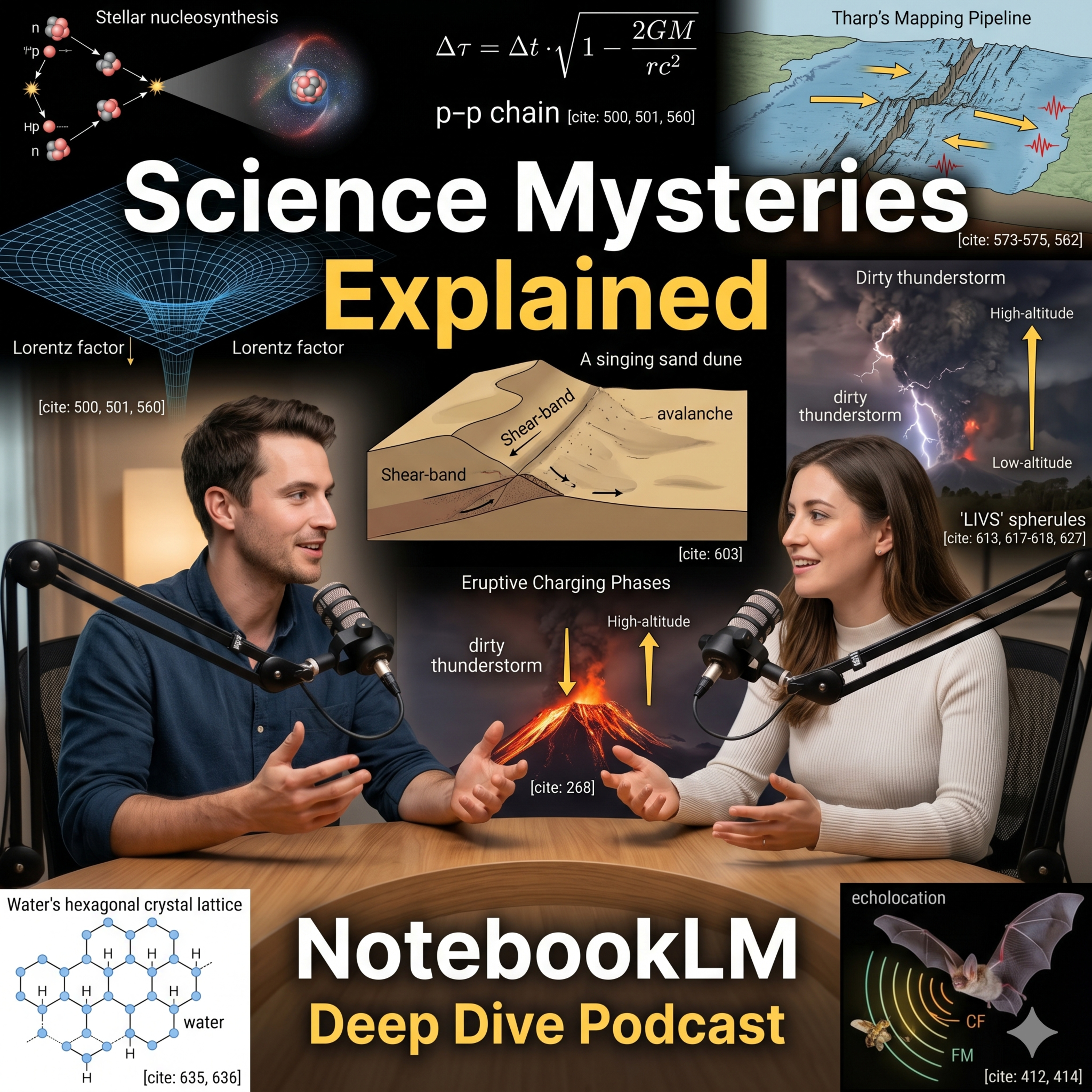
Mysteries of Science episode artwork

EPISODE · May 22, 2026 · 59 MIN

Mysteries of Science

from David's NotebookLM Audio Collection · host David Weissman

Based on the structured framework and underlying audio files, this specific NotebookLM Deep Dive podcast features two hosts—a curious questioner and a scientific explainer—who engage in a conversational journey to deconstruct how the world's most iconic natural puzzles transitioned from ancient myths into empirical realizations. Rather than leaving nature explained by supernatural gaps or divine wrath, the hosts talk about the exact physical, chemical, and biological mechanisms that govern a highly integrated planet. Over the course of their dialogue, the hosts systematically examine one hundred historical mysteries organized across four distinct thematic pillars.The Cosmos: The hosts discuss the machinery of the universe, explaining how the Sun isn't actually on fire but is a self-regulating nuclear fusion reactor. They talk about how gravitational torque and orbital synchronization tidally locked the Moon to always show the same face to Earth , why starlight twinkles due to atmospheric turbulence , and how the expansion and finite age of the universe resolve Olbers' Paradox to keep the night sky dark. Earth's Geology: The conversation pivots to a geophysically alive Earth, tracing how Alfred Wegener's mocked theory of continental drift was vindicated by mid-ocean rift valleys and mantle convection currents. They deep-dive into the physics of earthquakes as sudden releases of elastic strain , the fluid dynamics of liquid iron that power the core's geodynamo , and the precise physics behind how a freezing 9% volume expansion allows ice to float and insulate aquatic ecosystems. Biology & The Human Body: Moving into living systems, the hosts explain the bio-electrochemical pacemaking of the heart's sinoatrial node , the historical triumph of germ theory over the "bad air" miasma fallacy , and how plants harvest photons to split water during photosynthesis. They highlight remarkable evolutionary adaptations, discussing how a caterpillar activates imaginal discs to digest its own tissue into a biological soup inside a chrysalis , how bats utilize ultrasonic echolocation to map the night sky , and how baleen whales exploit the ocean's acoustic SOFAR channel to transmit songs across entire ocean basins. Physics & Nature's Patterns: Finally, the hosts analyze the mathematical rules of the physical world. They talk about how atmospheric gas molecules preferentially scatter shorter wavelengths of starlight to make the sky look blue (Rayleigh scattering) , what fire actually is at an atomic scale , and how geometric optics refract and internally reflect light inside spherical raindrops to produce a rainbow. They also look at nanoscale mechanics, detailing how geckos use atomic van der Waals forces across millions of keratinous setae to effortlessly walk upside down on polished glass ceilings. Ultimately, the hosts frame these discussions around "wow moments," emphasizing that scientific explanations do not make the universe smaller or less beautiful—knowing the exact math, chemistry, and physics behind these phenomena only makes nature infinitely more wondrous.

Based on the structured framework and underlying audio files, this specific NotebookLM Deep Dive podcast features two hosts—a curious questioner and a scientific explainer—who engage in a conversational journey to deconstruct how the world's most iconic natural puzzles transitioned from ancient myths into empirical realizations. Rather than leaving nature explained by supernatural gaps or divine wrath, the hosts talk about the exact physical, chemical, and biological mechanisms that govern a highly integrated planet. Over the course of their dialogue, the hosts systematically examine one hundred historical mysteries organized across four distinct thematic pillars.The Cosmos: The hosts discuss the machinery of the universe, explaining how the Sun isn't actually on fire but is a self-regulating nuclear fusion reactor. They talk about how gravitational torque and orbital synchronization tidally locked the Moon to always show the same face to Earth , why starlight twinkles due to atmospheric turbulence , and how the expansion and finite age of the universe resolve Olbers' Paradox to keep the night sky dark. Earth's Geology: The conversation pivots to a geophysically alive Earth, tracing how Alfred Wegener's mocked theory of continental drift was vindicated by mid-ocean rift valleys and mantle convection currents. They deep-dive into the physics of earthquakes as sudden releases of elastic strain , the fluid dynamics of liquid iron that power the core's geodynamo , and the precise physics behind how a freezing 9% volume expansion allows ice to float and insulate aquatic ecosystems. Biology & The Human Body: Moving into living systems, the hosts explain the bio-electrochemical pacemaking of the heart's sinoatrial node , the historical triumph of germ theory over the "bad air" miasma fallacy , and how plants harvest photons to split water during photosynthesis. They highlight remarkable evolutionary adaptations, discussing how a caterpillar activates imaginal discs to digest its own tissue into a biological soup inside a chrysalis , how bats utilize ultrasonic echolocation to map the night sky , and how baleen whales exploit the ocean's acoustic SOFAR channel to transmit songs across entire ocean basins. Physics & Nature's Patterns: Finally, the hosts analyze the mathematical rules of the physical world. They talk about how atmospheric gas molecules preferentially scatter shorter wavelengths of starlight to make the sky look blue (Rayleigh scattering) , what fire actually is at an atomic scale , and how geometric optics refract and internally reflect light inside spherical raindrops to produce a rainbow. They also look at nanoscale mechanics, detailing how geckos use atomic van der Waals forces across millions of keratinous setae to effortlessly walk upside down on polished glass ceilings. Ultimately, the hosts frame these discussions around "wow moments," emphasizing that scientific explanations do not make the universe smaller or less beautiful—knowing the exact math, chemistry, and physics behind these phenomena only makes nature infinitely more wondrous.

NOW PLAYING

Mysteries of Science

0:00 59:43

No transcript for this episode yet

We transcribe on demand. Request one and we'll notify you when it's ready — usually under 10 minutes.

No similar episodes found.

No similar podcasts found.

Frequently Asked Questions

How long is this episode of David's NotebookLM Audio Collection?

This episode is 59 minutes long.

When was this David's NotebookLM Audio Collection episode published?

This episode was published on May 22, 2026.

What is this episode about?

Based on the structured framework and underlying audio files, this specific NotebookLM Deep Dive podcast features two hosts—a curious questioner and a scientific explainer—who engage in a conversational journey to deconstruct how the world's most...

Can I download this David's NotebookLM Audio Collection episode?

Yes, you can download this episode by clicking the download button on the episode player, or subscribe to the podcast in your preferred podcast app for automatic downloads.
URL copied to clipboard!