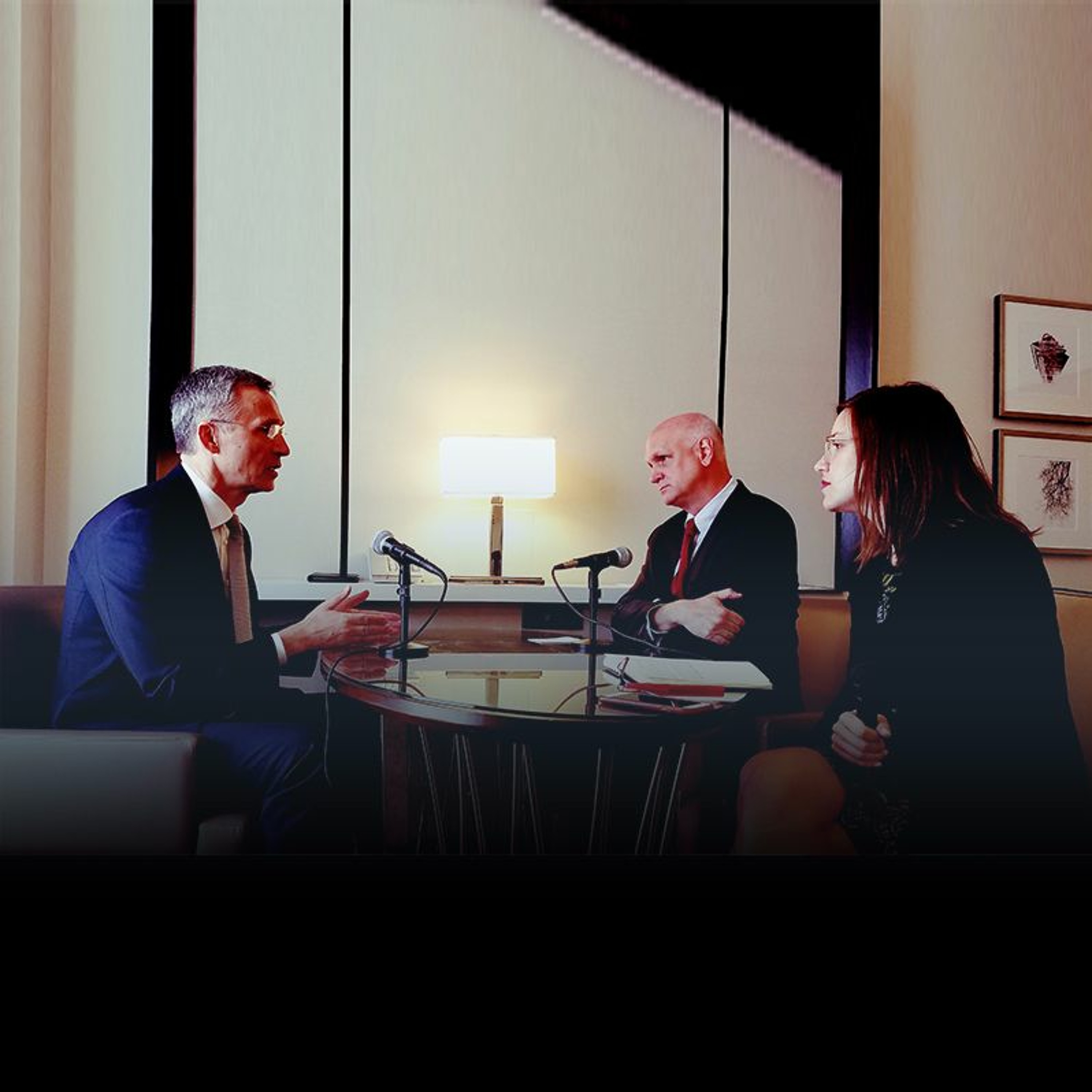
I'm Rachel Rizzo. I am the research associate with the newly renamed Transatlantic Security Program here at CNAS. And I'm Jim Townsend, and it is a great pleasure to be part of this new team and to work with Julie Smith. Julie isn't here today.
She is up in Chicago. But with us today is the NATO Secretary General Jens Stoltenberg. It is such an honor to be here with you, one of the great secgens of NATO. And thank you for giving us some time today.
Thank you so much for having me. Mr. Secretary General, I'd like to ask you one kind of broad overarching question before we get started. So you've been in the business of diplomacy and government service for a very, very long time.
Now as NATO Secretary General, but also as Prime Minister of Norway, Minister of Finance. In all that time working in diplomacy and more specifically transatlantic relations, is there one great truth that you've taken with you during your career? Maybe something that you can't learn from a book or a mentor, but a great truth that you've gained personally from your own personal experience? I think that's the importance of being able to make compromises.
Because in politics, and especially in democracies, it's very often necessary to reconcile different positions, different views. And sometimes compromises is regarded as a kind of a bad thing. But actually I think that in the long run it's a good thing to be able to make compromises and also to balance different interests. Interests not either being extreme in one way or another, but find some kind of middle ground.
So the importance of compromises is perhaps the most important thing I've learned. I think that's really interesting because in the Nordic countries, I think that's a hallmark of the politics that there's compromise. And something Washington is trying to relearn. So as you're here, if you talk about that, that would be a good thing for us to hear here in Washington.
You know, I was watching the press conference yesterday with the president, and when you started talking about the relaying in Arlington, I could tell that that really meant something to you. And I thought about it, and you know, as both as Prime Minister as well as the SecGen, sending forces off where they could be killed is a big deal. And I know from all the secretaries of defense that I've worked with, and particularly Bob Gates, but Ash Carter too, that was something very important to them as they were signing letters to the parents of those that had given their lives. And so what was going through your mind when you were laying that?
What did you think about it? Respect for all those people who have paid the ultimate price in different military operations and missions. Taking part in NATO operations, defending allies, and I also have a gratitude to the United States because I wasn't born during the Second World War. You know, my parents, they always spoke about the American troops coming to Norway in the summer of 1945, and they were regardless big liberators and the sacrifices the United States paid in liberating Europe after the end of the Second World War.
And then, of course, Norway is very different from the United States, and the United States has participated in many more wars and have many more soldiers killed in action. But being in the Wichern Five Minister, I also made decisions about sending Wichern soldiers into operations, for instance, in Afghanistan, and then receiving the message that we have lost. Some soldiers are, of course, by far the worst message that you can get, and therefore I feel heavy responsibility in taking that kind of decision. So therefore I also think it's extremely important to other, those who have lost their lives, for instance, by laying the wreath at the Arlington Center.
Well, thank you for that. That's very moving just what you said, and I can tell that that certainly impacted you hours after that ceremony as you were at that press conference. You know, being a NATO, Nick, myself, I was imagining what it must have been like as a section, watching NATO get sucked up into the U.S. presidential campaign.
And I say that because normally, with us, when we do a presidential campaign, NATO's not part of it, even foreign policy since the end of the Cold War. It really hasn't been a big feature. But here you are as a section, and all of a sudden in debates back during the campaign, NATO was part of their burden sharing. All these issues that were the province of a small group of us all of a sudden were part of the campaign.
And not only that, but after the election was over, it stayed in the news. The 2%, personally, I was amazed the 2% was making headlines here in Washington. So you've been riding a tiger. I mean, this thing has been big.
You've now come for your visit, and it's been a great visit, a really successful visit. I thought the tone, the substance of the press conference was great. So what are your reflections on that? I mean, waking up one morning in Brussels and all of a sudden finding you're in the headlines of the American campaign, and then all through those these days, what was it like riding that tiger?
So I actually appreciated that NATO became a topic in the US election campaign, because that shows the relevance and importance of NATO. It's worth to be totally forgotten. So, of course, being part of a campaign, there are statements and there are different views, and then there are also, of course, disagreements. But that's fundamentally a good thing.
And the focus on NATO during the election campaign, and also after the election, has increased interest for NATO in general, and has helped me to push some of the important topics I am very focused on as a sector general, burden sharing defense spending, but also NATO playing an even more active role in the fight against international terrorism. So I'm fundamentally welcome that there's been a lot of attention on NATO in the United States. Yeah, I have too. I think Julie and I were in the press more than we've ever been in the press before, talking about NATO and educating.
It's just good for you to do that. Yes, I loved it. I just, you know, we have the summit right around the corner. And one thing I was thinking about, if I were your staff, on the international staff, as we were thinking about the summit, you've had the defense ministers, which I think went pretty well on the whole, and the foreign ministers went well.
This visit, as I said, has just been a really, really good visit. But you're going to be doing it again in a few weeks at the summit, this time with all the allies around the table, President Trump will be there. So, Hattie, what do you do at the summit to make sure it's not just a rehash of the ministerials and this visit? I mean, you know, a month or two ago, I would have written an article that said, you know, the United States is going to have to show our commitment and our relevance.
But that's got to be done. And you also, with your visit particularly, you've addressed the burden sharing, and you've addressed counterterrorism. So, for the summit, how are you going to manage that so that you really take the ball forward? What do you want to get out of that summit?
First of all, I think it's important to remember that this is kind of a special meeting, because it's not a full-fledged summit. That is, leaders, as I said, are coming to Brussels on the 25th of May. But we're actually going to do two things. One part would be to take part in a hand over, certainly, of the new building, which also includes the inauguration of a 9-11 memorial.
There's a piece from the Twin Tower, which will be in front of the new building, and it'll be in the headquarters of the new building. And then a piece from the Berlin Wall, commemorating the Cold War and the Berlin Wall. So, reflecting away the history of Article 5, 9-11, and then the Cold War, and then the new building. So, that will be an important part of the program, will be to take part in these ceremonial events.
Then we'll have one working session. So, this is not a full-fledged meeting, but we will then address burn sharing and counterterrorism. And, of course, defense ministerial meetings, foreign ministerial meetings, bilateral visits, all of that is important, but it's a very strong signal and something very different to have all 28 or actually 29 million euros. That's right.
Heads of state and government present in Brussels. And to be the first time the new U.S. president, but also the new French president, meets all the others. So, just to have them there, to have them standing together, the family photo, sends a clear and strong signal of unity.
You know, that's an interesting point about the family photo. You know, the family photo is always a thing you do when everyone's... But this family photo is going to be very important. And that's a very good point.
I look forward to that. You know, one thing I thought about with this summit is, you're going to have Donald Trump, who's the big real estate guy from New York, he knows real estate, he's me walking into that new building, looking around, and I'm sure it's real estate things going to be going. But he told me that he was looking forward to take part in this handover ceremony. That's right.
So Belgium, which has been responsible for the construction of the building, they handed over to NATO. So, and since he knows about property and buildings, then he will be an expert. It'll be great. That'll be very interesting.
So we're going to close now with one last question, because I know you need to get in your mode game. And that is, I think it's something that you and I, and we've been working on for a long time, in the sense of NATO relevancy. And I say that because when the campaign started with President Trump, he was talking about NATOs being obsolete. And I've always felt the word isn't obsolete.
Alliance is not obsolete, and NATO's not obsolete. But there's a relevance that we always have to worry about, NATO staying relevant. And you mentioned counterterrorism. You mentioned the other new threats that we're having to deal with, problems coming out of the migrant, you know, crossing the Mediterranean, this type of thing.
These are missions for which NATO wasn't developed to handle. NATO was developed to handle what we're seeing up in the Baltic, Nordic area, and Poland, that type of thing. So NATO relevancy has got to be something that helps us with these new challenges. And I always felt that the United States doing the counter-ISIL coalition, to me, it always felt like that should be NATO doing that.
I understand why NATO didn't. And you had some very good discussions with Ash Carter and others about NATO's role. As we finalize, as you get ready to leave, what are you thinking about NATO's relevance and what we need to do to keep it relevant for these new challenges? The reason why NATO is the most successful alliance in history is that we have been able to adapt to change, and the world is changing.
For 40 years, NATO was focused on almost only one thing, that was to deter the Soviet Union. And we did collect the defense in Europe, and we were very successful in order to end the Cold War without firing any shots. So actually, it was a peaceful end of the Cold War. And then people started to ask whether we needed NATO anymore.
But then NATO went out of air, as we say. We were starting to address crisis outside of NATO territory. We helped end two ethnic wars in the Balkans, in Bosnia-Segovina and in Colombia of Serbia. Then we fought terrorism in Afghanistan after the 1911 attack.
And it is important to remember that the only time we had invoked Article 5 is after an attack on the United States. And hundreds of thousands of European Canadians have served in Afghanistan alongside American soldiers. And now we have to change again, because we still have to manage crisis beyond our borders. We see more terrorism, more violence in Iraq, Syria, and while in India.
So we have to step up our efforts to fight terrorism. But at the same time, we have to, in a way, go back to Europe and do collective defense and deterrence again in Europe, because we see a more assertive Russia. And I'm actually impressed by the strength and the speed of NATO adaptation, because since 2014, we have implemented the biggest reinforcements of our collective defense. We have cheap old designs of the NATO response force.
We have deployed, or we have the process of deploying four battle groups to the east part of the alliance. We have established eight new full headquarters in the east part of the alliance. And we have stepped up, for instance, when it comes to cyber defense, hybrid warfare, and many other things. So decision-making.
So NATO has actually been able to adapt. And that just shows the relevance and importance of NATO also in the future. Yes, the NATO EU center. I celebrate that.
Not just because of the hybrid issue, which is important, but actually being able to do the, having NATO and the EU come together on a project like that, that you can actually touch, and you'll see them sitting side by side. That's worthy of celebration. So that's something I'm really, really, I was proud of NATO about. And I think we should be very, very loud in celebration of NATO and the EU coming together.
Absolutely. Well, Mr. Secretary General, thank you so much for taking the time out of your schedule today. We really appreciate you being here with us.
Thank you. Thank you so much for having me. Thank you.