
EPISODE · Mar 13, 2026 · 27 MIN
Nature Trail
from Soundwalk · host Chad Crouch
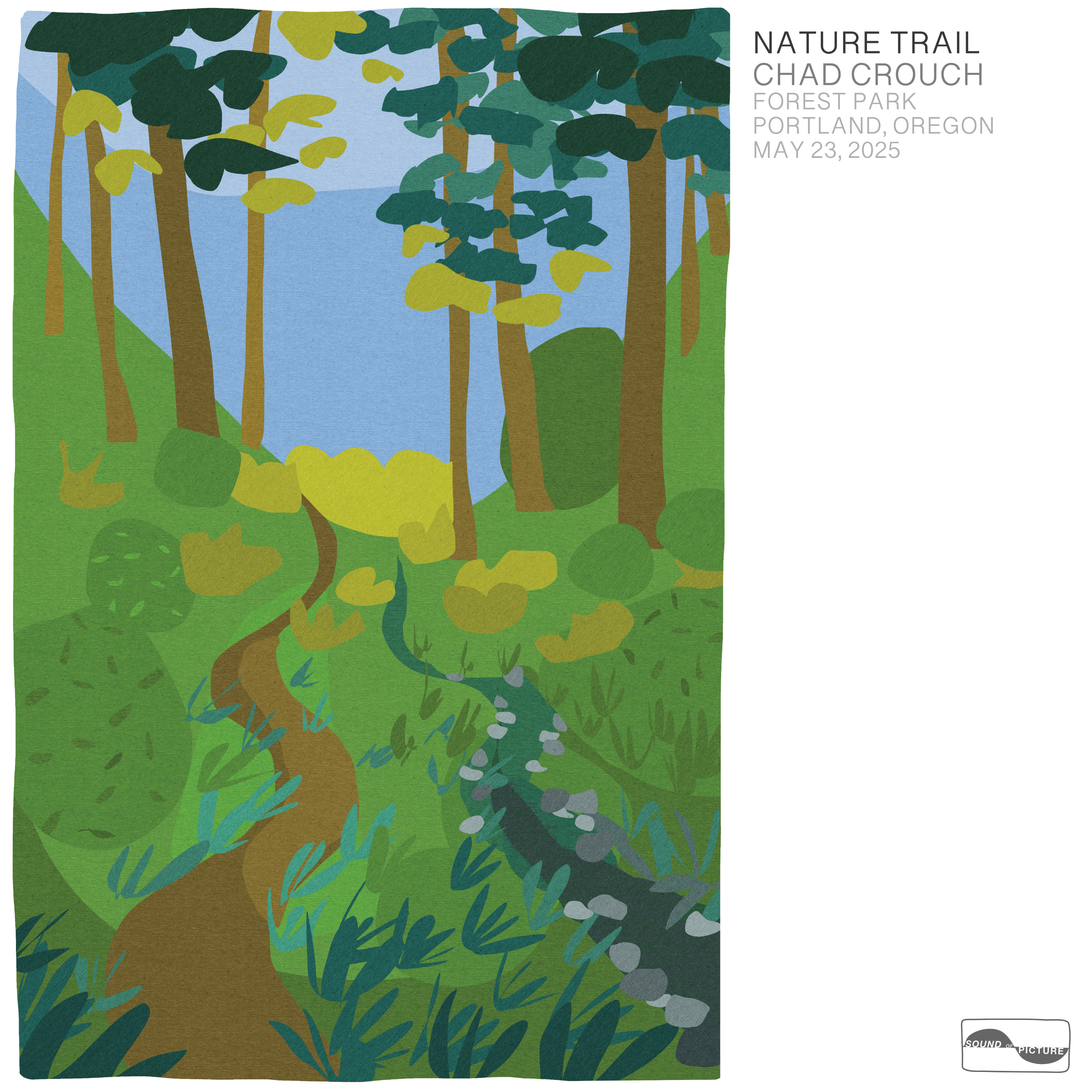
This is a story about a trail called Nature Trail. At the heart of the story is a simple question: What is nature for? Feel free to click play above to listen to the soundscape of Nature Trail as we ponder this question. Nature Trail was built in the 1960’s in the interior of the roughly 5,000-acre nature park that had been dedicated 20 years prior, but received little attention in the way of development. Indeed, the most newsworthy question in those early years seemed to be what should we call it? In 1957, a call for suggestions—perhaps favoring something more showy than the functional, socially adopted name, The Forest Park—yielded many (Skyline, Tualatin, Wildwood, Tualatin Mountain…) but the de-facto name won the day. Officially, “Portland’s Forest Park” was favored by one vote over “Skyline Forest Park”. The “Portland’s” part never seemed to really catch on. Actually, the biggest changes to the park, to this day, came in response to a 1951 fire that burned over 1200 acres in the center of it. Fifteen emergency access fire lanes were constructed in the early 1950’s, broadly perpendicular to the slope of the Tualatin Mountains, like rungs on a ladder. What was nature for in the 1950’s? Accessible nature was becoming scarce. The public wanted protections from both development and the threat posed by wildfire. These fire lanes likely became informal points of entry for the park users in the early years. A network of hiking trails was modest: around 10 miles in total, on the southern end in 1960. Today there are over 80 miles of trails. What was nature for in 1960? A refuge to visit and admire via trails and lanes. Today, Nature Trail still harbors subtle clues to its origins There’s an old steel pole gate and concrete bollards covered by so much moss they could pass for stumps at the end of Fire Lane 1. It all appears quite out of place in the quiet interior of Forest Park. Nearby there is a meadow-like ridge with a couple weathered picnic tables. Starting in the late 60’s and running for about two decades or so, this was the drop zone for thousands of children in a campaign to foster a connection with nature, formalized in 1968. A rare 1968 publication in the Library Use Only stacks of Multnomah County Library holds the key to understanding Nature Trail: Portland’s Forest Park Nature Trail was a 32-page interpretive guide authored by Oregon Outdoor Education Councils as informal curriculum for a generation of school children. Fifty-two markers on Nature Trail were keyed to entries in the guide. Midway through the trail was a shelter, bathroom and campfire area. Bus drop off and pickup areas were located on each end. What was nature for in 1968? Nature was a common good. It was a living lab for learning about the interconnectedness of plants, animals and humans, as stated in the booklet introduction: If you are quiet and observant, you may see some of the animals that live here. The forest community is a living area of plants and animals. It has many parts. Some tall plants shade everything on the ground. Under these grow the medium size and the small ground plants. Part of the forest community is the soil and the many organisms that live in the ground. It is the animals that live in the forest. It is the water that comes from the forest. The forest community is many more things. (Portland’s Forest Park Nature Trail, 1968) Mind you, this was all designed and implemented a couple years before Earth Day made its debut. A 1970 Oregonian article about Nature Trail noted the large coalition involved— the Park Bureau, Multnomah County schools, U.S. Forest Service, Oregon State Game Commission, Industrial Forestry Association, and others. Much of the trail building for Nature Trail was done by the Neighborhood Youth Corps, employing low-income urban teenagers in public works projects. It all took coordination and vision. Precisely who the masterminded Nature Trail isn’t easily discerned, but there is little doubt Thornton T. Munger was a galvanizing force from the late 40’s into the 60’s, inspiring people to work together, while advancing principles of conservation and education in the nascent Forest Park. Munger’s own connection to nature can be traced back to growing up next to an eighteen-acre natural area called Hillhouse Woods in North Adams, Massachusetts, which fostered his lifelong interest in forests. In 1908 he was hired by the US Forest Service, and trained under Gifford Pinchot, who between 1905 and 1910 oversaw a rapid expansion, roughly tripling the number of National Forests and acreage. In his retirement, Munger chaired the Committee of Fifty, convincing city leaders to designate the lands as a nature park. The committee eventually became the Forest Park Conservancy, that to this day provide a Nature Education Program with free public events, organize volunteers, raise money, and conduct community outreach. In 1960, Munger—in collaboration with C. Paul Keyser—wrote a 32 page report entitled The History of Portland’s Forest Park. In Part IV A Look Ahead, they write, In a few years nearly a million people will be living within a few miles of the Forest Park. Residences will crowd about it on three sides and industry will dominate its eastern edges. …There will be pressure to widen the roads, to straighten the curves, to pave, to build more roads. This should be resisted, for this “wilderness within a city” is not a place for speeding motorists; here there should be no need for haste. ...Here within city limits will be a continuous forest 7½ miles long. The roads and trails will be under over-arching trees, varying from virgin forest with giants up to 8 feet in diameter, to thrifty second-growth stands of tall Douglas fir. What was nature for in the 1960’s and beyond? * To provide facilities that will afford extensive nearby outdoor recreation for the people and attract tourists. * To beautify the environs of Portland. * To provide food, cover, and a sanctuary for wildlife * To provide a site on which youth and other groups may carry on educational projects. * To grow timber which will in time yield an income and provide a demonstration forest. That last point became contentious within a couple decades. Limited timber harvests were being recommended by the committee up until 1975, when the Portland Parks superintendent, facing environmentalist pressure, ruled out selective logging as part of over-all park management. What was nature for in 1975? Forest Park was closer to becoming a quasi-wilderness area, protected from all resource harvesting. (The Forest Park Rock Quarry lease was terminated in 1979.) Fire suppression remained a primary concern, though seasonal manned fire lookouts were by then retired. So when and why did the Nature Trail program dissolve? It’s not clear when, and I can only speculate on why. For starters, interior access roads around the park were closed to motor vehicles sometime in the 1980’s. Therefore, any bus passage would have been met with more friction. The built elements of Nature Trail would have been approaching their expected lifespan: numbered posts would be weathered and broken, the shelter roof would have by then become what we now call a “living roof”: an ecosystem of duff, mosses and seedlings. Beyond that, the environmentalist awakening of the 1970s met a formidable obstacle with the Reagan administration of the 1980s. So where are we now? What is nature for in 2026? In the pendulum swing of US politics we are lurching back to the 80’s mindset. Environmental protections are being systematically dismantled by the current administration in naked collusion with the fossil fuel industry. “Drill baby drill,” is one of the president’s most cherished rally cries. When I think back to my childhood in primary school, my most vivid memories are of when either someone visited the classroom, or the class took a field trip. I distinctly remember going to a site to hunt for fossils. I vividly remember Outdoor School; basically an overnight camp experience for sixth graders. Perhaps that’s what really replaced Nature Trail: the significant expansion of its objectives with Outdoor School. The first large scale implementation of Outdoor School in Oregon occurred in 1966, serving 500 students. The program grew steadily for decades, but faced budget pressures over the years as schools cut extracurricular spending. In 2016, Ballot Measure 99 saved and expanded it, setting aside Oregon Lottery funds to provide Outdoor School for every one of Oregon's 50,000 fifth and sixth graders, passing with over 67% of the vote. While other states have more modest programs or aspirations, this guaranteed entitlement is unique to Oregon. Perhaps more than any point in the last 50 years, US leaders have adopted an aggressively extractive attitude toward nature. For Oregonians, the 67% vote for Measure 99 was its own kind of answer to the question Nature Trail was posing back in 1968. May in Forest Park is peak birdsong time. My score is electric piano centered—I love the deep tones of this one. It’s naive and minimal as per usual. Thanks for reading and listening. Nature Trail is available on all music streaming services today, March 13th, 2026. This is a public episode. If you'd like to discuss this with other subscribers or get access to bonus episodes, visit chadcrouch.substack.com/subscribe
Embed this episode
Ready to play
Nature Trail
No transcript for this episode yet
Similar Episodes
No similar episodes found.