
EPISODE · Feb 8, 2026 · 16 MIN
Nearly Optimal Active Preference Learning and Its Application to LLM Alignment
from Best AI papers explained · host Enoch H. Kang
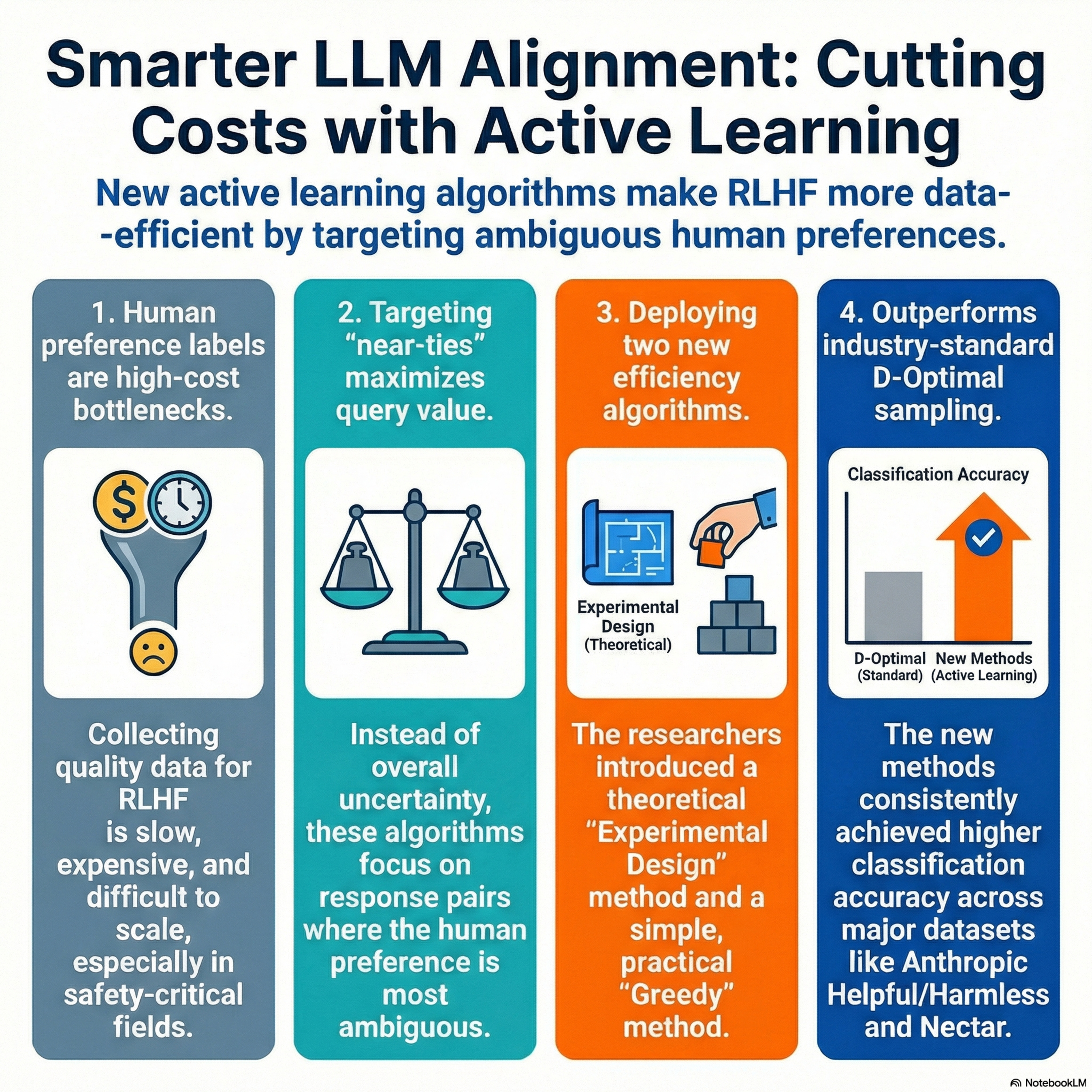
This research addresses the high costs of collecting human preference data for aligning large language models (LLMs) by introducing more efficient active learning techniques. The authors argue that traditional methods focus too heavily on worst-case scenarios, failing to account for the unique instance-dependent difficulty of specific preference pairs. To solve this, they propose a novel experimental design objective and a practical greedy algorithm that prioritize queries where the model is most uncertain about the preference direction. Their approach specifically targets response pairs with near-tie preferences, which are the most informative for refining reward models. Theoretical analysis demonstrates that these methods provide nearly optimal label complexity guarantees that adapt to the specific problem structure. Experimental results on real-world datasets show that these algorithms significantly improve sample efficiency and accuracy compared to existing benchmarks.
What this episode covers
This research addresses the high costs of collecting human preference data for aligning large language models (LLMs) by introducing more efficient active learning techniques. The authors argue that traditional methods focus too heavily on worst-case scenarios, failing to account for the unique instance-dependent difficulty of specific preference pairs. To solve this, they propose a novel experimental design objective and a practical greedy algorithm that prioritize queries where the model is most uncertain about the preference direction. Their approach specifically targets response pairs with near-tie preferences, which are the most informative for refining reward models. Theoretical analysis demonstrates that these methods provide nearly optimal label complexity guarantees that adapt to the specific problem structure. Experimental results on real-world datasets show that these algorithms significantly improve sample efficiency and accuracy compared to existing benchmarks.
NOW PLAYING
Nearly Optimal Active Preference Learning and Its Application to LLM Alignment
No transcript for this episode yet
Similar Episodes
Mar 31, 2026 ·54m
Mar 27, 2026 ·14m
Mar 24, 2026 ·42m
Mar 20, 2026 ·42m
Mar 17, 2026 ·41m
Mar 13, 2026 ·44m