
EPISODE · Mar 3, 2026 · 34 MIN
Nerve and Tendon Transfers for Hand Palsies — Radial, Median, Ulnar, and Combined Injuries
from Dr. Lara's Plastic Surgery Compendium · host Dr. Daniel Lara
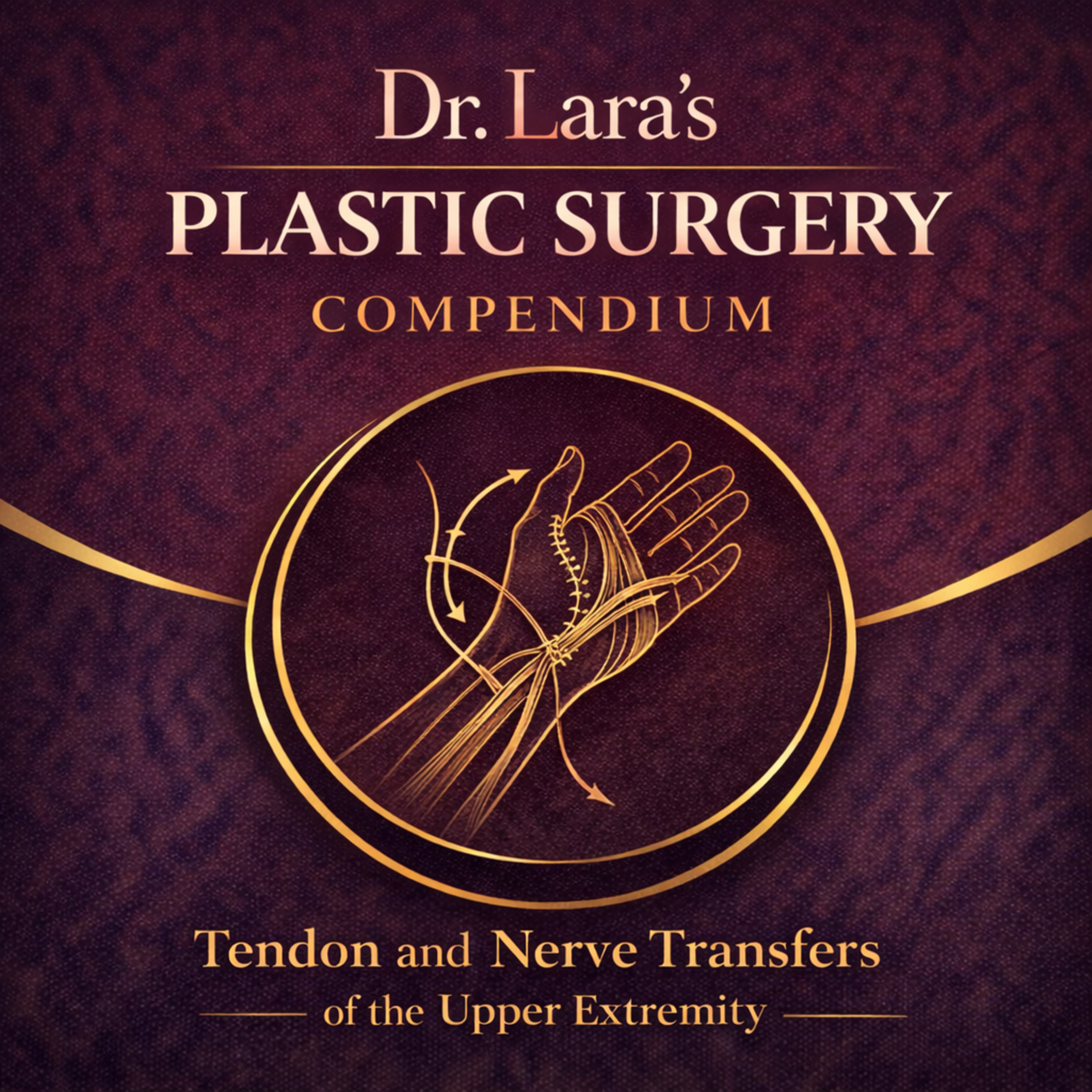
This episode reviews the core principles of nerve and tendon transfers for upper extremity palsies, focusing on timing, donor selection, biomechanics, and functional restoration.Topics include the decision-making framework for nerve transfers versus tendon transfers, with emphasis on “time is muscle,” Wallerian degeneration, motor end plate survival, nerve regeneration at approximately 1 mm/day, and the role of end-to-end and end-to-side “supercharged” nerve transfers.Tendon transfer principles are reviewed through the Steindler requirements, including soft tissue equilibrium, supple joints, expendable donors, adequate strength, straight line of pull, synergy, and the 3-5-7 excursion rule. The episode also explains how the tenodesis effect helps overcome excursion mismatch and why wrist motion is central to hand function.Clinical reconstruction is organized by palsy pattern, including radial nerve palsy treated with PT to ECRB, FCR or FCU to EDC, and PL to EPL; median nerve palsy treated with opponensplasty options such as EIP, Camitz, Huber, and FDS transfers; and ulnar nerve palsy treated using the Bouvier test, Zancolli lasso, Stiles-Bunnell transfer, and Smith transfer for pinch. Additional topics include AIN to ulnar motor nerve supercharging, sensory nerve transfers for the “blind hand,” spaghetti wrist repair sequence, tetraplegia reconstruction priorities, and anatomic variants such as Martin-Gruber and Riche-Cannieu anastomoses. Part of Dr. Lara’s Plastic Surgery Compendium — a high-yield audio reference for plastic surgery trainees and surgeons.DisclaimerThis podcast is intended for educational purposes only and is designed for medical students, residents, fellows, and practicing healthcare professionals. It is not intended to provide medical advice, diagnosis, or treatment for any individual patient. The content presented reflects general surgical principles and should not be used as a substitute for formal medical training, clinical judgment, or consultation with qualified healthcare professionals. Listening to this podcast does not establish a physician–patient relationship.SEO / Topic Keywordsnerve transfers, tendon transfers, hand palsy reconstruction, radial nerve palsy, median nerve palsy, ulnar nerve palsy, Steindler requirements, tendon transfer principles, time is muscle, Wallerian degeneration, motor end plates, end-to-side nerve transfer, supercharged nerve transfer, tenodesis effect, 3-5-7 excursion rule, PT to ECRB, FCR to EDC, FCU to EDC, PL to EPL, opponensplasty, EIP to APB, Camitz transfer, Huber transfer, FDS opponensplasty, Bouvier test, Zancolli lasso, Stiles-Bunnell transfer, Smith transfer, AIN to ulnar motor nerve transfer, spaghetti wrist, tetraplegia tendon transfers, Martin-Gruber anastomosis, Riche-Cannieu anastomosis
Embed this episode
NOW PLAYING
Nerve and Tendon Transfers for Hand Palsies — Radial, Median, Ulnar, and Combined Injuries
No transcript for this episode yet
Similar Episodes
No similar episodes found.
Similar Podcasts
No similar podcasts found.