
EPISODE · Feb 9, 2026 · 1H 3M
Network-Enabled Responses to Deglobalization (Buchnea & Wong 2026) | FT50 JMS
from Revise and Resubmit - The Mayukh Show · host Mayukh Mukhopadhyay
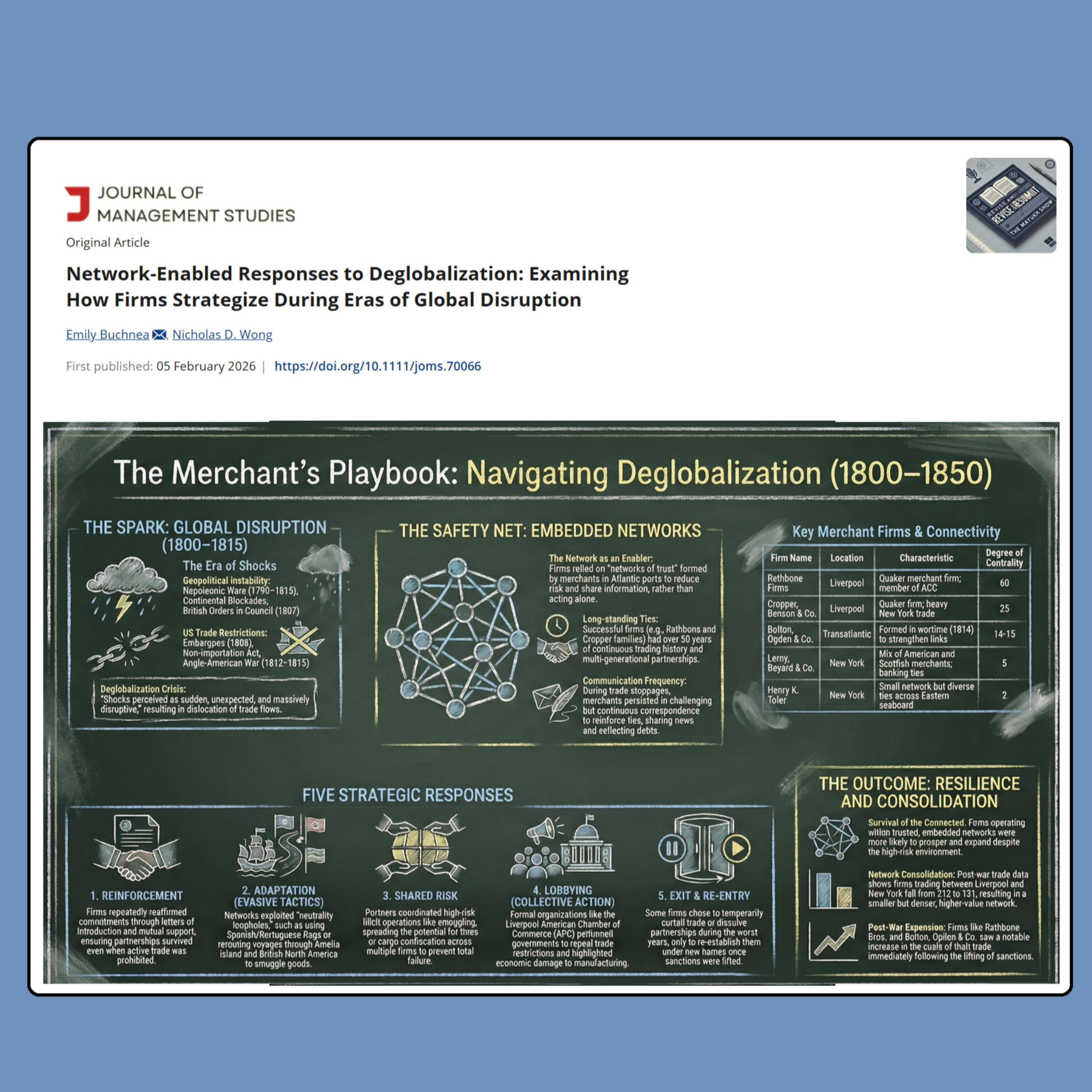
English Podcast starts at 00:00:00Bengali Podcast starts at 00:20:34Hindi Podcast starts at 00:34:13Danish Podcast starts at 00:48:27ReferenceBuchnea, E. and Wong, N.D. (2026), Network-Enabled Responses to Deglobalization: Examining How Firms Strategize During Eras of Global Disruption. J. Manage. Stud.. https://doi.org/10.1111/joms.70066Youtube Channelhttps://www.youtube.com/@weekendresearcherConnect over linkedinhttps://www.linkedin.com/in/mayukhpsm/Welcome to Revise and Resubmit 🎙️📚✨A few years ago, I watched a small, capable business owner I knew get blindsided. Not by a bad product. Not by a lazy team. By a sudden shift in the rules of the game. Routes changed. Permissions tightened. Partners went quiet. And what struck me most was this: survival didn’t come down to brilliance in isolation. It came down to who would pick up the phone, who would vouch for you, who could open a door you couldn’t even see 🚪🔑.That’s the puzzle at the heart of today’s episode, built around a new research article with a sharp, almost surgical clarity. The paper is titled “Network-Enabled Responses to Deglobalization: Examining How Firms Strategize During Eras of Global Disruption” by Emily Buchnea and Nicholas D. Wong, published online on 05 February 2026 in the Journal of Management Studies, a truly prestigious outlet on the FT50 list 🏛️✅.Instead of treating disruption like a headline, the authors treat it like a lived condition. They go back to the early 1800s, tracing merchant worlds linked between Liverpool in the UK and New York in the USA. They map who connected to whom, and they pair those maps with archival traces that show decisions being made under pressure 📜🧭. When borders tighten and authorities clamp down, firms do not just “cope.” They choose. They improvise. They lean on relationships that were built long before the storm.What emerges is a practical set of network-enabled responses, five recurring moves that show up across firms:Reinforcement: Strengthening existing ties when uncertainty rises 🤝Adaptation: Shifting paths and partners to keep exchange possible 🗺️Shared risk: Spreading exposure across trusted counterparts 🧩Lobbying: Pushing for rule changes instead of merely reacting 🏛️Exit: Knowing when leaving is the most rational strategy 🚪And there’s a quieter, harder implication. In some moments, these networks didn’t just help firms endure disruption. They helped them route around it, sometimes through actions that sit in the grey zone of rule-following ⚖️🕳️. The paper pushes us to ask what “resilience” really means when the environment becomes unstable, and when trust becomes a kind of private infrastructure.If you enjoy episodes that turn big forces into concrete decisions, subscribe to Revise and Resubmit on Spotify, and also find us on Amazon Prime and Apple Podcast 🎧📌. And don’t forget to subscribe to our YouTube channel, Weekend Researcher ▶️🔔.Now, here’s the question I want to leave you with: when the world starts pulling apart, is your real strategy the plan you wrote down, or the network you’ve quietly built over years, one relationship at a time? 🤔🕸️Thanks to the authors, Emily Buchnea and Nicholas D. Wong, and to the publishers, the Society for the Advancement of Management Studies and John Wiley & Sons Ltd., for making this research possible 🙏📖.
Embed this episode
Ready to play
Network-Enabled Responses to Deglobalization (Buchnea & Wong 2026) | FT50 JMS
No transcript for this episode yet
Similar Episodes
No similar episodes found.
Similar Podcasts
No similar podcasts found.