
EPISODE · May 5, 2026 · 27 MIN
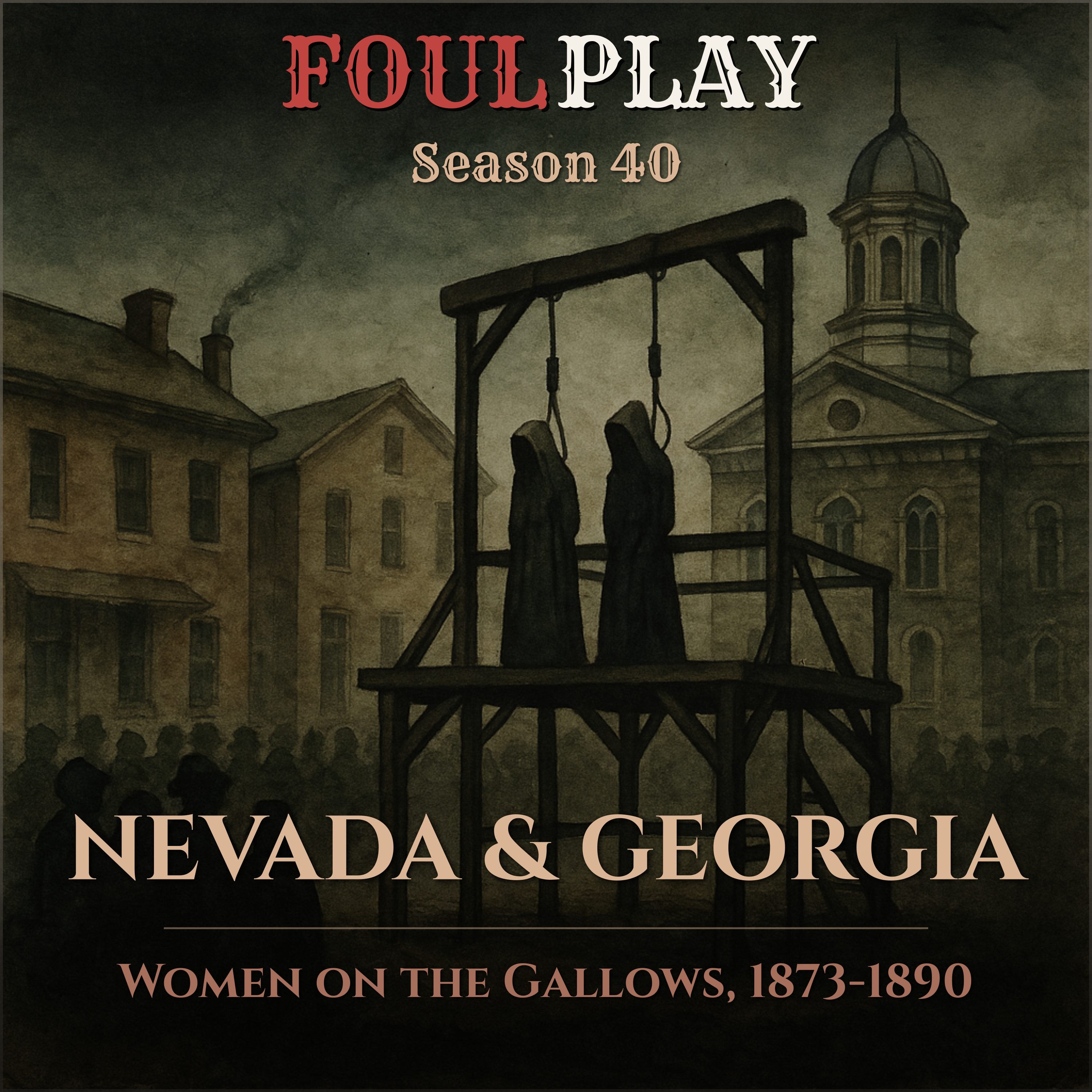
Nevada & Georgia: Women on the Gallows, 1873-1890
from Foul Play: A Historical True Crime Podcast · host Shane L. Waters, Wendy Cee, Gemma Hoskins
Historical SignificanceIn Georgia, a Webster County posse pursued Susan and Enoch one hundred twenty-five miles to Coffee County, Alabama. The grand jury indicted both on May 27, 1872, twenty-three days after the murder. Enoch's trial lasted a single day; the jury deliberated for three minutes. Both were sentenced to death on May 30. Twenty-six days from murder to death sentence. The Georgia Supreme Court denied Susan's appeal in *Eberhart v. State* 47 Ga. 598 (1873), with Justice H.K. McCay dismissing calls for mercy. Governor James M. Smith refused clemency four days before Susan was to die.Sheriff L.R. Barnard traced the Potts family over five hundred miles to Rock Springs, Wyoming, arresting the couple on February 16, 1889. Josiah Potts claimed Fawcett had killed himself after sexually abusing their daughter Edith, then approximately five years old. The abuse allegation was never investigated. The jury deliberated four hours, unanimous guilty verdict. Two hundred sixty-seven residents of Carlin petitioned the state board of pardons to commute both sentences to life imprisonment. The board refused. Sheriff Barnard himself opposed the execution.The Investigations and TrialsCase B, Georgia (1872): On May 4, 1872, after ten o'clock at night, Enoch Spann strangled his wife Sarah with a plow line, breaking her neck. According to his confession, Susan Eberhart held a handkerchief over Sarah's mouth at his command. Susan maintained she had been asleep and was compelled to participate under direct threat from a man who had already attempted murder twice, including a staged buggy accident where Susan had pulled Sarah from a swollen creek to save her life.Case A, Nevada (1888): Miles Fawcett entered the Potts household on New Year's Day to collect a debt and use knowledge of Elizabeth's bigamous marriage in Fresno, California. He was never seen alive again. His remains, charred, dismembered, buried in pieces throughout the cellar floor, were discovered on January 16, 1889, by the new tenant George Brewer. The only identifying object: a fragment of burned trouser pocket containing Fawcett's pocketknife.The CrimesSarah Spann was approximately fifty years old. She had lost a leg and lived as an invalid in a one-room log cabin inWebster County, Georgia, dependent on her husband Enoch for everything. A Confederate veteran whose own fellow soldiers had described him as "very ignorant and very imbecile, Enoch Spann was the man she was married to and the man who killed her.Miles Fawcett was born around 1830 near Manchester, England. He came west following the railroad, settling in Carlin, a Central Pacific division point established in 1868 with a population of roughly eight hundred. Fawcett worked a small ranch outside town. He kept to himself, known well enough that his pocketknife was recognized on sight but private enough that neighbors called him "Old Man Fawcett" and left it at that. He was fifty-seven when he disappeared.The VictimsNew Year's Day, 1888. A fifty-seven-year-old English carpenter named Miles Fawcett walks into a house on Silver Street in Carlin, Nevada, to collect a debt. He never comes back out. For a full year, the town absorbs his absence. When a new tenant probes the cellar floor and pulls up what he takes for a rotten turnip, it turns out to be a charred, decapitated human head. The woman who lived above that cellar, Elizabeth Potts, would become the only female ever legally executed in the state of Nevada. Meanwhile, in post-Civil War Georgia, an eighteen-year-old named Susan Eberhart is sent to cook and wash for a one-legged woman in a one-room cabin. Within days of her arrival, the man of the house begins telling her how he intends to kill his wife. Susan once waded into a swollen creek to save that woman's life. She would be convicted of helping to end it.Season 40: America's 250th Anniversary. Fifty states, fifty crimes, two hundred and fifty years of history. This double-feature covers Nevada and Georgia, two women sentenced to hang, separated by seventeen years and two thousand miles, connected by a question neither court could answer.This EpisodeThis episode contains discussions of murder, execution by hanging, domestic violence, sexual coercion, and dismemberment. Support Foul Play: Patreon: https://www.patreon.com/foulplaypodcast Website: https://www.mythsandmalice.com/show/foul-play/ Apple Podcasts: https://podcasts.apple.com/us/podcast/foul-play-crime-series/id1525832703 Follow us: Instagram: @foulplaycrimeseries Twitter: @foulplaypodOur Sponsors:* Check out Kensington Publishing: https://www.kensingtonbooks.comAdvertising Inquiries: https://redcircle.com/brandsPrivacy & Opt-Out: https://redcircle.com/privacy
Embed this episode
NOW PLAYING
Nevada & Georgia: Women on the Gallows, 1873-1890
No transcript for this episode yet
Similar Episodes
No similar episodes found.
Similar Podcasts
No similar podcasts found.