
EPISODE · Oct 1, 2025 · 41 MIN
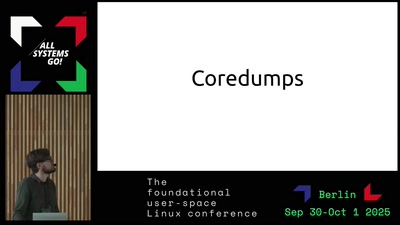
New Linux Kernel Coredump Infrastructure (asg2025)
from Chaos Computer Club - recent audio-only feed · host Christian Brauner
Coredumping on Linux has long been a nightmare. Currently two modes are supported: (1) Dumping directly into a file somewhere on the filesystem. (2) Dumping into a pipe connected to a usermode helper process spawned as a child of the system_unbound_wq or kthreadd. For simplicity I'm mostly ignoring (1). There's probably still some users of (1) out there but processing coredumps in this way can be considered adventurous especially in the face of set*id binaries. The most common option should be (2) by now. It works by allowing userspace to put a string into /proc/sys/kernel/core_pattern like: |/usr/lib/systemd/systemd-coredump %P %u %g %s %t %c %h The "|" at the beginning indicates to the kernel that a pipe must be used. The path following the pipe indicator is a path to a binary that will be spawned as a usermode helper process. Any additional parameters pass information about the task that is generating the coredump to the binary that processes the coredump. In the example core_pattern shown above systemd-coredump is spawned as a usermode helper. There's various conceptual consequences of this (non-exhaustive list): - systemd-coredump is spawned with file descriptor number 0 (stdin) connected to the read-end of the pipe. All other file descriptors are closed. That specifically includes 1 (stdout) and 2 (stderr). This has already caused bugs because userspace assumed that this cannot happen (Whether or not this is a sane assumption is irrelevant.). - systemd-coredump will be spawned as a child of system_unbound_wq. So it is not a child of any userspace process and specifically not a child of PID 1. It cannot be waited upon and is in a weird hybrid upcall which are difficult for userspace to control correctly. - systemd-coredump is spawned with full kernel privileges. This necessitates all kinds of weird privilege dropping excercises in userspace to make this safe. - A new usermode helper has to be spawned for each crashing process. On recent kernels a new mode has been added making use of AF_UNIX sockets. This talk will talk about the new modes, how they can be used, what advantages they have in comparison to the other modes, and look at technical implementation details. Licensed to the public under https://creativecommons.org/licenses/by/4.0/de/ about this event: https://cfp.all-systems-go.io/all-systems-go-2025/talk/MADB7R/
What this episode covers
Coredumping on Linux has long been a nightmare. Currently two modes are supported: (1) Dumping directly into a file somewhere on the filesystem. (2) Dumping into a pipe connected to a usermode helper process spawned as a child of the system_unbound_wq or kthreadd. For simplicity I'm mostly ignoring (1). There's probably still some users of (1) out there but processing coredumps in this way can be considered adventurous especially in the face of set*id binaries. The most common option should be (2) by now. It works by allowing userspace to put a string into /proc/sys/kernel/core_pattern like: |/usr/lib/systemd/systemd-coredump %P %u %g %s %t %c %h The "|" at the beginning indicates to the kernel that a pipe must be used. The path following the pipe indicator is a path to a binary that will be spawned as a usermode helper process. Any additional parameters pass information about the task that is generating the coredump to the binary that processes the coredump. In the example core_pattern shown above systemd-coredump is spawned as a usermode helper. There's various conceptual consequences of this (non-exhaustive list): - systemd-coredump is spawned with file descriptor number 0 (stdin) connected to the read-end of the pipe. All other file descriptors are closed. That specifically includes 1 (stdout) and 2 (stderr). This has already caused bugs because userspace assumed that this cannot happen (Whether or not this is a sane assumption is irrelevant.). - systemd-coredump will be spawned as a child of system_unbound_wq. So it is not a child of any userspace process and specifically not a child of PID 1. It cannot be waited upon and is in a weird hybrid upcall which are difficult for userspace to control correctly. - systemd-coredump is spawned with full kernel privileges. This necessitates all kinds of weird privilege dropping excercises in userspace to make this safe. - A new usermode helper has to be spawned for each crashing process. On recent kernels a new mode has been added making use of AF_UNIX sockets. This talk will talk about the new modes, how they can be used, what advantages they have in comparison to the other modes, and look at technical implementation details. Licensed to the public under https://creativecommons.org/licenses/by/4.0/de/ about this event: https://cfp.all-systems-go.io/all-systems-go-2025/talk/MADB7R/
NOW PLAYING
New Linux Kernel Coredump Infrastructure (asg2025)
No transcript for this episode yet
Similar Episodes
Mar 26, 2026 ·1m
Feb 8, 2026 ·4m
Jan 30, 2026 ·6m
Jan 2, 2026 ·47m