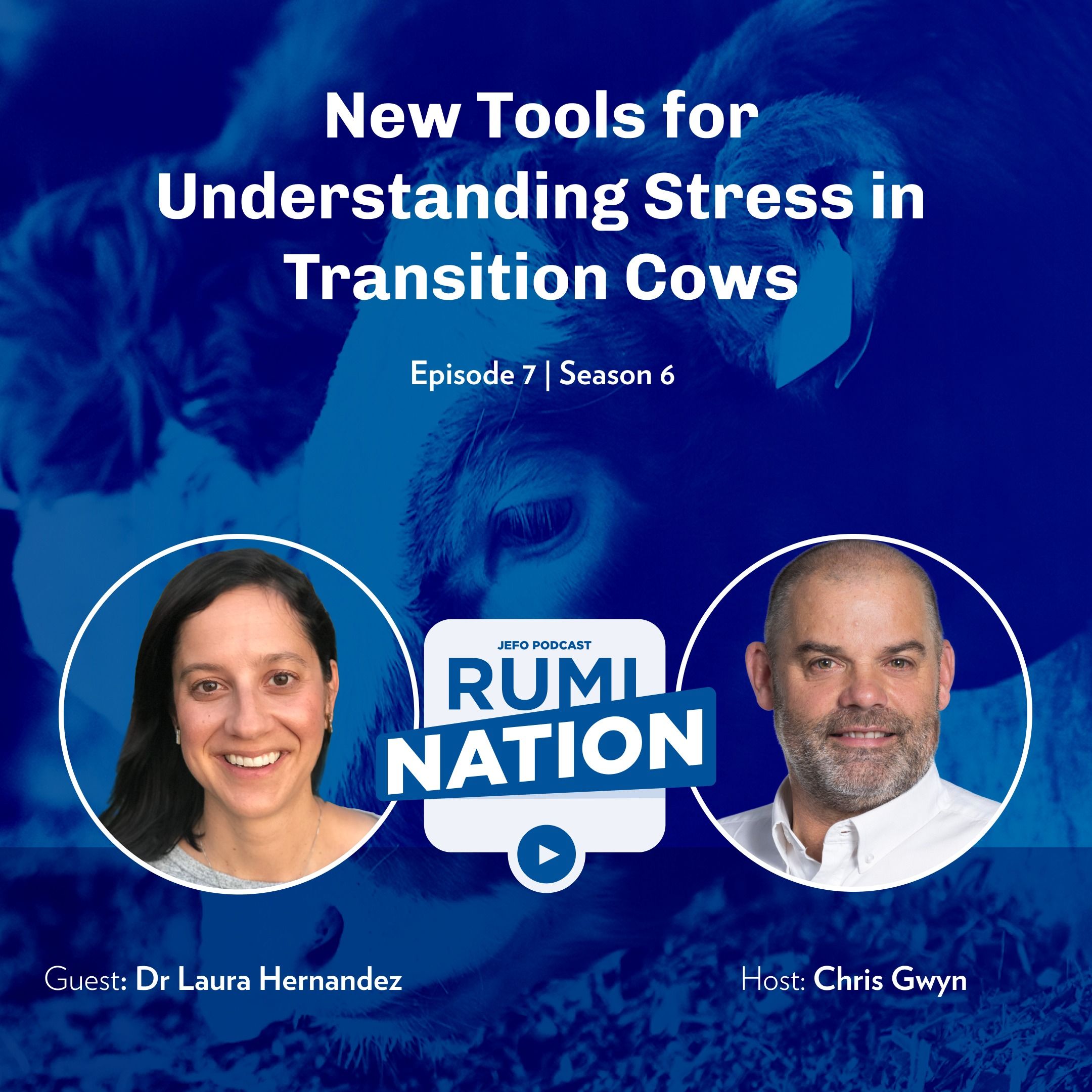
New Tools for Understanding Stress in Transition Cows episode artwork

EPISODE · Sep 9, 2025 · 14 MIN

New Tools for Understanding Stress in Transition Cows

from RumiNation · host Jefo

Timestamps & Summary Chris Gwyn (02:11)At JEFO, we've been looking at stressors across species, in particular in dairy cows. I was wondering if you could give our audience an overview of this study and why it's important.Dr. Laura HernandezSure. This was an ongoing collaboration with my colleague Dr. Milo Wiltbank, who's a reproductive physiologist here at the University of Wisconsin. We had a shared scientist who's now a professor at the vet school at the University of Florida, Pedro Monteiro. […] He's traditionally a reproductive physiologist. He developed this question about how this might impact return to cyclicity and timing of parturition. His main complaint was that in our projects, we could never figure out when the cows would calve, so they'd be sampling forever and ever and ever. And then finally the cow would calve earlier or late, of course. And so he was like, there's got to be a way we can figure this out. It also might be really critical to how successfully a cow comes back into cyclicity or what might happen with reproductive diseases, knowing that there are all these losses that occur that are due to a variety of problems in the first 60 days postpartum. […]We know that cortisol is a major stress regulator of all things, and it changes all the time in relation to a variety of stresses. [Dr. Monteiro] had read this paper, and I believe it was beef cattle, and they had shown that you could measure cortisol in the hair. Really, the hair cortisol is reflective that day for about two weeks prior to the actual date you took the hair sample. Because the cortisol deposits in the hair, and the hair doesn't go away. It grows, and then you shave it off, and you can do this measurement via RIA or ELISA of the cortisol. […] Chris Gwyn (10:10)You had demonstrated that if we can just take out some of the key points: low stress, low cortisol versus high. You were able to see a production performance different, wasn't there?Dr. Laura Hernandez That would be from a practical standpoint that if our data continues to go in the way that it has been, that if a farm wanted us to come, that this is something that could be done by a nutritionist or nutrition groups or veterinarian groups, that if they wanted to know what it looked like, say, in the prepartum period, they could take a hair sample when they dried cows off, and then maybe, depending on what their dry off protocol was, three weeks later, get another hair sample. That could be run, and they would have a good idea of what's happening. Or if they wanted to do it in a post-fresh cow, say 10 days postpartum, they could really take a look at what some of these pen changes might look like, if they did it in a new facility, or if they were having problems, is it due to stress? What's the stress level? How might that look on a threshold if we can develop one? It would be a really easy way to do so without bleeding a cow. All you have to do is shave the tail head. It's just a regular shaving. […]Chris Gwyn (12:43)Inherently, we may understand that certain periods of lactation or management practices have a different level of applied stress or stressors. Calving, regrouping, the whole process, mixing groups, but we don't know what costs us. Some association of a simple cortisol test with a number of studies that support milk loss or impacts on reproduction will reestablish or reinforce the need to perhaps change some management.Dr. Laura HernandezThat's my hope. I'm a very basic scientist, but all the things I root my science in are providing information to make good decisions that work the very best for a particular farm within the means of their ability to do things. I think that's why we're here, is to help them. We try to really make our work as translational as possible.

Measuring hair cortisol in dairy cows reveals how stress affects reproduction, milk yield, disease risk, and supports better farm management decisions.

NOW PLAYING

New Tools for Understanding Stress in Transition Cows

0:00 14:44

No transcript for this episode yet

We transcribe on demand. Request one and we'll notify you when it's ready — usually under 10 minutes.

RecoverU | Betrayal Trauma, Betrayal Recovery, Porn Addiction Recovery, Relationships, Infidelity NLP master life coach, Betrayal Recovery Coach, FDN-P Are you a wife who has discovered her husband is a porn or sex addict and you’re feeling overwhelmed and worried about the future?Are you a couple navigating recovery trying to rebuild trust and connection after betrayal but struggling to navigate the triggers and emotions that come up?Hi I’m Kylene, a betrayed partner in recovery, and Patrick, a former sex addict in recovery. In 2021, we found ourselves lost, overwhelmed and scared, having no idea if our relationship would survive or if we could heal as individuals. Thankfully, we got connected to powerful recovery tools quickly and began doing healing work both individually, and together.Now, we are 4 years in recovery and we have moved from lack of trust, to deep trust. From triggers and rumination every day to few and far between. From having a completely destroyed relationship, to creating a new, beautiful and happy relationship with 2 new, healed people.Kylene works as a betrayal recovery coach to help women move from trauma Liminal Space Abbi Manoucheri A podcast about the artist journey, responses to my grad experience, and hopefully a thoughtful rumination on maintaining our creativity and expression in our quest for a career in the arts. New episodes on Tuesdays! Breakup to Blessing Sylvia Suwan Breakup to Blessing is a podcast about navigating breakups, emotional healing, and rebuilding yourself after a relationship ends—without losing who you are in the process.If you find yourself overthinking your ex, struggling to let go, or caught in cycles of anxiety and attachment, this podcast will help you understand what's really happening beneath the surface.Grounded in principles of Attachment Theory and Emotional Regulation, each episode explores the emotional and psychological patterns that keep you stuck after a breakup—like anxious attachment, rumination, and identity loss.This isn't about quick fixes, playing games, or trying to control the outcome.It's about: • understanding why it's so hard to move on • learning how to regulate your emotions • breaking unhealthy patterns • and becoming more secure within yourselfWhether you're asking "Do they miss me?", "Why can't I move on?", or "How do I let go when I still love them?"—you'll find honest, grounded guidance here. Dingus Mike Cooter "Dingus" is a six-part radio drama produced by CBS and recorded at the height of the 1943 flu pandemic that swept through Hollywood. Denied of a marquee cast and blighted by a curious obsession with the object that drives its narrative, this innovative and formally-reflexive oddity disappeared almost completely without trace. In 2010 artist Mike Cooter set out to find and rehabilitate this elusive artefact, initiating a 12-year journey that now culminates in the re-emergence of "Dingus," his first major work for radio. Ostensibly a detective drama, taking its name from an American colloquialism for an object without name or of indistinct identity (from the German ‘ding’ / ‘thing’), "Dingus" emerges across six episodes and a supplementary documentary as a rumination on objecthood itself: how we claim to understand some-thing, and the effects that it might have. At once both utilising and unpicking the narrative conceit of the MacGuffin, "Dingus" can be heard to reverse the logic of an

Frequently Asked Questions

How long is this episode of RumiNation?

This episode is 14 minutes long.

When was this RumiNation episode published?

This episode was published on September 9, 2025.

What is this episode about?

Timestamps & Summary Chris Gwyn (02:11)At JEFO, we've been looking at stressors across species, in particular in dairy cows. I was wondering if you could give our audience an overview of this study and why it's important.Dr. Laura HernandezSure....

Can I download this RumiNation episode?

Yes, you can download this episode by clicking the download button on the episode player, or subscribe to the podcast in your preferred podcast app for automatic downloads.
URL copied to clipboard!