
EPISODE · Oct 20, 2025 · 12 MIN
NGC1068 and Its Kin: New Evidence for Neutrino Production in Galactic Cores.
from Multi-messenger astrophysics · host Astro-COLIBRI
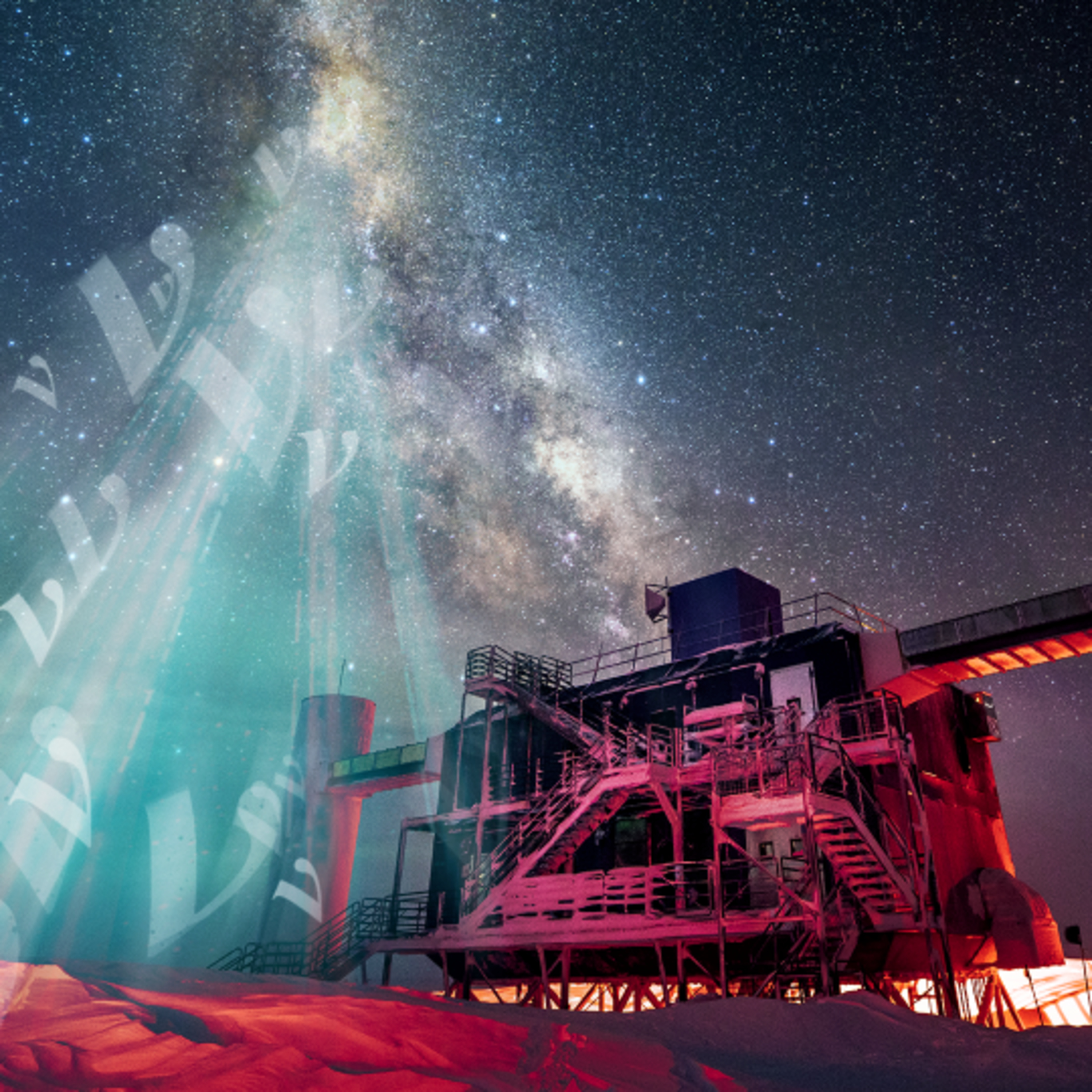
Join us as we discuss the latest results from the IceCube Neutrino Observatory, utilizing 13.1 years of data, that further link high-energy neutrinos to powerful cosmic sources.### Episode Highlights* **The Extragalactic Neutrino Puzzle:** The IceCube Neutrino Observatory consistently detects a diffuse flux of high-energy cosmic neutrinos, the majority of which are extragalactic in origin. These neutrinos are expected to be produced in hadronic interactions, which also generate gamma rays.* **Revisiting NGC1068:** The Seyfert galaxy **NGC1068** remains the most significant neutrino source identified in searches across the northern sky. Notably, the observed neutrino flux from NGC1068 exceeds its gamma-ray counterpart by at least two orders of magnitude. Using $13.1$ years of data, NGC1068's emission is characterized by a soft, unbroken power-law spectrum with a spectral index $\gamma = 3.4 \pm 0.2$.* **Focusing on X-ray Bright AGN:** The X-ray bright nature of NGC1068 motivated a new search focusing on $\mathbf{47}$ X-ray bright Seyfert galaxies, selected from the Swift/BAT spectroscopic survey based on their hard X-ray fluxes (20–50 keV). This hard X-ray band is chosen because it is more robust against obscuration compared to softer X-ray bands.* **A Collective Signal:** This dedicated search revealed a significant $\mathbf{3.3\sigma}$ excess from an ensemble of $\mathbf{11}$ X-ray bright AGN (excluding NGC 1068). These results significantly strengthen the evidence that $\mathbf{X-ray}$ **bright cores of active galactic nuclei are neutrino emitters**.* **Diversity in Emission:** The population of contributing AGN includes both Seyfert I and Seyfert II galaxies, suggesting that the level of nuclear obscuration does not significantly impact the likelihood of neutrino emission. However, the individual sources show diverse characteristics: while NGC1068 exhibits a soft spectrum dominated by lower-energy events, the second most significant source, NGC7469, has an excess driven by only two very high-energy events ($E_{\nu} > 100\text{ TeV}$). This suggests that not all X-ray bright AGN share the same neutrino production mechanisms.* **The Physics Connection:** The neutrino emission is likely produced in the immediate vicinity of the supermassive black hole (SMBH), plausibly within the AGN's $\mathbf{corona}$. In this environment, coronal X-ray photons interact with high-energy protons (photomeson production), generating the 1–10 TeV neutrinos observed by IceCube.***### Reference ArticleThe data and findings discussed are presented in the research paper titled:* **"Evidence for Neutrino Emission from X-ray Bright Active Galactic Nuclei with IceCube"**.* *Draft Version Date:* October 16, 2025.Acknowledements: Podcast prepared with Google/NotebookLM. Illustration credits: IceCube, Georgia Tech
Embed this episode
Ready to play
NGC1068 and Its Kin: New Evidence for Neutrino Production in Galactic Cores.
No transcript for this episode yet
Similar Episodes
No similar episodes found.
Similar Podcasts
No similar podcasts found.