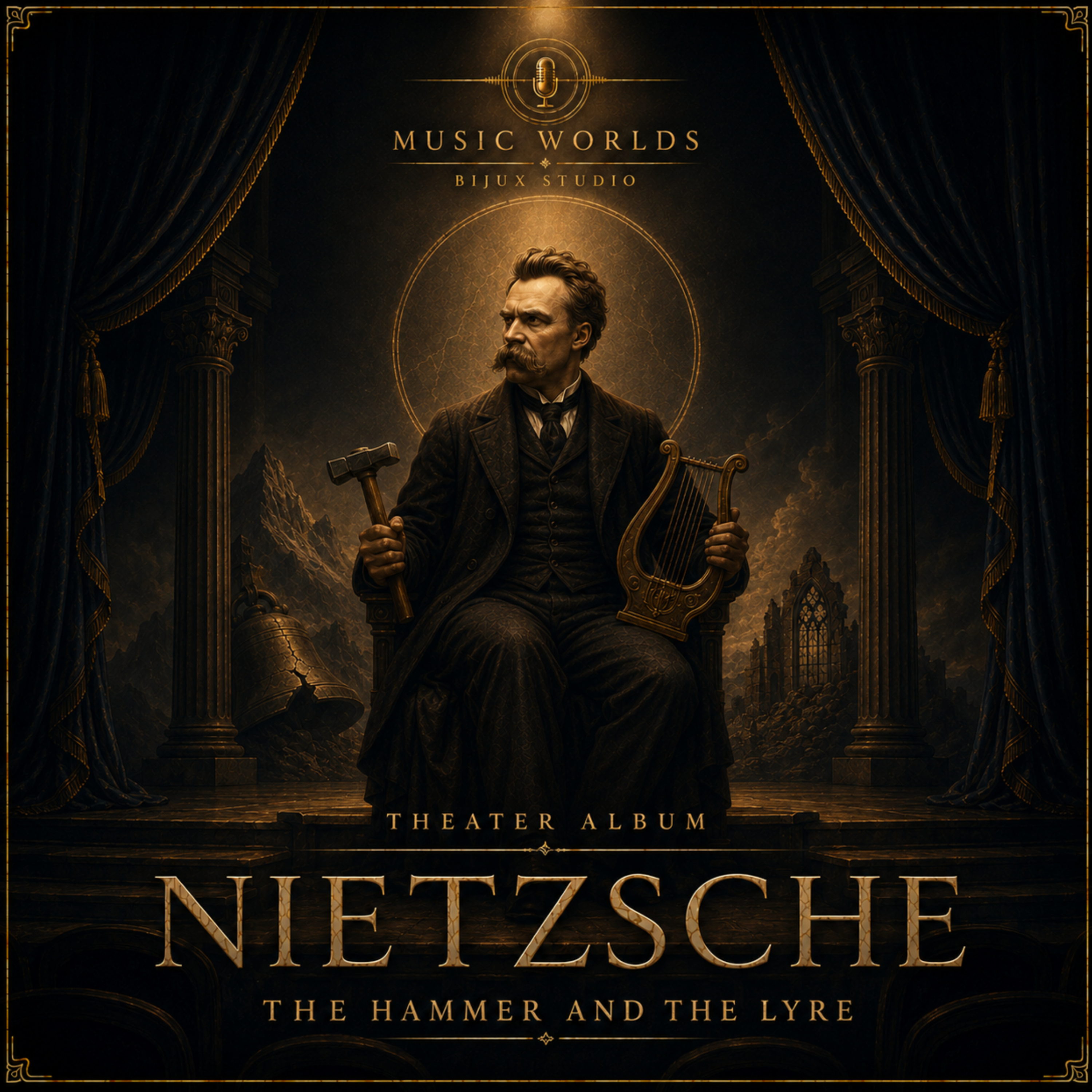
NIETZSCHE: The Hammer and the Lyre episode artwork

EPISODE · Jun 9, 2026 · 47 MIN

NIETZSCHE: The Hammer and the Lyre

from Music Worlds · host Bijux Studio

Episode 3 of Music Worlds enters the released Bijux Studio album Theater Album: Nietzsche.This episode uses the title NIETZSCHE: The Hammer and the Lyre, because that phrase names the inner drama of the album: Nietzsche arriving with a hammer to test hollow idols, and a lyre to give the wound rhythm.Theater Album: Nietzsche is not a biography, not a lecture, and not a future concept. It is an already released theatrical music work, available now on major music platforms including Spotify, Apple Music, YouTube Music, Amazon Music, and others.The album stages Nietzsche as a musical trial. A church bell cracks. The old heaven loses its authority. The marketplace laughs at noon. Morality is placed on a surgeon’s table. The body returns. The priest feeds the wound. Apollo gives form. Dionysus breaks the room. The ring asks again. And finally, the cracked bell becomes rhythm.At the center of the episode is one question:After the collapse of inherited meaning, what kind of human being can live without becoming smaller?The episode follows the album’s full transformation: a cracked church bell becomes a hammer; the hammer becomes a drum; the drum becomes a dance; and the dance becomes a yes.The journey moves through the full theater album: Prologue — The Bell Cracks — the old sacred order breaks, but its emotional force remains Your God Is Dead, Your Knees Remember — belief collapses, yet the body still carries guilt, obedience, and inherited shame No Heaven Will Pay Your Debt — the album turns from the empty sky back to earth, body, bread, sun, mud, and this life Every Truth Has a Body — truth is examined as hunger, wound, fear, perspective, and form of life They Called Their Fear Good — morality becomes genealogy, and fear is exposed when it disguises itself as virtue The Priest Fed the Wound — suffering receives poisonous meaning through guilt, bad conscience, and the ascetic ideal Apollo Measures, Dionysus Breaks — tragic art becomes the hinge from diagnosis to transfiguration Life Wants More Than Survival — will to power is heard as creative overflow, interpretation, shaping, and form-giving Become Worthy of Your Name — the self is not found, but forged through solitude, discipline, sickness, and height The Ring Asks Again — eternal recurrence appears as the heaviest test: can this exact life be affirmed again? Amor Fati — love of fate becomes the final yes, where the wound is not erased but made into music Epilogue — Zarathustra Comes Down Laughing — Nietzsche descends from the mountain, leaving the listener with the demand to become the danceThis is not Nietzsche explained as a textbook. It is Nietzsche staged through sound: cracked bell, hammer strike, wounded lyre, ritual drum, circular bass, mountain wind, and final dance.The episode explores why the lyrics were written this way, how the motifs evolve across the album, and how the music moves from collapse and moral autopsy toward tragic art, self-overcoming, eternal recurrence, and amor fati.Theater Album: Nietzsche asks whether suffering can become form, whether the wound can become lyre, whether the cracked bell can become rhythm, and whether a human being can answer life with yes.Find Bijux on Spotify, Apple Music, YouTube Music, and other major music platforms.Presented by Bijux Studio.

Episode 3 of Music Worlds enters the released Bijux Studio album Theater Album: Nietzsche.This episode uses the title NIETZSCHE: The Hammer and the Lyre, because that phrase names the inner drama of the album: Nietzsche arriving with a hammer to test hollow idols, and a lyre to give the wound rhythm.Theater Album: Nietzsche is not a biography, not a lecture, and not a future concept. It is an already released theatrical music work, available now on major music platforms including Spotify, Apple Music, YouTube Music, Amazon Music, and others.The album stages Nietzsche as a musical trial. A church bell cracks. The old heaven loses its authority. The marketplace laughs at noon. Morality is placed on a surgeon’s table. The body returns. The priest feeds the wound. Apollo gives form. Dionysus breaks the room. The ring asks again. And finally, the cracked bell becomes rhythm.At the center of the episode is one question:After the collapse of inherited meaning, what kind of human being can live without becoming smaller?The episode follows the album’s full transformation: a cracked church bell becomes a hammer; the hammer becomes a drum; the drum becomes a dance; and the dance becomes a yes.The journey moves through the full theater album: Prologue — The Bell Cracks — the old sacred order breaks, but its emotional force remains Your God Is Dead, Your Knees Remember — belief collapses, yet the body still carries guilt, obedience, and inherited shame No Heaven Will Pay Your Debt — the album turns from the empty sky back to earth, body, bread, sun, mud, and this life Every Truth Has a Body — truth is examined as hunger, wound, fear, perspective, and form of life They Called Their Fear Good — morality becomes genealogy, and fear is exposed when it disguises itself as virtue The Priest Fed the Wound — suffering receives poisonous meaning through guilt, bad conscience, and the ascetic ideal Apollo Measures, Dionysus Breaks — tragic art becomes the hinge from diagnosis to transfiguration Life Wants More Than Survival — will to power is heard as creative overflow, interpretation, shaping, and form-giving Become Worthy of Your Name — the self is not found, but forged through solitude, discipline, sickness, and height The Ring Asks Again — eternal recurrence appears as the heaviest test: can this exact life be affirmed again? Amor Fati — love of fate becomes the final yes, where the wound is not erased but made into music Epilogue — Zarathustra Comes Down Laughing — Nietzsche descends from the mountain, leaving the listener with the demand to become the danceThis is not Nietzsche explained as a textbook. It is Nietzsche staged through sound: cracked bell, hammer strike, wounded lyre, ritual drum, circular bass, mountain wind, and final dance.The episode explores why the lyrics were written this way, how the motifs evolve across the album, and how the music moves from collapse and moral autopsy toward tragic art, self-overcoming, eternal recurrence, and amor fati.Theater Album: Nietzsche asks whether suffering can become form, whether the wound can become lyre, whether the cracked bell can become rhythm, and whether a human being can answer life with yes.Find Bijux on Spotify, Apple Music, YouTube Music, and other major music platforms.Presented by Bijux Studio.

NOW PLAYING

NIETZSCHE: The Hammer and the Lyre

0:00 47:26

No transcript for this episode yet

We transcribe on demand. Request one and we'll notify you when it's ready — usually under 10 minutes.

No similar episodes found.

Frequently Asked Questions

How long is this episode of Music Worlds?

This episode is 47 minutes long.

When was this Music Worlds episode published?

This episode was published on June 9, 2026.

What is this episode about?

Episode 3 of Music Worlds enters the released Bijux Studio album Theater Album: Nietzsche.This episode uses the title NIETZSCHE: The Hammer and the Lyre, because that phrase names the inner drama of the album: Nietzsche arriving with a hammer to...

Can I download this Music Worlds episode?

Yes, you can download this episode by clicking the download button on the episode player, or subscribe to the podcast in your preferred podcast app for automatic downloads.
URL copied to clipboard!