
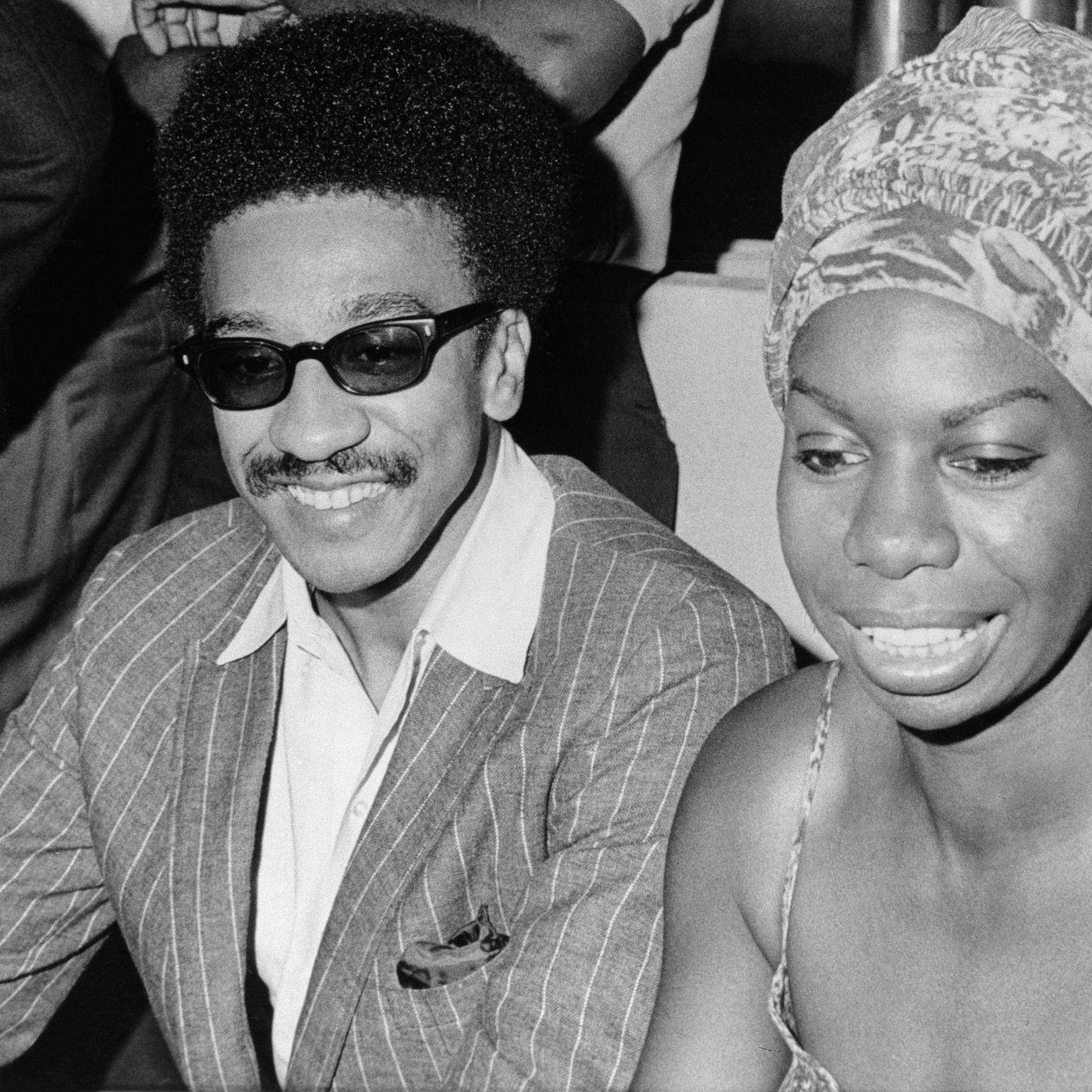
This week at a staff meeting, our producer Tracy Hunt told a story, really a story of a moment, from the weekend, as the protests in response to the killing of George Floyd were really escalating. I just asked her to tell me that story again on tape. Okay, so you were listening to a certain song. What happened exactly?
Can you set the scene? Yeah, it was Saturday, and I had been feeling pretty sad all day, just feeling kind of grumpy. And I was like, okay, you know what? It's off-care Saturday.
Let's just take a really long, hot shower, wash your hair, smell good, feel good. And so I did all that, you know, and I was just feeling very good physically, for the first time in a while, actually. And I decided I was going to play Nina Simone. I just typed in Nina Simone in Spotify and just let them start picking songs for me.
I wasn't really being really specific. And I opened, so I had a balcony in my apartment, and I opened the door to let some air in. And I'm just instantly in a barrage with all this sound, this cacophony of police sirens, people chanting. And then I was in my room.
The song that I was playing was Backlash Blues by Nina Simone. And I was like, whoa, what is going on? Like, wow, this is a very weird sound experience right now. Backlash, Backlash.
What is that song, just for people who don't know it? Backlash Blues, she actually wrote it with Langston Hughes, a great Harlem Renaissance poet. He wrote the lyrics, and she wrote the, I guess, the music. And the song is just like, who do you think I am?
Raise my taxes and freeze my wages, send my son to be a damn. You got me in second-class houses, second-class schools. Do you think that all colored people are just second-class fools? They're just second-class schools.
Just the backlash. I'm going to leave you with the Backlash Blues. I'm going to leave you with the blues. Yes, I am.
Wow. I mean, other than the Vietnam reference, it's been really on the nose for right now. Like, wow, this is Nina Simone in 1967, singing this out, and it's like a warning, a prediction or something. Like, talking forward to us 50 years.
Yeah. And one big question over this weekend, and I think we're going to have this question for a lot, is that everyone's like, why is this happening now? And I'm like, literally, this is why it's happening. This is, it's right here.
When things keep piling on, piling on, piling on, you know, there's going to be a release. And, you know, you look at the last couple months, it's just been piling on and piling on and piling on. It's coronavirus. It's the virus that's killing mostly black and brown people.
It's, you know, unemployment. And then you have, like, three really horrific killings of black people in three months. It just felt like there was a building up of stuff, and it kind of made sense. And so it was just a really bizarre moment.
And then I listened to Sunday in Savannah. At the beginning of this recording, she's saying something like, I'm so glad you guys came out tonight. I didn't know that you would because of everything that happens. And I was like, wait, what happened?
And I was Googling, and I found out that she performed three days after Martin Luther King Jr. was assassinated in Memphis. One more Sunday in Savannah. Hear the whole creation shout and praise the Lord.
So she dedicated the whole show to him. And she sings Mississippi Goddamn. And then there's, like, a couple moments in Mississippi Goddamn, which also, once again, feel kind of pathetic. Like, this is a very angry song already.
But then she kind of has, like, a moment where she's, she just kind of, like, has, like, kind of as a moment where she's saying, Good God, you know, the king is dead. The king of love is dead. I ain't about to be nonviolent, honey. We're not about to be nonviolent.
And there was something very, I don't know if alarming or strange, or I don't know what the right word is, but there's something kind of amazing. Like, these are the songs that she's singing for Martin Luther King Jr. And she's saying, yeah, let's get violent, you know? What's going to happen now in all of our cities?
Our people are rising. They're living in the world. And I should point out that, you know, when she was performing, several cities in the United States were burning because there were riots in reaction to Martin Luther King's death. She also, last year, a year ago, she has, like, a period where she just starts talking, and she's talking about other black artists who have died.
Coltrane left us. Otis Redding left us. In the last few years. You can go on.
Do you realize how many we have lost? Right. Then it really gets down to reality, doesn't it? Not a performance.
Not microphones, not that crap. But really, something else. Lost a lot of them. Like, she's just, she even says, I don't know how to feel anymore.
I'm just so numb. We can't afford any more losses. Oh, no. Oh, my God.
They're shooting us down one by one. Don't forget that. Because they are. Killing us one by one.
And hearing her say that, like, just... They're shooting us one by one. Yeah, it's just... I don't know.
She's just so necessary. We just need her so much. Can I just keep thinking, what would she be thinking about this moment? What would she have to say?
I don't know. It feels like she already said it. Yeah. Anyway, I found this quote that she said.
How can you be an artist and not reflect the times? That, to me, is the definition of an artist. I know that, like, one thing we were thinking about doing is reaching out to musicians, finding out how they're reflecting the time. And I'm just going to be having...
And I think even just in my work, I'm going to be thinking about this challenge. How can you not reflect the time? That's what you're supposed to do. Yeah.
You know, I kind of don't know if I'm up to it. Honestly, I... You know, I think we're all feeling that from very different vantage points. Yeah.
I think we all are. We're all feeling a little... Like, you know, I feel like every black journalist has this... Whenever this happens, a lot of black journalists, we get on our group chats and we're like, is journalism really the thing we should be doing right now?
Is that going to save us? You know, we go into this process knowing that, like, we're going to be entering mostly white spaces, but we do it because we really believe in serving our community. And, you know, when moments like this come up, you doubt it. And you're just like, is this really...
What else should I be doing? And, you know, I keep coming back to it. Like, I think I'm in the right place. I do, but I'm not sure.
It's hard. It's really hard. Yeah. Yeah.
He had to sing mountaintop And he knew he could not stop Always living with a thread Dead ahead. Come on, Sam. Coach, you better stop right there I will almost do the brain What will happen What will happen Now that the king of love is dead I will never continue He,'s in vain You know, and let's go He has to die Who will have