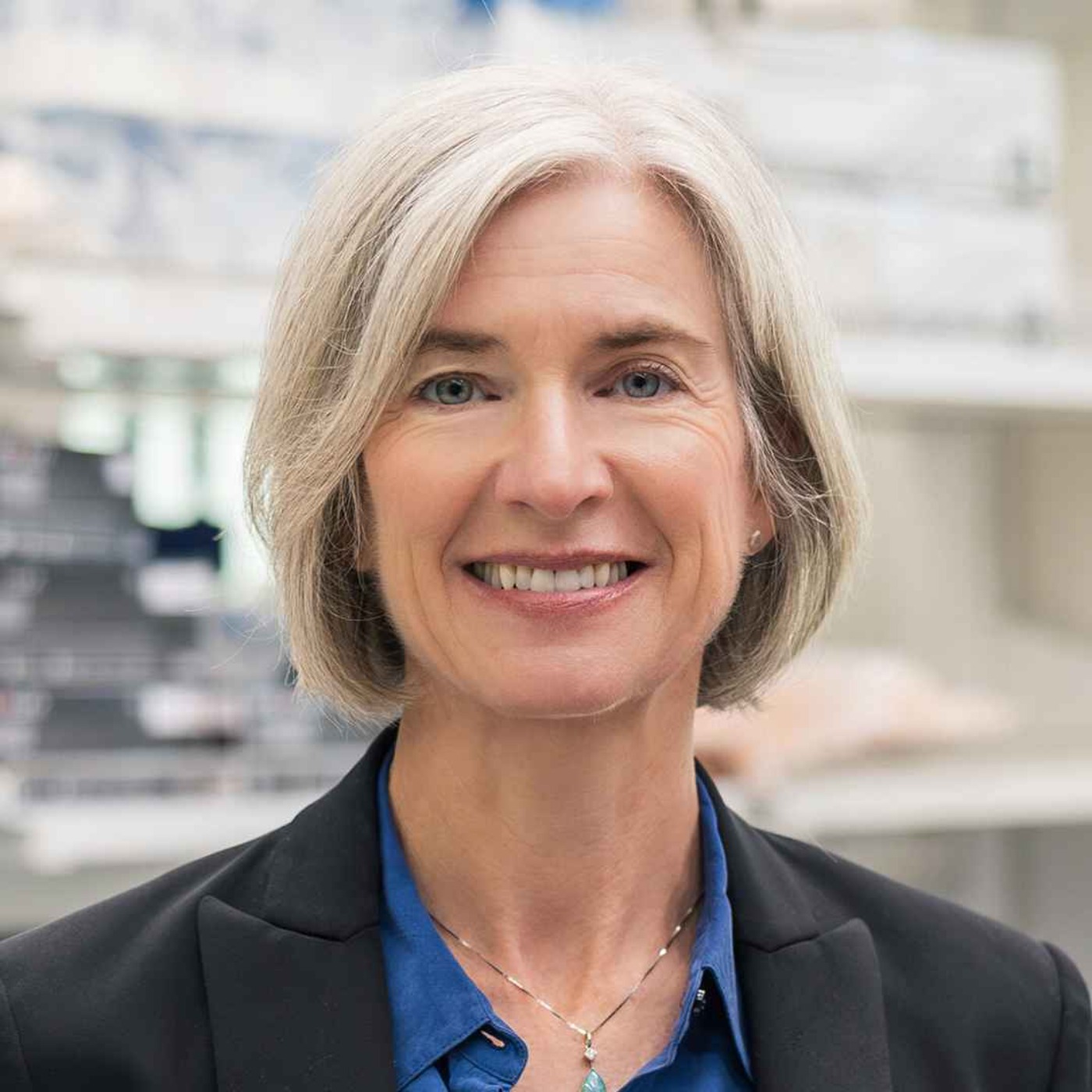
Nobel laureate Jennifer Doudna on CRISPR and the future of gene editing episode artwork

EPISODE · Aug 22, 2025 · 50 MIN

Nobel laureate Jennifer Doudna on CRISPR and the future of gene editing

from Berkeley Talks

For UC Berkeley’s Jennifer Doudna, the revolutionary discovery of CRISPR-Cas9 gene editing began 15 years ago with a meeting at the campus’s Free Speech Movement Cafe. “This is a quintessential story about Berkeley,” begins Doudna, a professor of molecular and cell biology and of chemistry, in a lecture she gave on campus in April. “The research that I'll talk about today wouldn't have happened … if I had been working anywhere else. And that's because we have a really collaborative environment on our campus.”At the cafe, Doudna listened while a Berkeley colleague described a possible adaptive immune system in bacteria that helps them fight off viral infection. Doudna's lab went on to research the molecules involved, discovering a pathway that allows bacteria to "learn" about viruses, store the information and use it for protection.The scientists realized this same system could be used to trigger DNA repair in plant, animal and human cells, effectively allowing them to "rewrite the code of life." The seminal paper on CRISPR was published in 2012 by Doudna and her key collaborator, French microbiologist Emmanuelle Charpentier. The pair went on to win the Nobel Prize in Chemistry in 2020.In this Berkeley Talks episode, Doudna discusses how CRISPR can be used to correct disease-causing genetic mutations, the impact that it's already having on people's lives and where she sees the technology going in the future.  “We're in an era of programmable genome editing,” she says. “It's really exciting to see all the possible applications of this. We know that it can be safe and effective to treat and even to potentially cure human disease, and we need to continue to advance the technology so that it can be deployed more widely.”Not only will that require continual activity on the science and technology front, she adds, but also in developing appropriate guidelines and regulations to ensure that CRISPR’s applications move forward responsibly. Doudna’s talk took place on April 4 as part of Brilliance of Berkeley, a course offered every spring by the College of Letters and Science that celebrates the campus’s exceptional faculty and their accomplishments. Each week, students listen to two guest lectures by top Berkeley scholars from an array of fields, followed by a Q&A. Watch the video on the Brilliance of Berkeley YouTube page. Listen to the episode and read the transcript on UC Berkeley News (news.berkeley.edu/podcasts/berkeley-talks).Music by HoliznaCC0.Photo by Glenn Ramit/IGI. Hosted on Acast. See acast.com/privacy for more information.

For UC Berkeley’s Jennifer Doudna, the revolutionary discovery of CRISPR-Cas9 gene editing began 15 years ago with a meeting at the campus’s Free Speech Movement Cafe. “This is a quintessential story about Berkeley,” begins Doudna, a professor of molecular and cell biology and of chemistry, in a lecture she gave on campus in April. “The research that I'll talk about today wouldn't have happened … if I had been working anywhere else. And that's because we have a really collaborative environment on our campus.”At the cafe, Doudna listened while a Berkeley colleague described a possible adaptive immune system in bacteria that helps them fight off viral infection. Doudna's lab went on to research the molecules involved, discovering a pathway that allows bacteria to "learn" about viruses, store the information and use it for protection.The scientists realized this same system could be used to trigger DNA repair in plant, animal and human cells, effectively allowing them to "rewrite the code of life." The seminal paper on CRISPR was published in 2012 by Doudna and her key collaborator, French microbiologist Emmanuelle Charpentier. The pair went on to win the Nobel Prize in Chemistry in 2020.In this Berkeley Talks episode, Doudna discusses how CRISPR can be used to correct disease-causing genetic mutations, the impact that it's already having on people's lives and where she sees the technology going in the future.  “We're in an era of programmable genome editing,” she says. “It's really exciting to see all the possible applications of this. We know that it can be safe and effective to treat and even to potentially cure human disease, and we need to continue to advance the technology so that it can be deployed more widely.”Not only will that require continual activity on the science and technology front, she adds, but also in developing appropriate guidelines and regulations to ensure that CRISPR’s applications move forward responsibly. Doudna’s talk took place on April 4 as part of Brilliance of Berkeley, a course offered every spring by the College of Letters and Science that celebrates the campus’s exceptional faculty and their accomplishments. Each week, students listen to two guest lectures by top Berkeley scholars from an array of fields, followed by a Q&A. Watch the video on the Brilliance of Berkeley YouTube page. Listen to the episode and read the transcript on UC Berkeley News (news.berkeley.edu/podcasts/berkeley-talks).Music by HoliznaCC0.Photo by Glenn Ramit/IGI. Hosted on Acast. See acast.com/privacy for more information.

NOW PLAYING

Nobel laureate Jennifer Doudna on CRISPR and the future of gene editing

0:00 50:57

No transcript for this episode yet

We transcribe on demand. Request one and we'll notify you when it's ready — usually under 10 minutes.

Carnivores Don't Get Sunburn - Carnivore Diet Talks Carnivores Don't Get Sunburn - Carnivore Diet Talks Welcome to “Carnivores Don’t Get Sunburn,” where we have fun and explore the carnivore diet and its transformative power. Join us as we uncover real stories from individuals who have thrived on this diet, defying convention and embracing optimal health. Plus, stay tuned for our upcoming documentary featuring diverse carnivores overcoming health challenges. Learn more at www.carnivoredietdocumentary.com.Excitingly, we’re working on an upcoming documentary where we’ll feature carnivores from various walks of life, conquering diverse health challenges. Join us on this journey and learn more at www.carnivoredietdocumentary.com.Join us in uncovering the power of the carnivore diet. Prepare to be inspired, informed, and empowered to embrace optimal health and well-being.Welcome to “Carnivores Don’t Get Sunburn: Unveiling Real Stories of the Carnivore Diet.” Stay tuned for our upcoming documentary. Discover how this lifestyle can transform lives. Learn more at www.carnivoredietdocumentary.com IT IS WHAT IT IS with SHALLZ - SHALLY ZOMORODI Shally Zomorodi What?  "It is what it is" with ShallZ – Shally ZomorodiWhen? WeeklyHow long? 35 minutesEvery week, Mother of 4, wife, morning TV news anchor and ultimate hostess, Shally Zomorodi talks about life - its up's and downs and how to stay on track in her weekly podcast, ‘It is what it is.’  Known for her high energy, infectious smile and ability to see the cup as half full Shally talks about all things in life and how to work through its challenges. From parenting, marriage, friendships, current events to how to smile when it just seems impossible ‘It is what it is’ is the perfect podcast to help inspire you to dance through the rain. Tracking Nuclear Weapons Programs Center for Strategic and International Studies The CSIS Proliferation Prevention Program talks to experts about transparency and nuclear weapons. Cover Stories with Chess Life US Chess Chess Life Editor John Hartmann talks to the authors of each month's Chess Life cover story.

Frequently Asked Questions

How long is this episode of Berkeley Talks?

This episode is 50 minutes long.

When was this Berkeley Talks episode published?

This episode was published on August 22, 2025.

What is this episode about?

For UC Berkeley’s Jennifer Doudna, the revolutionary discovery of CRISPR-Cas9 gene editing began 15 years ago with a meeting at the campus’s Free Speech Movement Cafe. “This is a quintessential story about Berkeley,” begins Doudna, a professor of...

Can I download this Berkeley Talks episode?

Yes, you can download this episode by clicking the download button on the episode player, or subscribe to the podcast in your preferred podcast app for automatic downloads.
URL copied to clipboard!