
EPISODE · Jul 24, 2025 · 43 MIN
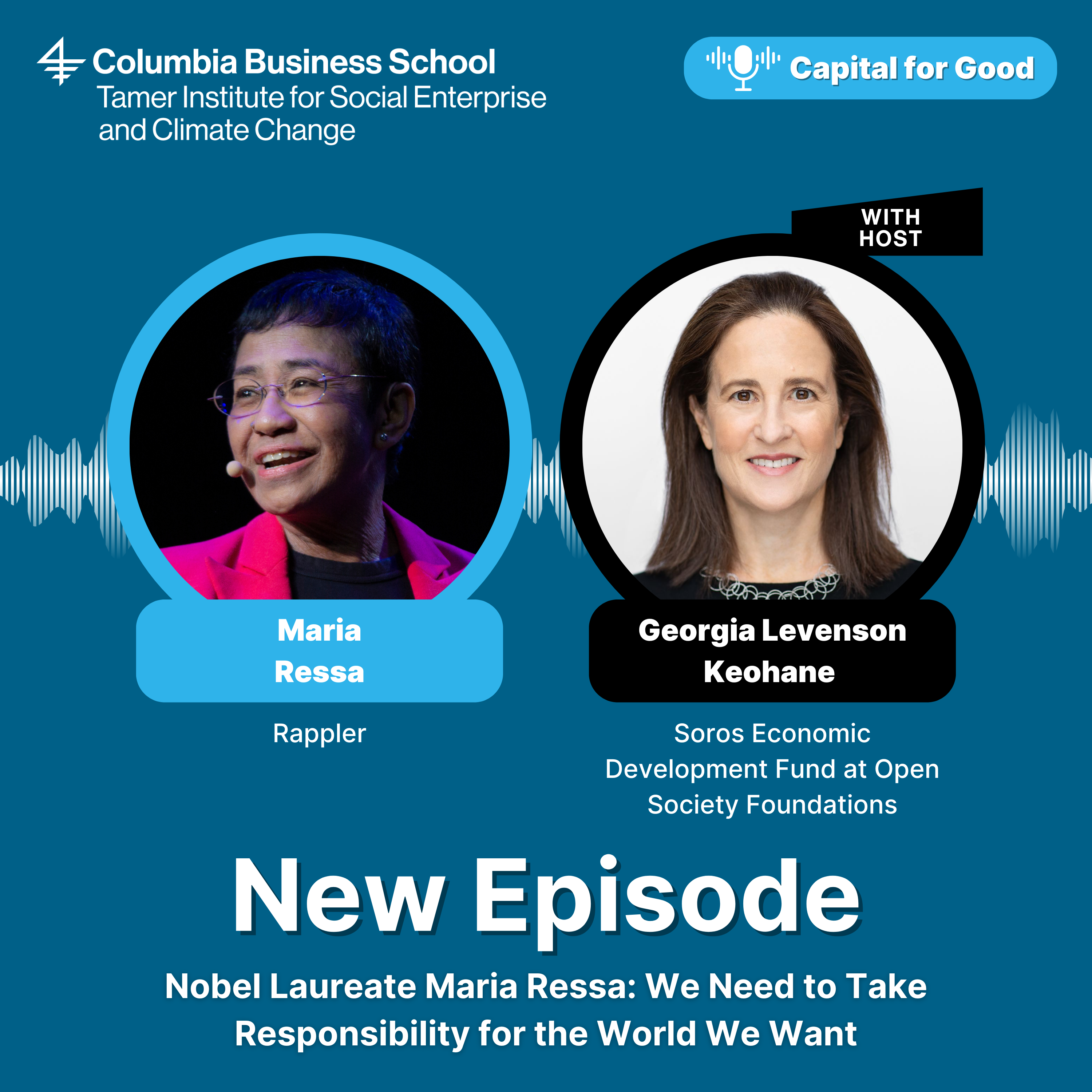
Nobel Laureate Maria Ressa: We Need to Take Responsibility for the World We Want
from Capital for Good
In this episode of Capital for Good we speak with Maria Ressa, the globally celebrated free speech champion, journalist, entrepreneur, dissident, and winner of the 2021 Nobel Peace Prize for her work "to safeguard freedom of expression, which is a precondition for democracy and lasting peace." Ressa is a co-founder of Rappler, one of the most influential media platforms in the Philippines. For her reporting on the administration of President Rodrigo Duterte, Ressa was threatened, arrested, tried, and convicted of cyberlibel, facing over one hundred years imprisonment. Today Duterte has been arrested by the International Criminal Court and awaits trial in the Hague, Ressa has been cleared of nearly all charges, and her work as a journalist and activist continues as she warns of the very real world challenges of online disinformation. We begin with Ressa's earliest days in the United States, when her family immigrated in 1973 after martial law had been declared in the Philippines. We discuss the importance of her education in those years, in elementary, high school, and at Princeton, and the support of those who "taught her to keep learning," lessons that would inform her pursuit of journalism when she returned to the Philippines. "I fell into journalism," Ressa says, as she found it to be critical "connective tissue between government and the people," and a way to "hold power to account." She and three fellow journalists launched Rappler in 2012; by 2016, when Duterte was elected President, Ressa found herself persecuted by the government — threatened, arrested, tried and sentenced to over one hundred years in prison — for reporting on its corrupt and increasingly authoritarian practices. We discuss Ressa's fight for her rights "as a journalist and a citizen" and her realization that technology could accelerate misinformation, distort truth, and blur the boundaries between the virtual and real world. "A lie told a million times becomes a fact," she says. Ressa chronicles these experiences in her 2022 memoir and call-to-arms How to Stand up to a Dictator: The Fight for our Future. Ressa cautions about the dangers of and linkages between the weaponization of algorithmically driven disinformation — and illiberalism worldwide. "Without facts you can't have truth, and without truth you can't have trust. The only government that exists without trust is a dictatorship: you can't have journalism or democracy." In her own work, she and Rappler are building upon the Matrix protocol, a secure, open-source decentralized platform that has the potential to become a global independent news distribution outlet. Although she is deeply concerned — "I feel like Cassandra and Sisyphus combined," she says – Ressa also maintains her faith in the power of people to come together for change. "It's all about community," she explains. "We are standing on the rubble of the world that was; we need to take responsibility for the world we want. We can build a world that is more just, more equitable, more sustainable; we can do this if we decide to come together, to demand better." Thanks for Listening! Subscribe to Capital for Good on Apple, Amazon, Google, Spotify, or wherever you get your podcasts. Drop us a line at [email protected]. Mentioned in this podcast: Maria Ressa Nobel Prize Lecture, (2021) How to Stand up to a Dictator: The Fight for our Future, (Harper Collins, 2022) A Thousand Cuts, (Frontline, 2021)
Embed this episode
Ready to play
Nobel Laureate Maria Ressa: We Need to Take Responsibility for the World We Want
No transcript for this episode yet
Similar Episodes
No similar episodes found.