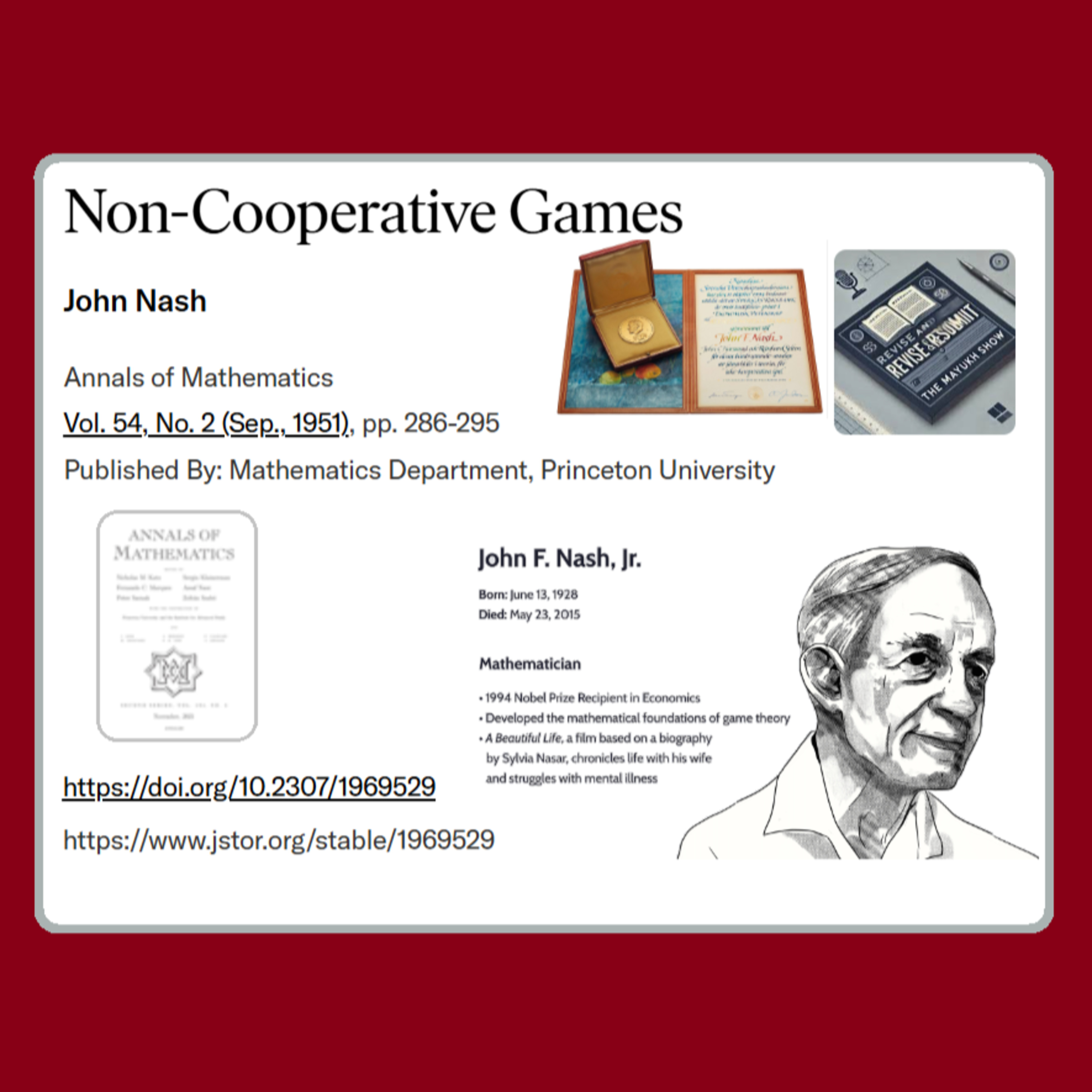
Non-Cooperative Games (Nash, 1951) - Weekend Classics episode artwork

EPISODE · Nov 10, 2024 · 21 MIN

Non-Cooperative Games (Nash, 1951) - Weekend Classics

from Revise and Resubmit - The Mayukh Show · host Mayukh Mukhopadhyay

Welcome to Revise and Resubmit and our Weekend Classics episode. Today, we’re diving into one of the foundational texts of modern game theory—a theory that redefined how we understand strategy, competition, and decision-making across fields. This paper? John Nash’s Non-cooperative Games, published in 1951 in the Annals of Mathematics. John Nash was not just a mathematician; he was a visionary whose ideas have influenced everything from economics to political science. Born in Bluefield, West Virginia, Nash’s journey to mathematical greatness began when he enrolled at the Carnegie Institute of Technology. Though he began in chemical engineering, his insatiable curiosity soon led him to mathematics, and by 22, he had completed his doctorate at Princeton University. But it was his groundbreaking concept—the Nash Equilibrium—that cemented his legacy, providing a new lens through which to view rivalry and strategic behavior. In Non-cooperative Games, Nash outlined the principles of equilibrium where competing players could each arrive at the best possible outcome, taking into account the decisions of others. This concept, now known as the Nash Equilibrium, has since become a vital tool for economists, policymakers, and business strategists worldwide. Imagine this: what if every decision, from corporate boardrooms to international negotiations, could be boiled down to a calculated equilibrium? Is it possible that even our most complex choices are, at their core, mathematical puzzles waiting to be solved? A heartfelt thank you to John Nash and to Princeton University and the Institute for Advanced Study for making this pivotal work possible. Listeners, if you’re as intrigued by these timeless theories as we are, don’t forget to subscribe to Revise and Resubmit on Spotify and catch our latest content on our YouTube channel, Weekend Researcher. We’re also available on Amazon Prime Music and Apple Podcast. Reference Nash, J. (1951). Non-Cooperative Games. The Annals of Mathematics, 54(2), 286–295. https://doi.org/10.2307/1969529 Open Access Paper Link: http://176.9.41.242/doc/statistics/decision/1951-nash.pdf Annotated Dissertation: https://gametheory.online/projects/documents/1521541344.pdf Princeton Library Link: https://library.princeton.edu/sites/g/files/toruqf6021/files/documents/Non-Cooperative_Games_Nash.pdf 1994 Nobel Seminar Transcripts: https://www.nobelprize.org/uploads/2017/05/nash-lecture.pdf Youtube channel link ⁠https://www.youtube.com/@weekendresearcher⁠

Welcome to Revise and Resubmit and our Weekend Classics episode. Today, we’re diving into one of the foundational texts of modern game theory—a theory that redefined how we understand strategy, competition, and decision-making across fields. This paper? John Nash’s Non-cooperative Games, published in 1951 in the Annals of Mathematics. John Nash was not just a mathematician; he was a visionary whose ideas have influenced everything from economics to political science. Born in Bluefield, West Virginia, Nash’s journey to mathematical greatness began when he enrolled at the Carnegie Institute of Technology. Though he began in chemical engineering, his insatiable curiosity soon led him to mathematics, and by 22, he had completed his doctorate at Princeton University. But it was his groundbreaking concept—the Nash Equilibrium—that cemented his legacy, providing a new lens through which to view rivalry and strategic behavior. In Non-cooperative Games, Nash outlined the principles of equilibrium where competing players could each arrive at the best possible outcome, taking into account the decisions of others. This concept, now known as the Nash Equilibrium, has since become a vital tool for economists, policymakers, and business strategists worldwide. Imagine this: what if every decision, from corporate boardrooms to international negotiations, could be boiled down to a calculated equilibrium? Is it possible that even our most complex choices are, at their core, mathematical puzzles waiting to be solved? A heartfelt thank you to John Nash and to Princeton University and the Institute for Advanced Study for making this pivotal work possible. Listeners, if you’re as intrigued by these timeless theories as we are, don’t forget to subscribe to Revise and Resubmit on Spotify and catch our latest content on our YouTube channel, Weekend Researcher. We’re also available on Amazon Prime Music and Apple Podcast. Reference Nash, J. (1951). Non-Cooperative Games. The Annals of Mathematics, 54(2), 286–295. https://doi.org/10.2307/1969529 Open Access Paper Link: http://176.9.41.242/doc/statistics/decision/1951-nash.pdf Annotated Dissertation: https://gametheory.online/projects/documents/1521541344.pdf Princeton Library Link: https://library.princeton.edu/sites/g/files/toruqf6021/files/documents/Non-Cooperative_Games_Nash.pdf 1994 Nobel Seminar Transcripts: https://www.nobelprize.org/uploads/2017/05/nash-lecture.pdf Youtube channel link ⁠https://www.youtube.com/@weekendresearcher⁠

NOW PLAYING

Non-Cooperative Games (Nash, 1951) - Weekend Classics

0:00 21:05

No transcript for this episode yet

We transcribe on demand. Request one and we'll notify you when it's ready — usually under 10 minutes.

Frequently Asked Questions

How long is this episode of Revise and Resubmit - The Mayukh Show?

This episode is 21 minutes long.

When was this Revise and Resubmit - The Mayukh Show episode published?

This episode was published on November 10, 2024.

What is this episode about?

Welcome to Revise and Resubmit and our Weekend Classics episode. Today, we’re diving into one of the foundational texts of modern game theory—a theory that redefined how we understand strategy, competition, and decision-making across fields. This...

Can I download this Revise and Resubmit - The Mayukh Show episode?

Yes, you can download this episode by clicking the download button on the episode player, or subscribe to the podcast in your preferred podcast app for automatic downloads.
URL copied to clipboard!