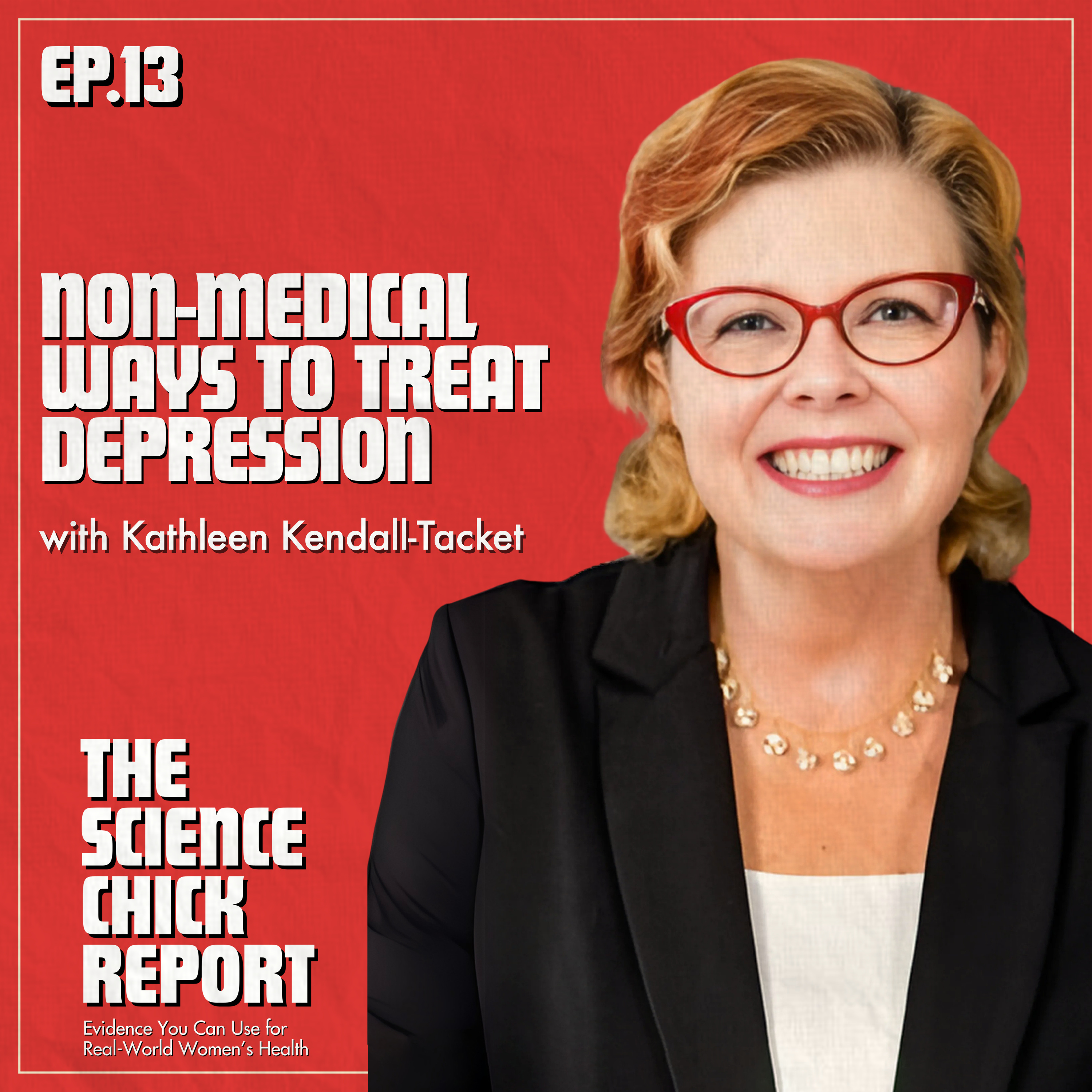
Non-Medical Ways to Treat Depression episode artwork

EPISODE · Apr 8, 2026 · 23 MIN

Non-Medical Ways to Treat Depression

from The Science Chick Report: Evidence You Can Use for Real-World Women's Health · host Kathleen Kendall-Tackett

What if something as simple as a group walk could be just as effective as antidepressant medication for some mothers?In this episode of The Science Chick Report, Dr. Kathleen Kendall-Tackett continues her series on practical, non-medical ways to support mothers experiencing depression, this time focusing on something simple but powerful: exercise.For many providers, it can feel frustrating when options like medication or therapy are off the table. But as she explains, there is still a lot you can do within your scope, and it does not have to be expensive or complicated.Dr. Kendall-Tackett breaks down the research behind moderate exercise and its impact on depression, including studies showing it can be nearly as effective as antidepressants. More importantly, she reframes exercise in a way that feels realistic for new mothers. This is not about intense workouts. It is about small, consistent movement like walking, often with the baby included.She also highlights how combining simple strategies like exercise, omega-3s, sunlight, and social connection can create meaningful change. Group walks, community support, and even light exposure can help reduce isolation and improve mental health in powerful ways.If you are a doula, nurse, or community health worker, this episode gives you practical, evidence-based tools you can actually use.Tune in to learn how small, consistent actions can make a real difference in maternal mental health.In This Episode:(00:00) Introduction(01:14) Alternative treatments for depression beyond medication(04:06) Community success stories walking and omega 3s(05:43) Research evidence exercise vs medication(09:53) Inflammation and exercise intensity(10:54) Types of exercise aerobic yoga strength training(13:27) Recommended exercise guidelines(15:53) Exploring local exercise options(18:17) Implementing light in group settings(20:04) Importance of follow up and evaluation(20:55) Scope of practice and safety considerationsNotable Quotes:(01:00) “There is actually a lot you can do, and you can talk to mothers about things they could do themselves, or you can even start a program together where you get together and really make a big difference.” — Dr. Kathleen Kendall-Tackett(01:25) “I have certainly run into this group of mothers over the years, mothers who just don't want to do the classic psychiatric thing—going on medications, doing therapy — Dr. Kathleen Kendall-Tackett(02:13) “Mothers or anybody who's depressed actually has options besides just pills and psychotherapy. And that is exercise.” — Dr. Kathleen Kendall-Tackett(03:25) “A moderate amount of exercise has a huge effect, not only in terms of physical health, but also mental health as well..” — Dr. Kathleen Kendall-Tackett(06:55) “This idea that you give people a pill and they get better automatically—it's not true all the time..” — Dr. Kathleen Kendall-Tackett(15:31) “The nice thing about exercise is that the effects are almost immediate.” — Dr. Kathleen Kendall-Tackett(08:52) Preventing prenatal depression is a great idea because if you can prevent prenatal depression, you actually lower the risk of preterm birth.” — Dr. Kathleen Kendall-Tackett(09:19) “With moderate exercise, which is what we're talking about here, it actually can lead to less lactic acid, and it doesn't seem to be a problem with the babies.”— Dr. Kathleen Kendall-TackettThe Science Chick ReportThe Science Chick Report Dr. Kathleen Kendall-TackettWebsiteLinkedInXFacebookResearchGate (upcoming paper)Mentioned Babyak et al. (2000) – Duke University exercise and depression studyBlumenthal et al. (2007) – Follow-up study: exercise vs. medicationNissen et al. (2021) – Systematic review of exercise and depressionDavenport et al. – Review of 52 studies on exercise and prenatal depression (131,000 patients)University of New Hampshire (1999) – Lactic acid in breastmilk and exercise

What if something as simple as a group walk could be just as effective as antidepressant medication for some mothers?In this episode of The Science Chick Report, Dr. Kathleen Kendall-Tackett continues her series on practical, non-medical ways to support mothers experiencing depression, this time focusing on something simple but powerful: exercise.For many providers, it can feel frustrating when options like medication or therapy are off the table. But as she explains, there is still a lot you can do within your scope, and it does not have to be expensive or complicated.Dr. Kendall-Tackett breaks down the research behind moderate exercise and its impact on depression, including studies showing it can be nearly as effective as antidepressants. More importantly, she reframes exercise in a way that feels realistic for new mothers. This is not about intense workouts. It is about small, consistent movement like walking, often with the baby included.She also highlights how combining simple strategies like exercise, omega-3s, sunlight, and social connection can create meaningful change. Group walks, community support, and even light exposure can help reduce isolation and improve mental health in powerful ways.If you are a doula, nurse, or community health worker, this episode gives you practical, evidence-based tools you can actually use.Tune in to learn how small, consistent actions can make a real difference in maternal mental health.In This Episode:(00:00) Introduction(01:14) Alternative treatments for depression beyond medication(04:06) Community success stories walking and omega 3s(05:43) Research evidence exercise vs medication(09:53) Inflammation and exercise intensity(10:54) Types of exercise aerobic yoga strength training(13:27) Recommended exercise guidelines(15:53) Exploring local exercise options(18:17) Implementing light in group settings(20:04) Importance of follow up and evaluation(20:55) Scope of practice and safety considerationsNotable Quotes:(01:00) “There is actually a lot you can do, and you can talk to mothers about things they could do themselves, or you can even start a program together where you get together and really make a big difference.” — Dr. Kathleen Kendall-Tackett(01:25) “I have certainly run into this group of mothers over the years, mothers who just don't want to do the classic psychiatric thing—going on medications, doing therapy — Dr. Kathleen Kendall-Tackett(02:13) “Mothers or anybody who's depressed actually has options besides just pills and psychotherapy. And that is exercise.” — Dr. Kathleen Kendall-Tackett(03:25) “A moderate amount of exercise has a huge effect, not only in terms of physical health, but also mental health as well..” — Dr. Kathleen Kendall-Tackett(06:55) “This idea that you give people a pill and they get better automatically—it's not true all the time..” — Dr. Kathleen Kendall-Tackett(15:31) “The nice thing about exercise is that the effects are almost immediate.” — Dr. Kathleen Kendall-Tackett(08:52) Preventing prenatal depression is a great idea because if you can prevent prenatal depression, you actually lower the risk of preterm birth.” — Dr. Kathleen Kendall-Tackett(09:19) “With moderate exercise, which is what we're talking about here, it actually can lead to less lactic acid, and it doesn't seem to be a problem with the babies.”— Dr. Kathleen Kendall-TackettThe Science Chick ReportThe Science Chick Report Dr. Kathleen Kendall-TackettWebsiteLinkedInXFacebookResearchGate (upcoming paper)Mentioned Babyak et al. (2000) – Duke University exercise and depression studyBlumenthal et al. (2007) – Follow-up study: exercise vs. medicationNissen et al. (2021) – Systematic review of exercise and depressionDavenport et al. – Review of 52 studies on exercise and prenatal depression (131,000 patients)University of New Hampshire (1999) – Lactic acid in breastmilk and exercise

NOW PLAYING

Non-Medical Ways to Treat Depression

0:00 23:46

No transcript for this episode yet

We transcribe on demand. Request one and we'll notify you when it's ready — usually under 10 minutes.

Frequently Asked Questions

How long is this episode of The Science Chick Report: Evidence You Can Use for Real-World Women's Health?

This episode is 23 minutes long.

When was this The Science Chick Report: Evidence You Can Use for Real-World Women's Health episode published?

This episode was published on April 8, 2026.

What is this episode about?

What if something as simple as a group walk could be just as effective as antidepressant medication for some mothers?In this episode of The Science Chick Report, Dr. Kathleen Kendall-Tackett continues her series on practical, non-medical ways to...

Can I download this The Science Chick Report: Evidence You Can Use for Real-World Women's Health episode?

Yes, you can download this episode by clicking the download button on the episode player, or subscribe to the podcast in your preferred podcast app for automatic downloads.
URL copied to clipboard!