
EPISODE · Aug 8, 2021 · 17 MIN
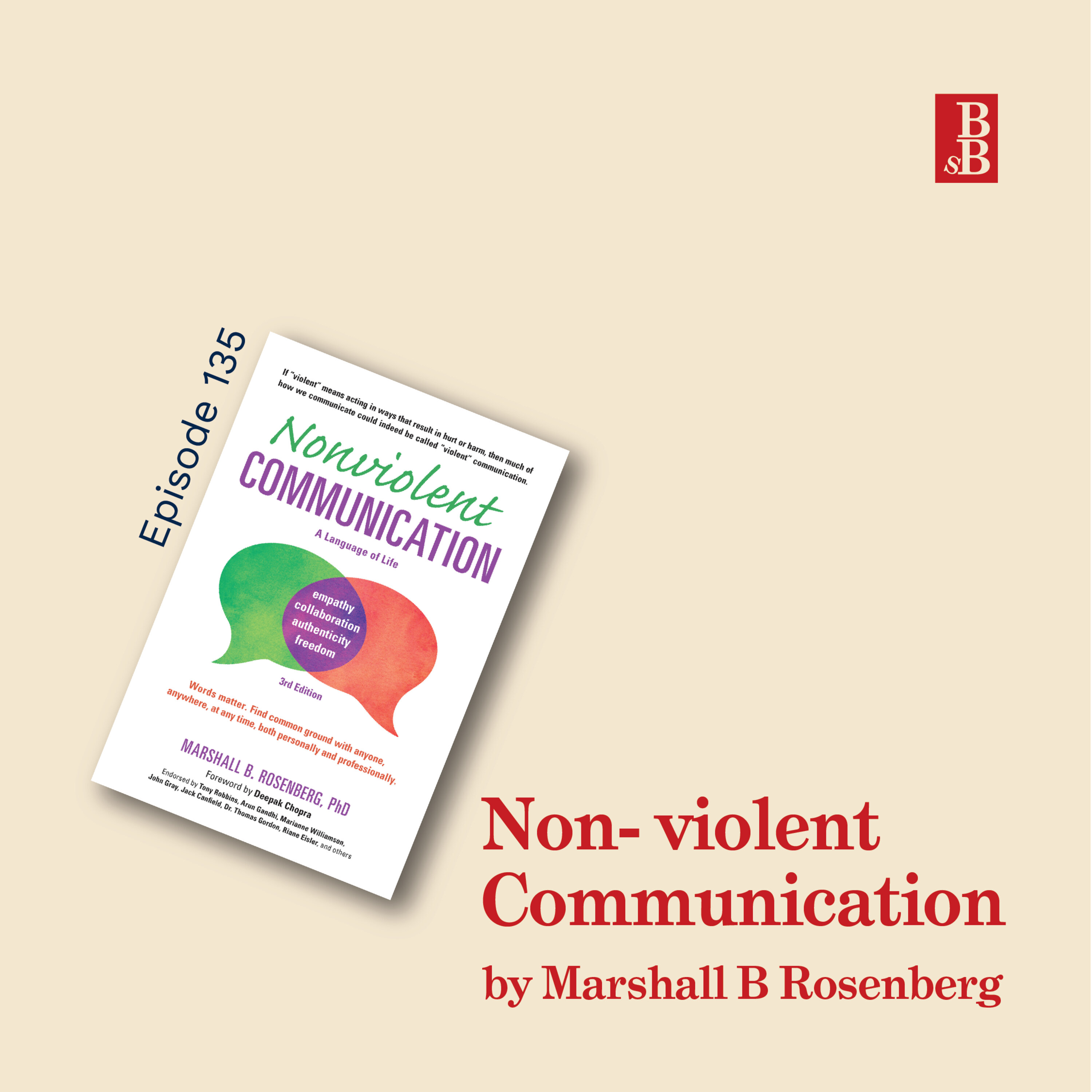
Nonviolent Communication by Marshall B Rosenberg: how to take personal responsibility for your feelings
from Steph's Business Bookshelf Podcast · host Steph Clarke
About the author Dr. Marshall B. Rosenberg was the founder and director of educational services for The Center for Nonviolent Communication. Growing up in an inner–city Detroit neighborhood Dr. Marshall Rosenberg was confronted daily with various forms of violence. Wanting to explore the causes of violence and what could be done to reduce violence, he chose to study clinical psychology and received his Ph.D. in Clinical Psychology from the University of Wisconsin in 1961. In 1966 he was awarded diplomat status in clinical psychology from the American Board of Examiners in Professional Psychology. Nonviolent Communication training evolved from Dr. Rosenberg’s quest to find a way of rapidly disseminating much needed peacemaking skills. The Center for Nonviolent Communication emerged out of work he was doing with civil rights activists in the early 1960’s. During this period he also mediated between rioting students and college administrators and worked to peacefully desegregate public schools in long-segregated regions. Worldwide reactions have been inspiring. Evaluations indicate that this training vastly strengthens the ability to connect compassionately with oneself and others, as well as to resolve differences peacefully. Reports also indicate that the benefit of the training is not only stable over time, but actually increases. Source: https://www.cnvc.org/about/marshall About the book Non-violent Communication is an enlightening look at how peaceful communication can create compassionate connections with family, friends, and other acquaintances, this international bestseller uses stories, examples, and sample dialogues to provide solutions to communication problems both at home and in the workplace. Guidance is provided on identifying and articulating feelings and needs, expressing anger fully, and exploring the power of empathy in order to speak honestly without creating hostility, break patterns of thinking that lead to anger and depression, and communicate compassionately. Practical nonviolent communication skills are partnered with a powerful consciousness and vocabulary that can be applied to personal, professional, and political differences. Included in the new edition is a complete chapter on conflict resolution and mediation. Source: www.amazon.com Big idea #1-Observe, feel, need, and request The nonviolent communication process is made up of four key stages. Observing concrete actions that affect your wellbeing Knowing how you feel as a result of what you observe. 3. Recognising the needs and the values and the desires that create the feelings that you are feeling. 4. The concrete actions you request in order to enrich your life. Going through this process allows you to express yourself better and notice the needs in others, more empathetically. It also allows more space for compassion, and allows you to reframe situations and feelings in a different way. By noticing the needs of others, more empathetically, you’re able to actually connect with them a little bit more, rather than simply assessing how wrong they are for what they’re saying or doing at the time. Because our analysis of others is often an expression of our own needs or values, not necessarily what the other person is thinking, or what they are needing at the time. Big idea#2 — Responsibility and expression Marshall says that we are particularly dangerous when we deny personal responsibility, and attach our feelings and actions to other people’s or other group’s actions. So essentially if we blame our actions or blame how we feel on what someone else does, we then deny personal responsibility for our own feelings and attach them to other people. There are several examples in the book that include situations like; Blaming the actions of others on how we react; (eg. I hit my child because he ran into the street). So the action of another person has caused your reaction. And we’re blaming them, rather than taking our own responsibility for what we did. Using group pressure (eg. I started smoking because my friends did). Blaming vague impersonal forces on what you do (eg. I cleaned my room because I had to) rather than assuming you have any control over what you choose to do. On the topic of expression, there’s stories in the book of people who have been angry at their partners for decades and decades for not meeting their needs. But having gone through the nonviolent communication training, they realise they’ve never actually made their needs clearly known. Instead, they’ve been stuck in resentment and anger and let these unmet and uncommunicated needs take over and really undermined their relationships. If we do not value our needs, and express them in a healthy way, we can’t expect others to do the same. Big idea #3-The root of feelings Marshall says that underlying our feelings, are our needs. We need to uncover these in ourselves and others, and we need to listen to what other people are needing, not what they are thinking. One of the techniques he uses for helping to uncover others’ feelings is paraphrasing. In one example in the book, Marshall was doing a bit of coaching or mediation, between a husband and a wife who are not communicating very well. Husband: “what good does talking to you? You never listen.” Now, if you had received/heard that from your partner, there’s probably a million different things you would respond with, some that are much more helpful than others. With some coaching, what the wife actually came back, using paraphrasing, was this: Wife: “are you feeling unhappy because you need to be heard?” Rather than attacking his position, or asking something that brings the responsibility to her, such as “are you unhappy with me?” she instead came back to that core underlying need. What is the need that is causing that reaction or statement or action from the other person or that statement from the other person? There’s so much nuance here, but the paraphrasing allows for a better conversation. It’s okay to be wrong when guessing the need, because by getting it wrong, you get closer to them helping you uncover the need. And it’s unlikely that you’re going to be right the first time. There’s usually going to be a bit of an uncomfortable exchange between the starting point and getting to that need. Importantly, this conversation isn’t about fixing, which is one of the traps we can fall into, it is about trying to understand the need and then the request or desire. We also need to distinguish between feelings and non feelings. One of the non-feelings examples of the book is: “I feel inadequate as a guitar player” In that statement, you’re assessing your ability as a guitar player rather than clearly expressing your feeling or your need. The actual feeling might be, I feel disappointed in myself as a guitar player, or I feel impatient with myself as a guitar player. It’s important in order to do this well, both with ourselves and with other people, to have a better vocabulary of emotions and be able to spot what is an emotion, and what is not. There’s another couple of examples here when you’re attaching a feeling to other people. We have to distinguish the feeling we have and remove the connection to other people. For example: “I feel unimportant to the people with whom I work” The word unimportant describes how you think others are evaluating you, rather than actually what you’re feeling. Maybe you feel sad or you feel discouraged. Similarly something like: “I feel misunderstood” That is an indication of other people’s level of understanding of you, rather than your own feeling. You might be annoyed or anxious. Words like bullied, cheated, abused, attacked, betrayed all related to our interpretation or judgement of someone else’s thinking or behaviour, rather than our own feeling. It’s such a subtle difference between between the two, and comes back to splitting out our own feelings and taking personal responsibility for them. Support my book habit: https://www.buymeacoffee.com/stephsbookshelfSee omnystudio.com/listener for privacy information.
Embed this episode
NOW PLAYING
Nonviolent Communication by Marshall B Rosenberg: how to take personal responsibility for your feelings
No transcript for this episode yet
Similar Episodes
No similar episodes found.
Similar Podcasts
No similar podcasts found.