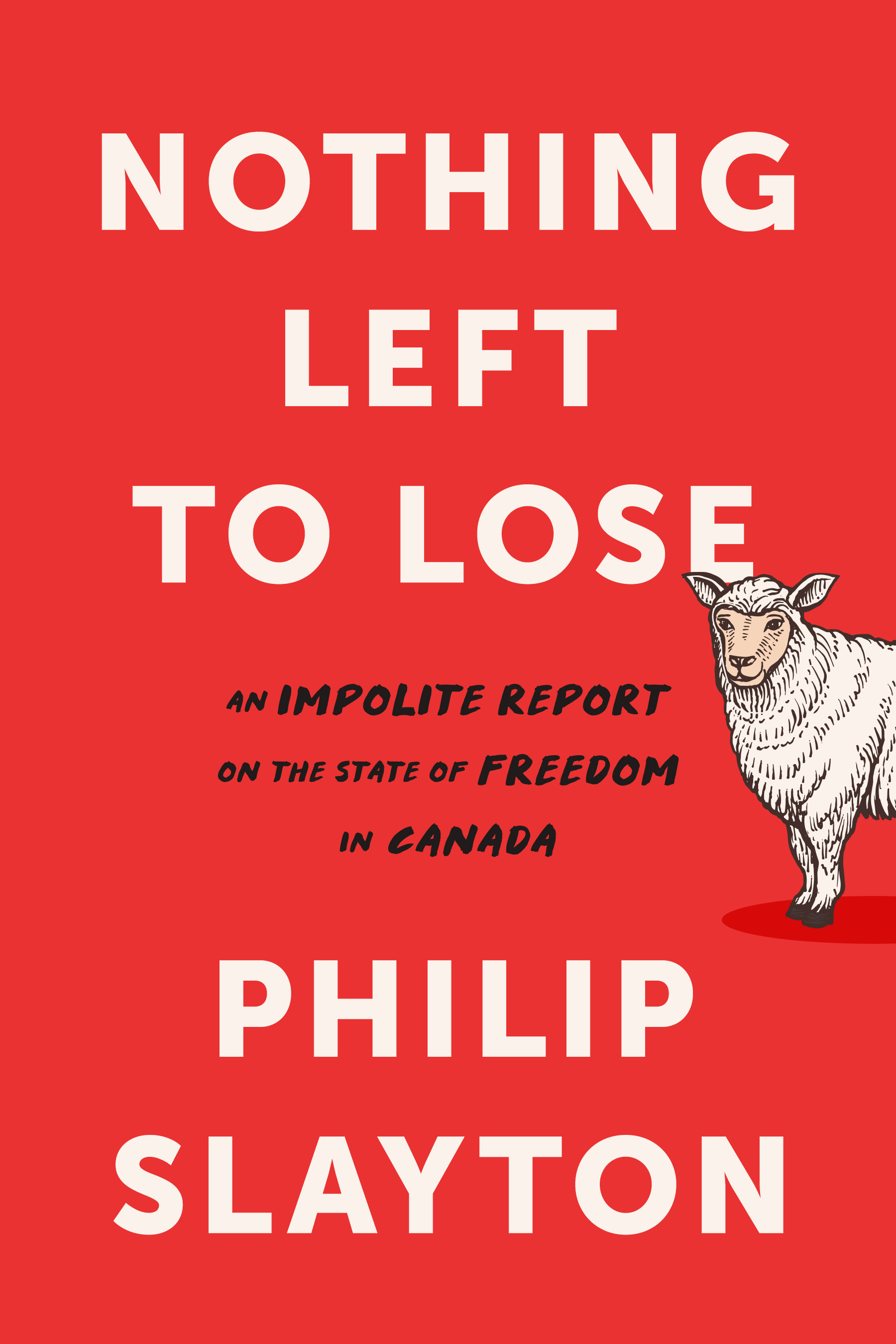
Nothing Left to Lose
from Lean Out with Tara Henley Hosted by Tara Henley
How free is Canada as a country? That’s a question that my guest on the podcast today tackled in a book back in 2020 — concluding that our freedom was actually pretty precarious. Philip Slayton is a Canadian lawyer and a former dean of law at Western University. He’s also a former president of PEN Canada, and a bestselling author. His latest book had a huge impact on me. It’s called Nothing Left to Lose: An Impolite Report on the State of Freedom in Canada. Philip joins me for a lively state of the nation conversation, looking at how the pandemic, economic inequality, and the use of the Emergencies Act to quash the trucker protests has impacted freedom in this country. TH: Philip, welcome to Lean Out. PS: Well, thank you. I’m happy to be here. It’s nice to see you. TH: Nice to see you as well. I’ve just re-read your book, and there’s so many interesting threads to pull. To start, I want to go through how you’ve defined the necessary list of conditions for freedom. It’s a long list. So I’ll just touch on a few: An alert and skeptical citizenry, willing to challenge authority; an appropriate apportionment of power between executive and legislative branches of government; a vigorous independent, diverse, and discipline press; a strong and independent education system; an effective justice system available to all; a rejection of political correctness. This book was written before the pandemic. You concluded freedom was precarious at that time. What is your assessment now, several years later? PS: Let me just begin by saying, as the points you read out suggest, my view of freedom is that it’s a very complex idea with many moving parts. It’s not susceptible to easy treatment, or the shouting of slogans. It’s complicated and needs to be seen as such. Okay, so, what’s happened since the pandemic? Well, I have mixed feelings. Initially, I was quite disturbed by what I thought was the heavy-handed approach of government to dealing with this. I wrote an op-ed piece in The Globe and Mail, maybe in June of 2020, saying, “I don’t like walking through the park and not being able to sit on a park bench. And I don’t like walking around and seeing a sign that says you may be asked for your identity credentials at any time.” This rubbed me the wrong way. But, on the other hand, there’s no question that it was a very serious public health crisis, very unusual. It needed unusual, and perhaps what in another context would be regarded as draconian, restrictions. That’s not a very satisfactory answer, I know. I don’t have a clear conclusion. I didn’t see anything in the pandemic that made me feel our freedoms were safe, that freedom was expanding. I did see things which suggested to me the opposite. But I think the opposite was, to some degree, justified by the circumstances. TH: We can talk more about that. I think probably there’s some points of disagreement there between you and I. But before we go any further, one thing I want to get out of the way. You are a former president of PEN Canada. We have American listeners on this podcast. Canada has “freedom of expression.” Can you give us a brief explainer of what that means legally? PS: Freedom of expression? Well, again, it’s a complicated concept. I’m sorry to keep saying that, but it’s true. I’m something of a freedom of speech absolutist, a freedom of expression absolutist. I think there should be very few restrictions on freedom of expression — freedom of speech being only one, but an important aspect, of freedom of expression. On the whole, in this country, from a legal point of view, from a government authority point of view, there are not many restrictions, I’m glad to say. Although I detect a worrying trend away from that laissez faire attitude on the part of government, and regulatory bodies, and the law in general. We seem to be moving in the wrong direction. But, generally speaking, freedom of expression means freedom to do, to write, to paint, to act, to say, pretty much with very few restrictions, whatever you want. Now having said that, Tara, let me come back to the idea of freedom being a complicated idea. Let’s take writing. For example, we can proclaim that people are free to write whatever they want. But if you look at the reality behind that, you see something of a different picture. You see, for example, that you’re free to write whatever book you want, but you can make no money virtually doing that … The reality is although you’re free to write, you can’t afford to do it. TH: That makes a lot of sense. Since we’re on the topic of writing, you write in the book about CanLit — about our literary culture, and how bitterly divided it is over things like the Steven Galloway case and the cultural appropriation debates. Talk to me about what you’ve seen evolve in our writing culture. PS: The first thing to say about the writing culture is that it’s small. There are not many people who write, and there are not many people who read. I mean, there are some dramatic exceptions to this, of course. The Margaret Atwoods, the Michael Ondaatjes. But they are very few and far between, and their influence is very unusual. Generally speaking, the writing culture in this country is moribund. Again, an example of what I just said. People are free to write whatever they want pretty much, as they should be. But there are very few people doing it in any kind of effective way that reaches a mass audience. So the writing culture, there’s a problem with it. Now, within the writing culture — as I write in the book, as you mentioned — there’s been tremendous divisions, tremendous controversy, and a lot of bitterness and serious unpleasantness, which is unfortunate. TH: On a related note, there’s the education system, particularly post-secondary, which you write about in the book too. We recently saw a professor at UBC law, Stéphane Sérafin, write about his experiences trying to teach property law and particularly aboriginal law in the context of this, I don’t what else to call it, “woke” ideology. It has resulted in a formal human rights complaint. This is someone, it’s worth pointing out, who spent years working in First Nations communities before going to law school and has a great appreciation and respect for Indigenous traditions. You write in your Collegeland chapter about this ideological movement on campuses, and its potential to shut down free speech and open debate. Walk me through the broad strokes of your argument there. PS: I find the prevalence of ideology on university campuses — it’s not just Canada, of course, it is many countries, and it’s throughout the university, virtually all faculties, including law faculties, as you mentioned — I find that to be extraordinarily dangerous, extraordinarily retrogressive. And, personally, an anathema to what I believe in. I’m old school on this, and not just on this, but just about everything. I think that the university is a place for free expression. Where anybody should be able, within very few limits, to argue whatever kind of argument they want to make. And it’s a place where arguments need to be tested objectively, according to their soundness — the soundness of the argument, the soundness of the facts they refer to, and so on. All of that is distorted by the intrusion of ideology. And it’s an intrusion of ideology which is often thoughtless, knee-jerk, riding whatever happens to be the current political currents. It’s depriving people at universities, students at universities, of the true basis of an education. As I say in the book, the most essential thing that an education does is teach you — and this is not original to me — how to distinguish a good argument from a bad argument. There are so many bad arguments floating around, people who trying to get you to buy into things, to subscribe to things, to do things when there’s really no sound basis for doing it. You need to be able to identify those bad arguments. You need to be able to test them. You need to be able to spot them… This is a public episode. If you would like to discuss this with other subscribers or get access to bonus episodes, visit tarahenley.substack.com
Embed this episode
No transcript yet.