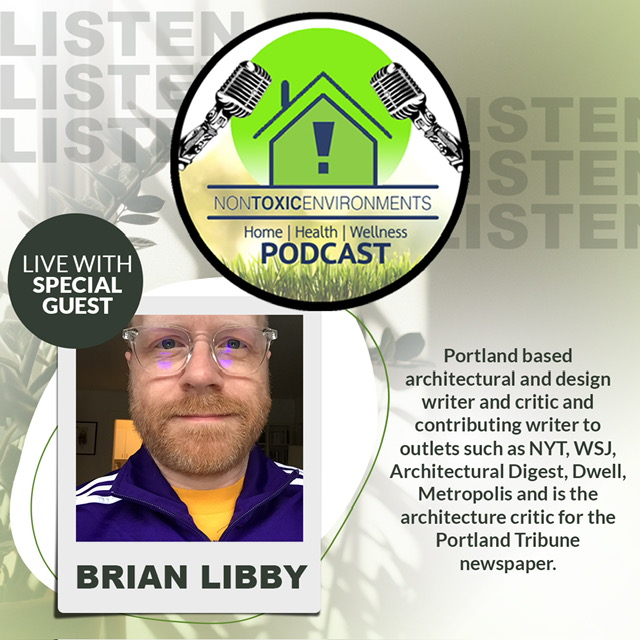
Hello my friends welcome back to Non-Toxic Environments. This is Andy Pace. It is so good to be with you again. This is the new season of Non-Toxic Environments.
I believe this is season 5 or 6 or 7. I don't know. It seems like I've been doing this for decades, but I'm very very happy to be back with you today. We have a wonderful guest on the first show for the new season.
His name is Brian Libby. Brian is a Portland Oregon based architectural and design writer and critic. He was a contributing writer to prestigious media outlets such as Dwell Magazine, Metropolis Magazine, Elemental Green, Architectural Digest, Architect the Atlantic, The Wall Street Journal, and The New York Times. He is also the architecture critic for the Portland Tribune newspaper.
And Brian joins us today to discuss the trends he has seen in healthy and sustainable home design as Portland is known for being a hub and innovator of healthy and green living. As a contributing writer to the popular magazine Dwell, Brian has his finger on the pulse of the most creative spaces that include nature and other healthy home amenities. He shares some of his favorite articles, architects, and healthy architectural ideas with us today. So please welcome Brian Libby.
Brian, thank you so much for joining us today. Thanks a lot. It's great to be here. Well, I can't say how excited I am to be here with you today.
Now I'm seeing my video all of a sudden is right up against my face. So I'm going to change that while we're talking here in case nobody knows what I look like. This is what I look like. Brian, I've been involved in the construction industry myself for many years, and you and I were talking just off camera.
I've been involved in the industry for about, well, over 30 years now. And I've been involved in projects firsthand, boots on the ground in the trenches as they say. And to be able to get involved or to hear about projects, read about projects from your perspective. And I want to call you an outsider because you've been writing about this for years now.
To about to hear about it from your perspective is extremely interesting. And what I hope we talk about today is some of the projects you've written about maybe some of your favorites. And then we're going to get into green and healthy design and construction and then kind of branch out from there because, well, of course, our listeners are those who are interested in healthy homes, healthy living. We're also interested in in in style and design and we'd love to know what's what the current and maybe the future trends are.
So first off, let me ask, how did you get into writing about architecture and design? Well, it's funny. I actually started out with a different ambition. I began my career as a movie critic and I was reviewing movies for a newspaper here in Portland.
And I wanted though to make the jump to being a full time journalist. I was doing it on the side while I had a day job working my way into the industry. And it so happened that my last day job was crucially for the local chapter of the American Institute of Architects. And I started getting interested more and more in architecture and realizing that it could be another avenue for me as a journalist.
By that time, honestly, I was actually already getting tired of reviewing movies just because for every really beautiful, wonderful, inspiring one, there's a lot of just kind of junk food you could say. And I realized that architecture and movies actually have certain similarities that interested me. I call it the spectrum between idealism and pragmatism. To put it another way though, both feature movies and buildings, they both may start out with one or two kind of individual creative authors like an architect or a screenwriter in the case of a movie.
But then they require these teams of people and a lot of money in most cases to make them happen. And you have to make some decisions along the way. You have to learn to act on the fly a little bit, even though you do your best to plan out every move and every step, every shot of the movie or every inch square inch of the house. Sometimes you have to think on your feet and make pragmatic decisions like what architects or builders would sometimes call value engineering, finding a cheaper solution.
And so I just find that interesting how you go on this journey, whether it's with your own home or with a $50 million Hollywood movie, how you go on this journey from something that's a really kind of personal creation and something that the work of just one or two people going to these teams of 10 or 20 or 100 people to make it work and how it changes along the way. That's fascinating. That's a great analogy between a movie and a project because one thing I always talk about is you've got to have that director, right, that a director that produces somebody that has the vision. And in most cases, in our case, it's going to be the homeowner.
The homeowner has that vision. They want to live in a home that's healthy for them and their family. But then so from that point who becomes the doer, who becomes what we would call the hammer on the project, right, that actually gets it, gets it taken care of. And so the in a movie, it's up to you're going to have the money involved.
You're going to have obviously the direction and so forth. The in construction, it gets watered down as you say value engineering. You have a budget for the project. The project comes in well over budget.
Somebody says, well, we can give you sort of the same somewhat the same vision, but it's going to change the overall aspect of the project. And then after the project is done, you look in and say, well, it didn't really meet what we're trying to achieve. And so it kind of I don't want to say ruins the project, but it waters it down a bit. And I'm sure you see that an awful lot in writing.
Uh huh. Uh huh. And so often when it comes to houses and building projects, there can be this kind of friction between that, which is the best value up front. What will get you to the finish line to get the house built without going bankrupt or something.
And that which is an investment that will save you money over time that that relates to the operation of the house. And sometimes those are at odds. You've got to spend more money to save money later. And it's not always something, you know, everybody, every homeowner or every home buyer has a kind of limit in terms of what they feel that where they can kind of stretch no further.
And so it's understandable sometimes, especially when you're trying to do everything at once. Right. And then the difference is between commercial construction and residential construction. The biggest issue is in commercial construction, you have a set of parameters.
You've got this rule book, you know, the specifications and the blueprints. For many years, I was involved in AIA and the construction specifications to to use to write architectural specs. In residential construction, there isn't any of that. You might have a few pages of a blueprint, but then beyond that, it's the Wild West.
It's whatever the builder decides based upon pricing and availability and comfort factor and all that. So again, to have the homeowner step in, or in some cases myself as a consultant step in and say, here's how it needs to be done. You get a lot of pushback from the industry because they don't like to be told what to do in the commercial industry. They are told what to do from the get go in the residential.
That's not the case. Yeah, it is kind of amazing to me in certain ways how primitive most residential home construction is and that we still build the overwhelming majority of our houses on site. It's true, of course, that we've seen prefabrication and modular occupy a greater segment of the market. And sometimes there are houses that wouldn't officially be called prefab or modular, but incorporate some of those same principles.
And we see that not just in homes, but in the building industry with things like cross laminated timber. But those progressive things I'm talking about, like modular or mass timber, they're still just less than 10% of what's getting built. And it's really not that different how somebody is building a house today, a stick built house made out of wood in most cases, compared to how they would have generations ago. Right.
And that is a question we get quite a bit from clients around the country is, what about the idea of doing a prefab or pre-panelized. I think my personal opinion is that is going to be the future of construction because of the biggest issue in construction right now is labor shortage. And then the quality of that skilled labor is reducing a little bit every year. I think the pre-panelized or the prefab homes can be built as well or much better than what's done on site, but it's just a matter of getting the industry to sort of adopt that and allow it to be adopted into the industry.
I'm interested in some of these hybrid ways, like a kind of sometimes it might get called mass customization or it might be called a prefab that is tailored to your site. But the one thing about a kind of traditional stick built house, a non prefab non modular houses is in theory, it can be tailored to that family, that client specifications, whereas a prefab modular houses is still a kind of speculative venture that's just for anybody. Like one thing I learned writing about commercial architecture is that it makes a big difference if it's speculative or not. Like if it's an office building just that a developer is hoping to run out to any company or if it's tailor made or a specific company.
It's just like a, you know, if you're a gentleman buying a suit, like a tailored suit is always going to fit nicer than something just completely off the rack. Or if you do buy something off the rack, you at least maybe want to take it to get it altered and make it fit a little bit better. And I think it's true with buildings too. Like it's not impossible, of course, to do a speculative house or a speculative office building that possesses many great design qualities.
But I just think more often than not, when you can have a house or a building tailored to people's individual needs, that's nice. You know, that's why I think some of these third ways are interesting, where you take advantage of some of the efficiencies of prefabrication, building things in a factory or even a protected warehouse, in some cases, in some smaller cases. But on the other hand, like you're getting a still a chance to tailor the suit a little bit. Yeah, I love that.
So it's that age old question when a customer says, well, how much more is it to build a healthy home versus a traditional home? Well, you know, you can't really compare because you're comparing apples and oranges. Most of the healthy home projects I've been involved with around the country, they're custom projects because they are tailored to the home or to the individual to whatever health. issue is happening at the time, where a home that's built on spec and somebody buys off the open market was not built that way.
So they're probably using more genie. I don't say generic but certainly not customized attributes of the home. So let me step back a little bit. You're based in Portland and I remember Portland from years ago.
I see Jay Watts is involved in on the zoom today and Jay is with a company called AFM Safe Coat. He and I walked the show floor of the second Green Build conference in the country was in Portland at a hotel room or a hotel conference center. Very small. It was so much fun.
It was electric back in the day. What what made Portland like that one of those initial hubs of green building back in the day? It's funny to say that I remember going to a couple of early Green Build conferences too. And I began my career right as the lead the US Green Building Council's lead rating system was beginning and you're right.
There was a kind of sense of excitement that we were there witnessing the beginning of something like a transformation of the building. But then at the same time I remember like attending an early Green Build conference in Austin, Texas and coming out feeling really excited that I decided at lunchtime go out and take a taxi to some tourist site might have been like the LBJ library or something and I decided to the taxi driver like just come from a Green Building conference and he said what's Green Building and it sort of put things in perspective for me a little bit. But in terms of Portland, I think maybe it started with the fact that there was a generation that took hold here starting in the early 70s that really began to transform the city in certain ways that caught on with a lot of other cities that had to do with kind of reducing the long trend or reversing the long trend of designing for the automobile like a sort of bisecting our downtowns with large freeways and that sort of thing. And so we started Portland was the first city to use intended funds for a freeway to actually build a nation's first light rail system.
We tore out another freeway right along our riverfront and put in a park and so it started with Progressive Urban Planning and then there was a kind of nice transition in some of those same people I think got interested in in sustainable building in Green Building maybe a decade or so later. And I think it's a city of entrepreneurial possibility because it's traditionally been a cheap city, an affordable city to live in where maybe you could, I think a lot of artists and creative people used to favor Portland because you could get away with having a part time job and then pursue your creative being a musician or whatever the case it was. And I think so too good entrepreneurs try things here and and yet of course being on the West Coast. There's always been an interest in environmentalism.
It's not completely accurate to say Oregon is a very liberal state because it's you know probably 52% liberal and you like any state you get a lot of difference in kind of political values between the city and the non city. And but I think there was a kind of there's a state's always seen in itself having a kind of Maverick spirit being a place where first things have happened in some of those realms like Oregon was the first day to insist all of its coastline be public and there's no such thing as a private you know beach in Oregon and so I think I think it was the first day to start giving people five cents or ten cents for returning their aluminum cans and glass bottles that sort of thing. And so I think the Green Building Movement in Portland kind of grew out of that in some ways. And there was a time where I felt like Portland was among the national leaders kind of early in the lead rating system days, but it does there is a little bit of a feeling here that that certain areas where we used to lead whether it's green design or bicycle infrastructure or urban planning.
There's a little bit of a feeling that we're not so much of a leader like we were maybe 15 years ago and Portland has also been one of the cities that has struggled at least in downtown to come back from the pandemic kind of maybe like San Francisco maybe not quite as bad but and so you know I would love I so appreciate that people see that that track record in Portland being a leader in some of these movements whether it's mass transit or green design or urban planning but you know I think the city is struggling to regain its confidence right now and you know it's it's both it's a little bit or sweet to talk about it in a way because I think everything is kind of circular everything is kind of cyclical and so often crisis and opportunity are the same thing like I think in the in the last decade kind of the last half of the 2010s Portland became a lot less affordable and became really kind of moment of popularity for certain cultural reasons a lot of people moving here and then became a kind of victim of its own success a little bit I know it's getting far from green design but I think it's to the kind of idealistic city that it was and you know like all cities that eventually faces some kind of growing pains. Sure well I really appreciate that that background in Portland because yes Portland has been a leader it's like Portland Austin. Seattle Pittsburgh even here in Wisconsin are like these hubs around the country and well it used to be thought that well you know environmental construction green building was was very politically motivated you hit on the head though it says less to do with that is more to do with that entrepreneurial spirit that Maverick spirit. People taking matters into their own hands individuals saying there's a better way to do this and it's tough I mean when you're a city like Portland and you're used to being the innovator and all these things and all of a sudden the rest of the country is kind of caught up to that or they're trying to catch up to that.
I mean the heavy lies the crown right it's very difficult to maintain that position so you know we'll see I guess the next decade or two what the next big thing to come out of Portland will be once you know somebody else has a very good idea to do things. So let me ask you getting back into construction then you've written for so many wonderful publications dwell as a magazine that I think all of us know because you know it's been it's been one of those mainstay publications that focused on sustainable and green in a lot of the writings over the years. Can you share maybe a story or two about some of the projects you've written about doesn't have to be in dwell of course but some of the things that you've written about that actually caused you to say there is a better way to do things. Yeah yeah one recent story comes to mind because of a specific material it's not often that a material becomes a story of the house but this was one I really enjoyed it was a house in Carmel California which you know if you've been there is just a magical little small beach community where a lot of artists and writers have lived over the years and it's got this incredible white sand on its beaches.
I know there are other parts of the country that have that certain ones in Florida so forth but there was this house that was kind of a glass box on the outside maybe with some overhangs to shade it a little bit but it had these wall panels on the inside. That were rammed earth panels and they were made using sand that was quarried from the actual site and it was interesting to me because when I had thought about rammed earth or been introduced to rammed earth in the past it was often a kind of an entire building or whole wall systems and stuff and it could be sometimes a little bit aesthetically wonky you know look I don't want to stereotype but maybe a little hippie dippy. At least the ones I've seen and these were rammed earth panels that were much more clean and clean lined and yet they were not just evoking but literally turning the dirt or the sand underneath the ground into a beautiful wall panel and so I was really wowed by that that was about a Berkeley California firm called Field Architecture father and son tandem and the other thing I love about well is even though it's true I have mostly written about projects here in Portland or Oregon or on the West coast. I get to sometimes do stories about houses and other parts of the world or talk to people who design them from other parts of the world.
I'm doing for example now I'm working on a story about a house in Yucabally California so right on the edge of the Joshua Tree National Park and it's designed by a firm in Montevideo Uruguay and it's for an owner who is an Italian expatriate who is relocated to the LA area and this is her kind of vacation home in California desert. I was actually interviewing the architect yesterday doing a zoom call where he's in Uruguay and I'm in Portland and in some ways I was actually like a story of disappointments in that I saw his firm had done lots of pre-fab in Brazil and Uruguay and I said did you do pre-fab here? Well not quite we did some pre-fabricated wall systems but it was too hard and I said well you know you've done some passive houses in Brazil and South America in the past was this passive house. No I didn't quite work out that way but it was still a beautiful house in the desert and what I really got a sense of talking to this guy is that they had embark on this journey to build this house and design it in 2020 right as the panelists.
I think that the pandemic was happening and it became a kind of survival story like they wanted it to be is innovative or is progressively designed or sustainable as it could but they also just wanted to get the damn thing done. And so I think that's something else that homeowners face like that that moment or that series of moments where you're doing everything you can but you also just want to kind of survive. You want to survive you want to get the job done at some point it becomes so stressful that it just you've got to move on with your life and you know it's it you know you sometimes have to choose the lesser of many evils on a project and I know all of our listeners will relate to this. So you're involved in a project and you have to choose between we've got X amount of money left on the budget we're going to put a metal roof on the house because we love the aesthetic and we love a sustainability aspect of it.
Or can we spend $30,000 less put on a 40-year dimensional shingle and then take some of those dollars and improve the into rare quality of the home because that's ultimately going to be bigger impact positive impact for the family. These are the stress points that all of our listeners are facing and really kind of gets me into the conversation between green or sustainable building and healthy. The project was the use of the sand the local sand to create these wall panel systems. We discuss this all the time in consulting calls that you know in Europe a lot of homes most homes are built in Europe utilizing things like stone and brick because and concrete because these are the elements that are found in that part of the world.
Here in North America what do we have just an abundance of trees and so wood has been the mainstay of construction since you know Jamestown in the 1600s. And if you go to if you go into one of those houses that were built in the 1600s well you can't actually go in them. They'll let you look at them from the outside because they're too unsafe to walk into yet the last time I was in Italy I stayed in a villa that was built in the 1400s and it's still operating as a hotel today because it was made from stone and concrete and brick. So long story short how do we get from building with materials that are designed to fail to design and building with materials that are designed to last and then also bring that price point down.
You must see this in your projects you talked about mass timber which is a newer method of constructing structural buildings but utilizing wood but it's designed to last a long period of time. How do we get to change this mindset. That's a good question or a lot of things you touched upon there. On one hand I do love the idea of retaining some kind of regionalism and building your house out of what people have built their houses out of there and being part of a local vernacular and so in the US we you're right we have a lot of wood and where I am in Oregon in the Pacific Northwest we really have a lot of wood.
And yet when you go to some of those places you mentioned like Italy, Europe and you see really old houses that have stood there for hundreds of years for generations you realize there are different kinds of sustainability like a house that just lasts and lasts and lasts. It is and has a kind of durability where that means multiple generations that don't need to rebuild something like that's in a way like the most sustainable house you ever build is the one you don't build from scratch. And so you know renovating an old house that can be renovated and adapted over time is a way that most sustainable kind of housing yet. In a way like wood even though it might not last as long as a stone or masonry house is much more sustainable in a different way in a couple of different ways.
One as you know whether it's mass timber like cross laminated timber or traditional stickbill of course wood sequesters carbon and that's one of the reasons that mass timber is taking off other than the fact that it can do more things structurally than traditional wood construction is that in a sense like the world needs to build even more out of wood. Just to produce less concrete and steel that are that are so carbon intensive in their production. You know there are all these different ways you can look at it I guess. And I think each homeowner has to kind of weigh what feels right for them and you know decide what your emphasis points are.
Are you creating a kind of machine that will operate as efficiently as possible and save you as much as possible on your utility bills or are you really thinking first about things like indoor air quality. Or do you want to do your part as a kind of citizen in a time where climate change seems to become all the more undeniable every day. And so it's not to say that you have to choose between those things but you know there's a lot of different ways to look at it I guess. It's an interesting question to consider wood as being detrimental for its durability in that way.
I think the other thing we're starting to think about here in the Pacific Northwest is traditionally we thought of California as a seismically active zone and the Northwest as not being seismically active. But research has shown that that's not exactly true that that we have fewer earthquakes but when we have them we have really big ones. And apparently the Pacific Northwest is quite overdue for the size of earthquake that has been recorded in ancient times here but is overdue now and is predicted to be basically they're saying that Pacific Northwest is going to get the biggest earthquake in American history. So our seismic codes are kind of rapidly or somewhat rapidly changing and one of the things I've learned over time is that wood construction has good size and properties that would essentially bend a little bit.
And so I've become interested in its resilience in that way as well. And you know I don't know it's a good question are there wood buildings that are a thousand years old like it's an interesting question. I remember going to a lecture one time about architecture by a Japanese architect and he he actually used like a wood building in a stone building to make a point in place. And so in the West we think of time as linear as one straight line and in the East they think of time as circular and so you know like everything comes back and he said that's why in the West the ultimate architectural symbol is the Acropolis which is allowed to kind of decay naturally over time.
And in the East it's the East A shrine in Japan which they actually rebuild in a kind of ritual way exactly every 20 years and so after about 18 years you'll start to see the new one rising next door to the old one and they they burn down their shrine their temple every 20 years. I don't mean that's not getting too upto. No that's great I mean in my head I'm thinking of this is very not a good comparison but I think of the Mitchell corn palace you know in Mitchell South Dakota where they're building those walls out of corn cobs what's every couple of years something like that. So you know it really is an interesting conversation though to talk about I love the concept of using locally produced materials that's why we use wood here that's why the use stone there that's why that sand and caramel is used to create those walls.
And that's why it's a lot of sense because overall it's less detrimental to the environment it's it's it's should in the long run everybody adopted the mentality it should start to reduce costs improve local economies all those good things. But it brings the larger question which is there's so many different ways to look at this and there is no right way. It's it's really individual and I think what the industry has done over the last 20 years is sort of painted everything with the same broad brush. For instance in our in our in our company we do a lot of material sales of paints and finishes and floor materials and they all have to meet certain codes for chemical emissions.
Why do they have to meet these codes for chemical missions because of the outdoor air pollution regulations. Well you think that's kind of funny why if we're using paint inside of our house. Why does an outdoor air pollution regulation have anything to do with the paint inside of my house well because that's what that's what the government says that's what the EPA says that it's possible that the chemicals that can emit from that paint could rise all the way up to the atmosphere react with nitrogen and UV and creates smog. Okay that's important I understand that completely agree with that concept however inside of the home.
That has nothing to do with the health of the occupant the toxicity of those ingredients has everything to do with the health so why don't we regulate that. Well because the government doesn't do that so you know we have to have these discussions and decide are we gonna let. Are we gonna let just a mass feeling of how we're supposed to be doing things based upon government regulations take care of how we design and build our homes are we gonna actually use our own common sense and say maybe we should do things like Portland. We actually have some entrepreneurial spirits and be a maverick and say we're gonna do things based upon how it affects our family our direct our neighbors are direct local community because ultimately that is sustainable.
It's a I think I think one of the things I learned you know at the beginning I was talking about being a movie critic before I wrote about architecture and I was just speaking also to a class at a university last week about this how everything is a kind of narrative in a way maybe that seems more true to me that because I'm a writer but I think of the decisions you make as a homeowner or as someone who is gonna renovate your house or anything like that is as being kind of like writing your own story and you have to decide what the emphasis points are. And you also that I describe it as a narrative and that like you know like I remember Joseph Campbell has been cited many times like and was a big influence on George Lucas because he talked about like the heroes journey and how all these cultures around the world have very similar kind of folk tales and legends and when you go on as especially as a homeowner building a home you it's like this obstacle course and you mentioned government regulation that's definitely one of the obstacles especially like here in Portland I don't know how much this plays other cities but people sometimes are just beside themselves at the permitting process like just feeling like you know it just doesn't make any sense that they should have to sit there and wait for months. And so I think that the hoops you have to jump through or the sort of stoplights you have to wait at as a homeowner dealing with government can be so frustrating and it's just part of it's just one obstacle in the course. And then you're of course being kind of shackled in way by cost options and everything is just so expensive and we saw you know in the pandemic all kinds of crazy issues with supply chains and things being affordable one minute and prices skyrocketing the most and so all of these all these factors are so fluid and volatile as well.
But it's so basic you know like I actually became a homeowner for the first time in 2021 like as we were coming out of the pandemic and it felt like a scary thing to do because life was still uncertain in many ways not just in terms of the COVID itself but all the economic ripples that were happening. But you know everybody told me you know you like you won't regret taking a plunge and that has proven absolutely be true like I can't imagine being in my apartment anymore. You know it's like a I feel like this home has become like almost like a kind of person that is part of my family or something like a like if I were going to make some massive life change like I would think about you know my house just like I do like you know my partner or my cat or anything like that other things that my family and my extended family and so you know it's a long journey that you go on and you have to the thing I have learned is a writer writing about architecture and other projects is like you have to want it bad. But then at the same time you have to sort of you know reel in your own enthusiasm in other ways that and keep a clear head.
You get you alluded to this like it's easy to get sort of seduced by some kind of individual material whether it's like your quartz countertops in a kind of aesthetic way or the metal roof you described in a kind of a functional way. And so I think it almost also must be hard just like how fast it has to happen like you wait a wait and wait for years to embark on this and suddenly you've got to make like all these decisions at once. And they're all interconnected. And so you know I think it's really hard just to be thoughtful when you're going through that kind of gauntlet but you're essentially writing your own story I think is right or that's what occurs to me time and time again in the buildings we love whether it's an art museum or somebody's house like they have a kind of clarity as an idea or as a story like as much as anything.
And you know that you like I said you have to want to have a sense of restraint not just about being seduced by individual materials but also you know realizing that you're not going to get everything that you want. And even if you think you even if you do get everything you want it's natural to be to always be wanting so you have to kind of know you know that about yourself that you know you're going to have to in some ways like the most important decisions are the things you say no to like do you say no to the right things. Right so I find that you know through in the industry there's always these trends that are occurring and the trend the last dozen years or so that I've seen is the is this trend to sort of bring the outdoors inside. And the outdoors inside meaning we want more natural light bigger windows more energy efficient windows we want better air quality.
We want it to feel like as if inside of your home you're not stuck in this box right the materials there's more natural materials being used wood floors there's more stone there's more things that just kind of give you that feeling of being outside. But now on top of that the latest trend is and this is because of specifically because of interest rates and the cost of of property that people are not looking at homes as this something I'm going to be in for three or four years and move on to the next one. My clients are changing rapidly to we're going to be in this home for a while. And so the home we buy may not be perfect.
But we can always get there maybe down the road we're going to remodel this and do this and fix this up but what they're looking for is basically a home with with a good bones it's got you know a good structure to it. There's not a mold problem existing. There's issues they don't have to take care of right away also because of the younger generation now that starting to get into the home buying. They don't want to have to do a lot of these repairs and updates because maybe they just don't have the time for it they don't have the skill level they think in order to do that.
They don't have the time to learn whatever the case is and it's very expensive right now to hire contractors so all these factors. So I see those two things as the biggest trends in construction the bringing the outdoors in still and then the trend of let's just buy something that has good bones to it and we'll do something down the road. I actually like that idea that if that's true that people are maybe a little bit less inclined to switch to a different house in three or four years that that is good for the real estate market and it's good for the economy. But I think I think in some ways I still feel a little bit snake bitten or always to keep in my mind what happened in the kind of mid 2000s with a great recession and how in those days kind of in the boom before the bust.
I remember becoming more and more aware of people who were kind of house flipping for a living and maybe what you're talking about is a little bit different. Maybe what you're talking about is is just being fluid with you and your families needs and you know those needs change over time and so three or four years is not unreasonable in that way. But I think because sometimes I've seen both residential and commercial real estate be first emboldened by a but then fall victim to speculation in a way that drives up the costs for everybody else that kind of like Holland to lip thing. Where you know like speculation I think is a I think of a I started out as an economics major in college and I'm always interested in this idea of what these different moves do for the economy and how the economy is a kind of like campfire that is dangerous to get too low a fire or to out of control of fire and I know that's not what you're talking about necessarily but I think it's encouraging the idea of people wanting to do a kind of more long term hold on a house and I love the idea of younger couples you know going in and finding houses that need a little TLC.
It is true that when you're young maybe you don't want to have to be you don't want to be overwhelmed by all the fixing up you have to do. But you know the bones are often better in these older houses you know you're inheriting oak floors instead of you know fake oak floors or you know that's a stereotype of course. But I think it's exciting to think of people you know kind of like the REM song goes like stand in the place where you live. I think that's exciting you know like here in Portland when it was the biggest boom also we were starting to see a fair amount of older homes torn down by developers and kind of larger spec houses built and put up for sale in their place.
And you know I remember oftentimes thinking like you know I can see that little house that you tore down was was too small and it needed some work but it just seemed kind of unsustainable and also like not what a young family would have chosen to do. And so I like you know the idea of homeowners who are there to really do a deep dive or you know get involved in a long relationship with their house. I guess I'm lucky in that most of the places I've lived have lived for many years like you know the house like a rough end I was in for at least 15 years. And even the apartment I was in before this house I was in for 17 years.
And so you know I like the idea of developing a relationship with a house over time or a building over time in that place where you live over time. You know I don't mean to over romanticize it. And of course there are people for whom buying a new house in a few years is the right move. But I like that idea of putting down deeper roots.
Well I think that plays to that conversation we had earlier about the kind of differences between how homes or communities are built in Europe versus in the United States. I mean here in the United States still 95% of the country is fly over country. You know and so you take an airplane from New York to Los Angeles and you see really nothing but green until you hit the cities right. In Europe I mean you are if you drove five hour radius around you know one city you could get into 12 different countries and so I mean they're packed together and so there's no room to build new.
They're just building either on top of the existing foundation or they just continue to live in those spaces that they built 400 years ago. So you know that's one of those things that we'll learn over time we're still a very young country. But there's something to be said about buying something that has had roots and then you can continue that. And so it'll be interesting to see how the new ways of construction whether it's you know 3D printed homes or inside a concrete form all these new technologies will maybe kind of help us on that that goal of building these homes that will last for generations as opposed to the throw away society that we're used to.
And you know it's a there's two sides to every coin to because I actually was just thinking of a couple of friends I have in England who would kind of lap or push back on the idea of how great they're there 500 year old houses. And I remember staying with these friends in London and I was sleeping on a on their floor like in a sleeping bag and it was like a wood floor. And I noticed that there was a little gap between some of the floorboards and I was able to look down between the floorboards and I could just see dirt. I was astonished.
You know like a and so like I think like they would say like a you know like what are you talking about like you Americans are the ones who who specialize in building a house from scratch and filling it with lots of air conditioning and everything and creature comforts and giant great rooms and and so we are let you make a great point we are lucky in the space we have here in America. And the opportunity we have to to build from scratch on our suburban edges if we want to it's it is true that there are issues of sprawl and waste but it's a it's a privilege we have as well that that we have all this land and this space like a And so I may like I may be someone who likes old houses in the center of the city but you know I love the white tapestry that we have in our country that that a lot of Europeans in some ways are are envious of the fact that I can get in my car in Portland and drive for like a half hour and be in a forest. You know you can't do that in your and most places and so you know I think it's true as well with sort of following your dream and going to the edge going to a small town and urban area. I think that's actually one of the other interesting residential trends is actually kind of a real estate trend now like you know that there was a kind of genie that we let out of the bottle with regard during the pandemic with regard to zoom and video conferencing like we're using now.
And even though a lot of offices are calling those employees back to the office now at the same time you won't ever be able to put the genie completely back in the bottle. And so it's going to be a lot more practical from a kind of jobs perspective to go to some of these places and build a house where you might not have felt able to in the past. I think like even though there's a lot of media reports now about certain American big city downtown struggling like San Francisco is maybe the poster child but it's you know it's rough here in Portland still too in Seattle like. You know but what I think often gets failed to be mentioned is how big city downtown's losses kind of gain of small towns and even neighborhoods as well.
And so you know I think it's there's a lot of people who are considering building a house in some kind of small town or less urban location and if they can solve some of the issues of getting a general contractor and getting supplies any there. You know people are able to do their jobs from anywhere they want more than ever. You know my sister is the politics editor of the San Francisco Chronicle and she lives in San Diego. So like that's not a green home or healthy home issue but I think it's worth noting that we live in we're living in a time where it's more possible than ever to build a house in a place you want even if your job isn't there.
Yeah totally agree with that point I found that anybody involved in the real estate industry in the last few years you can just see based upon a land purchase as a loan where all of a sudden now I live in a county west of Milwaukee. And my county, Waukesha County land goes up for sale and it's gone I mean relatively quickly and that happened even faster during the pandemic because families were like well. Alright the schools are closed we're now working from home everybody's working in the house you can't go anywhere the restaurants won't allow you in all this stuff can we get out of the country where people are spread out far enough where they just don't really care as much about that. And get away from some of these really over the top regulations and so forth so land grab was fast and I don't see that changing because now that we've got a taste of it it's like well I can see this sprawl happening even faster.
Anyway I could talk with you all day long this has been wonderful and I know we didn't talk as much about the whole green and healthy aspects of things but it was really a fascinating discussion. I love your perspective and I really hope at some point I can have you back on and talk about some specific projects. Oh any time it's a pleasure and I hope I didn't ramble too much about non green stuff but you know I think it's an exciting time for sustainable home construction whether it's pre-fab or indoor air quality you know health like we talked about at the beginning is becoming more of a factor not just energy efficiency and saving money on your power bills indoor outdoor you know there's a lot of interesting trends going on and you know I think it's an exciting time to be a homeowner. Fabulous Brian Libby thank you so much for joining us today.
Thank you pleasure. Alright take care. You too.