
Hey folks, just a quick note, this story that you're about to hear has in it an interview that contains some threats of violence, might not be appropriate for sensitive listeners or young children. Wait, you're listening to RadioLab from WNYC. Now, for some reason, this speakerphone doesn't ever want to go off. Can you guys call me right back and I won't put it on?
Okay. All right, sorry about that. Hey, I'm Jan Abengran. I'm Robert Krollich.
This is RadioLab. And today we have a story about something that you might not know. You might not know that you have, but you definitely do have it. Yeah, sort of a crazy...
Maybe even scary. Maybe even scary. Even secret. A crazy, scary, secret.
Hello. Hello. Hey, Saren. Hey, it comes to us from our producers, Tracy Hunt.
Hey there. And Saren Wheeler. Yeah, I'm here. Okay.
No speakerphone, no. Okay. So this story for us got started with this woman, Laura Crehill. I am a freelance internet marketer.
She's from Colorado and in the mid 90s, something happened to Laura that hadn't happened to anyone in centuries. So we'll just... Why don't you just take a sec to 1996? The day you got your jury summons.
That very first one. Well, that was the day of jury duty. I had totally forgotten about the jury summons until the day of. And I picked it up and I read the back of the summons and it said something about six months in jail if you don't show up.
And so I didn't have a ride to the courthouse. And so I called the court and asked them if I really had to show up since I didn't have a ride. And they're like, yeah, yeah, you have to show up. And I said, well, I'll have to hitchhike then.
And if something happens to me, I said to them, my blood is on your hands. I wanted to make them feel guilty about making me show up. But that didn't work. She said I had to show up anyway.
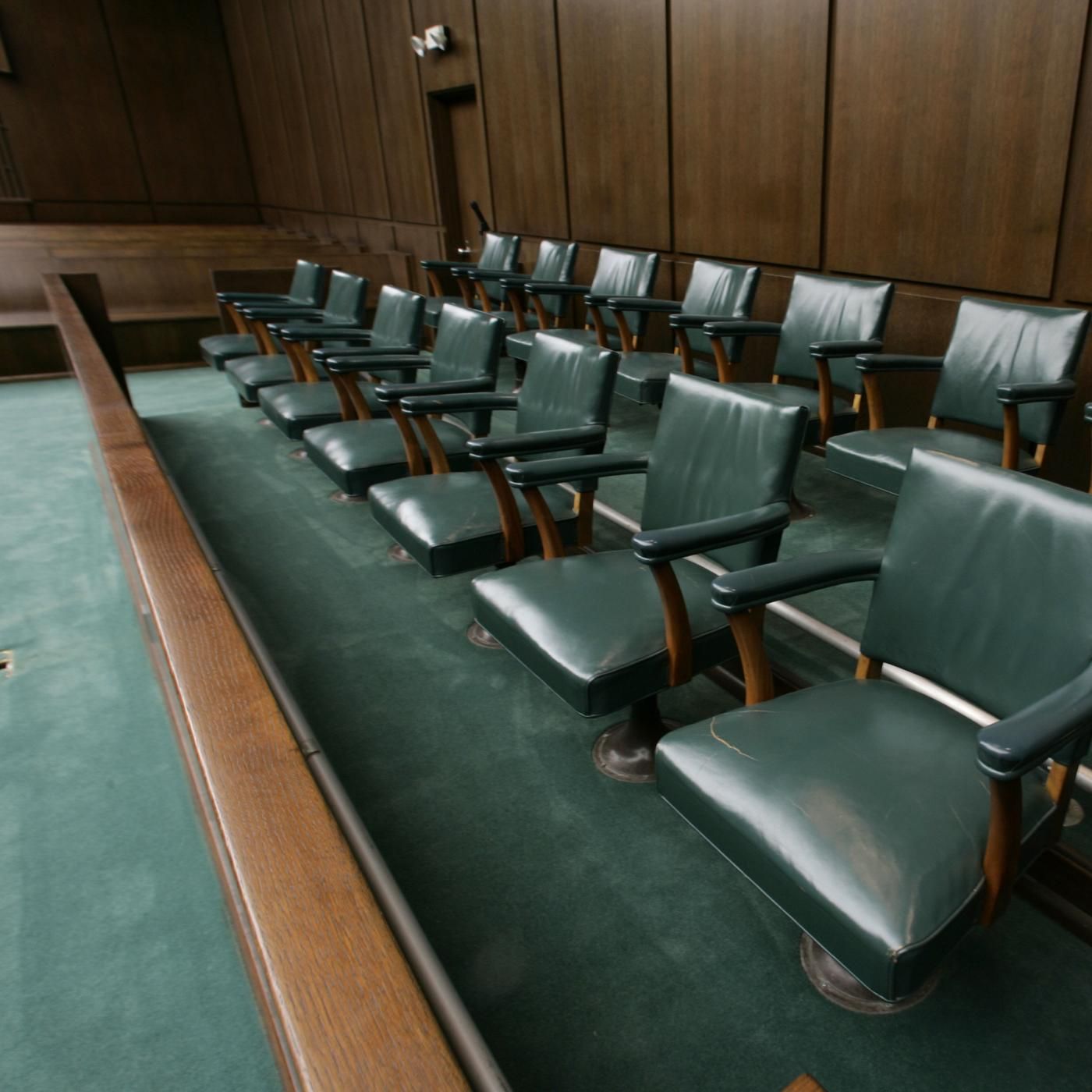
But whatever. And when she got there, she walked in to the seat. I think there's about 40 jurors in the pool of jurors. And first they fill up the box with 12 jurors and then they ask them questions about themselves.
Real quick. Were you hoping to get booted off? Oh, yeah. I was hoping to get booted off.
Of course. Any good red-blooded American was hoping to. But towards the end of the jury selection. I was one of the last ones to be selected.
So the next day, Laura and the 11 other jurors showed up to hear the case. And the case was for this 19-year-old girl. And she was charged with possession of methamphetamine. What happened was that she was up in Central City, which is a gambling town.
And that day she was driving in her van with her boyfriend and eventually the two of them drove it to this casino. Her boyfriend jumped out of the van. He went to the casino. And then she kept driving and then the police pulled her over.
They just for whatever reason pulled her over. I don't know what she got pulled over for. They just pulled her over. And the police said that she got out and put her purse on the hood of the car and then made a lunging movement towards it.
Which they said gave them probable cause. To search her purse. Because now they're thinking, oh, did she have a weapon in her purse? Like what did she try and hide?
And so the police opened up her purse and they start kind of rifling through it. At which they found this one ounce of methamphetamine. And so one of the questions before the jury was, is this young woman guilty of possession of methamphetamine beyond a reasonable doubt. So at the end of the trial, Laura and the other 11 jurors got up and went to the jury room to delivery.
And so we talked about a lot of things. One of the things I remember we talked about was whether or not the police were lying about her lunging towards her purse and things like that. There is also the fact that she did have this map. But it was unclear whether it was actually hers or not.
Because according to the girl, when her boyfriend got out of the van. He put something in her purse, she said, without her knowledge. This girl saying the meth might be his, but it's definitely not hers. I mean to me, that's the whole thing.
It's element number one of the possession charges that they have to knowingly possess. So for Laura. If she said she didn't know she had it. And it could be her boyfriend.
Then she's not guilty. It seems I heard that it was just like a pretty big hole in the prosecution's case. I mean to me, I just couldn't get beyond that. And so Laura turned to the other jurors.
And I said to them, I was like, well, isn't that enough reasonable doubt for you to acquit her? And they were all like, no, she had it in her purse. She knew it was there. It's almost five o'clock.
We need to convict her and go home. But Laura wouldn't budge. She just couldn't get herself to go along. And so she held out.
And that night when she went home, she just kept turning this case over and over in her mind. And she started wondering what the girl was looking at as far as a sentence, right? But that's not technically what a juror is supposed to do. No, in fact, the judge in this case and generally the judge had told them, you know, like, I'm the one that gets to decide the sentence.
You don't have to worry about the sentence here. You just have to find out whether she's guilty or not guilty. But I was worried about the sentence. You know, you have if when you're a juror, you have somebody's liberty in your hand.
And so Laura sat down on her computer. She got online. And she found this criminal statute. And so her understanding, this girl was looking at two to six years.
And she's like, well, that just feels so out of whack. That doesn't feel right. Also, it's a felony charge. You know, you can't erase that.
So the second day of deliberations, you know, we just went back and forth. We're the police lying. Yes, we think the police are lying. Is that reasonable doubt?
No, it's not reasonable doubt. After all, my arguments about reasonable doubt were exhausted. That's when Laura turned to the other jurors and tried this completely different tactic. She looked at them and she was like, look, even if you think she's guilty.
We didn't have to convict her for any reason that we could let her go. But even if she broke the law, we could say we don't agree with the law. You know, we're here. We're here to be the conscience of the community.
That's what I told them. You don't have to convict her. But wait, that seems like I would imagine some people might be like, what are you talking about? Of course we do.
We're supposed to just say whether she broke the law or not. That's what a jury does. Right. Right.
Well, that's where everything broke down. Because as it turns out, when Laura started making this argument, a whole series of events set into motion. One of the jurors apparently they wrote a note saying, Laura's in here. She's talking about sentences.
She's saying that she's only going to acquit this girl. That note got sent to the judge and apparently the judge exploded and called us all back in and declared a mistrial. And then about a month later. The sheriff showed up at my house with a summons for contempt of court.
Paul Grant represented Colorado juror Laura Creehill. And suddenly Laura's story caught fire. After she refused to convict a young woman in a drug case last year. I was the first juror in 400 years that was actually punished for their verdict prosecuted.
Really? Well, actually 326 years. The point is when Laura told those other jurors that they could essentially ignore the law, that they could disregard the facts that they disagreed with the law. She had tiptoed.
What you're about to see is going to infuriate a lot of you. Into this very bizarre... A lone juror tosses out the law. Almost like a loophole.
Like a legal loophole of some kind. I think it's absolutely appalling that on some sides people see as a trapdoor to anarchy. And on other sides people see it as like one of the foundational bedrocks of what it means to be in a democracy. I have to say the first time I heard about jury nullification.
I googled it. And the first thing that came up was this YouTube video that was like a little explainer thing with an animation. And I think it was like the first thing that was said on the front on the kind of frozen screen of the YouTube video was you can get arrested for talking about this. Really?
And I was like, oh, okay, I'm hitting play on that. Like, let's go. You can get arrested for talking about this. Well, that ends up being sort of true.
It also sort of not, which is what makes it a loophole. Thank you. Yeah, just this way. Anyway, as we dug into it, we figured, you know, we're going to need some help understanding this thing.
So I was thinking that it would start with a little bit just, you know, kind of what your nullification is. Yeah. So we called it our favorite legal expert. Right.
Ellie Misal. And I am an editor of Above the Law and the legal editor of More Perfect on WNYC. More perfect. What is that?
That sounds amazing. Yeah. The first thing that we asked him was, you know, like, just give us a pure uncut version of jury nullification. Okay.
So a pure aspect of jury nullification would be, um, let's say I am the defendant. I am accused of stealing a car. I absolutely stole that car. Everybody saw they had me dead, so they had me on video.
My momma said he stole the car. No reason. Your DNA is in the car. You know, DNA is in the car.
But I stole the car because my kid was sick and I needed to get to the hospital to take him to the hospital. I had no other option. And so I smashed the windows to somebody else's car. I hotwired it.
I put my kid in the back. I drove to the hospital to save my, save my kids life. Now I'm up for child from the, you know, the guy who has the alley. The guy who has the alley is like, he stole my car, which is true.
I demand justice. Yeah. And the jury says, yeah, no, no, we're just going to, the jury would nullify that clear, that clear illegality, that clear crime that I committed. So it's like, yes, he took the car.
But the law, the way it's written doesn't account for the fact that in this particular case, that's okay with us. Right. So that's, that's kind of the pure version of it. And that's kind of the most, uh, kind of happy, clappy, does.
That's a very happy version of it, right? Yeah. I could have stolen Dustin Bieber's car. I probably couldn't get convicted in a court for that.
Nobody likes him. Nobody likes him. So they could be saying the law is not nuanced enough. They could be saying the punishment is off.
They could be saying, in this case, the supposed victims are deserved it, or they could be saying, we disagree with this law. Right. Okay. Wait.
Something I don't understand is like, so here we have a situation where Laura says she doesn't be with the sentence. Like, does she or any of the other jurors have like a right to do this? Is there, is there like something written in the Constitution that says they can do that? No.
There's nothing in the Constitution that directly explicitly says, yes, you have the right to completely ignore the law and let off whoever you want to feel like it. That's not a constitutional right. Okay. But it's not exactly a crime.
Because Ellie says a jury is told to do what they think is best. If they think their best is nullifying a law, that's also not exactly illegal. Which, just to get back to Laura for a second, is why the court never actually charged her for jury nullification? Instead, they found her guilty for not answering questions directly during the jury questioning process.
But eventually that conviction was overturned on appeal because in general, the things that are said in a jury room are protected. They're private. Yeah. So it's not a right.
It's not a crime. What it is, is a power. You can give it kind of like, I know monster life. The X-Men, Wolverine.
So, Wolverine's power is he can, he can detach steel adamantium claws from his hands. That's just a fact of Wolverine's life. He just, he has the ability to do this. It's his power.
Now, is it a right for him to have claws shooting out of his hands? No. Absolutely not. Is it illegal for him to have claws shooting out of his hands?
Well, not really. Right? It's illegal for him to use them in certain ways, right. So Wolverine comes into your house and scratches you on the face.
That's assault. against a law prescribing assault. But Wolverine has the power to just walk around as he is with these claws in his hands. It's built into the nature of his being.
Real quick to the people who care about superhero powers, we know that Wolverine's power is actually the ability to heal, but at least points still holds. Wait a second, this is throwing me off a bit. So the jury, like if the claws, so the jury has this claw like power or whatever, but they're not allowed to use it? I mean, the simple point is that jury nullification is as fundamental to juries as having claws is to Wolverine.
That's just a fact of their existence. But they still get in trouble if they use it? Lorded. How did we end up in this weird place where you can do it?
You don't have the right to do it, but you can do it. But if you do it or even talk about it, you might get in trouble. I'm super glad you asked that question because it gives me a chance of, hey, Matt, are you back? Could you cue some English-jaunty 1700s type music?
Coming right up. All right, now we're in the mood. All right, explain. Yeah, so I ended up finding this guy, Jeffrey Ebenson.
Professor of law and government at the University of Texas at Austin. And Jeffrey told me it all has to do with this sort of battle over who has the power to decide what the law is. And he says he opens shots of that battle go all the way back to the William Penn trial in 1670, which is really the birth of religious liberty. I guess you can also cue some sounds of horses on cobblestone streets and just do the horses.
So much better, thank you. OK, so in 1670, London, England, we've got a guy, William Penn. So William Penn, at the time, was a young man. He was a Quaker.
And one day, he's walking through the streets of London to hold a prayer meeting in Grace Church meeting chapel. He walks up to the chapel door, but he finds it locked by the authorities. And the reason the doors were locked was because there was actually this century-old law on the books that made it a crime to essentially be a Quaker. But what Penn does?
Hey. Yeah. OK, one, both of you, and two. Hey, you gather round, gather round, yes.
Penn starts calling everybody together in the street. Oh, boy, yes, gather round. And as more and more people start together, there is a large throng, like three or 400 people show up. Come on, come on.
And so the authorities seize the occasion to arrest him for breach of the peace. You take your hands off of me, you get him. And eventually, I get him. Penn gets thrown into jail, and he gets a jury trial.
The indictment is as follows that William Penn of London. Now the government, King, was pretty much just charging Penn for being a Quaker. But the authorities thought they could go underneath the table and just prosecute him for what was the common law crime of breach of the peace. Are you guilty as you stand entitled to manner and form, as for said or not guilty?
I plead not guilty in manner and form. And the case is pretty open in Chet. I mean, he gathered hundreds of people in the middle of the street. According to law and the evidence, he's guilty.
But his defense is, show me what law and even makes it a crime to worship God in my own way. So the jury went off to the jury room? But the jurors come back several times and say we cannot agree. What was their hang up?
Well, don't know how inside the heads of those people you can get, but it seems like they just didn't feel like locking him up for that was the right thing to do. Even though it was technically against the law. Right. And so the judge says to the jurors.
I am telling you that if the evidence shows that Penn preached to a throng on a public thoroughfare, and he clearly did, you have to find him guilty of the crime of breach of the peace. And then the judge locks him up in the jury room without food, tobacco, or arrest facilities for a quote, considerable amount of time, end quote. And then finally they come back and acquit him. The judge accepts the acquittal and then orders the jurors to jail for perjury.
With the whole jury in jail. Yeah, they get locked up. But there's one guy in the jury who's like, this is not cool. So that guy ends up filing an appeal.
It went to the highest courts in the realm. All the way to the king's court and the chief justice ruled that it henceforth would be illegal to prosecute jurors for a not guilty verdict. So this becomes the start of jury nullification. And what it really was was the birth of this kind of bubble, this protected space called the jury room that you can't punish anybody for what they do in the jury room.
So that notion crosses the Atlantic Ocean and becomes a part of the American tradition of law so that when the colonies are coming up, they have trial by jury and they have juries. And smart people are writing things about how the jury is the place where the people get to decide what happens. And we have to protect that, you can't punish them for what they do. And so you get people like Adams and Jefferson making grand arguments about the role of the jury.
And actually, Jeff, he says, one of the things that we get from a jury is freedom of the press. We're in the 1700s, this newspaper guy in New York. Supposedly, libel the king or the crown. And to the jury, in that case, it was pretty clear that he did.
But they decide that the law itself is unjust. And boom, there you go, freedom of the press. So this idea is sort of baked into our nation's beginning. Of trusting ordinary people to do the work of justice themselves, ordinary people being white men at the time.
But then, in the mid-1800s, that starts to change because of two things. One, more and more laws are being written, and it is more complex and complicated, and it is harder for people to understand. Number two, the legal world is becoming way more professional. More and more people are getting legal training.
Even judges who before didn't have to necessarily have legal training to become a judge. They're getting legal training. And so now judges are seen as the experts in the law. And then what happens is that you see more and more judges sort of take back the power to decide what the law is from the jury.
And the United States Supreme Court made clear. In a decision in 1895. That juries had no responsibility for deciding whether to enforce the law, question number one, or what the law properly interpreted was, question number two. And from this, you get the sort of judges instructions that are given to the jury.
And we still have this sort of instruction today. That ladies and gentlemen of the jury, the case is now upon you. It is your job to find the facts. But it is my job to instruct you on the law.
Now, it wasn't exactly that jury notification became illegal. It more like just the court kind of pushed it down, made it a sort of unspoken thing. And over the next 100 years or so, it does, I mean, certainly there's times when jurors sort of refuse to convict the famous cases are like during prohibition and some arguments that during the civil rights movement in the Vietnam War. But really, the explicit idea of jury notification, the idea that this is really a role for the jury, stays mostly underground until the clause come out.
That's after the break. Yeah. Hi, this is Albert in State College, Pennsylvania. Radio Life is supported in part by the Alfred P.
Sloan Foundation, enhancing public understanding of science and technology in the modern world. More information about Sloan at www.slone.org. Jad, Robert, Radio Lab. So we're talking about jury notification, which is the power of juryists to perhaps ignore the law.
Tracing Hunt and Storm Wheeler are reporters. And you guys were saying it was underground for a while. Yeah. I mean, then what happened?
The 90s happened. No justice! No justice! There was a perfect storm of two events, both of them, in California.
This is the man's favorite girl. First, you have the Rodney King trial where you have this videotape. We've all seen the pictures of Los Angeles police officers beating a man they had just pulled over. In this video, you see Rodney King, he's on the ground.
And police are surrounding him, and they're kicking him and beating him with the tans repeatedly. Showing to most reasonable observers that there was severe police brutality against an unarmed black man. Four Los Angeles police officers charged in the police department. Initially, the trial was supposed to be held in Los Angeles.
But because of concerns about media exposure, it got moved. To neighboring Ventura County, where the jury is almost all white. And after a months-long trial and weeks of jury deliberations. The jury in the Rodney King case has delivered its verdict.
You get an acquittal. They acquit the officers. Not one of the four police officers seen on videotape beating, Mr. King a year ago, is guilty of using excessive force.
They've all been found not guilty. And of course, they all know, like, what happened in L.A. after that. Five days of rights.
We've seen rocks and bottles and various things going to power school. More than 60 people were killed. He is bleeding unconscious in the street. You can see a white plume of smoke.
There was about a billion dollars worth of damages. There are several other plumes just like that in this area. I must say, I'm scared. We all saw what happened.
And it looked very much to African-Americans in Los Angeles that these white people in Simi Valley, California, had voted race rather than evidence to acquit. I'm 43 years old. I have witnessed this for 43 years of my life. The injustice.
I cannot even convey to you the hurt. So according to Jeffrey, that was round one. And then just three years later. OK.
It's a white, white car. You get round two. I believe that this is a police attraction. O.J.
Simpson's quite Ford Bronco. There you see the police. The O.J. Simpson truck.
Yeah, it was charged as laid by L.A. police against O.J. Simpson in connection with the brutal slang of his ex-wife, Nicole, and 25-year-old Ron Dole. There is massive blood evidence.
Bloody footprints, one of the bloody gloves. Massive DNA evidence. Blood drops leading up to and inside the house in his bedroom. And you had a predominantly black jury.
You heard the jury in the above and tied election. Find the defendant, or is all James Simpson not guilty of the crime of murder? A quits. You heard the verdict.
Can we ask you a reaction? So while many black people felt that a white jury ignored the law in the Rodney King case. He was a disgrace. Now many white people felt that a largely black jury.
I think it's absolutely appalling. It gives me no faith in the jury system whatsoever. And then the same thing in acquitting O.J. He's guilty of his own.
He's guilty of his own. He's guilty of his own. According to Jeffrey, these two cases together they sparked a national conversation about jury nullification. The day after the O.J.
Simpson verdict the Wall Street Journal around a first page story, essentially arguing that in inner cities throughout the country, black jurors were remarkably acquittal prone. In other words, according to the article, there was a spike in acquittals among black jurors in cases where the defendant was also black. And the most likely explanation is a kind of jury revolt. Now, Jeffrey actually argues that this idea of a jury revolt was overstated, in part because he says he could never really know if a jury is actually ignoring the law.
But sometimes we as prosecutors would persuade a jury beyond a reasonable doubt. But the jurors would still find a man guilty. George John Law Professor Paul Butler, who was a prosecutor in D.C. at the time, says that's exactly what was happening.
Did that feel wrong to you? It felt wrong personally because, you know, like every prosecutor, I went in another notch in my belt. So yeah, it took me off. But the reason they were doing this is because they didn't want to send another young black man to jail.
Which Paul says was mostly what his job was. If you go to criminal court in D.C., you would think that white people don't commit crimes. They're just utterly absent from the criminal court. And obviously that's not a reflection of the real world.
And over the years, day to day, blocking up black people, it takes a psychic toll. Paul says he started to ask himself. Did I go to law school to put black people in prison? And for me, the answer became no.
Well now a black law professor is urging black juries to use nullification in their fight for racial justice. That led me to not only understand what these African-Americans jurors were doing in D.C. But in cases of non-violent crimes. To endorse him.
If you let a guilty defendant off, isn't that the same as really taking the law into your own hands? It absolutely is the same as taking the law in your own hands. As a political protest. Part of three, one black man is under criminal justice.
I'm here with King. So yeah, I mean, that one sort of seems to grow directly out of the racial mix of things that were going on in both Rodney King and in the O.J. case. But as this was all bubbling up, there was a group called the Full Informed Jurors Association that started actually in this tiny but whole of a town in Montana with these like super libertarian.
You can say that because you are from Montana. Yes, I am from Montana. I'm allowed to say that. And they started this group that was basically advocating for jury nullification.
Writing on pamphlets, you know, sending out things. Eventually the internet comes along and attention to jury nullification just kind of goes. There's claims like jurors in Atlanta in the mid 1990s started equating sports like bookmaker people defendants on a regular basis, even though like in the past, those cases had served and seen as slam dunks. And in the post trial interviews, jurors were saying that they saw the reason was they saw no moral difference between betting on sports and playing like the Georgia Lottery.
By the time you get medical marijuana initiatives in round 1996, all of a sudden, it's become much, much more difficult for prosecutors to convince attorneys to convict in marijuana cases. And so prosecutors are deciding not even to file charges in those cases. It comes up in gun right cases during that time. So you have like this spasm of interest, largely because of these two kind of race-related trials.
And then suddenly you have it kind of spreading sort of in all these different places. Brose your back to jury rights. And in fact, today what you're seeing is this kind of rising activism. Good morning.
Would you like to brose your back to jury rights? Around getting the word out about jury nullification. Brose your back to jury rights. Morning, ma'am.
Would you like to brose your back to jury rights? A lot of this is happening at courthouses all across the United States in Philadelphia, in Florida. Just say, you know, your name and who you are, what you do, what you do. We actually sent a reporter to Denver to talk to this guy.
Yeah, yeah, sure. My name is Mark Iana Chele. You spelled that last name, I-A-N-N-I-C-E-L-L-I. I am with an activist for jury nullification.
Three days a week. Very cold, very hot, rain or shine. Mark would show up at the courthouse. Yeah, and he's some other people.
We're out of here today talking about jury rights. And they would just stand near the steps of the court and hand out these pamphlets that basically say that your right is a juror to the not guilty. If it's a bad law designed by bad politicians. You know, you have the right to vote your conscience.
Juror is there to represent the conscience of the community. You have the right to judge the law. You can vote not guilty and not tell anybody. And if you're right, that's personally legal.
And that's how you get rid of bad law. Kind of these people of various sorts. Like they have various sorts. You'll get the kind of guns rights people.
You'll get the libertarians out west. And with Occupy Denver. You get like occupiers like Mark. And you might get some like racial justice people who think they're, you know, too many brown people in jail.
So jury nullification is a very big tent. See, there's a prosecutor in the city. He's got the L.L.B. in tote bag.
Why, sir, we like a pressure about your jury rights. But then the thing is here is we get to the getting control of our guys like Mark. We got arrested here. Who hand out these pamphlets in front of courthouses?
They sometimes get arrested. We were distributing information. And they came down and they got seven of these right here from the Fulleons Warm Jury Association. And we were handing them out to everybody.
And I get arrested for seven class five felonies. Looking at 21 years in prison. Under what grounds? Jury tempering.
Almost always jury tempering. Yeah. But so no one ever says. No, once a jury can't.
They can't legal because obviously it's not. And so they get arrested for jury tampering. But then these cases will go and they'll get appealed. And eventually, I don't think we found a case where this isn't true.
Every single case, the charges will get thrown out because it's free speech. We are now in a first amendment free speech war. OK, Jalen, can you hear me? Yeah, I hear you.
OK. This is Julian Heiklin. He became a kind of a jury nullification activist hero of sorts when he was arrested in 2010 at the Federal District Court here in Manhattan. Well, I made nine appearances at this courthouse and was arrested five times.
And he was about 78 years old at this point. And he was just handing out flyers? Yeah, yeah. Do you have like a desk or like a table set up?
Or are you just standing there? No, I stand up. I have a sign that says jury information. And I just, as I go by, I just pass out this one page flyer.
And do people come up to you when they see jury information? Like, are there? Some do, some do. More of them run away.
And he used to show up at courthouses, like, all over the place, like New Jersey and in Pennsylvania and like in Philadelphia and in Florida. And actually, when we talked to him, he was in Orlando, staying with his friend Mark. And they were heading down to the local courthouse the following Monday to urge people to nullify laws they don't agree with, basically, because they see nullification as a kind of a check on times when the government or a law goes in their view too far. We have many cases like this that have shown it.
When the slaves were escaping from the south and going up north, people were running them up into Canada. And they were told that they had to return them. After all, the slaves were property. What they were guilty of was theft when they didn't return these slaves.
This is probably the most famous example of jury nullification cases where Northern jurors, even though they knew someone had harbored a slave and was therefore guilty, they would just refuse to convict. They didn't do it. That's actually the most important jury nullification case that this country probably ever had, is they just left a slave. They just sent him up to Canada.
They were just violating the law out and out. That's the point of having a jury. In fact, Thomas Jefferson made the statement, the only thing that will save this country is the jury. The only thing.
Hey, by the way, if you need to stop and take a drink of water, don't hesitate. No, I need to stop and cry a little. Because anyway, let's go on. You don't mind if I cry while we talk about this.
It just touches me pretty much. I mean, what is it? Of course, I don't mind if you cry. I've got some curious, what is it that's hitting you in that way emotionally?
Well, I think about these cases that I just can't believe. What's happened to this country? I can't believe how corrupt this country has become. And you're seeing that corruption in people being locked away put away for things they shouldn't be put away for?
Well, for drugs, for example. Do you know that we now are the number one prison state in the world? We have the highest percentage of prisoners in any country in the world. That's the United States of America.
And of course, look at the people. 40% of the people are in there for drug violations. Why does the government have any right to tell you what you can do with your body? It's the same thing for prostitution.
Why should the government be able to tell you whether you can have sex or whether you can't have sex? Or why you can smoke a cigarette? Or why you can't smoke a cigarette? Now, I understand why the government tells you you can't shoot somebody else.
To me, that makes sense. But if you want to shoot yourself, ditch your business. Anyway, and I'll tell you something, we're going to the courts even though to pass out this literature on Monday in Orlando. That's why I'm down here.
And I'm in contact with a judge and he's been in contact with me. And he's informed me that if I show up, I'll be arrested. What's the case in Orlando? Well, we have 50 or 100 people along, I hope, along with me.
Adelian, is that what you're doing at the courthouse? Are you going to be passing out the jury pamphlets? That's exactly right. And the judge has promised us that we'll be arrested.
He said he... And I'm asking all my people to come with guns and shoot the cops that come after us. You're not serious about that, are you? I am serious.
Well, I mean, that would be the thing that you just said you understand why the government would stop someone from, I mean, that crosses a line going to shoot. There comes a time when you've got to stop it. And I think that time is December 5th. It's got to be ended.
You got to start killing the police and the guards and hopefully the judges until they learn how to behave. Well, but that's not justice either. The point is we've tried now for years. It doesn't seem to sink into them that it's their job to uphold the law, not to keep throwing people in prison.
For 70 years, I've been doing this. And this is the first time it ever occurred to me that I would ever have to do such a thing. But I can't help it. I have a hard time that you believe...
No reason why I have to be arrested and taken away and if they're going to try and do it, I want them killed. But you realize, I have a hard time believing that you believe that deserves killing a court clerk who has a family who... I want them to try and arrest me. They've been warned.
I've sat in the letter. I've told them anybody that comes within 15 feet of me that's an officer of the court or an employee of the court, that they're to be removed one way or the other. I've come to the conclusion that it has to be ended. Well, I hope to see that it's ended on December 5th.
We can't put up with it anymore. I think that if you're in a position of considering doing what you've just said you're considering doing, that this... I'm not going to do anything. It's only if they do something.
Well, okay. No matter what we have to do, it's not going to happen again. Julian, I'm going to interrupt you there and just say, you know, I think we're probably best off just ending the conversation and letting our microphone person go home and letting me... Anyway, you've heard my opinion.
It's not only my opinion, it's my intention. Yeah, we hear you. We got it. Okay, thank you very much for having me.
Okay, thank you. Thank you, Julian. Bye-bye. Holy...
Oh my God. Do you have the tape stickers number? Yes, I do. You want to just give them all right now?
Yeah. When I talked to him, you never said anything like that. What happened after that interview or the tail end of that interview? So after we hung up, we felt we had an obligation to call law enforcement down there because it sounded very much like he was making a direct threat with a time and a place.
And so that Monday he and his friend Mark did show up. Neither of them are armed. Neither of them are armed. Yeah, any of the other people he'd been wanting to show up.
No, it was just them, no why he'll show it up. And the police say that somebody who works at the court and told him that he had to leave, that he was trespassing. He refused to leave. A police officer didn't also came.
He was shouting things about shooting police officers. At one point, apparently he attempted to hit the court worker, but he actually didn't. And he was started with threatening public workers, assault and trespassing. So what happened then?
So the charge for threatening public workers, that was dropped, the prosecutor's dropped that charge. But he is still facing two misdemeanor charges of assault and trespassing. Did when you were sitting there in that interview, did that change in any way your feelings? One way or the other about during the notification?
Because I kind of feel like it did for me a little bit. My answer would be really short, no. Okay, why no? I think he's just sort of, sounds like an angry, frustrated person.
He's angry about people not letting him talk about what he wants to talk about in front of a courthouse. Sorry? I guess not. I mean, I did hear when I was talking to him, I mean, partly because I had been thinking about during notification, sort of in the most heroic terms, is like this chance to stand up against an unjust law.
And this conversation just made me realize it can also, it also kind of gets like twisted up with this really deeply anti-government idea. Like you talk to these people and you hear arguments that sound like burn it down. That's my problem. That burn it down instinct.
It was always sort of at a distance for me. It felt just much, much closer. Yeah, that's kind of mine. When I hear that tape, I think that's the strain and that's the kind of thinking that you bump into a lot that I find one of the most frightening things.
I find it more frightening than almost anything. That idea that like we, the people should be triumphing over everything. I find that to be a really scary idea that pops up. I think like Tracy, I've always thought this is a checks and balance kind of thing.
Like you have a system, we have a legislative branch, it passes laws. I mean, the laws are what you'll concede or circumstances change or you find out a consequence of the law that people of one race are constantly going to jail and realize aren't or getting electrocuted or not. And then you get these ordinary people walking into these position points and saying, you know what, this doesn't work. This doesn't feel right.
It's just wrong. And that's like, if you don't have that, then the legislators don't get that little prick in their little bubble. I totally hear you. I mean, I never advocate for going along with a bad law.
And I think we are rife with bad laws right now. But there's something potentially corrosive about saying to a person, you can just negate the law. Think about all the times when white juries in the South refused to convict people of horrible things. I mean, that's absolutely jury nullification.
And that's like, that is the history of post-reconstructions in the South, you know? Yeah, but you can make those same arguments on the other side. Think about what juries did during the civil rights movement. This is Supreme Court Justice Sonia Sotomayor, speaking at NYU in 2016.
If it weren't for jury nullification, we would have many civil rights individuals who would be convicted felons or otherwise for things that today we think are protected by the First Amendment. There is a place, I think, for jury nullification, finding the balance of that, and the role that a judge should or should not play, our forefathers did not believe that juries necessarily always got it right. But it was, I think what they believed is that the jury getting wrong was better than the crown getting it wrong. It goes at some fundamental level to how we want as a people to be governed.
Do we wanna be governed by experts? Do we wanna be governed by each other? What power do we want each of us to have over the other one? This is what this question really comes down to.
This is, once again, Eileen Stahl, legal editor at the WNYC Show, more perfect. The older I get, the more comfortable I become with the idea of an unelected white man sitting in judicial robes, deciding everything, as opposed to 12 random jerk-offs from the street. And I say that knowing full-well, but that is a horribly elitist and kind of terrible, for that reason, solution to the problem. We have these.
It also puts hand, it concentrates power into mostly white hands. It concentrates power into mostly white hands. It concentrates power into the system when we're saying that one of the only benefits of jury nullification is to be a check on the system, right? If you look at it only from the perspective of the defendant, then jury nullification seems like a great way to protest the system, right?
But I'm kind of, I've started to look at things more from the perspective of the victim, which victims are getting justice and which victims are not. And when I start to look at it from that angle, what I see is jury's nullifying cases when the victim is of color, or when the victim is a woman, try, try bringing a rape case, try bringing a date rape case in this country, try it. It's really hard. And one of the reasons why it's really hard is the jury, is the jury sitting there talking about she was asking for, talking about what was she wearing, talking about why was she out that way any damn way, right?
That's a jury doing that to the woman as much as any other part of the system. So when I think about it from the perspective of the victim and how is, what are the avenues of justice for the victims? If you're a person of color, if you're a minority, if you're an other, I feel like the jury makes it very hard for you as the victim to get justice. I feel better about the judge not caring if the people that you shot happen to be white or black.
A jury cares a lot about that. If you can't convict a cop when you know we did it, when you saw him do it, when you can't convict the cop who shot was caught, you can't even indict the cop who choked Eric Garner to death in broad daylight. That, that to me requires a much more drastic rethink of how we do things in this country. And to me, the first people to go have to be these GD jurors.
I find that really persuasive. I don't, and maybe that's because I've served on a bunch of juries, I've been on about six now, and I have time and again been amazed at what one time I was in a murder case. So a man had been accused of stabbing a woman 22 times and she died on a staircase, and the four one, and in New York they just picked the person who's picked first becomes the four person. So she came in, she sat down, she looked, how many of you noticed like the defendant's lawyer was asleep a lot of the time?
Every hand went up, we'd all seen this, and she said, here's what I want you to do. Let's go back over everything that we know, and essentially retry the case. And we actually, we went together through every bit of evidence, looking for some, some doubt somewhere. We staged the stabbing, we went back over the distances, whether they could quit the guy I've gotten from here to there in that amount of time, I live in that neighborhood, I don't think you can, maybe you can, maybe you can.
We basically did the job of the court all over again, ourselves. And when we were done, she's okay, let's vote now. And when it came clear to the four women that we were gonna convict, because she was counting the votes and finally the 12th vote went to convict, she was shorter than her chair. So when she got off her chair, she was smaller than when she was sitting on her chair, but she asked us all to hold hands.
We just spent five days, we've been sequestered in a hotel, each has had policemen guarding us because they have some violence about it. So we were all standing on there, but she has a whole hand, and then she looks up at the ceiling, and it's one of those ordinary rooms, and she addresses the woman who was killed. And she says, we have spent the last few days trying to do something that is just, and you were there, you died, at his hands or didn't. We decided that you did it, and we hope, and we pray that this is a system that works, and that you are getting justice.
And she said, God bless America. Wow, that's amazing. Even though I think you're expressing that kind of faith in democracy that I think is in George's supply right now. Big thanks to producers, Storm Wheeler, and Tracy Hunt.
No, we should say a couple of things too. First of all, Jeffrey Egglinson, his book is called We The Jury, and also Judge Fred B. Rogers. And Colorado.
Nancy Martyr, a law professor at Chicago, Camp College of Law. Valerie Hans, Professor of Law at Cornell Law School. Paula Haniford, with the National Center for State Courts. And Robert Lewis in the WMIC Newsroom for helping me out with some public record stuff.
And one more quick note, Laura Creehoe, the woman from the beginning of the story, the juror who got punished. She actually passed away earlier this year, and we just want to say what a pleasure it was to talk to her, and how lucky we feel to have been able to tell her story. This story has produced my Mac Tilti and Tracy Hunt. I'm Jad Iboomrod.
Thanks for listening. This is Emily Crockett, calling from Washington, D.C. Radio Lab is produced by Jad Iboomrod. Dylan Keefe is our director of sound design, Soren Wheeler, his senior editor.
Jamie York is our senior producer. Our staff includes Simon Adler, David Gabel, Tracy Hunt, Matt Keilte, Robert Krollwich, Andy McEwen, Lotif Nasser, Melissa O'Donnell, Ariane Wack, and Molly Webster, with help from Valentina Bonini, Begar Vitale, Phoebe Wang, and Katie Ferguson. Our fact checker is Michelle Harris. WNYC's journalism and storytelling is heard by millions of passionate listeners, sponsors of our programming gain our listeners attention, and their respect.
Learn about how your organization can support WNYC and WNYC studios at sponsorship.wnyc.org.