
EPISODE · May 13, 2026 · 33 MIN
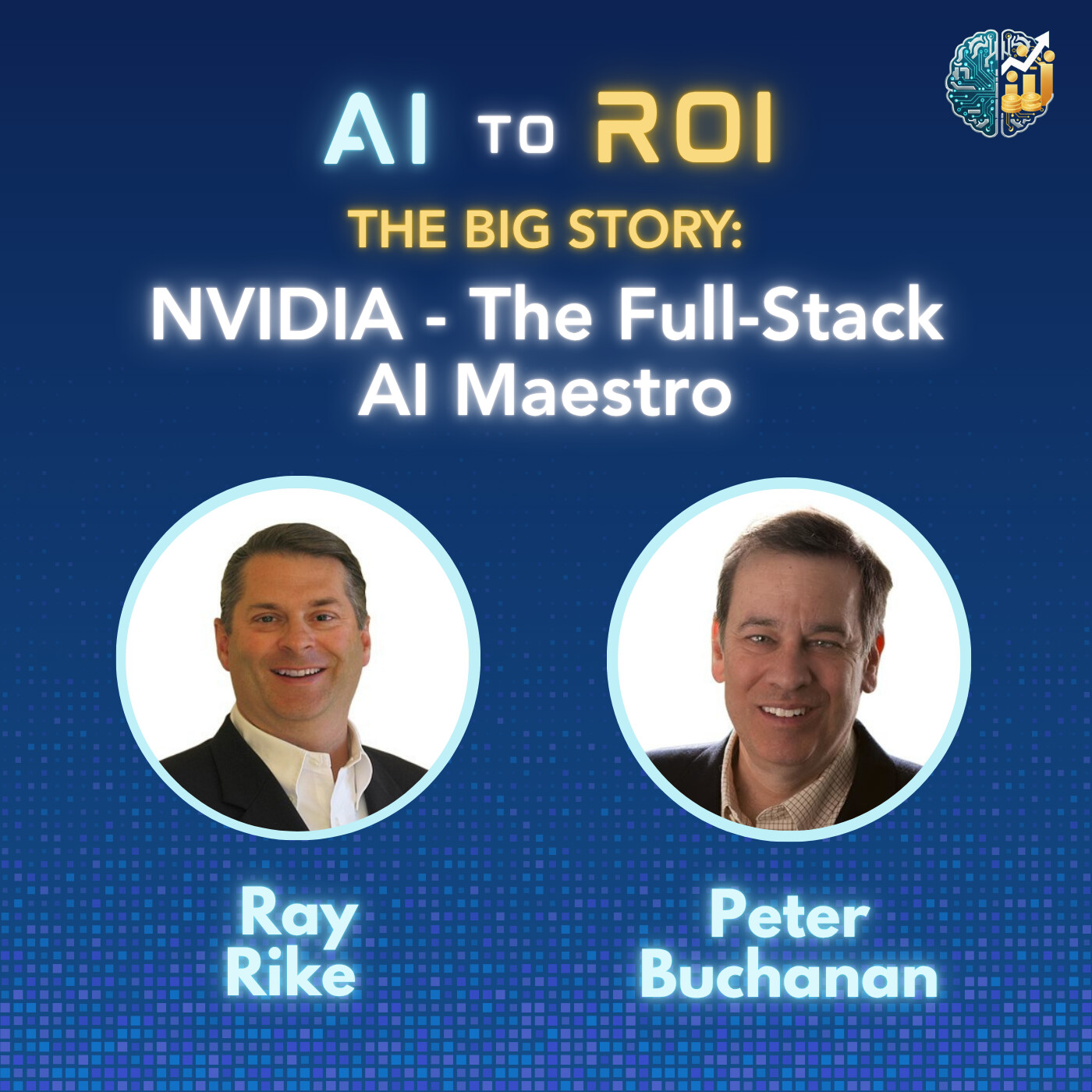
NVIDIA – The Full-Stack Maestro
from AI to ROI (fka Metrics that Measure Up)
Five months ago, Ray and Peter called NVIDIA the maestro of the AI economy. Since then, NVIDIA has not just conducted the orchestra. It has rewritten the music and may be building the entire concert hall. In this episode, Ray and Peter revisit their October thesis, walk through everything NVIDIA unveiled at GTC, and break down what it all means for enterprise AI buyers navigating infrastructure, inference costs, and procurement strategy.What we covered in this episode:From GPU maker to full-stack AI platform: the transformation is completeNVIDIA's strategic intent is no longer just selling chips. It is embedding its technology across the entire AI stack and becoming the foundational layer on which the rest of the AI economy rests. Ray draws the only historical parallel he can find: what IBM was to enterprise technology from the 1960s through the 1980s. The difference is NVIDIA is moving faster, with more cash, and with a software flywheel IBM never had.GTC was not a product launch, it was a platform declaration NVIDIA unveiled the Vera Rubin platform, a fully integrated AI supercomputer with liquid cooling and a two-hour installation window. They licensed Groq's LPU architecture in a $20 billion deal that combines GPU and LPU chips to deliver 35x token throughput over current Blackwell systems. They launched NemoClaw (an enterprise-grade agent framework already partnered with Adobe, Salesforce, and SAP), Dynamo (an open-source inference operating system), and the Nemotron family of open-source frontier models. Jensen committed $26 billion over five years in free cash flow to build best-in-class frontier models with no outside funding required.The financial performance is in a category by itselfFiscal year 2026 revenue came in at $215.9 billion, up 65% year over year and 8x since 2022. Data center revenue exceeded $190 billion. Free cash flow hit $97 billion, translating to a 47% free cash flow margin. Combined with 65% growth, that is a Rule of 40 score of 109. Ray notes he has never seen anything like it at scale, and NVIDIA is a hardware company running 80% gross margins. CFO Colette Kress described their inference position as: "right now, we are the king of inference."The moat is not hardware. It is ecosystem lock-inSince 2022, NVIDIA has committed over $50 billion across 170 venture deals, with corporate deal volume growing from 12 deals in 2022 to 67 deals in 2025. Portfolio companies include OpenAI, Anthropic, xAI, CoreWeave, and Lambda. Sovereign AI contracts signed since October total $30 billion across France, the Netherlands, Canada, Singapore, and the Middle East. Hyperscalers still represent roughly 50% of revenue, but the faster-growing segments are sovereign entities, enterprise verticals, and NeoCloud providers, which is exactly the diversification NVIDIA needs as hyperscaler CapEx normalizes.The risks are real but manageable from where NVIDIA sits todayCustom ASICs from Google, Amazon, Meta, and Microsoft represent the most credible competitive threat, though those chips are optimized for internal platforms and do not solve multi-cloud or on-premise deployment needs. Export control escalation remains a live risk, with NVIDIA restarting NH200 production for China. TSMC concentration is a structural vulnerability, especially given geopolitical risk around Taiwan. And three hyperscalers account for over half of NVIDIA's receivables, some of whom are actively building competing chips.What enterprise AI buyers should do right now.Ray and Peter close with four concrete takeaways for enterprise buyers: evaluate the full infrastructure stack, not just GPU cost; model inference economics carefully before deciding which models to run and where; pursue a strategic partnership with NVIDIA rather than transactional procurement, because partnership creates supply access standard customers do not get; and do not assume custom silicon from hyperscalers solves your problem, because data residency and on-premise requirements often mean NVIDIA needs to be part of the solution regardless.See Privacy Policy at https://art19.com/privacy and California Privacy Notice at https://art19.com/privacy#do-not-sell-my-info.
Embed this episode
What this episode covers
NVIDIA has transformed from a GPU maker into the full-stack foundational layer of the AI economy, posting a Rule of 40 score of 109 while building a moat through hardware, software, inference architecture, and $50 billion in ecosystem investments that enterprise buyers can no longer afford to treat as just another infrastructure vendor
NOW PLAYING
NVIDIA – The Full-Stack Maestro
No transcript for this episode yet
Similar Episodes
No similar episodes found.
Similar Podcasts
No similar podcasts found.