
EPISODE · May 30, 2026 · 24 MIN
Obesity: Is it a Disease of Chronic Refined Carbohydrate Excess
from Diabesity Decodified - Is Food the root cause of Type 2 Diabetes Mellitus pandemic?
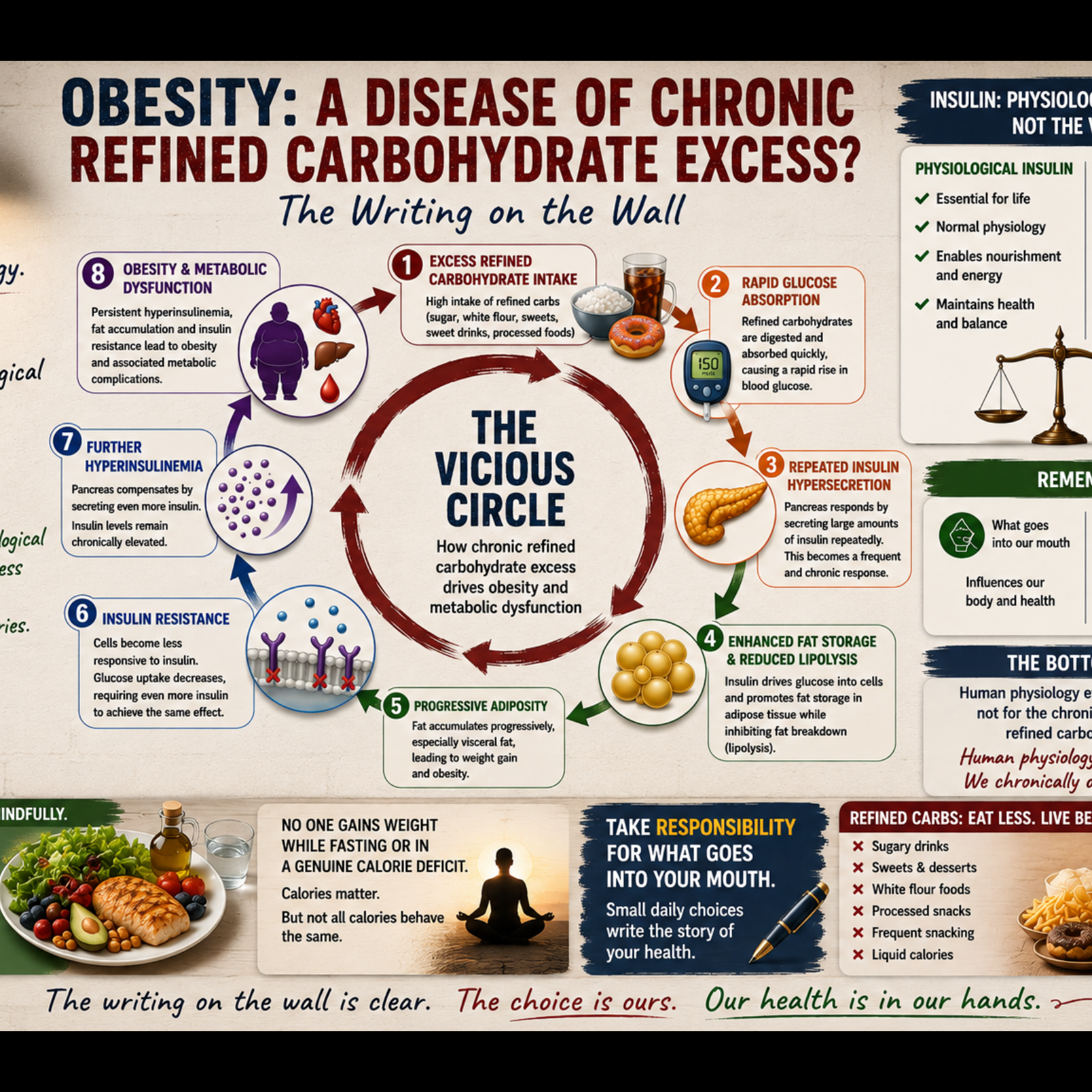
Obesity: Is It a Disease of Chronic Refined Carbohydrate Excess?Obesity is the most discussed, researched,and misunderstood health conditions of modern civilization. Genetics, hormones, exercise, stress, sleep, medications, and socioeconomic factors play a role. An important question remains: Are we overlooking a dominant cause?The article explores the hypothesis that chronic excess intake of refined carbohydrate calories is the principal modern driver of obesity.Human genes have changed little over the past few decades, yet obesity rates have risen dramatically worldwide. During the same period, food processing has changed profoundly. Modern populations are increasingly exposed to highly refined, rapidly absorbable carbohydrate-rich foods in quantities and frequencies unprecedented in human evolutionary history.This hypothesis does not deny the laws of thermodynamics. Any sustained caloric surplus can lead to weight gain, and no one gains weight while maintaining a genuine calorie deficit. Calories matter. All calories are not metabolically equivalent.Refined carbohydrates, particularly glucose-rich foods stripped of natural fiber, are rapidly absorbed, producing sharp rises in blood glucose. This stimulates insulin secretion. Insulin is an essential physiological hormone that facilitates glucose utilization, nutrient storage, fat deposition, and inhibition of fat breakdown.The problem is not physiology.The problem is chronic physiological overstimulation.The article proposes following sequence:Excess refined carbohydrate intake → rapid glucose absorption → repeated insulin hypersecretion → enhanced fat storage and reduced lipolysis → progressive adiposity → insulin resistance → further hyperinsulinemia → obesity and metabolic dysfunction.This explains how obesity and insulin resistance reinforce each other over time.The profound weight loss seen in untreated type 1 diabetes mellitus demonstrates insulin’s indispensable role in nutrient storage and maintenance of body mass. Conversely, chronic hyperinsulinemia creates a metabolic environment that favors fat accumulation.Importantly, this does not imply that carbohydrates are inherently harmful. Traditional societies consumed carbohydrate-rich diets for centuries without experiencing the modern obesity epidemic. However, those diets contained substantially more fiber, underwent minimal processing, involved less frequent eating, and contained less added sugar than modern ultra-processed foods.The distinction, is not between carbohydrates and no carbohydrates, but between natural, minimally processed carbohydrates and highly refined, rapidly absorbable carbohydrate calories consumed chronically and in excess.The article argues that responsibility cannot be assigned solely to governments, industries, healthcare systems, or commercial interests.All of us participate in and share responsibility for the current predicament. To a considerable extent, we influence what goes into our mouths.Equally important may be what comes out of our mouths—our words, attitudes, relationships, and behaviors—which also influence health and wellbeing.Obesity is not primarily a moral failure, nor is human physiology fundamentally flawed. Human physiology evolved in environments of scarcity. Modern refined food abundance chronically stimulates biological pathways that were originally adaptive and essential for survival.Human physiology did not fail us.We chronically overwhelmed it.If chronic refined carbohydrate excess is indeed the dominant driver of modern obesity, then prevention and treatment may require renewed attention to food quality, food processing, dietary fiber, and the metabolic consequences of what we choose to eat.The writing on the wall may be clearer than we think.The choice is ours.Our health is in our hands.
Embed this episode
Ready to play
Obesity: Is it a Disease of Chronic Refined Carbohydrate Excess
No transcript for this episode yet
Similar Episodes
No similar episodes found.
Similar Podcasts
No similar podcasts found.