The odds of encountering a tornado in Canada are 1 in 412,371. But when the weather warnings take effect, you're running like the wind. But did you know that if you've had chicken pox, the odds of getting shingles are 1 in 3? Why leave it up to chance? Ask your healthcare professional about Shingrix. The Shingrix vaccine helps protect adults against shingles. 100% protection not guaranteed. Adverse reactions may occur. Visit Shingrix.ca.
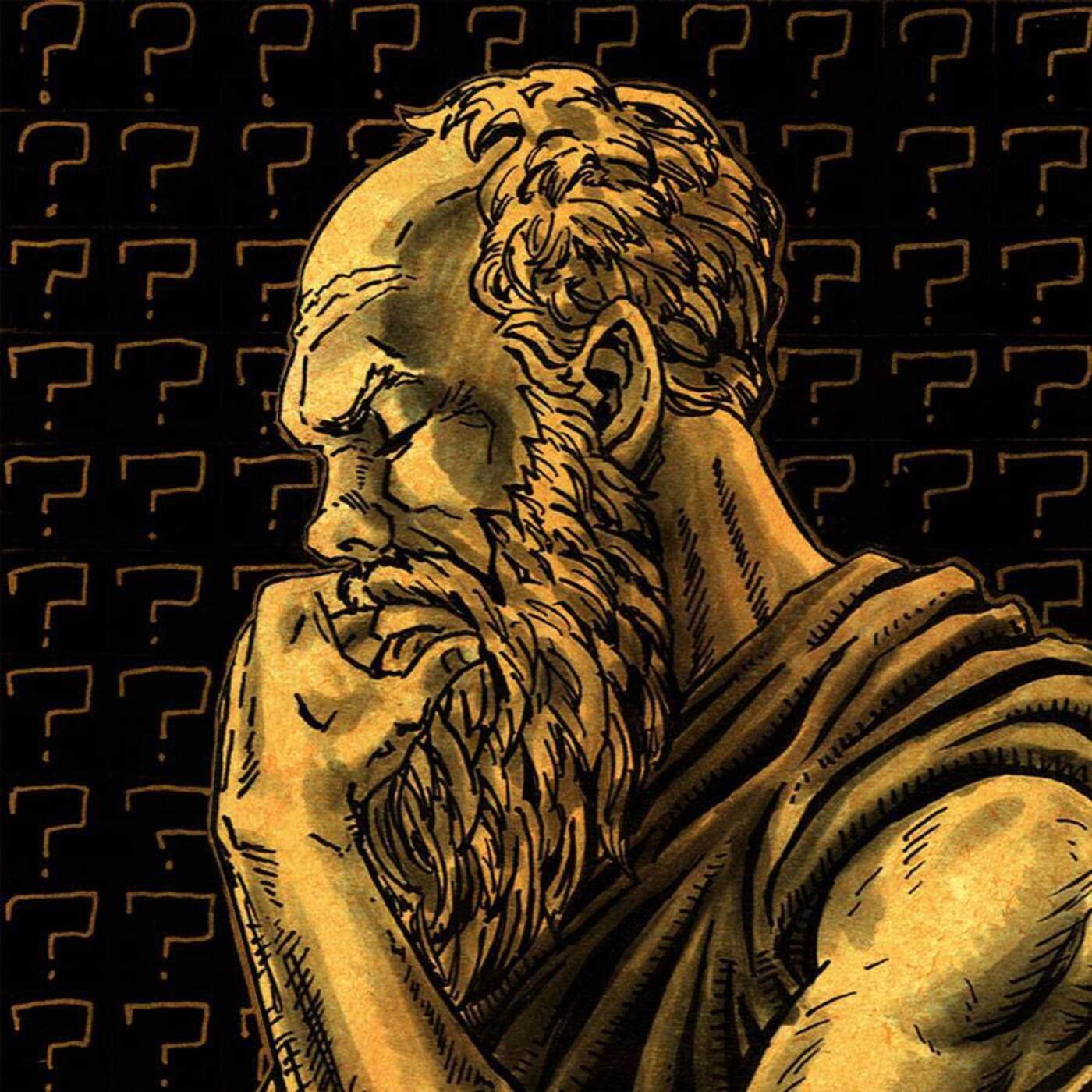
Hello, and welcome to a very special throwback episode of Our Fake History. This week, I am throwing you back to season three with episode number 61, What's the Problem with Socrates? This was one of those episodes that I remember coming together very quickly. Sometimes I have to slave over these shows, but other times they just flow out of me. I think the reason this one came so easy was because I felt like I was visiting old friends. You see, as an undergrad, I spent quite a lot of time trying to wrap my head around the finer points of platonic philosophy. And yeah, I know, that sounds hopelessly pretentious, but as an undergrad, I may have been hopelessly pretentious. It's just the truth. But I honestly feel like I really learned how to write while trying to make sense of dialogues like The Republic, The Credo, and The Symposium. So anytime I go back to the Greeks, I get this warm sense of familiarity.
Now, this one was fun to research because in all of my time studying ancient Greek philosophy in university, I never once took a class that took the Socratic question seriously. As you'll hear in the episode today, the Socratic question is essentially, what should we believe about Socrates? Which version of Socrates is the real Socrates? Now, occasionally, a professor would mention the fact that because Socrates didn't write anything down, we have to rely on the writings of Plato and a handful of others to reconstruct his philosophy. But then, invariably, the professor would just move on, diving into the ideas which were always deemed to be, quote-unquote, more important. This is part of the reason why I started this podcast. In university classes, and even in books on various topics, these questions are often skated past. It still drives me crazy when someone drops a nugget like, maybe everything we know about Socratic philosophy is wrong, and then just moves on. I mean, come on, that seems worth exploring, right?
Now, when I went back and re-listened to this episode, I realized that when I made it, I hedged my bets at the end, and I didn't really draw any firm conclusions around Socrates. As you will hear, I do my best to explain the different portrayals of Socrates in the ancient sources, but then I don't really come down one way or another on which one is the most accurate. I really let you, the listener, draw your own conclusions. Now, interestingly, this episode was number 61, and I'm about to release episode number 161 at the beginning of September. So that means that I have done 100 episodes of Our Fake History since this episode on Socrates originally came out. Over the course of 100 episodes, a podcast can evolve. You see, in my earlier episodes, I think I was far more careful when presenting my personal opinions on topics. In fact, I would rarely do it unless I felt like it was absolutely necessary to give the episode some closure.
But if you've been following this podcast for a while, then you might have noticed that I've become a bit more comfortable sharing my personal opinions on the topics that we cover here. I always do my best to make it very clear when I'm sharing an opinion. I really try to demarcate my personal musings from the real research. But you might have noticed I weigh in a bit more these days. At a certain point, I think I realized that it made the show more entertaining when I shared my hot takes and my personal conclusions. I also discovered that you folks listening were sophisticated enough to know when I was presenting historical facts, when I was explaining an expert opinion, and when I was letting myself indulge in a little fun speculation. You always get it. And I should have always trusted you. But in these earlier episodes, I was far more careful. And I think you can hear that in this one, for better or for worse.
So after listening back to this episode today, if you're curious what my personal opinion is on which version of Socrates seems like the most accurate, then hit me up on Twitter at Our Fake History or at the Facebook page, that's facebook.com slash Our Fake History, and we can keep the conversation going there. I do have thoughts on this, but I don't want to tell you right now because I'm afraid I might spoil the episode. Also, make sure you check your feed in two weeks' time when you will be getting a brand new episode of Our Fake History as we start Season 8 of the show. In the meantime, enjoy episode number 61, What's the Problem with Socrates?
There's a story that once in ancient Athens, there lived a young man named Aristocles. Aristocles was the son of an aristocrat, and as a result, he was given the best education that money could buy in the ancient world. He soon proved himself to be a bit of a star student. Not only was Aristocles academically gifted, he was also a talented athlete. He was broad-chested, even as a boy, and quickly gained a reputation as an excellent wrestler. He was so good, in fact, that he qualified to wrestle at the Isthmian Games, which was basically a low-level Olympics.
Aristocles was that guy in high school who just managed to be good at everything. He was real valedictorian material. As he grew into adulthood, it became clear that above all else, Aristocles was an artist. He devoted himself to writing epic poetry and creating tragedies for the Athenian stage. This guy was well-rounded in a way that you rarely see. I mean, how many of you out there know a star wrestler who's also a math whiz who writes plays? I know, these people are out there, but you have to admit, they're a pretty rare breed.
But for Aristocles, his true passion was his art. He was determined to become a great master of the tragic form, like Athens' great playwrights Sophocles or Aeschylus. But one day, everything changed. We're told that Aristocles was hurrying past the theater of Dionysus. He had an armful of tragic plays that he had written, and he planned to submit them for consideration in an upcoming dramatic competition. It was there, in front of the theater, that he came upon a very unusual-looking man.
The man was bald, bearded, and had almost comically exaggerated features. He had big, almost bulging eyes, a snub nose, and a noticeably paunchy belly. This man was hardly the model of Greek physical perfection. Nevertheless, there seemed to be something about him, and it stopped the young Aristocles in his tracks. The bald man was surrounded by a small group of students, and he seemed to be conducting a lesson of some sort. But it was unusual, as it seemed more like a conversation and less like one of the dry lectures most Greek students were accustomed to.
Aristocles stopped to listen, and before long, he had been dragged into conversation with the man. What was actually said that day in front of the theater was not recorded, but it clearly had a profound effect on the young Aristocles. You see, Aristocles would never end up delivering his plays that day. Instead, he turned around, went home, lit a fire in his hearth, and threw everything that he had ever written into the flames. As he did it, he apparently shouted, quote, Come hither, O fire god, I have need of thee, end quote.
From that day forward, this young man swore that he would never write another tragedy. He would become a pupil of this strange teacher, and he would devote all of his mental energies to the pursuit of philosophy. You see, Aristocles would end up becoming famous after all, but not as a tragedian. His works of philosophy would prove to be some of the most enduring in all of human history. So why haven't you heard of the great philosopher Aristocles? Well, that's because he rather preferred to go by his nickname, Plato.
The old man that Plato had encountered in the market that day was none other than the person credited with founding the entire Western philosophical tradition, the great Socrates. Now, there is a good chance that this story about the first meeting of Plato and Socrates is a complete work of fiction. Our first source for this story comes from a writer named Diogenes Laertes, who was writing nearly 500 years after the events in question apparently took place. But this is perhaps oddly appropriate, considering most of what we know about Socrates scholars have gleaned from works of fiction. Socrates is often given credit for laying the foundations of Western philosophy.
To give you a sense of his importance, in the history of philosophy, any philosophers who were active in Greece before Socrates are usually just called the pre-Socratics. This suggests that everything that came before was just a prelude to the man himself, and everything that came after was just building on his great example. But here's the thing. Socrates never wrote anything down. Everything we know about his life and philosophy comes to us from the writings of his students, the most famous being Plato. In Plato's writings, Socrates is a nearly divine figure. He is the perfect philosopher who uses his great powers of insight to reveal the ignorance of other people. But the issue is that Plato wasn't a historian.
His writings about Socrates weren't meant to be an exact report on the philosopher's life. Instead, Plato puts words in Socrates' mouth in order to make larger philosophical points. In other words, Plato's Socrates is a literary invention. Just like a movie that's based on a true story, the writer takes liberties with the truth in order to make the final product more interesting, entertaining, or poignant. All of this is to say that our main source on Socrates' philosophy may have not been reflecting the real person at all.
We have to ask, how close is the Socrates we read about in Plato's dialogues to the real historical figure? Did the real Socrates even come up with any of the ideas we think of as quote-unquote Socratic philosophy? Have we been giving credit to the wrong guy? Let's find out today on Our Fake History. Episode number 61, What's the Problem with Socrates?
Hello, and welcome to Our Fake History. My name is Sebastian Major, and this is the podcast where we explore historical myths and try to determine what's fact, what's fiction, and what is such a good story that it simply must be told. Today, we are diving into a historical riddle that is commonly referred to as the Socratic problem. You see, Socrates is perhaps one of the most famous people to have ever lived. He's been called the father of Western philosophy.
He's been venerated as the wisest human being to have ever lived, and in some circles, he's even been celebrated as a martyr for philosophy. Socrates occupies the same rare air that is usually reserved for religious figures. He gets named alongside the likes of Confucius, the Buddha, and Jesus in terms of his influence and insight into the human condition. Almost every first-year philosophy survey course begins with Socrates. In the Western tradition, he is patient zero for political and moral thought. So, I'm sure you're asking, if this guy is so great, then what's the problem with Socrates? Well, as I mentioned in the introduction, we don't have anything from Socrates directly. All we have are representations of Socrates. Now, normally, this wouldn't be a big deal.
There are countless historical figures who didn't leave writings behind. It's quite common to rely on the testimony of contemporaries when trying to understand a figure from the past. But what's tricky about Socrates is that his students weren't really out to record his ideas exactly as they came out of his mouth. They weren't journalists. They were philosophers. This meant that Plato and a handful of Socrates' other students used Socrates in their writing as a tool to give voice to their own ideas.
The Socratic problem is that we don't really know where the philosophy of Socrates ends and the philosophy of his students begins. This has led some to go so far as to claim that Socrates may not have been a real person at all. The theory goes that Socrates was a completely imaginary character invented specifically to be the mouthpiece for ideas in philosophical dialogues. In the same way that Tiresias, the blind prophet, shows up in almost every Greek tragedy to guide or warn the other characters, Socrates turns up in the dialogues to instruct and challenge the readers. From this perspective, Socrates is just a stock character.
But I think we need to be careful not to get too far down that particular rabbit hole. I think it's extremely valuable for us to ask, how do we know what we know about history? Sometimes my own students get caught up on the idea that maybe we can't say anything for sure about the past. Maybe it's all just made up. Maybe everyone is just a historical myth.
But that kind of thinking can be dangerous. It leads us to a place where absolutely anything can be true, which in turn makes us vulnerable to charlatans and propagandists who will remake the past into any form they find the most useful. You see, we can say with quite a bit of confidence that Socrates did exist. We know this because multiple independent sources attest to his existence. When independent sources agree on something, then barring a massive and pointless conspiracy, you can safely say that it's a fact.
You see, as much as Plato is our main source for Socrates, he's not our only source. There are at least three other writers who lived at the same time as Socrates who tell us about him. There are also a handful of writers who wrote after Socrates' death who claimed to be working from primary sources from his lifetime. So, right off the top, we can chuck out the idea that Socrates was a 100% fictional character. However...
Beyond the general agreement that Socrates lived in Athens, taught philosophy, and was executed by the city, there isn't a whole lot of consensus around who he was and what he believed. There is a lot of contradiction between the sources, and also within the sources. For instance, just in Plato's dialogues, the character of Socrates seems to hold a number of pretty contradictory philosophical opinions. This can make piecing together the quote-unquote real philosophy of Socrates darn near impossible. But Plato tells us that Socrates once said that, quote, the unexamined life is not worth living. So let's examine this life and see if we can draw some conclusions. So who was Socrates?
Well, according to tradition, Socrates was born in Elopece, just outside of Athens, sometime around 470 BC. He was a commoner. According to Plato, his mother was a midwife and his father was a sculptor and stonemason. As a young man, we're told that Socrates went into the family business and trained as a sculptor himself. There was even a tradition in the ancient world that Socrates had carved a number of the famous statues that stood near the Acropolis in Athens. But this is almost certainly a historical myth that came from a confusion around the real sculptor's name. He was called Socrates of Thebes, and he was a different guy.
No, our Socrates would not end up making a name for himself as a sculptor. Instead, he seemed to enjoy spending most of his time hanging around the workshops outside of the Agora. That was the big open-air market that was the heart of Athens' commercial and civic life. You see, at the time, youths were not allowed to enter the Agora proper. Instead, they took to loitering around the workshops just outside of it.
There, Socrates would engage people in conversation, and he developed his philosophy. Or at least, so we're told. After the outbreak of the Peloponnesian War, Socrates apparently did his civic duty by serving as a Hopolite soldier and fighting against the Spartans. The war would end up dragging on longer than Socrates' particular term of military service. The conflict between Athens and Sparta was still raging when Socrates started to make a name for himself as kind of a wacky local character. And this is where the sources on Socrates really start to conflict.
You see, depending on who you believe, Socrates was either a genius who pioneered a new way of thinking, challenged the status quo, and inspired a generation, or he was an affable wise guy who was full of Ben Franklin-like tidbits of wisdom, penny saved is a penny earned kind of stuff, or he was a total charlatan who hustled the children of the idle rich with his BS pseudo-philosophy. These three wildly different portrayals of Socrates come from three main contemporary sources. Those are Plato, Xenophon, and Aristophanes, respectively. Plato gives us Socrates, the nearly divine genius. Xenophon gives us Socrates, the good-natured but misunderstood dispenser of street sense. And Aristophanes, the playwright, gives us Socrates, the greedy clown. So, who should we believe?
Well, this is the heart of the Socratic problem. Now, the interesting thing is that for most of history, Plato's version of Socrates was not considered the most historically accurate. That particular honor was given to Xenophon. So, who was Xenophon? Well, Xenophon was a contemporary of Plato's who was also a student of Socrates'. But he's perhaps most famous as a historian.
Xenophon was one of the legendary 10,000 Greek mercenaries who fought for the would-be Persian king Cyrus the Younger. For those of you that don't know this story, you should really check out Daniele Bolelli's take on this tale. It's pretty great, filled with gory details. But if you don't have time to go check out his stuff right now, in a nutshell, this group of Greek mercenaries was hired by a Persian prince to help him win the throne. In the course of the battle, the guy that had hired them was killed.
So then the 10,000 needed to fight their way through hostile territory all the way back to Greece. It's a pretty awesome story. So awesome, in fact, that it inspired the 70s cult comic book and film The Warriors. Anyway, Xenophon's history of that adventure is probably his best known contribution to world literature. However, he's also one of the most important sources we have on the life of Socrates. Since Xenophon had a reputation as a historian, his take on the life of the philosopher was given more credence. It was generally understood that Plato wrote allegories, and his Socrates was therefore more of a literary creation. This was until the 1800s, when the academic world really started to engage with the Socratic problem in a serious way.
In 1818, a German scholar named Friedrich Schliermacher published a paper titled The Worth of Socrates as a Philosopher. In it, he argued that after Socrates, there was a noticeable change in Greek philosophy. Therefore, any portrayal of Socrates where he seems regular of his time or not in some way extra special should not be trusted. He contended that for philosophy to change as much as it did, Socrates must have been a truly remarkable thinker. That certainly comes through in Plato, but it doesn't come through in Xenophon, so therefore we shouldn't trust Xenophon. Schliermacher went on to critique Xenophon's two big works on Socrates, The Apology and The Memorabilia. He contended that Xenophon's goal in both of these works was to defend his old teacher, who he believed was unfairly put to death by the Athenians. Schliermacher claimed that to make this defense, Xenophon made Socrates' philosophy less revolutionary.
He purposely toned it down, made it more conservative, and ultimately more palatable to his ancient audience. Now, to be fair, Xenophon Socrates is quite different from Plato's. In the memorabilia, he seems less interested in bigger moral questions and more interested in solving very mundane problems, like reconciling fighting brothers or a mother and a son. He's also less dedicated to the so-called Socratic method of questioning his companions and pointing out their ignorance. Now, this is like his main attribute in Plato.
He asks these pointed questions to the people he's speaking with and eventually proves to them that the logic that brought them to certain conclusions was faulty. Plato's Socrates is the guy who is wise because at least he knows that he knows nothing. He's aware of his own ignorance. Xenophon's Socrates, on the other hand, has all sorts of practical advice for people. He isn't wise because he knows nothing. He knows stuff, and it's very practical and helpful stuff.
This portrayal was far too ordinary to satisfy Schliermacher. Socrates' influence suggested he was special, and Xenophon Socrates just wasn't that special. This interpretation would prove to be hugely influential. For the next 200 years, Plato's Socrates would be given precedence by the scholars. To this day, most academics seem to favor Schliermacher's interpretation. As an example of this, I would point to a lecture series by philosophy professor Michael Segrou. In his introduction, the professor pretty much spits at Xenophon as hopelessly pedestrian. In his estimation, Xenophon just doesn't get Socrates.
And as such, his take on the philosopher can be safely ignored. But here's the thing. It's quite possible that Schliermacher and those who have followed his lead have conflated Plato's massive influence on philosophy with Socrates. It's not out of the question that Xenophon's Socrates is in fact completely accurate. The great leap forward in philosophy may have belonged to Plato and not his teacher. Plato may have made Socrates more impressive in his dialogues in order to more effectively communicate his points. So we have to ask.
How do we separate our Socrates from our Plato? Well, let's see what we can do. Scholars of Plato like to divide his work into three main periods, early, middle, and late.
The form that Plato liked to work in was called the dialogue. For those of you not familiar, the dialogues kind of read like plays, which is fitting given Plato's origins as a playwright. In them, different people, known as interlocutors, come together and have a discussion about a particular philosophical question. In the Republic, the question is, what is justice? In the Symposium, the question is, what is love? In almost all of these dialogues, our most important interlocutor is Socrates.
He usually asks pointed questions of his fellow interlocutors and then occasionally fleshes out his own ideas in longer speeches. Now, one of the big questions for scholars of Plato has to do with which ideas are the Socrates ideas and which ideas are the Plato ideas. Here's the thing. There's no way to really know for sure. Most scholars seem to accept the theory that the early dialogues have more Socrates in them, and the later ones are more all about Plato. To support this, some have pointed out that in the later dialogues, Socrates speaks a lot less and sometimes isn't even present. In one of the final dialogues, a character called the Athenian Stranger gets all the good lines, which has led many scholars to conclude that he's a stand-in for Plato himself.
Where it gets trickier is in the early to middle dialogues. For instance, the dialogue that is considered to be the most purely Socratic is the Apology. But even that has Plato's fingerprints all over it. The Apology is Plato's detailing of the defense that Socrates offered at his trial. Now, for starters, the trial of Socrates is an event that we can pretty confidently say happened. Multiple sources speak of it. And Xenophon also went so far as to write his own version of the Apology.
So why was Socrates put on trial? I mean, what could this guy have possibly done? Well, it appears as though the real Socrates eventually ran afoul of the wrong people in Athens. When Socrates was indicted, the Peloponnesian War had finally come to an end, and Athens had lost. The war had been a disaster. The empire that Athens had cobbled together was now in the hands of their greatest rival, Sparta. It was a humiliation for a famously proud group of people. After the war, Athens was governed by a number of Spartan puppets known as the Thirty Tyrants. But eventually, the last of these was overthrown, and Athens was once again able to be ruled by a democracy.
In an attempt to keep the peace in this new democracy, the government passed something called a law of oblivion. This meant that no one could be prosecuted for a crime that happened before the reinstatement of the democracy. Everyone got a blank slate. No one was going to keep an old political rivalry alive by dragging their old enemies through the courts. But of course, people found a way around this. You see, back during the war, Socrates had been connected to a particularly controversial politician named Alcibiades.
According to some sources, but notably not Plato, Alcibiades had been a student of Socrates. He was also the politician that most people blamed for Athens' disastrous defeat in the war. After the war, anyone who was seen as one of Alcibiades' cronies was a target. Socrates was potentially seen as an influence on Alcibiades, which meant that there were powerful people who wanted some revenge. But in this new Athenian democracies, Socrates couldn't be brought up on charges for things that happened during the war. So they needed something else. What they came up with was the charge of not recognizing the gods of the state, importing new and strange deities, and corrupting the youth of Athens. It was a flimsy charge at best, and probably had nothing to do with the real grievances with Socrates. But those charges were expedient, and so those were the ones that were brought forward.
Plato's apology of Socrates is a classic in every sense of the word. It's the ultimate indictment of a corrupt state, a hypocritical legal system, and a morally bankrupt population. Over the course of his speech, Socrates proves that he not only honors the gods, but is in fact more pious than his accusers. As for the charge of corrupting the youth, he boldly claims that he's actually the only person in the city who isn't corrupting them. Athens is corrupt, and he's teaching the youth to love virtue and seek knowledge. It's a bold defense, and one that almost seems designed to annoy the jury. It's the whole, I'm not out of order, you're out of order, this whole damn courtroom's out of order defense. In Plato, this argument is presented far more systematically and thoroughly than it is in Xenophon. Xenophon's version of the apology is a little less sophisticated, and as a result, comes across a little more arrogant and knowingly antagonistic.
Plato's apology is crowned by Socrates claiming that he needs to be found not guilty because he provides an essential civic service. Plato has Socrates say to the jury, quote, If you kill me, you will not easily find another like me who, if I may use such a ludicrous figure of speech, is a sort of gadfly given to the state by the God. And the state is like a great and noble steed who is tardy in his motions owing to his very size and requires to be stirred into life. I am that gadfly which God has given the state and all day long and in all places am always feasting upon you, arousing and persuading and reproaching you.
End quote. Now, I absolutely love this argument. He's making the case that society needs provocateurs, or gadflies as he calls them, to keep it healthy. The state will become complacent and corrupt unless annoying people like him keep society awake and force it to constantly articulate what it stands for. Now, it's important to note that this argument does not appear in Xenophon's version of the trial. Here you really have the key difference between the two Socrateses.
Xenophon's Socrates is defiant. He hasn't done anything wrong. He worships the gods. You can kill him if you want because he doesn't fear death. But Plato's Socrates is more subtle. Here he seems to be saying, I understand why what I'm doing looks seditious. And it's because...
It is a little bit, but it's a good kind of sedition. It's the bitter medicine that keeps the state just. Instead of just saying, I've done nothing wrong, he's saying that what I do is only wrong if you aren't concerned with the greater philosophical health of the city. One thing that both Xenophon and Plato agree on is that the jury ultimately found Socrates guilty. It was the custom in the Athenian courts that both the prosecution and the defense could propose a punishment and the jury could vote on it. In this case, the prosecution proposed the death penalty. Our two authors have Socrates respond in two different ways. Xenophon tells us that Socrates refused to name a punishment because he insisted that he did nothing wrong.
Plato, on the other hand, tells us something much better. In his apology, Socrates makes the case that he should get what is due to him. Since he has provided such a valuable service to the city, he should be honored with something called maintenance. This basically means that he gets free lunch. If he was granted maintenance, all of his living expenses would be covered by the state. This was a special honor reserved for athletes who won the Olympics. So you can imagine what a taunt this was to the jury. Either honor me or kill me. It's so cheeky and fearless and all around badass. Where Xenophon's Socrates is cranky, Plato's Socrates is hilarious.
But in the end, both Xenophon and Plato agree that the jury voted for execution and Socrates was condemned. But the way Socrates goes down in these two dialogues is quite different. In Plato, Socrates would rather die than give up philosophy because, quote, an unexamined life is not worth living. His only claim to wisdom comes in his recognition that he knows nothing. Now, these two statements are usually held up as the ultimate tenets of Socratic philosophy. But interestingly, they aren't really present in Xenophon. So either Xenophon simply didn't grasp the subtleties in Socrates' arguments, or maybe he understood Socrates perfectly, and it was Plato who punched up this speech to make it more appealing.
Honestly, the Socrates in Plato's Apology is a much more attractive character. He's smoother with the crowd, he's funnier, his arguments are more high-minded, and even though he baits the jury, he doesn't seem to be begging for death. It's no surprise that people have wanted to believe that Plato's Socrates was the quote-unquote real Socrates. He just sounds like a cooler dude. But that doesn't mean that he was.
Now, Plato does have this in his corner. He was actually at the trial, and Xenophon wasn't. When Xenophon wrote his version of the Apology, he was working from other people's accounts of the proceedings. However, in Xenophon's defense, he approached the event like a historian. He was looking to faithfully represent what went down that day.
Plato, on the other hand, was writing philosophy. As many scholars have pointed out, Plato borrows elements from both tragic drama and epic poetry in his apology. His apology is a work of art that's meant to teach virtue. In other words, the exact reporting of the facts is kind of a secondary concern. So we're left wondering if Socrates comes off so much better in Plato because Plato just got him a bit better than Xenophon, or if he consciously made his teacher more eloquent, more thoughtful, and ultimately a better philosopher. There might not be a satisfying answer to this one, but it's worth considering at least one more portrayal of Socrates before we put this whole thing to rest. For all of their contradictions, Xenophon and Plato at least agree that Socrates was a great philosopher and an important teacher.
But this isn't the only word out there on Socrates. The other famous portrayal comes to us from the playwright Aristophanes. In his comedy The Clouds from 423 BC, Socrates is presented as a complete and utter fraud, who teaches that the clouds are the real gods and hustles young men for their money. Now, what's interesting about the clouds is that it gives us a real insight into what Athens was anxious about at the time they executed Socrates. The city was filled with new ideas. The natural sciences were starting to be developed, which challenged traditional understandings of natural phenomenon. In the past, the gods were thought to control nature. These new sciences were complicating matters. The city was also filled with teachers known as sophists.
The sophists were teachers of rhetoric who promised to make their pupils excellently persuasive speakers. In Athens' democracy, being a persuasive speaker was essential if you wanted political power. The sophists would teach you how to argue a point even if you didn't believe it, or if it was demonstrably wrong. The point wasn't to get to the truth, the point was to win the argument. Now, Plato hated sophists and railed against them in his dialogues.
There are a number of dialogues where Socrates debates the sophists and exposes them as frauds, whose art only confuses people and leads them away from the path of virtue. But interestingly, in Aristophanes' The Clouds, Socrates is a sophist, and a particularly sleazy one at that. When Socrates first appears in the play, he's elevated above the crowd on a special lift that was typically only used for representations of the gods. If you've ever heard of deus ex machina, which means the god in the machine, well, this lift was the machine. So Socrates is made to look like a comically false god, or someone who's stupid enough to think he's a god.
At one point, he gets his would-be student, Strepsiades, to lie down and contemplate the clouds. Socrates asks Strepsiades if he was aware that the clouds were actually gods and goddesses. They then have this little exchange, quote, Strepsiades, heavens no, I thought they were mist, dew, vapor, that sort of thing. Socrates. You are obviously not aware of the great sustenance they give to a vast tribe of sophists, high-powered prophets, long-haired idlers with fancy signet rings, and especially the airy quacks who write those convoluted dithyrams. They are very happy to support them in their idleness because they bring the clouds so much into their poetry." In that little passage, you get to the heart of a particular attitude that was common in Athens at the time.
Aristophanes is basically saying that philosophers, sophists, street-side prophets, and even poets are all cut from the same cloth. They're all lazy, they leech off of respectable citizens, and they would rather worship the clouds than the tried and true Greek gods. To really hammer home how impious Socrates and his ilk are, he has him compare Zeus' thunderbolts to really loud farts. I just love how timeless a good fart joke can be. This play is like 90% fart jokes.
But the question is, how fair is Aristophanes' critique of Socrates? Well, first we should consider the fact that Socrates is a bit of a composite character in this play. He seems to be a stand-in for all of the thinkers in Athens at the time that seemed newfangled and irreverent. He's a combination of a sophist, a philosopher, and a natural scientist, all of whom are being lampooned as lazy and impious. Now, we should take this with a grain of salt, because it's clearly meant as a parody. It'd be like watching Saturday Night Live and then thinking that you got a good sense of who the president was. But, I mean, here's the thing. Parody's only funny unless it exaggerates something that's widely known to be true.
So perhaps we shouldn't throw this away entirely. In his introduction to the clouds, Alan Summerstein proposes that Socrates was chosen to encapsulate all of these different characters because he was an easy target. He was someone who was well-known in Athens. He taught on the streets, he had a public profile, and he already had a comically disheveled appearance. Even Plato admitted that Socrates rarely washed, went barefoot, and had a distinctive smell about him.
In Summerstein's estimation, Socrates was an easy target and made for a good clown. So Aristophanes lumped him in with the sophists that Plato contended Socrates hated. Now, in an interesting little side story here, we're actually told that Socrates went to see the clouds. He went to the theater, and when the weird version of Socrates came out on the stage, the real Socrates stood up at the theater and waved to the crowd. Now, I can't confirm if that story is true or not, and it kind of has the feel of a legend, but I like that one. I really want that one to be true.
So, in the end, most scholars don't take Aristophanes' version of Socrates too seriously. It's so wildly different from every other source on Socrates' life that we should certainly be careful with it. Aristophanes was also trying to be funny. His goal wasn't to accurately report on the life of Socrates, but to joke on a whole myriad of new thinkers in Athens. The truth seems to have been that some of these guys were shameless hustlers. Plato himself makes the same critique of the sophists.
New scientific and philosophical ideas had created a new skepticism about the gods, which many older Athenians clearly found disturbing. This plague goofs on those anxieties, but it also helps us understand why a jury of Athenians could be convinced to kill Socrates. They weren't just lashing out at him, they were lashing out at what they thought he represented. He may not have been a sophist or particularly impious, but he was perceived to be part of this new movement in the city, and a lot of people didn't like it. Or, maybe Socrates was a bit of a sophist. There's always the chance that Aristophanes was closer to the truth than we give him credit for. Now, this is certainly not the opinion of most experts, but all of those experts also admit that we really don't know anything about Socrates for sure. In this sense, the Socratic problem may be unsolvable.
There are tantalizing little scraps that have survived from Socrates' other students, people like Antipsenes, Aristippus, and Aschines of Svetos. But sadly, their works have been lost over the centuries, and instead only exist as quotes and fragments. Gathering a sense of who Socrates was from these sources is particularly tricky. The bits we have from Antisthenes seem to align with Plato's view of Socrates. He was the ultimate philosopher. Antisthenes would apparently even claim that Plato had ripped off some of his ideas. Also, he had this amazing nickname. He was called the Absolute Dog. I kind of love that.
But again, there's so little that has survived from him that it's hard to really know. The Socrates that appears in Plato does seem to be more than human. He is the embodiment of philosophy itself. Plato was obsessed with the idea of perfect forms. Well, in the dialogues, Socrates exists as the perfect form of the philosopher. He is the ideal. And perfect ideals rarely exist in reality.
What we can say for sure is that Socrates made an impression. He inspired playwrights to mock him, his students to deify him, and his countrymen to kill him. That kind of stuff doesn't happen if you're not, in some way, remarkable. But I guess in the end, it's only appropriate that when it comes to Socrates, all we know is that we know nothing. Okay, that's all for this week. Join us again in two weeks' time when we will explore yet another historical myth. Before we go this week, though, I would like to give a special shout-out to the following people. Emily Patton, Eric Stark, Winter Elizabeth Coifman, Barry Kasvin, and Rob Hamilton. All of you have decided to support the show at the $5 or more level on Patreon. So, you know what that means. You're beautiful human beings. You're really good at it. You're good at being people.
Thank you. Thank you so much. Thank you to everyone who continues to support the show on Patreon, who goes to OurFakeHistory.com and makes one-off donations, or who buys the extra episodes on OurFakeHistory.com. All of this support really, really helps. It's made my life so much better and has really helped me keep the show coming. So thank you to everyone. I'm, as always, very humbled by your support.
If you are listening out there right now and you think you might want to support the show, it's easy. All you got to do is go to patreon.com slash ourfakehistory and sign up for a monthly donation. If you sign up at the one, three or five dollar levels, there's all sorts of cool extras that you get as well. We're also zeroing in on one of our Patreon goals. And once we hit that Patreon goal, then all of the patrons will get to vote on what they want the next extra episode to be. We're getting closer to that goal every day. So if you pledge now, we'll get to that spot.
In the meantime, if you want to get in touch with me, you can always send me an email at OurFakeHistory at gmail.com. You can hit me up on Twitter at OurFakeHistory or you can go to the Facebook group. That's Facebook.com slash OurFakeHistory and check out all the stuff I'm posting there. Also, if you're ever curious about the sources that I use to create this show, you can go to ourfakehistory.com, you can click on the page for whatever episode you're interested in, and you can look at the bibliography that I post there. As always, the theme music for the show comes to us from Dirty Church. You can check out Dirty Church at dirtychurch.bandcamp.com. All the other music that you heard on the show today was written and recorded by me. My name is Sebastian Major, and remember, just because it didn't happen doesn't mean it isn't real.
It may be fall, but winter is coming. BetMGM Casino is putting a spin on the iconic television show Game of Thrones. You can now play the Game of Thrones casino game at BetMGM Casino. Forge your path to the throne with Dragonfire and over 4,000 ways to win and more. Journey through Westeros and discover casino excitement like you've never seen before. Download the BetMGM Casino app and check out the Game of Thrones casino game. Will you be next to take the Iron Throne? BetMGM and GameSense remind you to play responsibly. 19 plus to wager. Ontario only. Please play responsibly.
If you have questions or concerns about your gambling or someone close to you, please contact Connects Ontario at 1-866-531-2600 to speak to an advisor free of charge. BetMGM operates pursuant to an operating agreement with iGaming Ontario.