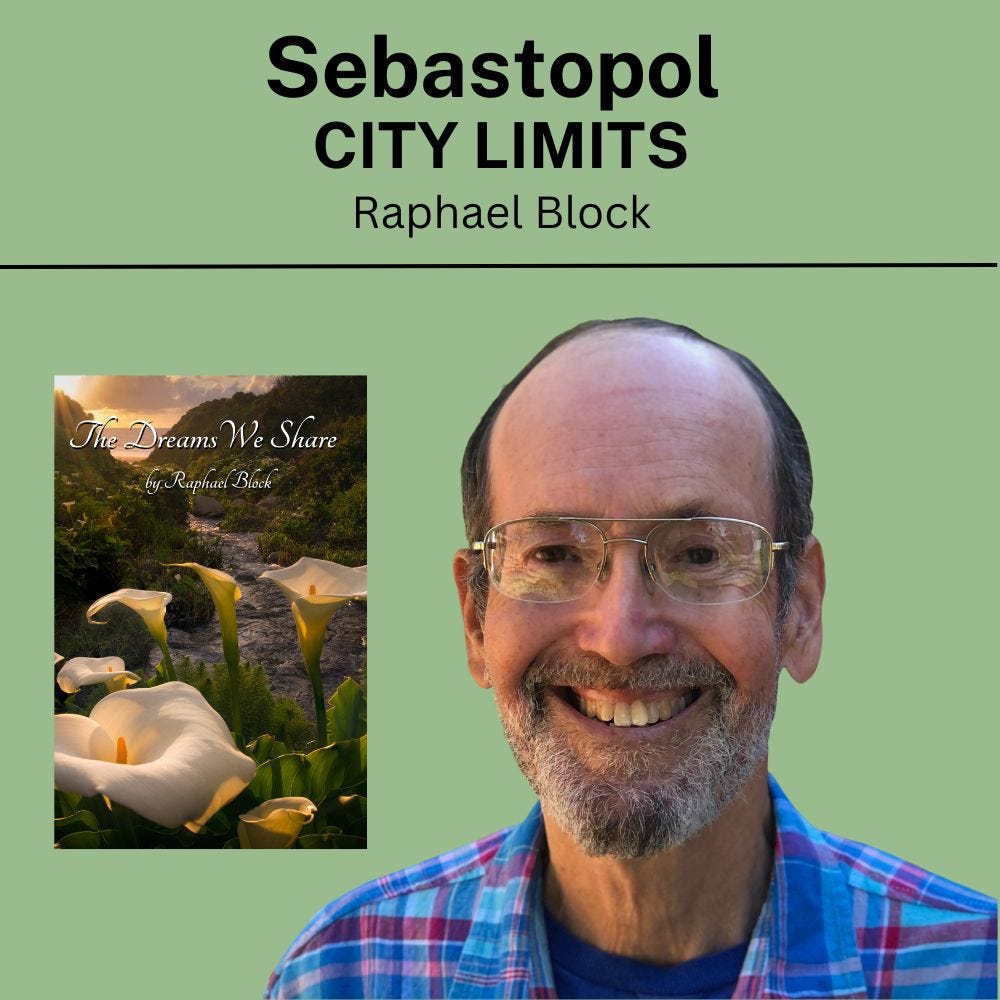
Old Cat: Poet Raphael Block
from Sebastopol CITY LIMITS Podcast Hosted by Dale Dougherty
Sebastopol poet Raphael Block talks about his latest book of poetry, The Dreams We Share and shares several of his poems, including one about an old cat that sought out his attention. Described as an eco-poet, Block is moved by the Earth to speak in his own wonderful voice about what he sees and experiences all around him. “When I go outside, I'm literally moved by the earth. Physically. Emotionally. I would say spiritually too.” He makes note of what attracts his attention. “Sometimes it grows into a poem,” he says. Transcript Raphael Block Dale: I am joined by Raphael Block, a Sebastopol poet who has a new book out called The Dreams We Share. I will let you first introduce your wonderful voice. Raphael: I'm delighted to be here. Thank you. Dale: Explain your voice. Raphael: It's mostly a London accent. I spent most of my life there, though I was born in Israel on a kibbutz, which parents went out from England to help found it. In fact, I spent the first year of my life there, which included a baby house and before they moved to Haifa, the port city, which is the same latitude as San Francisco and has a large bay. When I first came to San Francisco on a visit in 1987, I felt immediately at home on a very visceral level because I could smell the pines as well as see the ocean. Perhaps I could share a poem about my childhood. Dale: Sure. Is that in the current book? Raphael: It's about third or fourth one in. It's called "I touch my childhood scents." I touch my childhood scents a sage leaf to roll and stuff into an acorn. We'd hollow by scooping into its soft flesh. Close to it base, we'd pierce a hole for a stem and make a smoker's pipe. A wind-snapped pine branch— I hold that sappy split near my nose and I'm back in the hills of Haifa, the uncharted territory of my boyhood, sailing pine bark in puddles. And the little old man with missing teeth carrying a framework of sticks on his back bearing bagel rings, pretzels, whole sunflower seeds wrapped in cellophane, whom we'd see on rare trips to town. I am that acorn now. And the sage and pine? I’m still being drenched in their scents. And the long gone bagel man? Perhaps from Poland or Russia? Perhaps, a concentration camp? Who makes the time to ask as we buy their goods and hurry away? Dale: Very nice. How did you get to Sebastopol then? Raphael: We moved here 30 years ago before, my wife and three year old daughter. First West Marin, actually to the Inverness Point Reyes community and after five years there we were way out beyond Inverness. It was very beautiful, but it felt a little isolated as a community. And we were invited to come and live on a friend's property outside of Sebastopol. That's the short of it. Dale: Have you been writing poetry most of your life, or is it something that came in later in life? Raphael: It came in later. In fact, if you'd have asked me in my forties would you like to come to a poetry gig? I'd have looked at you as if you were asking me the strangest question in the world. It came as a gift. I was 50 when I started writing after my wife's passing. She had breast cancer --Deborah my, my dearest and she passed 21 years ago. I was fortunate to raise our daughter who was 11 years old at the time. Happily she lives close by now in Santa Rosa with her husband. And I'm very happy about that. Dale: That's an interesting thing of starting midlife in something very new. It's encouraging to maybe other people out there that think oh, I didn't do this as a kid. I didn't grow up doing this, but you can start something new. Raphael: Absolutely. In fact, I was raised on a science track. Poetry and the arts were not in my curriculum from age 13-14 in British schools. These things can happen anytime in life. Dale: So you describe yourself as a nature poet or an eco poet of sorts. How did that connection happen for you? Raphael: Every day, Dale, when I go outside, I'm literally moved by the earth. Physically. Emotionally. I would say spiritually too. Even going for a walk, it can change your mood. It changes mine entirely and I'm observing and being affected by everything around me. That's how most of the poetry happens for me. It's observation of little details and I make notes of whatever it is that attracts my attention in that way. Sometimes it grows into a poem, especially if it combines with some other inner experience. I'll give you an example if I may. Sure. I stepped into the garden a few days ago and I was about to actually go into town and jump into the car. I was on automatic. And a little voice said, "Hey, stop a minute. Take a couple of minutes. Just look at your garden." There was this black winged butterfly and it was really lustily beating its wings among the flowers. It took off. I could see an orange underside, landed again. I could see a kind of turquoise sheen on the wings. It was spectacular. So I just watched and later on I wrote down a few lines about it and then it resonated in me. It reminded me of an experience I had, which was my seven years ago, I had the most serious operation of my life for Crohn's Disease, which has been my companion since at least age 29. I remember I spent seven hours on the operating table and they removed most of my digestive system. So I'm very lucky to be alive. I'm very grateful. So I connected it with that experience where I had to, I felt I had a choice of which side of the threshold I could land, and I had to beat my wings pretty lustily during that time to remain here because I still had work to do as well as relationships with my daughter and so on. Dale: So then like a conscious choice you had to... Raphael: Yeah, I had to fight for life. So then if I added that to the poem. It's a prose poem at the moment. It's just at a early stage. It has to grow still. So it's observing something, which is a classical way of approaching art. People have done that all over the world for thousands of years. You just take in, listen. Watch. I would say that's the most important quality needed in relation to the Earth at the present time, if I dare generalize, is to listen to the earth. Dale: We find ourselves today spending a lot of time on digital devices. But those moments in nature, I guess need to be celebrated and recognized and encouraged. Raphael: I'm retired now, but even as a teacher, the less time I would spend on the screen, the better. I do spend a fair amount of time on email and other poetry related is absolutely grateful that I can type up my poems and then revise them easily. But every minute you can spend or I can spend outside is really richly rewarded. I've given up social media because I don't want a virtual reality. I'd rather see the real thing, even looking out the window is a treat for me. Dale: That's great. How about reading another poem? Raphael: Thank you. I'd like to share one, it's called “Her Unbroken Giving.” It's in the last section, I believe, which is called We the Healers. Her Unbroken Giving I. It'll happen unplanned, like the gopher burrow that diverts the waters rushing down the hillside from their appointed channels to a flat patch -- where pools now gather, sit, trickle through layers of silt, sandstone, and clay to the aquifer that feeds the well. II. When I was a child and someone hurt me my petals closed, my shell snapped shut, I burrowed underground. And what do I believe will coax this wounded Earth to show me Her face in all weathers. And what do I believe will coax our wounded Earth to show me Her face in all weathers. Dale: In June, you have an event coming up. Raphael: Two (events). One is a Novato library. It's part of the Marin Summer Traveling Show. That's on Saturday the 17th. 2-3pm. There'll be a bunch of poets, very good poets. That's quite fun. I haven't been there before. At the end of June, perhaps more locally for some people at least, is Cafe Frida on South A Street. Every three months, Ed Colletti hosts about eight poets. So I'll have about … Get full access to Sebastopol Times at www.sebastopoltimes.com/subscribe
Embed this episode
No transcript yet.