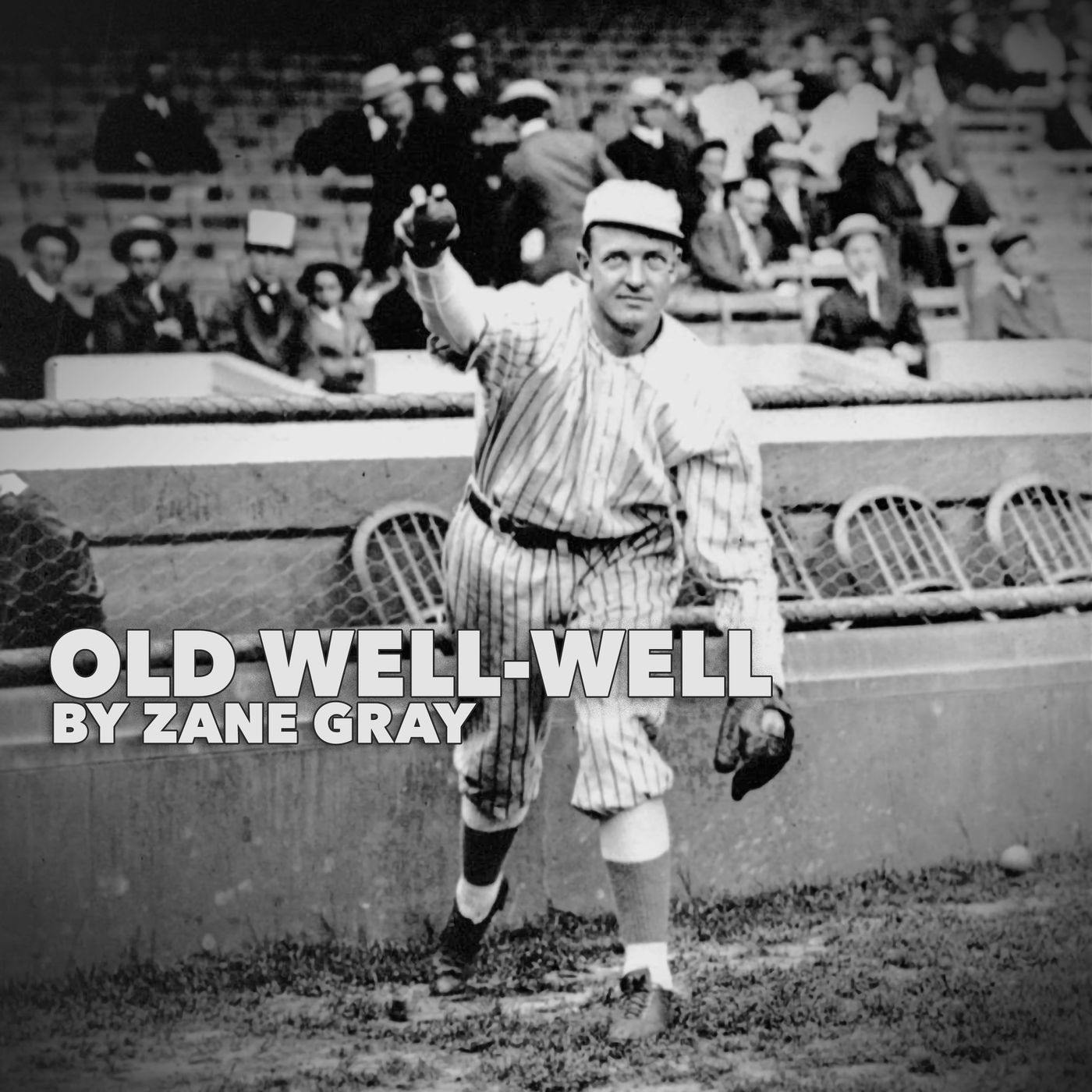
Hi, I'm Don McDonald and this is Lit Reading. A couple of things before we start the story. First, please follow the show. Algorithms are fickle and I need all the friends I can get and it costs you nothing. Second, the ads. Yeah, they're a necessary evil like flossing or small talk at weddings. So we get them over with now. Once the story starts, nobody cuts in. So let's get our flossing done. Welcome to Lit Reading. I'm Don McDonald. Professional baseball in the United States dates back more than 150 years. It's been considered the great American sport since the 19th century.
Popular sports attract rabid fans, as was the case even back in 1910 when Zane Gray wrote Old Well Well. He bought a ticket at the 25-cent window, and edging his huge bulk through the turnstile, laboriously followed the noisy crowd toward the bleachers. I could not have been mistaken. He was Old Wellwell, famous from Boston to Baltimore as the greatest baseball fan in the East. His singular yell had peeled into the ears of 500,000 worshipers of the national game and would never be forgotten. At the sight of him, I recalled a friend's baseball talk. You remember Old Wellwell? He's all in. Dying, poor fellow. It seems young Bert, whom the Phillies are trying out this spring, is Old Wellwell's nephew and protege.
Used to play on the Murray Hill team, a speedy youngster. When the Philadelphia team was here last, manager Crestline announced his intention to play Burt in center field. Old Wellwell was too ill to see the lad get his tryout. He was heartbroken and said, if only I could see one more game. The recollection of this random baseball gossip and the fact that Philadelphia was scheduled to play New York that very day gave me a sudden desire to see the game with Old Wellwell. I did not know him, but where on earth were introductions as superfluous as on the bleachers? It was a very easy matter to catch up with him. He walked slowly, leaning hard on a cane, and his wide shoulders sagged as he puffed along. I was about to make some pleasant remark concerning the prospects of a fine game when the sight of his face shocked me, and I drew back. If ever I had seen shadow of pain and shade of death, they hovered darkly around Old Wellwell.
No one accompanied him. No one seemed to recognize him. The majority of that merry crowd of boys and men would have jumped up wild with pleasure to hear his well-remembered yell. Not much longer than a year before, I had seen 10,000 fans rise as one man and roar a greeting to him that shook the stands. So I was comforted by a situation strikingly calculated to rouse my curiosity and sympathy. He found an end seat on a row at about the middle of the right field bleachers, and I chose one across the aisle and somewhat behind him.
No players were yet in sight. The stands were filling up and streams of men were filing into the aisles of the bleachers and piling over the benches. Old Wellwell settled himself comfortably in his seat and gazed about him with animation. There had come a change to his massive features. The hard lines had softened. The patches of gray were no longer visible. His cheeks were ruddy. Something akin to a smile shone on his face as he looked around, missing no detail of the familiar scene.
During the practice of the home team, Old Wellwell sat still with his big hands resting on his knees, but when the gong rang for the Phillies, he grew restless, squirming in his seat, and half-rose several times. I divined the importuning of his old habit to greet his team with a yell that had made him famous. I expected him to get up. I waited for it. Gradually, however, he became quiet as a man governed by severe self-restraint and directed his attention to the Philadelphia center fielder. At a glance, I saw that the player was new to me and answered the newspaper description of young Bert.
What a lively-looking athlete. He was tall, lithe, yet sturdy. He did not need to chase more than two fly balls to win me. His graceful, fast style reminded me of the great Kurt Welch. Old Welwell's face wore a rapt expression. I discovered myself hoping Bert would make good, wishing he would rip the boards off the fence, praying he would break up the game. It was Saturday, and by the time the gong sounded for the game to begin, the grandstand and the bleachers were packed. The scene was glittering, colorful, a delight to the eye. Around the circle of bright faces rippled a low, merry murmur.
The umpire, grotesquely padded in front by his chest protector, announced the batteries, dusted the plate, and throwing out a white ball, sang the open sesame of the game. Play! Then old Wellwell arose as if pushed from his seat by some strong propelling force. It had been his want always when play was ordered, or in a moment of silent suspense, or a lull in the applause, or a dramatic pause when hearts heat high and lips were mute, to ball out over the listening, waiting multitude his terrific blast. Well, well, well! Twice he opened his mouth.
gurgled and choked, and then resumed his seat with a very red, agitated face. Something had deterred him from his purpose, or he had been physically incapable of yelling. The game opened with White's sharp bounder to the infield. Wesley had three strikes called on him and Kelly fouled out to third base. The Phillies did no better being retired in 1-2-3 order. The second inning was short and no tallies were chalked up. Brain hit safely in the third and went to second on a sacrifice. The bleachers began to stamp and cheer. He reached third on an infield hit that the Philadelphia shortstop knocked down but could not cover in time to catch either runner.
The cheer in the grandstand was drowned by the roar of the bleachers. Brain scored on a fly ball to left. A double along the right foul line brought the second runner home. Following that, the next batter went out on strikes. In the Philadelphia half of the inning, young Bert was the first man up. He stood left-handed at the plate and looked formidable. Duveen, the wary old pitcher for New York to whom this new player was an unknown quantity, eyed his easy position as if reckoning on a possible weakness. Then he took his swing and threw the ball. Bert never moved a muscle, and the umpire called a strike. The next was a ball.
The next a strike. Still, Bert had not moved. Somebody wake him up! yelled a wag in the bleachers. He's from Slumbertown, all right, all right! shouted another.
Duveen set up another ball, high and swift. Bert hit straight over the first baseman, a line drive that struck the front of the right-field bleachers. Picharito! howled a fan. Here, the promise of Bert's speed was fulfilled. Run! He was fleet as a deer. He cut through first like the wind, settled to a driving stride, rounding second, and by a good long slide beat the throw into third. The crowd, who went to games to see long hits and daring runs, gave him a generous hand-glapping.
Old Wellwell appeared on the verge of apoplexy. His ruddy face turned purple, then black. He rose in his seat. He gave vent to smothered gasps. Then he straightened up and clutched his hands to his knees. Bird scored his run on a hit to deep short, an infielder's choice with the chances against retiring a runner at the plate. Philadelphia could not tally again that inning. New York blanked the first of the next. For their opponents, an error, a close decision at second favoring the runner, and a single to right tied the score.
Bell of New York got a clean hit in the opening of the fifth. With no one out and chances for a run, the impatient fans let loose. Four subway trains in collision would not have equaled the yell and stamp in the bleachers. Maloney was next to bat, and he essayed a bunt. This the fans derided with hoots and hisses. No teamwork. No inside ball for them.
Hit it out! yelled a hundred in unison. Home run! screamed a worshiper of long hits. As if actuated by the sentiments of his admirers, Maloney lined the ball over short. It looked good for a double. It certainly would advance Bell to third, maybe home. But no one calculated on Bert. His fleetness enabled him to head the bounding ball. He picked it up cleanly, checked his headlong run, threw toward third base. Bell was halfway there. The ball shot straight and low with terrific force and beat the runner to the bag.
What a great arm! I exclaimed, deep in my throat. It's the lad's day! He can't be stopped! The keen newsboy sitting below us broke the amazed silence in the bleachers. What do you think of that? Old Wellwell writhed in his seat. To him, it was a one-man game, as it had come to be for me. I thrilled with him. I gloried in the making good of his protege. It got to be an effort on my part to look at the old man. So keenly did his emotion communicate itself with me. The game went on. A close, exciting, brilliantly fought battle.
Both pitchers were at their best. The batters batted out long flies, low liners, and sharp grounders. The fielders fielded these difficult chances without misplay. Opportunities came for runs, but no runs were scored for several innings. Hopes were raised to the highest pitch, only to be dashed astonishingly away. The crowd in the grandstand swayed to every pitched ball. The bleachers tossed like surf in a storm.
To start the eighth, Stranathan of New York tripled along the left foul line. Thunder burst from the fans and rolled swellingly around the field. Before the hoarse yelling, the shrill hooting, the hollow stamping had ceased, Stranathan made home on an infield hit. Then Bedlam broke loose. It calmed down quickly, for the fans sensed trouble between Binghamton, who had been thrown out in the play, and the umpire, who was waving him back to the bench. You dizzy-eyed old woman, you can't see straight, called Binghamton. The umpire's reply was lost, but it was evident that the offending player had been ordered out of the grounds. Binghamton swaggered along the bleachers while the umpire slowly returned to his post. The fans took exception to the player's objection and were not slow in expressing it.
Various witty enconiums not to be misunderstood attested to the Bleacher's love of fair play and their disgust at a player's getting himself put out of the game at a critical stage. The game proceeded. A second batter had been thrown out. Then two hits in succession looked good for another run. White, the next batter, sent a single over second base. Burt scooped the ball on the first bounce and let drive for the plate. It was another extraordinary throw. Whether ball or runner reached home base first was most difficult to decide. The umpire made his sweeping wave of hand and the breathless crowd caught his decision. Out!
In action and sound, the circle of bleachers resembled a long, curved beach with a mounting breaker thundering turbulently high. "'Robber!' bawled the outraged fans, betraying their marvelous inconsistency. Old Welwell breathed hard. Again, the wrestling of his body signified an inward strife. I began to feel that the man was in a mingled torment of joy and pain, that he fought the maddening desire to yell because he knew he had not the strength to stand it. Surely in all the years of his long following of baseball, he had never had the incentive to express himself in his peculiar way that rioted him now. Surely before the game ended, he would split the winds with his wonderful yell.
Two beans only base on balls, with the help of a bunt, a steal, and a scratch hit, resulted in a run for Philadelphia, again tying the score. How the fans raged at Fuller for failing to field the lucky scratch. We had the game on ice, one cried. Get him a basket. New York men got on bases in the ninth and made strenuous efforts to cross the plate, but it was not to be. Philadelphia opened up with two scorching hits and then a double steal. Burke came up with runners on second and third.
Half the crowd cheered in fair appreciation of the way fate was starring the ambitious young outfielder. The other half died in the wool home team fans bent forward in a waiting, silent gloom of fear. Burt knocked the dirt out of his spikes and faced Duveen. The second ball pitched, he met fairly, and it rang like a bell. No one in the sand saw where it went. But they heard the crack, saw the New York shortstop stagger and then pounce forward to pick up the ball and speed it toward the plate. The catcher was quick to tag the incoming runner and then snap the ball to first base, completing a double play.
When the crowd fully grasped this, which was after an instant of bewilderment, a hoarse crashing roar rose across the field to bellow back in loud echo from Coogan's Bluff. The grandstand resembled a colored cornfield waving in a violent wind. The bleachers lost all semblance of anything. Frenzied flinging action, wild chaos, shrieking cries manifested sheer insanity of joy. When the noise subsided, one fan, evidently a little longer winded than his comrades, cried out hysterically, Oh, I don't care what becomes of me now!
Score tied. 3-3. Game must go 10 innings. That was the shibboleth. That was the overmastering truth. The game did go 10 innings. 11. 12. Every one marked by masterly pitching, full of magnificent catches, stops and throws, replete with reckless base running and slides like flashes in the dust. But they were unproductive of runs. 3-3. 13 innings. Unlucky 13th, wailed a superstitious fan. I had got down to plugging and for the first time, not for my home team. I wanted Philadelphia to win because Burt was on the team.
With old Wellwell sitting there so rigid in his seat, so obsessed by the playing of the lad, I turned traitor to New York. White cut a high, twisting bounder inside the third base, and before the ball could be returned, he stood safely on second. The fans howled with what husky voice they had left. The second hitter batted a tremendously high fly toward center field. Burt wheeled with the crack of the ball and raced for the ropes. Onward, the ball soared like a sailing swallow. The fleet fielder ran with his back to the stands. What an age that ball stayed in the air. Then it lost its speed, gracefully curved, and began to fall.
Burt lunged forward and upwards. The ball lit in his hands and stuck there as he plunged over the ropes into the crowd. White had leisurely trotted halfway to third. He saw the catch, ran back to touch second, and then easily made third on the throw-in. The applause that greeted Burt proved the splendid spirit of the game. Bell placed a safe little hit over short, scoring White. Heaving, bobbing bleachers, wild, broken, roar on roar. Score four to three. Only one half inning left for Philadelphia to play. How the fans rooted for another run, a swift double play, however, ended the inning.
Philadelphia's first hitter had three strikes called on him. Asleep at the switch? yelled a delighted fan. The next batter went on a weak pop-up fly to second. Nothing to it. Oh, I hate to take this money. All over. Two men, at least, of all that vast assemblage, had not given up victory for Philadelphia. I had dared not look at old Wellwell for a long while. I dreaded the next portentous moment. I felt deep within me something like clairvoyant force, an intangible belief fostered by hope.
Magoon, the slugger of the Phillies, slugged one against the left-field bleachers, but being heavy and slow could not get beyond second base. Kless swung with all his might at the first-pitched ball, and instead of hitting it a mile as he had tried, he scratched a mean, slow, teasing grounder down the third-base line. It was as safe as if it had been shot out of a cannon. Magoon went to third. The crowd suddenly awoke to ominous possibilities. Sharp commands came from the players' bench. The Philadelphia team were bowling and hopping on the sidelines and had to be put down by the umpire.
An in-breathing silence fell upon the stands and field, quiet, like a lull before the storm. When I saw young Bert start for the plate and realized it was his turn at bat, I jumped as if I'd been shot. Putting my hand on old Wellwell's shoulder, I whispered, Bert's at bat. He'll break up this game. I know he's going to lose one. The old fellow did not feel my touch. He did not hear my voice. He was gazing toward the field with an expression on his face to which no human speech could render justice. He knew what was coming. It could not be denied him in that moment.
How confidently young Burt stood up to the plate. None except a natural hitter could have had his position. He might have been Wagner for all he showed of the tight suspense of that crisis. Yet there was a tense, alert poise to his head and shoulders, which proved he was alive to his opportunity. Duveen plainly showed he was tired. Twice he shook his head to the catcher as if he did not want to pitch a certain kind of ball. He had to use extra motion to get his old speed, and he delivered a high straight ball that Burt fouled over the grandstand. The second ball met a similar fate. All the time the crowd maintained that strange waiting silence.
The umpire threw out a glistening white ball, which Duveen rubbed in the dust and spat upon. Then he wound himself up into a knot, slowly unwound, and swinging with effort, threw for the plate. Burt's lithe shoulders swung powerfully. The meeting of ball and bat fairly cracked. The low-driving hit lined over second, a rising, glittering streak, and went far beyond the center fielder.
Bleachers and Stans uttered one short cry and then stared at the speeding runners. For an instant, approaching Doom could not have been more dreaded. Magoon scored. Kless was rounding second when the ball lit. If Bert was running swiftly when he turned first, he had only got started, for then his long sprinter stride lengthened and quickened. At second, he was flying. Beyond second, he seemed to merge into a gray, flitting shadow.
I gripped my seat, strangling the uproar within me. Where was the applause? The fans were silent, choked as I was, but from a different cause. Kless crossed the plate with the score that defeated New York. Still, the tension never laxed until Burke beat the ball home in as beautiful a run as ever thrilled an audience. In the bleak, dead pause of amazed disappointment, Old Wellwell lifted his hulking figure and loomed, towered over the bleachers. His wide shoulders spread, his broad chest expanded, his breath whistled as he drew it in.
One fleeting instant, his transfigured face shone with a glorious light. Then, as he threw back his head and opened his lips, his face turned purple. The muscles of his cheeks and jaw rippled and strung. The veins on his forehead swelled into bulging ridges. Even the back of his neck grew red. Well, well, well! Ear-splitting stentorian blast.
For a moment I was deafened, but I heard the echo ringing from the cliff, appealing clarion call, beautiful and wonderful, winding away in hollow reverberation, then breaking out anew from building to building in clear concatenation. A sea of faces whirled in the direction of that long unheard yell. Bert had stopped, statue-like, as if stricken in his tracks. Then he came running, darting among the spectators who had leaped the fence. Old Wellwell stood a moment with slow glance lingering on the tumult of emptying bleachers, on the moving, mingled colors in the grandstand, across the green field to the gray-clad players. He staggered forward and fell. Before I could move, a noisy crowd swarmed about him, some solicitous, many facetious. Young Bert leaped the fence and forced his way into the circle. Then they were carrying the old man down to the field and toward the clubhouse. I waited until the bleachers and field were empty.
When I finally went out, there was a crowd at the gate surrounding an ambulance. I caught a glimpse of old Welwell. He lay white and still, but his eyes were open, smiling intently. Young Bert hung over him with a pale and agitated face. Then a bell clanged, and the ambulance clattered away. Known for his Western novels, Zane Gray was one of the most popular novelists of the early 20th century. Gray was also a huge baseball fan and published a number of stories about the sport. One of the first American authors to become a millionaire, more than 100 movies were made from his popular tales.
Thanks for listening to another edition of Lit Reading. I hope you like what you hear. If you do, please leave a review at Apple Podcasts. They're the primary review place. And tell your friends, your acquaintances, people you run into about these stories. Because the more literally the merrier. We want everyone to be able to listen to these anytime all over the world. Again, thanks for being there. I'm Don McDonald.
Well, that's all there is for this story. Oh, wait, I almost forgot. Your homework. Please follow the show. If you enjoyed the story, leave five stars on Spotify or five stars and a few kind words on Apple Podcasts. Raving is encouraged. Mild gushing, it's acceptable. Then find the share button and send lit reading to a friend who says they don't have time to read. Now they don't have to. Oh, and thanks for listening.