
EPISODE · May 27, 2026 · 11 MIN
Old Wells, Road Salt, and Drinking Water: A Pennsylvania Groundwater Detective Story
from Waterlines: How Water Shapes Our World · host jaywen
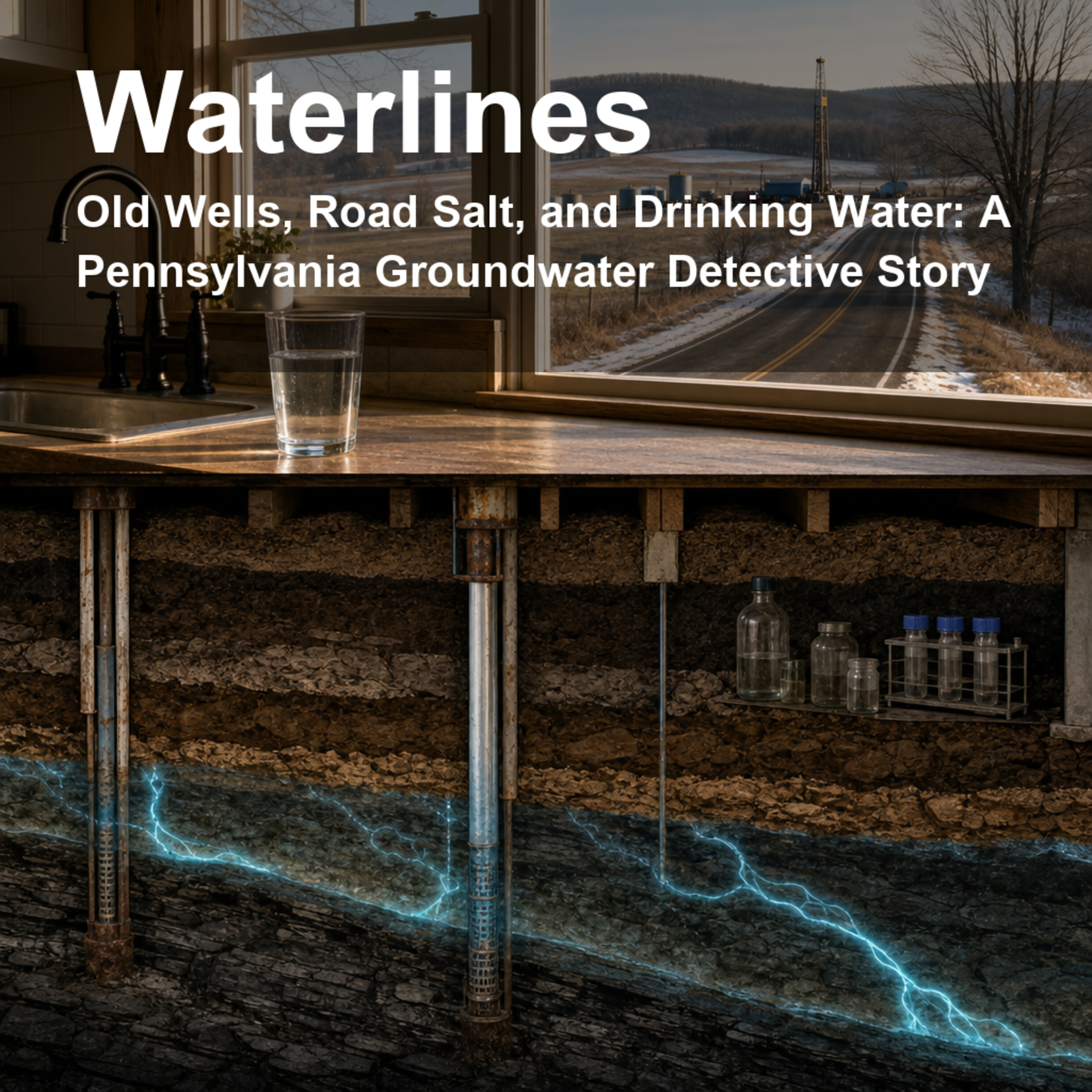
Groundwater problems rarely arrive with a label saying where they came from. For families on private wells, a change in taste, saltiness, metals, or methane can raise urgent questions: Is it nearby drilling? Old oil and gas wells? Road salt? Natural geology? This episode follows scientists trying to answer those questions in two Pennsylvania landscapes with very different energy histories. One county had intense recent shale gas development; the other had more than a century of conventional oil and gas activity, plus road de-icing and brine use. The surprise is not a simple blame story. It is a careful look at how old infrastructure, everyday winter road practices, and limited historical water data can complicate what we think we know about water quality.We unpack how researchers compared groundwater chemistry before 2000 and after 2010, why public baseline data are so valuable, and how a stronger statistical test helped them compare uneven datasets. The study found no broad groundwater degradation signal in heavily developed Bradford County, while Mercer County showed slight increases in some dissolved salts and metals. The likely suspects include legacy conventional wells, road salt, and oil-and-gas brines used on roads, not recent high-volume hydraulic fracturing alone.Citation: Wen, Tao; Agarwal, Amal; Xue, Lingzhou; Chen, Alex; Herman, Alison; Li, Zhenhui; and Brantley, Susan L. “Assessing changes in groundwater chemistry in landscapes with more than 100 years of oil and gas development.” Environmental Science: Processes & Impacts, 2019. DOI: 10.1039/C8EM00385H.Disclosure: This Waterlines episode uses AI-generated voices.
Embed this episode
NOW PLAYING
Old Wells, Road Salt, and Drinking Water: A Pennsylvania Groundwater Detective Story
No transcript for this episode yet
Similar Episodes
No similar episodes found.
Similar Podcasts
No similar podcasts found.