
EPISODE · Aug 13, 2026 · 29 MIN
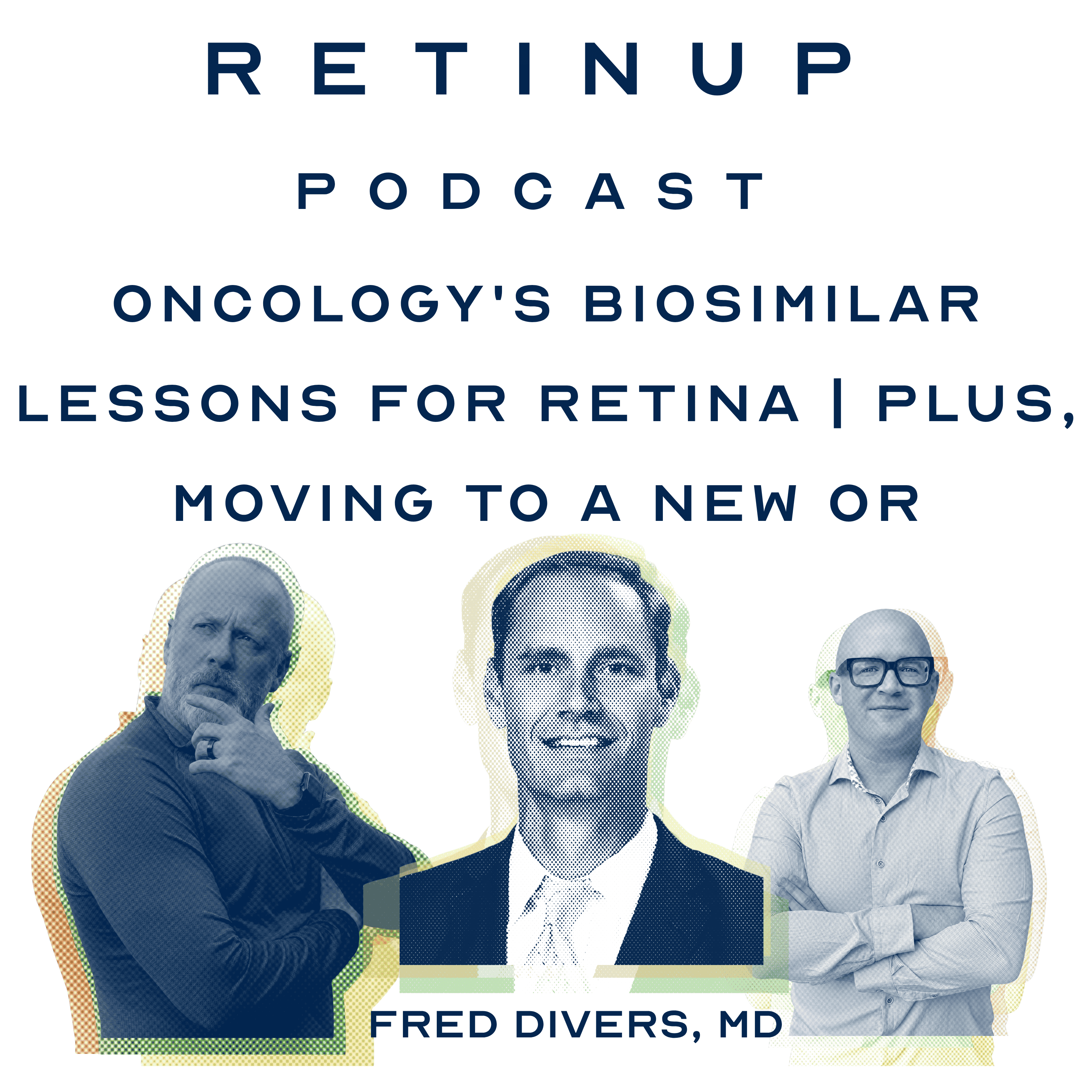
Oncology's Biosimilar Lessons for Retina | Plus, Moving to a New OR
from RetinUp Podcast
The companion piece to RetinUp’s previous episode on biosimilars is here, featuring an oncologist who has lived through biosimilar disruption for the past decade. Stephen "Fred" Divers, MD, CMO of the American Oncology Network, joins John and Scott to share what oncology has learned from nearly a decade of biosimilar use: the ASP deterioration cycle, payer formulary pressure, the race to the bottom, and what retina should do differently as its own biosimilar era accelerates.During the Vitreoretinal View segment, John discusses his fresh move to Boulder, sharing what it's like to operate in a new OR for the first time in years — new staff, new preferences to rebuild, and a new clinical reality: operating at 5,400 feet above sea level requires adjusting gas concentrations, counseling patients about altitude travel, and understanding why the vacuum on a vitrectomy machine behaves differently.Hosts: John Kitchens, MD, Scott KrzywonosTopics CoveredBiosimilars in Oncology: Lessons for Retina (Stephen "Fred" Divers, MD)History: biosimilars entered the EU in 2005, the US in 2008 under the 351(k) pathway; oncology has roughly a decade of meaningful real-world experience.The ASP deterioration cycle: when biosimilars enter the market, manufacturers offer rebates to drive prescribing behavior; those rebates fold into ASP prospectively at roughly six months, causing progressive price deflation. With each additional market entrant, competition intensifies and the race to the bottom accelerates.The life cycle: the first biosimilar offers meaningful margin; by the second or third entrant, margins erode significantly. Manufacturers may pull products, let ASP reset, then reinsert. Ironically, the originator drug can eventually offer the best margin — after cycling through multiple biosimilars.Payer formulary mandates: when payers limit formulary to a single biosimilar, practices can become underwater if that product takes a price increase before ASP catches up. Dr. Divers' approach: push back on single-product mandates and discourage manufacturers from taking price increases after securing guaranteed market share.Formulary management: keep less than 48 hours of drug on hand; constantly renegotiate contracts as new biosimilars enter; treat formulary decisions as a quarterly exercise, not an annual one.Patient experience: biosimilar transitions are largely invisible to patients from an efficacy and safety standpoint; batch-to-batch variability exists even within originator biologics, which is part of the scientific rationale for the biosimilar framework.340B context: a program originally designed for underserved clinics treating HIV patients that expanded exponentially into hospital systems, now accounting for 50–60% of drug dispensing nationally. Creates perverse incentives that complicate biosimilar adoption decisions in oncology.What retina should do differently: build operational flexibility for frequent formulary changes; don't set and forget; invest in pharmacy infrastructure; expect continuous renegotiation; and be prepared for the margin on any given biosimilar to disappear faster than anticipated.Vitreoretinal View: Operating in a New OR — and at AltitudeJohn has joined Rocky Mountain Retina Associates in Boulder, Colorado, alongside Geeta Lalwani, MD.New OR realities: starting fresh means rebuilding every case card preference — forceps, drape, glove size, block needle, prep protocol, etc. An email requesting a case card was the prompt that made John realize how much institutional knowledge travels with a surgeon invisibly.First days: stick with the familiar; introduce changes only once settled. Forceps especially — "like tennis shoes, you don't change brands that often." Alcon and Zeiss reps were on-site to support the transition.Operating at altitude (5,400 feet): SF6 gas concentration must be reduced compared to sea level use; John typically uses 28–30% SF6 at Lexington's elevation; this must be adjusted in Boulder. Patients must be counseled against travel above 7,000–9,000 feet until the bubble resolves — patients who live at altitude must plan accordingly.Vacuum performance: the Alcon Constellation cannot achieve the same vacuum at 5,400 feet as at sea level; surgeons operating at altitude should be aware of this mechanical limitation and adjust technique accordingly.Key TakeawaysBiosimilar margins are meaningful early and deteriorate fast — retina specialists should plan for continuous formulary management, not annual decisions.Payer formulary mandates to a single biosimilar are the highest-risk scenario; practices should push back and keep options open.Biosimilars are clinically safe and effective; the challenge is entirely economic and operational, not clinical.Operating in a new OR requires rebuilding institutional knowledge from scratch — and at altitude, requires recalibrating both gas concentrations and patient counseling.SponsorsRetinUp is an editorially independent podcast supported with advertising.This episode is made possible by Genentech, maker of Vabysmo (faricimab-svoa). Watch their Purple Chair Series at Vabysmo-hcp.com.Learn more about Alcon’s Unity VCS at UnityVCS.com.CreditsProduction & Marketing: Laura Brown | Business Operations: Liz Hogan🎧 Listen at RetinUp.com | Apple Podcasts | Spotify | YouTube
Embed this episode
NOW PLAYING
Oncology's Biosimilar Lessons for Retina | Plus, Moving to a New OR
No transcript for this episode yet
Similar Episodes
No similar episodes found.
Similar Podcasts
No similar podcasts found.