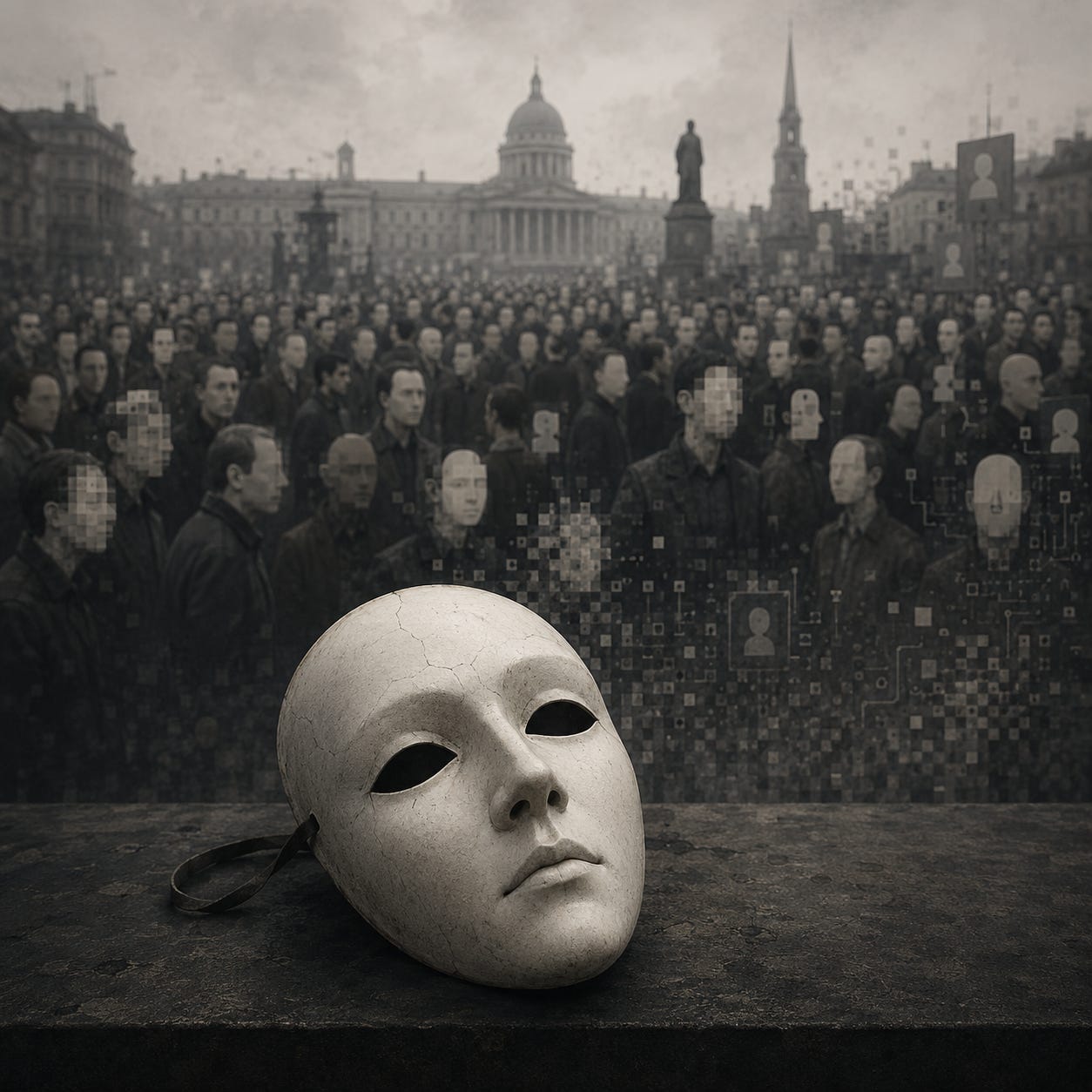
One Human, Many Masks
from Language Matters by Elias Winter Hosted by Elias Winter
A person opens his phone and sees that everyone is angry. Everyone is saying the same thing. Everyone is mocking the same target. Everyone is repeating the same accusation, the same slogan, the same moral certainty. A politician has betrayed the country. A migrant has ruined the neighborhood. A woman has lied. A product has changed lives. A war must be fought. A man must be destroyed. A company must be trusted. A nation must be hated. The screen says this is society. But who is speaking? Is it a thousand real people, each arriving independently at the same judgment? Is it one political campaign with a thousand accounts? Is it a marketing agency? A foreign government? A bored teenager? A company protecting its stock price? A bot farm? A group of paid influencers? An artificial intelligence system producing human-sounding outrage at machine speed? Is it a crowd, or only the costume of a crowd? A false claim deceives the intellect. A fake crowd deceives the social instinct. This is the quiet terror of the modern public square. We no longer know when society is speaking and when society is being simulated. That uncertainty does something to the soul. It does not merely confuse us about facts. It weakens our ability to trust our own perception of reality. We look at a comment section and wonder whether it is human. We look at a trend and wonder whether it is purchased. We look at a viral outrage and wonder whether it began in conscience or in strategy. We look at a wave of reviews, likes, replies, shares, slogans, flags, denunciations, and praise, and we ask the question no healthy society should have to ask every hour of the day: Is this the voice of the people, or is this machinery wearing the people’s face? The old internet had a promise. It was not always noble, and it was never innocent, but it contained a strange democratic grace. You could arrive without your passport. You could speak under a name you chose. You could become a handle, an avatar, a sentence, a recurring tone in a forum, a mind without a résumé. You were not always your job, your family, your class, your country, your body, your legal record, your employer, your accent, your address, your face. You could wear a mask. And the mask was not always a lie. Sometimes the mask was what allowed the truth to appear. A worker criticizing an employer may need a mask. A dissident under a regime may need a mask. An immigrant afraid of both the country he left and the country he entered may need a mask. An abuse victim may need a mask. A teenager discovering forbidden thoughts may need a mask. A person writing about addiction, sex, shame, grief, faith, betrayal, or spiritual collapse may need a mask. The mask can be cowardice, yes. But it can also be mercy. It can be the narrow doorway through which an endangered truth enters the world. The powerful rarely understand this. They often confuse exposure with virtue. They say, “If you have nothing to hide, use your real name.” But this is the language of people who have been protected by names rather than hunted through them. A name does not mean the same thing for everyone. One person’s real name is a platform. Another person’s real name is a leash. The real-name internet has always presented itself as moral hygiene. If everyone used their legal identity, we are told, there would be less cruelty, less fraud, less abuse, less chaos. There is a partial truth there. Some people become uglier when they believe they cannot be found. Some lies breed in darkness. Some threats should not be protected by pseudonyms. But the real-name solution is morally crude. It solves one problem by creating a larger one. It says: because some people abuse masks, no one should have them. It treats the whistleblower and the troll as the same kind of creature. It treats the dissident and the scammer as if both are merely hiding. It forgets that the powerful already have institutions, lawyers, security teams, public relations departments, citizenship, wealth, and distance. It is the vulnerable who need obscurity. The answer to fake people cannot be forcing all real people to become visible. That is the first principle. The second is this: anonymity is ancient, but infinite artificial multiplicity is new. Human beings have always hidden. We have signed pamphlets under false names. We have written letters anonymously. We have whispered against kings, churches, fathers, bosses, mobs, parties, and police. The hidden voice belongs to political history, religious history, literary history, and the history of survival itself. But something has changed. The mask used to belong to a person. Now the mask can be mass-produced. A single actor can manufacture thousands of apparent speakers. A company can create artificial praise. A political movement can simulate grassroots anger. A government can seed panic into another country’s public square. A scam network can flood reviews. A botnet can make fringe sentiment appear mainstream. An artificial intelligence system can generate endless comments, replies, profiles, images, biographies, confessions, jokes, prayers, accusations, and testimonies. The fake account no longer needs to sound fake. The artificial voice no longer needs to stumble. The machine can produce warmth, indignation, irony, grief, patriotism, moral certainty, consumer enthusiasm, ideological purity, and personal anecdote. It can say “as a mother,” “as a veteran,” “as an immigrant,” “as a teacher,” “as someone who used to believe the opposite.” It can borrow every costume of human credibility. The deepest fake is not a fake image or a fake quote. The deepest fake is a fake public. A fake public is more dangerous than a false statement because it does not merely tell us what to believe. It tells us what others already believe. It manufactures social reality. It surrounds the individual with an illusion of consensus. It says: everyone knows this, everyone sees this, everyone agrees, everyone is angry, everyone is laughing, everyone has moved on. And because human beings are social animals, because we are built to sense the tribe, because moral courage is exhausting and loneliness hurts, counterfeit consensus can become a form of governance. People do not only obey laws. They obey atmospheres. If the atmosphere can be manufactured, then power no longer needs to persuade each person directly. It only needs to make each person feel alone. This is the actual crisis. It is not simply that bots exist. It is that we are losing the ability to distinguish between a people and a simulation of a people. The crisis of the next internet is not only false information. It is false social reality. Imagine a city waking up to panic. Overnight, thousands of posts appear claiming that migrants have made the streets unsafe. The stories sound local. They mention neighborhoods, schools, gas stations, grocery stores, police scanners, worried mothers, old men afraid to walk at night. Some accounts have profile pictures. Some have years of ordinary posts. Some tell little stories with human details: a daughter who no longer takes the bus, a grandmother who heard shouting, a neighbor who “finally said what everyone is thinking.” A few of the posts come from real frightened residents. Some come from political operatives. Some come from newly created accounts. Some are generated by AI. Some are copied and localized across cities. Some are paid. Some are automated. Some are human beings reacting sincerely to a panic that was manufactured before it reached them. By morning, the trend is visible. By afternoon, politicians cite “public concern.” By evening, local news reports “growing outrage.” By the end of the week, a policy is proposed. The crowd has become real in its consequences, even if it was partially fake in its origin. This is how artificial posts become perceived consensus. Perceived consensus becomes media coverage. Media coverage becomes political pressure. Political pressure becomes law. The machinery creates the atmosphere, and the atmosphe… This is a public episode. If you would like to discuss this with other subscribers or get access to bonus episodes, visit eliaswinter.substack.com
Embed this episode
No transcript yet.