KPBS On Demand is supported by the Museum of Photographic Arts at the San Diego Museum of Art. Presenting Cecil Beaton's Fashionable World through January 10. Spending the 1920s through 1950s, the exhibition includes fashion photography for Vogue, portraits of Hollywood stars, and more. Accomando. Beth Accomando. And today's Cinema Junkie podcast is shaken, not stirred. Mr. Bond. Oh yes, Mr. Bond. My name's Bond. James Bond. My name is Bond. James Bond. My name's Bond. James Bond. My name's Bond. James Bond.
Now you're of this. I hope we're going to have some gratuitous sex and violence. I certainly hope so too. Do you want to play it easy? Or the hard way? Let me remove Mr. Bond's heart. There should just be enough time for him to watch his beating. Do you expect me to talk? No, Mr. Bond, I expect you to die. You look pale, Mr. Bond. I hope I didn't frighten you. I see I've always been a nervous passenger. Some men just don't like to be driven. No, some men just don't like to be taken for a ride. Welcome, please. You like cliches, don't you?
Your new BMW 750. All the usual refinements, machine guns, rockets, the GPS tracking system. Where do you hide your gold knuckles in this outfit? Oh, I never carry weapons after business arts. Yeah? So you're off duty? I'm completely defenseless. James Bond, the one who has to make love to a woman, and she starts to hear having a choir singing. She repents and immediately returns to the side of right and virtue. But not this way. Well, you can't win them all. I think you're a sexist, misogynist dinosaur. Touche. You know, this sort of behavior could qualify as sexual harassment. What's the penalty for that?
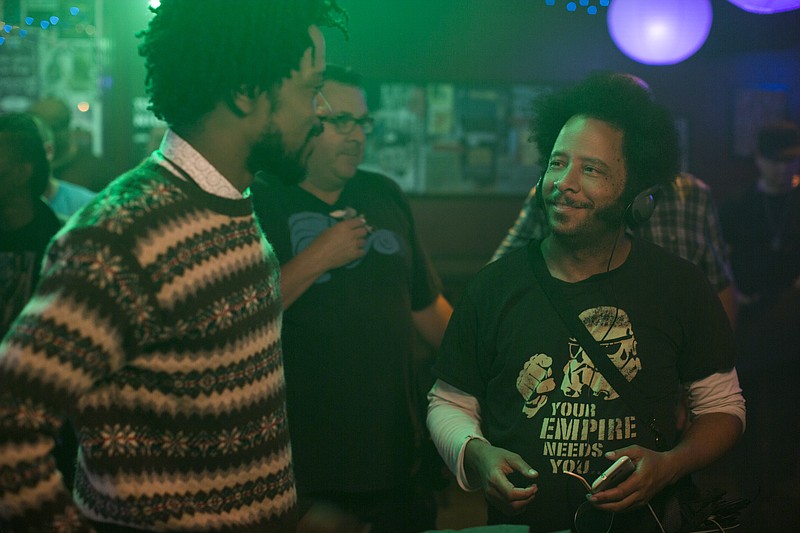
That's right. And James Bond is scheduled to come back for the 25th time in the official 007 franchise in 2019. And today, I'll be talking about all things Bond with actor Tom Stewart, who created a one-man show for the San Diego International Fringe Festival called One Man Bond, in which he takes us through all six actors and all 24 Bond films in less than 60 minutes. But before we go off on our MI6 mission, I want to highlight a film that comes out next week that has a mission of its own. Boots Riley's directorial debut, Sorry to Bother You, is about a young man named Cassius Green. And you need to hear his name said out loud. He's just trying to survive in the not-too-distant future. Sorry to Bother You may be Boots Riley's first film, but he comes to filmmaking after decades of success as a rapper, music producer, and activist organizer.
He studied filmmaking back in college, but got pulled away from film by music and in 1991 created the political activist hip-hop group, The Coop. Sorry to Bother You deals with race, capitalism, workers' rights, art, and activism. He describes it as an absurdist dark comedy with magical realism and sci-fi inspired by the world of telemarketing. Here's the trailer.
Stick to the script. Hey, hello. Um, Mr. Davidson. Cassius Green here. Sorry to bother you. Let me give you a tip. You want to make some money here? Use your white voice. My white voice? I'm not talking about Will Smith's wife. Like this young blood. Hey, Mr. Kramer, this is Langston from Regalview. As always, we'll be getting that out to you right away. You're doing so good with the voice thing. Oh, yeah!
The film announces a bold new screen talent, but one marked by assurance and maturity from decades of work mixing art and politics in music. Riley not only has something to say, but he has the artistry to say it in a fresh new style that demands attention. Although the issues he tackles in the film feel very much of the moment, he says he first started writing the screenplay back in 2011. Strangely enough, today, the economic system that we're in, which is the motor that's pushing all of the craziness that's going on in our world, was the same then. I mean, we put this movie out in 2012 or 1972, and it would have been relevant.
That Mr., which is just Mr. with seven underscores, the character that Omari Hardwick plays, he had the line in our 2014 version that got published on McSweeney's. He had the line, worry-free is making America great again. It's just a movie that has a class analysis. So that analysis allows you to understand the system works and puts all the chaos that we get from our news feed into a working framework that allows you to understand how ways that we might be able to fight things. The news and most media usually doesn't supply that class analysis.
All the events that we hear usually seem like they're just like coming out of nowhere or they're crazy. And, you know, they end up shrug their shoulders and hunch their back and walk off into the distance instead of. One thing I found interesting in your film in terms of kind of the tone and the take you have is that you don't really fault Cassius as much as you might see in other films that are kind of satiric or, you know, making political commentary. And I thought it was kind of fresh to have that take where you seem a little more sympathetic towards him than some other films tackling the same issue might be. Yeah, I think that's because.
is different though I mean because to be an organizer for some is interchangeable but you can't really say you're an organizer if you haven't done things within some of that being organizing where you people in their place of work or place of that they live to try to do things how do I get them on their team it's not my I'd be working against my ultimate goal to just try to show that person that they're wrong I read an interview with you, and I was impressed at how many kind of diverse influences you cited from music and literature and film. And I was just wondering if you could talk a little bit about the kinds of things that have influenced you as an artist. You know, I'm always searching. I mean, I even had a search. So literature, definitely, and music. I get excited about things, even the things that didn't all the way work.
but they had something that that artist was trying to do that might inspire me or, you know, give way to things like that. So, for instance, I mean, it's not the same because we're talking about Francis Ford Coppola, but I think he had a film that really didn't work in a lot of ways. I liked what he was doing with transitions and reflections in that movie. He did some things that were practical transitions that I wouldn't have the budget to be able to do certain things that were inspired by that. But one thing he does with reflection when...
Terry Garr is like working in a window. I forget what it is. It inspired something in the movie, which doesn't happen in that same way, but it got me thinking about reflections. But yeah, as an artist, I'm always striving for other things that get me excited. And that kind of comes maybe from hip hop and what we call digging in the crates, which is how many of us got our education. I also try to look for new things in life to get me inspired for that process. I went through a period, somewhat embarrassing period that people don't know about, between my second and third albums, where I say that I...
doing it stop doing music just to do this organization called the young comrades which I did but during that time I also got slightly obsessed with miniature I had this idea of all of these rooms I would make that with the loomings about the world and you know like there'd be a prison and it was collecting all the stuff going to doll places and other for wherever I could get miniature stuff and collected like half of a garage worth of stuff and then one day I was like yeah I'm gonna do this and 12 people are gonna see it I got rid of all that stuff and never really went but exploring these ideas I always try to take it Well, and the film is such a genre-bending film because you've got magical realism, you've got science fiction, you've got social commentary, you've got humor. What was kind of feeding into that? I think that's just the way I think and the way I get to happen is that I've been in art and know that there are different things you can do. You put these things out there, these emotions, these ideas, and for their whole life. And it plays and it takes on different meanings. And it's not yours anymore very quickly. I get to kidnap people for an hour and 45 minutes and make them created to make them have certain. And that's more and more.
Do you see art always being kind of wrapped up with some sort of activism? Making art. That passion guides your aesthetic in a different way that's not following or not flippant or not just putting things together to see what can happen. But my point is that you need to be passionate about something. I don't care whether it's love, sex, making the world better, whatever. And so I think that all art is connected to political ideas. Even if it's just that something that makes it seem like the world is off. Because of me, I as a human being.
the world better anything that I do because I'm trying to also be honest as an artist and put my view of the world into my art I need to do that like otherwise what people do is they they end up falling into cliche because most of what we A lot of times, the art that we tend to create is more influenced by other artists' visions of the world than really our own real life. And I always have to check myself for that. And when I'm checking myself for that, I have to decide what I really think about a situation. And what I really think about the situation is going to be connected to larger ideas about the world. And that's going to come into my artwork all the time. Well, I want to thank you very much for your time and for making this film. It was great. Thank you. Thanks so much for talking about it. That was writer-director Boots Riley, whose provocative new film, Sorry to Bother You, opens next week.
and it demands to be seen. Now to Bond, James Bond. San Diego International Fringe Festival just ended, and one of my favorites from the 11 days of eyeball-busting shows was Tom Stewart's one-man Bond. As a fan of Bond since my earliest days, I was thrilled at the 007 geekery on display in his show, as well as the impressive showmanship of taking on the entire Bond franchise in an hour. Since the franchise is at a turning point with Daniel Craig's announced departure, I thought it would be the perfect time to geek out about James Bond with someone who's just immersed himself in the entire canon of films. But first...
Let's hear how his one-man show starts. Well, this is a racist film, didn't you hear the theme song? Hold it. I'm Felix Leiter, but don't worry too much about that. It'll be a different action next time. I'm with the CIA. CIA? Finally, someone who's more racist than I am. Speaking of racism, this is Quarrel. He's a big black man with bulging eyes and big trucks of dragons. You think I'm racist? You ain't seen nothing yet. Shut up and read your racist dialogue. I don't know nothing about nothing. Actual lie!
There's something in the bedsheets. Is it Morningwood? No, it's a tarantula. Kill. Spider-wave. Soundtrack. Thanks for taking me to Crafty Alley, Quarrel. Sorry I'm late. I was just using a woman sexually before handing it out to police and shooting it on our man. Coming, Felix? Nah, we Americans just wait until the hard work's done and claim all the credit. Let's camp on the shore in full view of anyone who happens to be passing. Coming out of the sea naked, except I'm not naked, just a flesh-collar suit. I'm Honey Rider. Knife! Well, you're a castration threat. I'll have to coerce you to have sex with me so I can hold on to my fragile masculinity. Old shit would be caught. I'm Dr. No. I'm a disabled villain. It's going to be a thing.
I have metal hands and this is totally not going to be my downfall. Oh no, I'm falling down. If only I could grip. All right, honey, let's go and have sex in a dinghy before I leave you in the sea and go back to a woman who appreciates Scottish sports. Tom, you have just come off of the San Diego International Fringe Festival where you did a show, a one-man show called One Man Bond. So let me ask, where did your love for James Bond start? Do you remember the first time you saw a Bond movie? I do, yes. I mean, this is more by putting it together retrospectively. But in Britain, when I was growing up, Bond films were always shown on public holidays.
That was the tradition, and back then there was a limited number of channels, so it was real event television. I'm pretty sure it was Moonraker, because I have no memory of a Bond before certain shots and images in Moonraker, and it would have been a holiday Monday sometime. Yeah, I think it seemed incredibly, this is odd to say actually, but it seemed incredibly contemporary to me. If it was Moonraker, it could have also been View to a Kill. They seemed the most stylish pieces of anything I'd ever seen in my life. The colours, the music.
But I do remember that it was part of a really big event and it was very much gathered around the television. And yes, it seemed like a completely different world from the one I belonged to. So you started with Moonraker and you still became a fan. I'm amazed. Yes. Well, I mean, I had to say, yes, I know it's since become my least favorite Bond film by some distance. But at the time, I think I still had a sense that this was something very interesting and important. Obviously, the fact that it was such a big deal when they're on TV, I would have got the sense of that as a child. But, you know, everyone's kind of familiarity with it was very attractive to me. So, you know, different generations of my family seemed to know Bond as if they were.
you know, a close friend, which was interesting to me. So I kind of just fed into that. And without really knowing what Bond was or who it was or what the Bond films were, I very quickly adjusted to them as something that was part of British cultural life and family life. I love how you deal with Moonraker in the show, especially after hearing you talk about how Moonraker was your gateway to Bond. Now you know what? I'm not gonna summarize this one. Because this film should never have been made!
And what inspired you to turn your passion for Bond into a one-man show? A few different factors. First of all, in the past year, I set up a theatre company, Lonesome Whistle Productions, that was devoted to developing innovative forms of solo theatre. So that's where the one-man part of it came from. Beyond that, I was very interested in adding to the kinds of theatrical works that condense great canons of culture into a small amount of stage time. So thinking in terms of the reduced Shakespeare company or a more kind of...
a more kind of pop culture version would be the One Man Star Wars trilogy, which was a big hit at the Edinburgh Finch Festival some years ago and I actually saw it at the time. To sort of take that to another level by doing it with the Bond films, which is sort of to assert that the Bond films are a significant contribution to world culture as Shakespeare or Dickens. But also to say that there's a precedent for this kind of theatre and to do it with 24 films rather than, say, a trilogy seemed like a really great challenge to me to do. And the other element was really thinking of how do you bring film and film language onto the stage and thinking of... ways it's been done before through things like Mystery Science Theatre 2000 and riff tracks and to sort of, you know, try and find a way to do a live commentary on a film on stage. And so all those things kind of coagulated into the show that...
that i did all right so in tackling this what was your approach did you kind of like write jot down little notes from each of the films did you go back and re-watch the whole canon how was what was this process like the process was um i i first of all the bond films are kind of lodged in my memory certain images lines and i find myself going back to the films really just to kind of check that my memory was correct and this was kind of interesting because there were things which i thought i'd imagined happening in the films which of course when i went back to the film Yes, they did happen. And, you know, outrageous pieces of sexism and racism and just general prejudice, really, that I thought couldn't possibly be there in a film from 1984 or even into the 2000s and to find that they were absolutely there. But then watching the films back, you know, I would see things that I'd never observed before. And it was about finding a way to kind of bring unity to these films and see what are the major themes of the series? Because, of course, one of the unique and wonderful things about the Bond films is that...
Unlike many other major film franchises, they lack continuity. You know, they really do draw a line in the sand at the end of every film. I mean, there's a couple of exceptions to that, but pretty much that goes for all of them. They just stop. It's like a reset clock every time. And so in adapting all the films into one hour, I had to get some sense of continuity between them. And that was mainly kind of thematic. Then you sort of think, well, you know, try and treat this as one.
story with a through line and what does that look like there's obviously comic potential in that because they're not consistent from film to film and the backstory changes all the time so yeah it was it was very much it was that and also i think it really started off with a alternative screenplay as if the bond films were all one film and i had to sort of transcribe the screenplay in a way that would play as one hour of stage time so that meant kind of how would you describe the scene in written form and then finding a way to theatricalize it so it was a very it was a very fluid process in in that sense but uh it was it was interesting because you get a very different perspective on the films. Now, you mentioned going back to these films and finding sexism and racism and things like this. We're at a weird point I found in fandom where, you know, you have the Star Wars fans demanding that Last Jedi be removed from the canon and raising money to try and remake it and things like that where there's this kind of weird bent on fandom right now. But as a fan of Bond, and I'm a huge fan of Bond, I grew up on them from, you know, my parents took me to see them when they came out in the theater originally when I was a young kid. But so how do you reconcile those things? Because obviously you're still a fan, going back and realizing that James Bond was sexist.
Doesn't necessarily ruin the films for you. My sister can't watch them. Like she, you know, she's a feminist and she's just like, oh, you know, these things are horrible. But for you, how do you reconcile this? And can you still love the Bond films, even if they have those elements in them?
Yeah, I mean, you can't do to it what you do with a lot of great works of culture that have problematic representations in them because it's really not that long ago. And then some of the most egregious examples of problematic representations happen in films that are actually quite recent in the canon. I think Skyfall is one of the most abominably sexist films ever made. So you can't really use the historical excuse for it. You have to give a lot of the films the benefit of the doubt in terms of what they're trying to do and eventually failing. It's a series that kind of wants to pay tribute to.
changing attitudes in society. And you see that very clearly with the representation of women as the film goes on and race. But it also wants to do justice to a formula that everyone is comfortable with and very much demands from these films, perhaps more than any other film series that I can think of. They want certain things to happen in a Bond film. That requires politically being very, very retrograde sometimes.
A lot of the, when you watch, you know, there's kind of key films like Man with a Golden Gun or Golden Eye, where you can see the film is trying to talk about feminism, changes in political attitudes, but it also has a kind of commercial acknowledgement that there needs to be some sort of suspension of disbelief. That doesn't kind of resolve things. It doesn't make them easier to watch or it doesn't excuse them. But it really is a dialogue that's going on. It's like, how do we take this character who...
is really, even from the early 60s onwards, something of a dinosaur in terms of their political attitudes. And how do we introduce him into this modern world every time? And that's one of the pleasures of the series. And sometimes it's very self-conscious. Sometimes it happens accidentally because they're trying to address contemporary issues and failing. It's definitely something that works. And I think if you go back to the roots of the film series in the Ian Fleming literary canon, he never wanted you to like James Bond. This is something that the films have kind of...
have kind of drawn out of him the idea of a hero. He really wasn't a hero and necessarily a likable character. And I think when certain actors have drawn on that fact, there's no particular reason that you see that what Bond does and how he interacts with the world is necessarily a template for how we should all act in a society. And in fact, it's often the opposite of that. If you're adding kind of a heroism to what Bond does, that might say more about you as an audience member than it does about the film itself. He really is this kind of blank canvas. And we don't know what his politics are. We just know that he makes some dubious moral choices. And I think that was...
occasionally the Bond films are more complex than we give them credit for in that sense. But which is all my way of kind of hedging around the fact that they are politically very difficult films. And I think it's interesting to sort of see where we go with that. And we think about it in terms of sexism and racism. But the series is also whenever it's kind of expressed explicit ideological beliefs.
It's even more difficult. I mean, you know, there's a Bond film from the late 80s, Living Daylight, Timothy Dalton's first film, where Bond is sort of an honorary member of the Mujahideen, which is a sort of... I mean, some other Hollywood films did it at the time because the US was on the side of Afghanistan against the Russians. But nonetheless, you know, that really is backing the wrong horse politically. What the hell are you up to, Cameron? Selling dope? Not so loud. That's the chief of the Snow Leopard Brotherhood. Who? He's the biggest opium dealer in the Golden Crescent. I've worked for them from time to time. I couldn't care less if the Russians died for my bullets or their opium.
Besides, we need the money to buy arms. I think it's a very complicated thing, and you have to look at them in context, but at the same time... You don't absolve them for being particularly egregious. And you also, you know, it's not a historical question because some of the more recent Bond films have been the worst in terms of the political mistakes they've made. One of the appeals for me is that even though there was sexism involved and that some of the female characters are kind of, you know, degraded, but the lead girls, lead women, they were always called Bond girls. They were really called Bond women. But when I was growing up, they were called Bond girls, even though they were adults and all. But characters like Pussy Galore, she might have a porn star name and all that, but...
You don't remember her being, like, a submissive character or a character. Like, she gets to kick James Bond's butt. And, like, to me, her character was so much more interesting than women or actresses who were being presented more as these kind of role models. Because back in the 60s, like, Doris Day was supposed to be this career woman who was on her own. She bored me to death. And I couldn't see her. But Pussy Galore, I'm going like, wait a minute. She runs her own airline with all these women. She ends up making this moral decision to cross the guy she's been working for. And she does end up, you know.
flipping James Bond in a fight and all that, I'm going like, I don't exactly see what's wrong with that. You put your finger on a very important point, which is the quality of the stars involved in the films to transcend the material they're given in the script. And that's true across the board, really. I mean, the example you give with Pussy Galore, and that's a lot to do with Anna Blackman's performance. Who are you? My name is Pussy Galore. I must be dreaming. I thought I'd wake up dead. Tranquilise again. No culture. I see. Well, I'm delighted to be here.
Can I do something for you, Mr. Bond? Just a drink. A martini. Shaken, not stirred. Won't you join me? Not on duty. I'm Mr. Goldfinger's personal pilot. You are? And just how personal is that? I'm a damn good pilot. Period. Well, that's good news. By the way, where is our host? He flew on ahead. This should be a memorable flight.
You can turn off the charm. I'm immune. On Her Majesty's Secret Service, Diana Rigg has a, you know, she's not, in terms of script, she's not really treated differently than many of the Bond girls or Bond women. But there is something about her which transcends that and seems incredibly strong, no matter how much the script wants her to submit to Bond, even to the point of marrying him.
And, you know, that goes with a lot of the, you know, a lot of the villains as well, who, you know, are often kind of terrible racial caricatures. Yafet Koto in Live and Let Die is written in a way that's, you know, almost worse than Ian Fleming's original version of the Mr. Big character, which is one of the most hideously racist representations in literature. And yet because of, you know, because of Yafet Koto, who is one of the, you know, one of the suavest and most powerful charismatic character actors I could possibly think of. Kananga, poppy grower in thousands of acres of well-camouflaged fields protected by the voodoo threat of Baron Zandy.
And as Mr. Big, distributor and wholesaler through a chain of filial sole restaurants. Wholesale? Sell heroin for money? My apologies, I'm sure you simply give it away. Excellent, Mr. Potter. That's precisely what I intend to do. Two tons of it, to be exact. When entering into a fairly competitive field, one finds it advisable to give away free samples. Man or woman, black or white, I don't discriminate. Two tons of heroin with a street value well over a billion dollars. Nationally distributed free. That should make a certain group of families rather angry, wouldn't you say?
You remember him as this really... elegant Bond villain who's kind of nailed the characterization and you don't think about how he's written, you think about how he's played. And I think that's really helped across the years. All right, so you brought up On Her Majesty's Secret Service, which is, for Bond fans, a really interesting film. This was the film Sean Connery had decided not to return. They put this Australian actor, George Lazenby, in the role. You mentioned Diana Rigg, who is probably one of the top Bond girls. Her and Honor Blackman are just the cream of the crop. So you've got this film, On Her Majesty's Secret Service, which...
I play these games where, you know, you go like, oh, if you could go back in time, what would you do? And people have these, you know, things where like, oh, you know, I'd stop this horrible thing from happening. I'm like, no, there's only two things that I want to do. I want Sean Connery in On Her Majesty's Secret Service and I want the sequel to Buckaroo Bonsai. Like, those are the two things I would fix in the universe, as shallow as that may be. But what are your feelings about On Her Majesty's Secret Service? Because on a certain level, it's one of the best Bond films in terms of kind of its construction and it's got Diana Rigg, but it has, some people love George Lazenby, more people kind of have issues with him. So what's your take on this one?
It is my, I think it is the best Bond film. It's certainly my favorite Bond film. I've heard this before. Most people say, well, what if Sean Connery did Honor of Majesty's Secret Service? My view is, what if George Lazenby had done Diamonds Are Forever?
That's the kind of alternative Bond history that I'm interested in pursuing. Yeah, I mean, Lazenby was the wrong choice in so many ways, primarily because he wasn't an actor. I mean, that's number one. It's got to be number one on your list. He was a model who kind of finagled his way into the role by lying to the Bond producers about his acting background. And they kind of, they felt that that was enough because he'd lied to them and got away with it. They thought that that gave him an acting resume, which is a really interesting form of casting. And I don't want to discount that because they were definitely onto something. And they sort of tested him in a very perverse way where they brought stunt.
actors to his hotel room to to fight him to see if he could you know so it was it was a really experimental way to cast a bond and while while it ended up with an actor whose naivety was kind of there for all to see on screen and especially vocally he couldn't really handle the role and he had to be he had to be dubbed with his own voice and also the voice of British character actor George Baker at one point which is actually part of they turn that into part of the plot because he's pretending to be a he's in disguise as a character who we know is played by George Baker but so there are some actual interesting consequences to George Lazenby not being an actor and and they managed to work with that of course the biggest challenge is that this is the most emotionally demanding role for a Bond to play and you know there are points in the movie where you think he's not living up to that And then the final scene of the movie where, spoiler alert, I mean, decades old, there's got to be an embargo on that by now, where his wife of, well, let's say two minutes of screen time is killed. But darling, now we have all the time in the world. He's got a point we do look like it had for a flower shop. And that reminds me, I didn't even send you flowers. Anyway, you have given me a wedding present. The best I could have. The future. Mrs. Bond, shut up. And don't eat it all at once. He loves me. Instinctively.
Infuriatingly. Intensely. In... In... In... In? Incubitably. First a boy, and then a girl. It's Blofeld!
Blofeld. The final scene is him left with her corpse and he's kind of in a traumatised, grieving state and he's trying to explain to a highway patrol officer what's happened. And this is one of the very, I mean, must be one of the only points in the Bond film series where they quote directly from the books. It's verbatim how the end of Ian Fleming's On Her Majesty's Secret Service, which was something that Lazenby had read and was moved by. And he delivers that scene as well as I think any actor could. He absolutely nails.
the emotion in that scene. Because he really felt it. He read the book and he cried and he understood what was going on. It's all right. It's quite all right, really. She's having a rest. We'll be coming on soon. There's no hurry, is there? We have all the time in the world.
And I think he had life experience of similar grievances. So in the end, you know, when you get to the end of Honor and Majesty's Secret Service, George Lazenby's figured out how to act. So I would have loved to have seen what he did in Ground Himself Forever because I think if he'd have stayed in the role, they would have made it something of a sequel. Or at least they would have certainly referred to the fact that he was a widow and they would have made that part of the movie. The way it turns out in the Connery continuation, they just sort of forget about it and you can remember it if you want, but if you don't want to, it doesn't cost you anything in terms of the film.
But more broadly, in terms of Honor Majesty's Secret Service, I think it is almost a cliche to say it's your favorite Bond film because it's most unlike anything else in the Bond canon. But the undeniable quality of the cast, of the script, of the action sequences, the fact that, you know, you... You have a desire not only to build the depth of the characters, the complexity of the drama in the film, but also that you actually want to do something slightly experimental and artistic with the form. One of the cliches of the Bond film style is that this kind of nod and wink to the audience, that we refer to everything that we're doing. We tell the audience what's going on. We share a joke with them. Well, they do that on Her Majesty's Secret Service on a whole nother level to almost where the point it's like a John Luke Goddard film. It's self-reflexive in the way that it deals with film style and film art. And to do that...
In the late 60s, on the back of the Connery films, I mean, it's not only brave, it's ridiculous. And it didn't pay off. It wasn't very successful, and Lazenby immediately left the series, although he was contracted to do at least another four Bond films. And yet it also works as a Bond film. One of the great criticisms of License to Kill, which was Timothy Dalton's last Bond film, was that it's a very serviceable late 80s thriller. But it's not a Bond film. But Honor, Majesty's Service still pays tribute to the formula while doing something amazingly different with it. And in many regards, whether it's the score...
The Bond girls, the villains, the supporting characters are some of the best you'll find in the series. But it really is trying to do something different. I mean, all the Bond films say that, and they invariably don't manage to do it. Every Bond film goes, we're going to do something different this time, and they very rarely do. But Honor Majesty's Secret Service means it.
And every time I go back to it, I have exactly the same feelings. It's like, I don't want this to be the best Bond film because that kind of cheats all the other Bond films. But it really doesn't. The quality is undeniable. And by the end of the film, whatever problems you have with George Lazenby, for me, are a result. You know, you're watching someone on screen become an actor. Not just become Bond, but actually become someone who could go on to be a professional actor if he didn't then decide to leave the role.
Well, it's funny because I grew up with Sean Connery as James Bond, and I was in love with James Bond. And when he left the series, I was so angry about George Lazenby taking over the role. And my initial reaction to that was just like, I hated him. I loved Diana Rigg, but I hated him in the role. And it seriously took me decades to return to that film and see it kind of with some objectivity. And I had the chance to see the film at the TCM Film Festival a few years ago, where George Lazenby was there. And he talked about the whole getting the role in casting. And the one thing he pointed out, which kind of made something click for me, is he said,
He thinks the real reason they cast him was because he wasn't afraid to step into Sean Connery's shoes. He said, I'm a cocky bastard and I don't care what anybody thinks and I don't care if I do a terrible job. I don't care about even being an actor. But he said that that kind of an attitude was something that they didn't want somebody who was terrified to step into the role or trying to imitate Sean or something like that. And when he pointed that out and I watched the film again, it's like I was going, you know, I will have to say he tries to own it.
own the role himself. He doesn't try to be Sean Connery. He doesn't seem timid about just taking it on. And I have to say, I have warmed up to the film in a broader sense beyond just Diana Rigg. Yeah, and it's interesting you say that because I'm sure, I can't imagine that the producer Saltzman and Broccoli would have gone into the venture without thinking that he could handle the role and that he would go in with confidence and that people would buy he was Bond. But what really comes across in his performance, and yeah, it might be a byproduct of his naivety as an actor, is that he brought vulnerability to the role. And this was something that we hadn't seen.
really at all with Sean Connery. And it's something that's a characteristic to the more modern Bond films is that Bond has some, you know, he's fragile in a way we didn't see before. And there was a little bit of that in the early Connerys, but by the time he got to You Only Live Twice and he's not as interested in playing the role anymore, he's kind of coasting a little bit. He's really kind of playing it more for laughs. Lazenby is kind of interesting in the sense that he seems to be more of a prototype for the Daltons and the Craigs who have, you know, they're slightly more unsure of themselves, which is closer to the way Fleming...
envisioned the character originally than what Connery did. I think all the Bond actors have really kind of just wandered into the role, which is something that you don't see often when actors take over these iconic roles. I mean, you know, when Roger Moore took over with Live and Let Die, certainly the script is still written in that kind of Connery mould and, you know, he's doing things that don't really suit his portrayal of the role. But in terms of how he's playing it, he really does look like he's been playing the character for years. Black Queen on the Red King. Miss.
Solitaire. My name's Bond. James Bond. I know who you are, what you are, and why you have come. You have made a mistake. You will not succeed.
Rather a sweeping statement considering we've never met. There's only been six Bonds, but none of them look particularly nervous when they take over the role, which is hard to understand given how much history there is there and the legacy of it. And I think that's a credit to the producers in finding these actors who don't seem to have this problem with what they're stepping into. And that would be a huge part of the way that you would cast the part. Well, and Roger Moore came off of The Saint and The Persuaders. And so, I mean, he had a history of playing kind of these iconic roles. So it was almost like, all right, I'll just shift, you know. And he wasn't...
No offense to him, but I mean, he was kind of the most cartoonish of the Bonds on a certain level. And so, I mean, he was kind of playing himself in all those series and that. And he just kind of like slid into it and it's like, all right, give a little tweak and I'm Bond. Right. Yeah, it did feel that way. He was Fleming's pick for the role, even back when the series started in 62. Ian Fleming apparently picked him as his idea of what Bond was. And that's another interesting part of the Bond series is there's only ever been a very small pool of actors who've ever been considered for the role. Timothy Dalton was considered to take over when Moore did.
Moore was considered to start the series. Pierce Brosnan could have easily taken the role when Dalton did. So up until Daniel Craig, really, there's only been a handful of actors who can play it. And I think that speaks to a kind of an intimacy, an almost kind of Bond family, which sets it apart from other big franchises, which make effort to find the biggest star possible to fit into a certain role. And, you know, we want this actor to kind of bring something to the Bond.
Up until Daniel Craig, the options were very limited. I think that helps with the transition from Bond to Bond. You're not really surprised. And in the mid-'80s, it could have gone to Pierce Brosnan or it could have gone to Timothy Dalton. In fact, Pierce Brosnan basically started playing Bond and it was only a contract dispute with Remington Steele that dragged him back. And Dalton, who was the original choice but then stepped aside, came back into the role. So it's a very, I would use the word incestuous, franchise. But compared to, given how big it is and how world-beating a film series it is.
It really is something that has a real intimacy about it. Now, you mentioned Timothy Dalton. I love Timothy Dalton. And I enjoy his performance because you mentioned this vulnerability. He seemed to be this kind of a little bit more emotional Bond. But I feel so bad for him because he got saddled with the worst Bond movies as a whole. The films just didn't seem to work that well. And I felt like if he'd been given a real shot, I think he could have been a great Bond and been in films that were really good. But the two films he was in just seemed to be the worst crafted ones. It's funny. In doing the show at the Fringe Festival...
The love for Timothy Dalton radiates to the room. As soon as I mentioned his name, I had two whoops in different audiences for his name. And this is something that I've seen since Daniel Craig took over the part from people who were admirers of Timothy Dalton when he was actually making the films and saw in him a really excellent kind of studied portrayal of Bond as a character. To then see Daniel Craig get all the kudos for doing that, critically. People who saw Dalton thought, well, what's the big deal? Timothy Dalton was doing this 20 years ago.
Over 20 years ago. I know Simon Pegg and Nick Frost, when they were making Hot Fuzz, which starts Timothy Dalton, they said exactly the same thing during the publicity. They were asked, why bring back... you know, Timothy Dalton. And it was when Daniel Craig's first Bond films were coming out and they said, well, because he did Daniel Craig before Daniel Craig. You know, he did all the same things and audiences weren't ready for it. Roger Moore had been doing the role for over a decade. I mean, that's also very important to point out. I mean, it's like following Tom Baker in Doctor Who very much in terms of longevity. There's more than one generation for whom Roger Moore is their only Bond. And so he had that to deal with. He also had a huge...
changing the direction of the tone of the films that he had to manage. And this is a lot for one man to do. And I think he did it brilliantly. And people are seeing that now going back to it. His films are played down. Living Daylights is played down because, as I mentioned before, he's allied to the Taliban. So it's not a film that people want to be reminded of too much. And License to Kill was seen as a failed experiment in changing the Bond formula. So he's kind of saddled with a lot of things that, as an actor, in terms of what he was doing, he got the blame for things that were nothing to do with his performance.
When you look at it in retrospect, you see that he completely, he fundamentally altered the way that Bond films have been since. Because in every, you know, throughout the Brosnan era and throughout Daniel Craig's era, it's been kind of, it's become a new convention of the Bond films, that there are some emotional consequences for Bond within the frame of the film. And that wasn't something that was necessary before Timothy Dalton. But his legacy, I think, really is that... Bond has to be something of a character. There has to be some complexity. It has to go through some kind of emotional crisis within the frame of the film. I mean, even in Die Another Day, which is one of the most absurd, comicalized Bond films, there's an opening sequence in which Bond is tortured. And I think that's the legacy of Timothy Dalton and the idea that, yes, Bond works as a serious character with layers and depths, and we have to pay some kind of tribute to that in each of the films, in small or large amounts.
Timothy Dalton opted not to return to the series. I know they wanted him to come back with GoldenEye. And that's another kind of alternate Bond film history of if Timothy Dalton decided to do one more Bond film, it would have been GoldenEye. I mean, a lot of the emotional dilemmas in GoldenEye, you sort of watch. And I think Pierce Brosnan's, I think, one of the best leading men I can think of. But there are certain scenes where you think, well, I'd like to see Timothy Dalton have a go at that beach scene where, you know, Bond's pouring over, you know, he's pouring over how he's been portrayed and thinking about his dead parents and things like that.
So, yeah, I think he's more present than we might remember. And there is a lot of love for him, either from people who felt he wasn't given the best chance when he first came out, or people who have sort of seen that he laid the groundwork for the kind of Bond films that Daniel Craig does now, that they're not possible without him. We brought up Daniel Craig. I remember when he got cast, there was such an upheaval in the Bond fandom. He's blonde, as if that were something that would absolutely prevent you from playing the role. He's short. He's the shortest Bond we've ever had. There was a lot of negativity before the film came out. But I have to give credit to the franchise because that reboot, because it essentially kind of relaunched the character in a new way. Casino Royale is probably one of my top three.
Bond films and I just love the way they re-energized it and it just felt so good to see if like Bond is back and you really kind of felt like yes he is your file shows no kills Bond but to become a double O it takes two how did you die your contact not well you needn't worry the second is yes considerably the man was his chief private banker to the world's terrorists which would explain how he could set up a high stakes poker game at Casino Royale Montenegro If he loses this game, he'll have nowhere to run. You're the best player in the service. The Treasury has agreed to stake you in the game. But if you lose, our government will have directly financed terrorism. I will be keeping my eye on our government's money. And off your perfectly formed house.
The fan response was absolutely ludicrous. If you go back to 1962 and the things that people were saying about Sean Connery, how he couldn't be the Bond of the Fleming series. He was too working class. He was too burly. He was Scottish. Yeah, exactly. He was Scottish. And then you flash forward to a few years later and Ian Fleming's changing the nationality of the character because the idea of Bond is now inseparable from Sean Connery. And I think Daniel Craig's pulled off a very similar feat, really, in kind of embedding himself into the Bond character.
I think crucial to that reboot, and it was really the first time that the Bond films had done a chronological reboot in the way that we're familiar with now, you know, that up until that point, it was sort of accepted, although it didn't make any sense in terms of, you know, physical time, that Bond was sort of the same character and carried over whatever experiences he'd had from previous films. This was very much, this is Bond's first mission. It was contemporary with Batman Begins and a bunch of films that were trying to do the same thing, taking the character back to their origin story. In literary terms, Casino Royale was the origin story, and it was the perfect choice of source material. But the director, Martin Campbell, who had also relaunched the series in Goldeneye 10 years before, I think he needs to be given amazing credit. He's twice taken the series from oblivion, whether it be artistic oblivion or just, you know.
No one wants to see these films anymore. So how do we make it happen? In two completely different ways with Casino Royale and Goldeneye, which are not similar in any ways you can think of. Yeah, and they kind of introduced the idea of Bond as a blank canvas that we would gradually put experiences and emotions onto. Daniel Craig really embodied the idea of this is a clean slate.
Whatever happens to Bond in these films, that's what he will become. He has no kind of essential personality, which again is riffing off what other kinds of films at the time, the Bourne series, or even in television with 24, similar kinds of ideas of how you shape a character from a kind of empty mould almost. I think it did a terrific job, and it's really interesting how little things have changed from the Connery era in terms of the process of... behind-the-scenes issues that Craig is going through now with his disillusionment with the series, which he's been very public about. He's creeping into his fifth film now, which will kind of put him on a par with Connery and Yon Lee twice, and that'll probably be his last film as Bond as well. And he's starting to kind of do the same things where he's becoming more relaxed in his performance style, and he's starting to coast a little bit in the last couple of films. So it's really interesting how little things change.
there's remarkable consistency in the way these films have been produced, you know, decades of film history and yet they're still making Bond films the same way that they always did and the actors are still sort of doing the same thing. And in the show, I mean, I make fun of him perhaps more than any other Bond actors for being, you know, being kind of rough and tumble and a stroppy teenager. That is a kind of caricature. I had tremendous respect to him as a character actor and his approach to the role. I mean, there's points at the beginning of Casino Royale where you're watching and you think, wow, this is really going to be something different.
And it's when he runs out of ammunition during an action sequence and he throws his gun at the person he's fighting. That and then, of course, the famous example of the martini, you know, do I look like I care when he's asked how he wants his martini prepared. There is something very bullish about that. I mean, it does go back to Dr. No and how Connery played that in the film. And there are certain moments where there really is the script writers give him things to do that say you really don't know who Bond is. In Dr. No, he shoots an unarmed man repeatedly for no other reason than it seems statistic satisfaction.
And you sort of wonder, who is this character? What's his moral code? And I think Daniel Craig's reintroduced that idea as everything we're familiar with has been stripped away. And one of the other big controversies, if you can call it that, at least in fan terms, was the lack of gadgets, the absence of Q from at least the first two Daniel Craig Bond films, Moneypenny. So there really was a sense of stripping away. And one of my favorite sequences in Casino Royale is when...
he's trying to resuscitate himself using a hospital which is inside a car. And I think it's like, well, this is pretty low-tech. We're getting to really low-tech, and anyone can come by and figure out, oh, you plug this lead back into his heart, and he'll be resuscitated. And that's a different level from the invisible car. But it's almost a reaction to that in some senses. But the other thing to say about Casino Royale, which, again, has nothing really to do with Daniel Craig, a little bit to do with Mark Campbell, but also the screenwriters, an hour of screen time.
is devoted to a card game and that that's one of the i think it's one of the bravest choices in popular cinema that i can think of with this jet exchange we enter the final phase of the game which means no more binds the big blind is now one million dollars they really make an attempt so we're going to adapt this book which is really one set piece you know an extended card game Five million. All in. Bet is six million. Race. Race. Twelve million. Head up.
And they do complete justice to that and introduce suspense into the Bond films, which is something that never even... Suspense and dead time and all these things that seem antithetical to the Bond films. And not only do they work, it's one of the most satisfying set pieces in any Bond film and there's no plane straddling or no underwater sequences or anything elaborate. It really is just people sat around a table playing cards for at least an hour of screen time devoted to that. And so there are a lot of very, very brave choices in that film, a lot of which pay off. And I think that sort of explains why...
The other films in the Daniel Craig series have not really been able to kind of live up to that, especially Quantum of Solace coming straight off. I mean, there were problems with that film anyway, but coming off Casino Royale and what it had to follow conceptually, it's almost impossible to match up to people's expectations of that. And you gave it, you ribbed it quite a bit in your show. The end of Casino Royale. James Bond will return in... What's it called again? Whiznows of Solitude. Quantum of Solace.
Yeah, which is, I don't actually, you know, I think it's, again, you know, you go back to License to Kill, it's a perfectly serviceable thriller, but not really a Bond film. Casino Royale was not the first film Judi Dench was in, but I think it was the first film where, like, you really found her memorable as M, and she has been a wonderful addition, I think, to the series. Yes, she really is. Now, I have to be very clear, I'm not a big fan of Judi Dench in her other endeavors as an actress, and yet I think she's a great M. When she started out in Golden Eye, they were very specific about her being a kind of feminist antagonist to Bond. Point taken.
Even with your cavalier attitude towards life. And it was necessary, but, you know... That didn't really play to her strengths as an actor, I think, to make her a political issue, which she effectively was, certainly in GoldenEye. Although her scenes in GoldenEye are really excellent. But once she's kind of relieved of that, and as the Brosnan film works through, she kind of cools towards him, and you get the sense that they're starting to have the original relationship of M and Bond, which I think Fleming always imagined as a kind of surrogate parent, especially because in Bond's origin story, he's orphaned and adopted.
And that's been brought back in recent Bond films. But yeah, once she gets into Casino Royale, it's her first scene, I think, in Casino Royale. She says almost exactly the opposite dialogue that she says in her first scene in GoldenEye. So there's a sense that M has been reset to something. that it always was you know what and again this goes back to like political sometimes the problems you have with the film politically are actually quite good for your film for your actual film pleasure because she comes she comes straight into the film and she you know she said i miss the cold war and you know you spies you to have the decency to defect which are just great lines of dialogue anyway but philosophically it marks her out as as someone who belongs to that old order of the secret service which was the which was always the original idea for m that he represented the old guard and and she She completely embodies that. And she's kind of skeptical of this new young agent and his maverick ways. And that's the original relationship between Bernard Lee and Sean Connery. And interviews with Judi Dench, she has said that she hears the voice of Bernard Lee in her head when she plays M. Bernard Lee playing M up until Moonraker. So through three James Bond actors. And I think that's wonderful. And that really speaks to the sense that she does have this. She understands the tradition of the role. I mean, she was originally brought in to break that tradition and shatter it. And she did a very good job of that. But I think the reason they've kept her around.
that they kept her around because she's been flexible, you know, she's been flexible and she understands the tradition of the role and she understands that this is a great character actor part if you play it the right way and the right way is to play it like Bernard Lee originally played it, which is not to take anything away from the actors who played it since, but it's just, you know, it's just character actor logic that there's one good way to play this role. Bond, this may be too much for a blunt instrument to understand, but arrogance and self-awareness seldom go hand in hand. So you want me to be half monk, half hitman? Any thug can kill. I want you to take your ego out of the equation and to judge the situation dispassionately. I have to know I can trust you and that you know who to trust. And since I don't know that, I need you out of my sight. Go and stick your head in the sand somewhere and think about your future. Because these bastards want your head. And I'm seriously considering feeding you to them. And I think she absolutely nails it. I mean, I think Skyfall is sort of interesting in that...
It's kind of giving into the cult of Judi Dench a little too much for my liking. And, you know, they let her read a poem. And I sort of think, well, you know, like, are we just saying goodbye to a, you know, beloved character actor? Or, you know, is this really necessary, you know, to add another 10 minutes of the film to say goodbye to Judi Dench? But, I mean, she played the role as long as Bernard Lee did, perhaps even in longer. I'm not sure of the actual timeline, but certainly they matched each other. So it's very...
Very, very significant part of the canon. Of course, you know, the first thing that happens to Spectre is she comes back from the dead, which is just, which just says, you know, and it makes it very hard for Ralph Fiennes to sort of put his individuality on the role, even though that is supposed to be returned to a more traditional M in some senses, in the sense that he's male and he smokes a pipe. But she, I really think she was the one who carried on the spirit of Bernard Lee. And I do want to talk about Q a little bit. Q is such...
a fun character. He's always, poor Q, his work with all the gadgets is never respected by Bond. And he went through, I think he went through more films than any other actor in the Bond series. He must have done. And by the end, he actually got to go out into the field and was quite charming in an unexpected way. But Desmond Llewellyn was the actor. What are your feelings about Q?
Well, I mean, it's one of those great filmmaking legends of, you know, an actor who's brought in essentially to do a bit part and ends up staying for decades and becomes the most essential part of the franchise. I mean, I'm trying to think of other examples of this. There's Paulie and the Sopranos who has a similar kind of trajectory. But really, I mean, that is this greatest example. You know, in the original books, there was no Q character. It was just Q branch. It was an entity. And the film's kind of started with that in mind. He doesn't appear until From Russia With Love. And when he does, he's got a...
he's just a kind of incidental character called Major Boothroyd, and he's just the person who brings Bond his equipment from Q Branch. So he's just a kind of a delivery mechanism, really. An ordinary black leather case with 20 rounds of ammunition here and here. Now, if you take the top off, you'll find the ammunition inside. And the side here, flat throwing knife. Press that button there, and out she comes. Inside the case, you'll find an AR-7 folding sniper's rifle, .25 caliber, with an infrared telescopic sight.
Then if you pull out these straps, inside of 50 gold sovereigns, 25 in either side. Now, watch very carefully. An ordinary tin of talcum powder inside a tear gas cartridge. That goes in the case against the side here like that. It's magnetized so it won't fall. Shut the case. Now, normally to open a case like that, you move the catches to the side. If you do, the cartridge will explode in your face. Now, to stop the cartridge exploding, turn the catches horizontally like that.
Then open Norman. But then something about the actor and his chemistry with Connery and also the changes that the series made during Goldfinger, which was to stress technology, stretch this idea of espionage as this very kind of elaborate thing, which is something that really only starts with Goldfinger. That just turns Desmond Llewellyn into... into a full-blown character. And it's those scenes in Goldfinger that really shape him. And the dynamic between Q and Bond hasn't really changed since, no matter what actor's playing him. And that's all from... It's really interesting if you go back and watch Goldfinger.
it seems as if Bond, the scene is kind of, the first scene with Q where he's given the Aston Martin, it plays as if we've seen this scene so many times before. Connery is acting as if, you know, this always happens with Q. And of course, we've never really seen Q before. He hasn't been a character before. And so it's wonderful that the very first encounter between Bond and Q where he's on a piece of technology plays as if all the other ones, it's not actually, the history it's referring to doesn't exist, but the way it's written and the way Connery reacts to him and the way that Desmond Llewellyn sort of talks over Bond and gives these elaborate explanations, it just, it immediately fell into a...
a double act that seemed like it had a long history. And incidentally, we'd appreciate its return, along with all your other equipment. Intact for once when you return from the field. Oh, you'd be surprised the amount of wear and tear that was on out there in the field. Anything else? Well, I won't keep it for more than an hour or so if you give me your undivided attention. That's kind of stayed all the way through, really. What I think is so brilliant about Desmond Llewellyn's performance is that he really is the traditional straight man act to Bond. We've installed some rather interesting modifications. You see this arm here?
Now open the top and inside your defense mechanism controls. Smoke screen, oil slick, rear bulletproof screen and left and right front wing machine guns. Now this one I'm particularly keen about. You see the gear lever here? Now if you take the top off, you'll find a little red button. Whatever you do, don't touch it. No, why not? Because you release this section of the roof and engage and fire the passenger ejector seat. Ejector seat, you're joking.
I never joke about my web 007. The technology becomes more and more absurd as the films go on, but he remains the same kind of staunch, straight, this is serious, pay attention to this. So it's this beautiful kind of double, this kind of wink to the audience. It's like, you know this technology is ridiculous, and yet I'm going to treat it as if it's real science, as if it's completely possible. And that takes us all the way to the invisible car in Die Another Day, which unfortunately he never got to, he didn't survive to do, but I think that would have been a beautiful testament. Talking about alternate Bond history, I'd have loved for Q to introduce Bond to the invisible car. But he gives him a remote control car, which is wonderful.
And, yeah, so he begins as this straight man, and then later on in the series, he starts to get more gags. They suddenly cotton on to the fact that he's got some really good one-liners. He delivers one-liners really well. Remember, if it hadn't been for Q Branch, you'd have been dead long ago. Everything for a man on holiday. Explosive alarm clock. Guaranteed never to wake up anybody who uses it. Dentonite toothpaste. To be used sparingly. It's the latest in plastic explosive. I could do with some plastic.
He looks good in disguises. He starts to go out in the field. You know, they put fake beards and mustaches on him. And then the biggest mistake they make, I think, in License to Kill is they overuse him. And then you begin to see there's a real place for the supporting characters in Bond, but it isn't always, you know, the more you put them in the film, you don't get, it's not the best use of them to just keep including them more. And in License to Kill, they keep trying to find excuses why Q should be helping Bond in the field. And they can't seem to find any reason, even the screenwriters can't seem to find a way why he's useful suddenly. And so he was always a victim of that.
I think once they got back into the Brosnan era, it was very... I mean, of course, he was getting a lot older, so he was limited as to what he could do. But they put him back in Q Branch, and they just did a series of visual gags in a laboratory, which is really where he belongs. But it's definitely a... He's the kind of gateway to a side of the Bond films, which is just about fun. It's just about pure visual slapstick fun. I think he's a perfect person to do that. It might be a kind of airplane situation where they hire all these serious actors, and they don't realize that they're all comic geniuses. But I think that's the same thing. He's...
Comic capabilities are absolutely beautiful. In GoldenEye, there's a gag about a baguette, which he nails almost like he's been a comedian all his life. It's absolutely beautifully done, and it's a kind of perfect tag to the scene. But, I mean, what's kind of interesting about it is, you know, it's a very familiar character from British post-war culture, this sort of Quatermass reassuring scientist, you know, as science and technology becomes risky and dangerous and scary with the advent of nuclear power, you need someone. You need someone very straight-laced, middle of the road to kind of bring it all together and make us think we're in control of it. And I think that's where Q is best. Well, I want to talk about the Bond film that's my favorite. It's partially my favorite for sentimental reasons. But I think my favorite Bond, the one that I just love watching all the time, is From Russia With Love.
To me, it kind of was a little bit more like the books. It was not as gadgety or, you know, silly. It felt a little more rooted in kind of the spy world of, you know, danger and political intrigue and things like that. But I just, that film, I just really love. Even though it doesn't have my favorite Bond girl in it, but the relationships that Bond has with other characters, with his contacts and with the villain who's played by Robert Shaw, that's...
my favorite. Yes. It's interesting when you watch back the series and, you know, Doctor No is a great start to the series, but it came out of a television script and it really feels like it. It's almost like Dragnet in Jamaica. But once you get into From Russia With Love, we start to get elements that stick with the series and just become absolutely, you know, indispensable. The first real theme song. From Russia With Love I fly to you
Much wiser since my goodbye to you. I've traveled the world to learn I must return from Russia with love. Which, you know, is now, you know, you can't do a Bond film without having a star name to a theme song, which, you know, Matt Monroe from Russia Would Love was the first of those half-naked ladies dancing in the title sequence. That was the first time we saw that. First time we, you know, we saw the film starting with a circle, you know, and the film starts inside there. So there's lots of that, but it is an incredibly well-crafted film and a real attempt to adapt a book that was perhaps the best known and distributed Bond book at the time.
famously popularized by President Kennedy, who listed it as one of his favorite books at the moment. But a very unusual Bond book, as Bond only appears in a third of the book originally, and obviously they weren't going to do that with the film. But like you say, the world around Bond, his antagonists, his contacts, is shaped, is fleshed out in a way that we don't see in other Bond films. And that really comes from the books, because two-thirds of it is setting the scene, and then we finally get Bond appearing and how he interacts with it. And so, yeah, I think it's an excellent film. And in terms of the villain as well, I mean, Robert Shaw has yet to be bettered, really, in terms of steely, cold villains. I mean, it's the most uncomplicated villain you'll see in a film, but perhaps the scariest. You see the headlines? British agent murders beautiful Russian spy, then commits suicide. Amy, which lunatic assignment did they get you out of? My orders are to kill you and deliver the lecture. Oh, I do. It's my business. It'll be slow and painful.
How much are they paying you? What's it to you? We'll double it. Your word of honour? As an English gentleman? The first one won't kill you. Not the second. Not even the third. Not till you crawl over here and you kiss my foot.
It's a really, really excellent piece of cinema. And I think it was also the first Bond film that added the Hitchcockian element to the Bond film series. So there are scenes in the film which are very reminiscent of Hitchcock's North by Northwest and The 39 Steps. That brings a totally different tradition of British cinema into the Bond series that Doctor No really didn't have. It was a very plain kind of police procedural kind of storyline. And From Russia with Love brought in, I guess, a more imagistic...
kind of Bond film, more elaborate set pieces. And then Goldfinger goes in its own way, but it's clearly influenced by... by a kind of ramping up of the stylistic elements of the Bond films that we see in From Russia With Love. And so many great characters, even in smaller roles. Kronstein, this sort of chess master who devises this elaborate plan to entrap Bond in a kind of political scandal, in an international political scandal, is just so beautifully done. And it's also interesting, you can see that they didn't envision the Bond films as being separate entities, separate stories, the beginning of From Russia With Love.
harks back to Dr. No. And the entire reason why they're trying to entrap Bond is because he's killed Dr. No and he's starting to become a problem. It starts the story arc of Blofeld and Spectre for real. I think, as you've reminded me, that it's the first and only time, really, you get a Bond girl who comes back as the same character. And they clearly wanted to build on that. And obviously, I think Goldfinger goes in another direction. But yeah, it's a really important...
It's a really important point in the series, and I think more characteristic of what we know and love about the Bond films crystallized into a film than Dr. No is, or the logic would dictate that Dr. No is the one that sets the formula, but I think from Russia with Love it is. But it sets it in a way that is some of the best examples of any aspect or element of the Bond films is available at some point from Russia with Love. We mentioned that Daniel Craig is on what is probably going to be his last Bond film, so this opens up this whole window again.
Where does the series go? Where does this franchise go in the future? I've been resistant to the idea of a black Bond or a female Bond, not because I don't want to see that in the series. I would love to see it in the sense of Daniel Craig handing the mantle over to 008 and 008 is Idris Elba or is a female Bond. The only time I felt like I wanted to see Bond be...
cast in a radically different way was in the late 90s. I was a huge fan of Hong Kong action films. And my dream at that point was that they would give the franchise to John Woo and they would cast Chow Yun-fat as Bond and there would be this political intrigue about the handover of Hong Kong. And I thought like, this is the moment where you can do something radically different and tie it into something that like makes sense and make the Asian actor make sense as a Bond, you know, agent. And I felt like I totally blew that moment.
I don't know what you see for the future of Bond and where you might like to see it go. Yeah, I mean, again, this is one of the things that makes the Bond franchise different from other series of this kind is it's very much, it's a colonial story. It's a British colonial story. It doesn't have that kind of, you know, we think about how flexible a format like, well, I mean, this is not film, but Doctor Who is and where, you know, you can conceivably put a woman or person of any race or any kind of makeup in that role. And it would still work because the format is that open. With Bond, you know, the format isn't. It's a story of a kind of globe-trotting white Britain who, you know, belongs to a kind of fantasy of empire that didn't even exist when the character was first.
or was severely in decline when the character was first conceived, and now is a relic of a relic. But that's something that I don't think the Bond films can do without. They just have to find ways of remapping that situation. And I think it's a testament to the ingenuity of the producers and writers that they've continued to do that. They've seen how...
In a sense, what Fleming predicted with the Bond supervillains was something that then came back with the advent of global terrorism in the 90s and 2000s. And they were able to sort of capitalize on that and see that Fleming was also almost looking ahead to a kind of Osama bin Laden figure with the supervillains he was writing. It wasn't states warring against each other. It was these insane individuals who were creating global chaos. And so I think that that's...
So that's a big problem if you want to re-imagine the character in terms of gender, in terms of race. But it's interesting in a sense because going back to George Lazenby, an Australian actor, that's the first kind of post-colonial moment in the Bond films. They give the actor over. I don't think there was – they probably weren't kind of thinking too much about the ramifications of that, but essentially saying, well, the Britishness of the character can be interpreted in a post-colonial way. Anyone who can be traced back to that, which definitely opens a field to my mind to a Jamaican Bond.
especially with the series linked to Jamaica and Ian Fleming's kind of link to Jamaica, that that would be a definite route to go. And, you know, I would love to see that or any kind of, you know, West African connection. So I think there's definitely opportunities to do that. And the Hong Kong example is a great one because, you know, the idea of a handover from Hong Kong back to China and to do that with a bond, I think that would have been an excellent opportunity. Yeah. Oh, my God. But it's not a...
It's not a series which is necessarily open to many of those possibilities in the way that so many film franchises are. I just think you have to become continually, you just have to be attuned to the way in which society is changing and different ways in which Bond is out of step with the society that he's in now. I mean, I'm not a fan of Skyfall in the way that people are, but the scene that comes to my mind is when Bond is tracking a... a villain through the London Underground, and Q says over the headpiece, it's like, people take the train every day. He's never been on the London Underground before because he's this kind of elite guy. In terms of his class, he's very insulated from the rest of Britain. And I think that's definitely with the massive social divisions in British society now. There's better ways to talk about how Bond is an affront.
to many of the things, many of the changes in British society, other than recasting him as a woman or a different ethnic group. And I think there is just a lack of fit there. I think it's still possible that they will do it. I think if they are going to do it, it would have to be in a sort of post-colonial sense. Then the decision is, it's like, how much do you, which is facing the new series of Doctor Who as well. It's like, once you've done, once you've made that leap, how much do you talk about it? And how much do you want things to be how they always have and show people that it's possible to do diversity and yet have the formula?
and that's going to be a huge challenge, and I don't know if the producers will necessarily be up for that. Also, going back to that idea of the Bond family, you know, Barbara Broccoli is still producing the Bond films, the daughter of Albert Coby Broccoli. So it's not, you know, I mean, obviously major film companies and major businesses are involved in the making of the Bond films, but at the root it is sort of the same people who've always been producing it or was part of the same family. You know, only a small handful of people, even directors, have done Bond films. So that might affect, they might not necessarily, see the wider picture of what the Bond films are. I guess the thing, what I would kind of like to see is something that does what Our Majesty's Secret Service did to the series, which is to stylistically uproot the films. I think even when you've had major directors like Sam Mendes in, they've not really imprinted anything stylistically new or different on the series, at least in my mind. Although they've done kind of character work, which was interesting. Those are the kind of changes I'd like to see. And, you know, something that...
that is less conservative when it comes to the films themselves. You know, I don't know, flashback-based Bond films or, you know, the possibilities in that field are endless. But yeah, I think you get major structural problems if you try and change the gender or race to an extent of the character. A friend of mine is trying to get a movement going to get Edgar Wright to direct the next one, which I think is kind of an interesting idea. Yeah, and it's really...
It's really interesting to look at the directors who've done Bond films over the years and how they've coped with the format. For years, the more workmen like a director you were, the better you were suited to a Bond film. I think Lewis Gilbert described making Bond films as just shepherding people. There's no filmmaking involved in it. You have these giant sets to cope with and these huge casts. It's about how you manipulate those. It's only recently that they thought about bringing in auteur directors to put their stamp on the series.
Sam Mendes doing a pair of Bond films, which kind of say as much about his style as a director as they do about the Bond films themselves. And that's something that the Bond films are not really attempting. They've always tried to kind of efface the personality of the director who's involved in it. So it's always a... And then there's great directors who have just spectacularly failed, like Lee Tamahori, to make a decent Bond film. And Roger Spottiswood is a great documentary filmmaker, but also made The World Is Not Enough, which is not a great Bond film. But yeah, they all go into it with the same idea of producing something different and new with the style. But I don't think...
I think that will be interesting to see for the future, is what kind of director they select. And Danny Boyle is an interesting choice. I mean, it's replacing one auteur director with another, for sure. But it's also bringing some of the pop art quality of Bond back. If you think of Danny Boyle's history with films like Trainspotting.
Which has a Bond reference in it. Yes, it has a Bond reference. And I really hope he brings some of the cast of Trainspotting into Bond. I think they'd be excellent supporting actors. And Johnny Lee Miller is, of course, the grandson of Bernard Lee. So, I mean, he would be the perfect choice to be some character in a Bond film. So, yeah, so I think, you know, it's possible to imagine that you'll get a very Danny Boyle-like film, but I think you'll also...
It's difficult to predict, but I think you'll also get something which has that kind of pop-out quality of a goldfinger or a spy who loved me that might not, and this is a prediction that I'm sure I won't want on record when the film actually comes out, but you'll get something that takes itself somewhat less seriously, at least in terms of the visual style and the fun of the film, which has been, Spectre has kind of made up some of that ground, I think, but the Craig films as a whole, there's not a great deal of humour. and fun about them. They take themselves very seriously. And I wonder if hiring Danny Boyle is to inject a little bit of colour and... I mean, yeah, colour and pop art and pop culture and trying to re-inject that into the franchise. In my head, I see it as a very... Whatever the next film is, it's going to be a very colourful film. And wait, he'll surprise you. It'll be black and white. Yeah, no, exactly. And gritty. It'll be all filmed in handheld cameras and documentary stuff. It'll be 28 days later, but as a Bond film.
And what's going to be the future for your one-man bond? Usually shows at Fringe kind of either vanish into the ether or go on a tour of other Fringe festivals, but there's usually not a whole lot of opportunity for people to get a second chance to see them. It's a very open show, and I feel like I definitely want to revisit it by the nature of the Fringe Festival. I was trying to be as live and as low-tech as possible because that's the kind of nature of the beast, but I think there's definitely a future for incorporating screenings of the films or clips from the films as a way of... Going back to that mystery science theatre analogy, there is a way in which you can see the show as a kind of live commentary on the Bond films. And so it would be interesting to explore that with the Bond films playing underneath them and how that affects it. And that would fill in a lot of the gaps for the people who perhaps felt that they didn't know the references. And that would kind of solve the problem of foreknowledge, is that you would be able to see what was happening and what was being parodied as it happened. So I'd like to do something in that respect. Beyond that, I don't know.
It definitely works as a solo show, and I think it's enough of a pop culture phenomenon that it could come back. But I like the idea of it as multimedia, maybe as well incorporating some music more, recorded music more as well. I think my renditions of the Bond themes only go so far with alternative lyrics to the theme songs. So it'd be nice to see some of that put into some kind of original context. And, you know, it is...
It's a discussion of the Bond films, not simply a recap of what you see on screen, so that there is a comparative dimension to it that I'd like people to see. I don't think people believe me that certain things happen in Bond films, so I'd like to actually have to have the scene itself on screen. It's like, yes, Telly Savalas really is Blofeld, and yes, he really is smoking a cigarette like that because he thinks that's how Europeans do it. Yes, it's all happening. So yes, and people can see Grace Jones slap herself in the face for no reason.
in A View to a Kill. Grace Jones. So I think there is a future for it, but maybe it's more interdisciplinary with regards to matching up theatre and film in a way that you can actually see. So the Bond films aren't just in my head as I present them to you, that you can actually see some evidence of them. Well, I'm looking forward to that. I greatly enjoyed your show at Fringe, and I really enjoyed sharing some Bond geekery with you. Yeah, me too. Thank you so much.
That was Tom Stewart, creator and star of the Fringe show One Man Bond. Thanks for spending another geeky session with listener-supported KPBS Cinema Junkie podcast. Check out a new episode every other Friday. If you've been enjoying the show, please recommend it to a friend and leave a review on iTunes. It takes just a minute of your time, and it's the best way to encourage new listeners to sample the show. Till our next film fix, I'm Accomando. Beth Accomando, your resident cinema junkie.
KPBS On Demand is supported by San Diego County Toyota dealers. The Toyota Tundra offers a full-size pickup capability with power of up to 437 horsepower and 583 pound-feet of torque. Visit your Toyota dealer or toyota.com. We make it easy.